
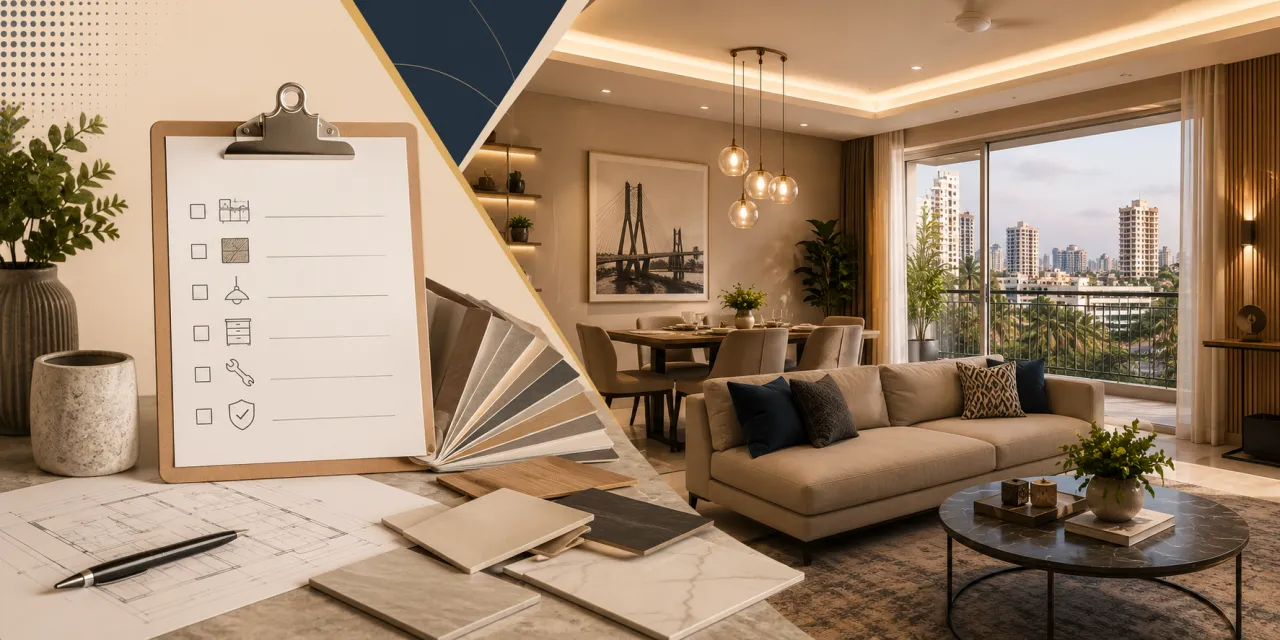
Interior Design Quotation Checklist for Bandra East, Mumbai Homeowners
A quotation is more than a final number. It is the working agreement that explains what will be designed, supplied, installed and excluded. For homeowners comparing designers and companies serving Bandra East, a careful checklist can prevent vague scope, unexpected add-ons and difficult handovers.
This guide is arranged around the rooms and services most commonly discussed in a home project. Keep it open while reviewing proposals, and ask every designer to quote on the same brief. That is the only reliable way to compare two different-looking estimates.
Start with the project scope, room by room
Before comparing rates, write down the areas you actually want included. A quotation for a modular kitchen cannot be compared fairly with one that also includes wardrobes, false ceiling, electrical changes and painting. Note the home type, approximate carpet area, possession status, existing conditions and your preferred completion sequence.
Kitchen
Check cabinet layout, carcass and shutter materials, internal accessories, countertop, backsplash, sink, faucet, handles, lighting and appliance provisions. Ask whether dismantling an old kitchen, plumbing changes, gas-pipeline coordination and debris removal are included.
- Specify finishes such as laminate, acrylic, membrane or veneer.
- Record the number and type of drawers, shutters and lift-up units.
- Confirm edge profiles, soft-close hardware and brand or approved equivalent.
Bedrooms
For each bedroom, separate wardrobe, loft, bed-back panel, study desk, bedside storage and dressing unit. A tall wardrobe with drawers and accessories costs differently from a simple hanging-and-shelf arrangement.
- Mark internal divisions and shelf thickness.
- State whether lofts run across the full wardrobe width.
- Include mirrors, lights, handles and cable management where needed.
Living and dining spaces
List TV unit, crockery or bar storage, foyer console, pooja unit, ceiling work, wall panelling, curtains, painting and loose furniture separately. This helps you identify which items are custom-built and which are bought from another vendor.
Storage and utility areas
Do not overlook a compact utility, passage cabinet, shoe storage, balcony cabinet or overhead storage. In an apartment, these small areas can have awkward ducts, beams or service access. The quotation should show how those constraints are being handled rather than hiding them under “miscellaneous carpentry”.
Renovation and complete interiors need different quotations
A renovation quote may cover demolition, civil repairs, waterproofing checks, flooring, plumbing, electrical rewiring or painting before furniture is installed. A complete-interiors quote may focus mainly on fixed furniture and finishes in a new or relatively finished apartment. Ask the designer to state which category applies to your project.
For an older home, request a site inspection before accepting a fixed figure. Hidden wall damage, uneven floors, concealed wiring and moisture can only be assessed properly on site. If an item cannot be assessed yet, it should be marked as a provisional allowance or excluded—not silently added later.
Compare designers on method, not only on the total
Shortlist designers and companies serving the area through the Bandra East directory. Review their services, project photographs and communication process, then ask for a comparable proposal. The most useful comparison includes who measures the home, prepares drawings, coordinates vendors, supervises installation and handles defects after handover.
Ask how many design revisions are included, who approves shop drawings, whether a project manager visits the site and how changes are documented. A lower quote may reflect fewer drawings, less supervision or a narrower material specification rather than better value. You can also browse interior projects and design ideas to make your brief more specific before requesting proposals.
Use precise material and hardware descriptions
“Premium finish” is not a specification. Each line should identify the material category, thickness where relevant, finish, colour or code, edge treatment and hardware. If a brand is important, name it. If the designer proposes an equivalent, ask for the acceptable alternatives and what happens if the selected product is unavailable.
| Quotation area | Details to record | Question to ask |
|---|---|---|
| Carcass and shutters | Board type, thickness, finish, edge banding and colour | What is used inside the cabinet, and is moisture-resistant material included where needed? |
| Hardware | Hinges, channels, baskets, lifts, handles and soft-close mechanism | Which brand and model are included? Is installation covered? |
| Countertop and sink | Material, thickness, cut-outs, backsplash, sink type and faucet provision | Are transport, cut-outs, sealing and plumbing connections included? |
| Electrical and lighting | Point count, wiring scope, switches, fixtures and concealed work | Does the quote include only points or also fixtures and circuit changes? |
| Finishes | Paint system, polish, laminate, tiles, wall panels or glass | What surface preparation and number of coats are included? |
| Installation | Delivery, assembly, protection, touch-ups and cleanup | Who coordinates site access and removes packing or construction waste? |
Look beyond the headline price
Ask for a room-wise or work-package breakdown with quantity, unit, rate and amount. Then check taxes, design fees, transport, installation, supervision, site protection and disposal. Clarify whether appliances, curtains, loose furniture, civil work, electrical upgrades and painting are included or excluded.
Common hidden-cost questions include: Is a site measurement fee adjustable against the project? Are extra revisions chargeable? What is the rate for a change after production starts? Is a premium charged for a different hardware brand? What happens when the site is not ready on the agreed date? Get the answers in writing.

Estimate your starting budget
Use the interior cost estimator to organise an early budget range before you compare quotations. Treat the result as a planning aid, then validate it against your actual scope and chosen materials.
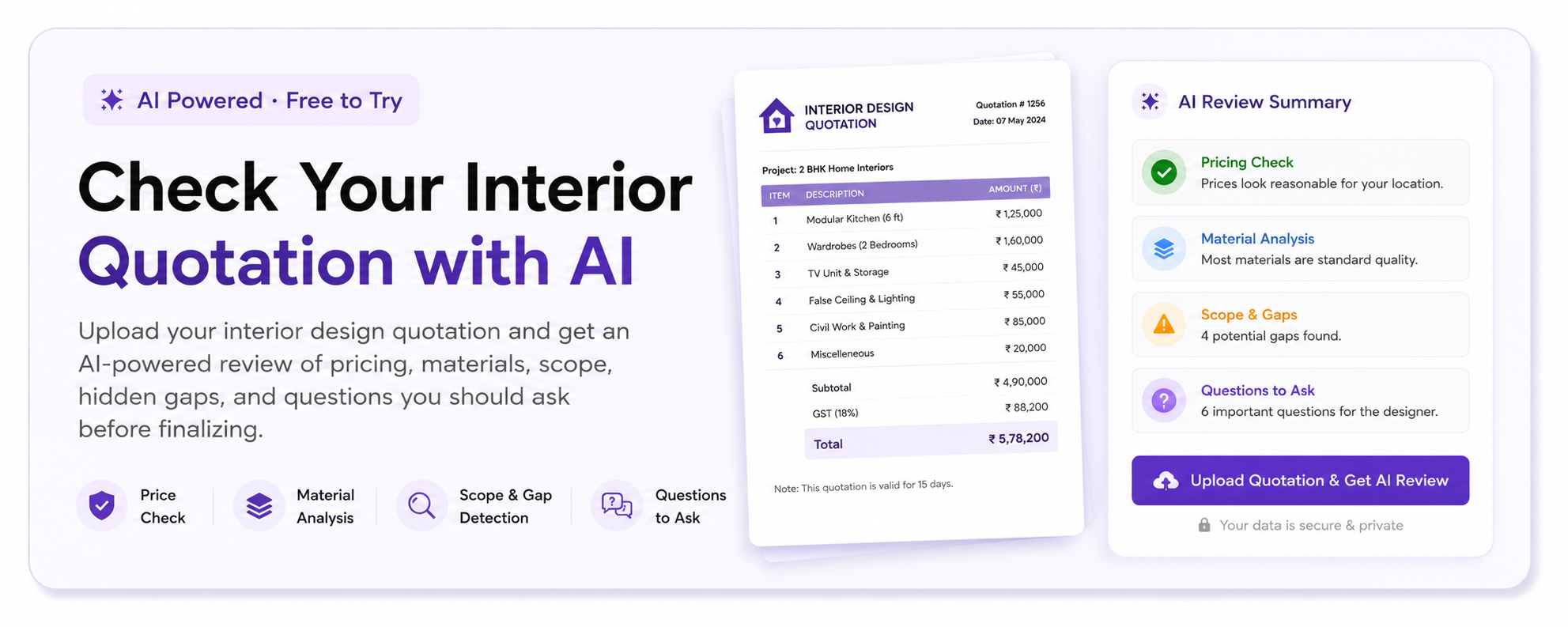
Check the quotation structure
Paste or review your proposal with the AI quotation checker to spot missing categories, unclear exclusions and inconsistent descriptions. Use its output to prepare questions; do not treat it as a substitute for a site inspection or contract review.
Payment stages, warranty and change control
Do not pay an advance until you understand the deliverables tied to it. A sound proposal should connect payments to stages such as design approval, material procurement, production, delivery, installation and snag closure. The exact schedule can vary, but the milestones should be clear and proportionate to work completed.
- Ask for a written contract, detailed scope and signed quotation.
- Confirm the tax treatment and obtain invoices or receipts for payments.
- Check the cancellation, postponement and refund terms before production begins.
- Ask how price changes, substitutions and client-requested additions will be approved.
- Get a warranty document stating coverage, duration, exclusions and the contact process for hardware, electrical items, finishes and workmanship.
- Confirm who completes the snag list, when handover occurs and what documents or spare materials you receive.
Keep a single record of approved drawings, finish samples, messages, variation orders and payment proofs. If a verbal promise changes the scope, ask for a revised line item before work proceeds.
Red flags worth pausing over
Unclear scope
Be cautious when the proposal uses broad phrases such as “complete carpentry” or “all civil work” without quantities, drawings or exclusions. A quote that cannot explain what is not included is difficult to control.
Pressure to pay
Urgency, a large advance without stage deliverables, refusal to issue an itemised quotation or reluctance to name material brands should prompt further questions. Do not rely on a verbal assurance that details will be finalised later.
Before you approve, ask these five questions
- Which rooms and tasks are fully included, and which are excluded?
- What exact material, finish, hardware and brand or equivalent are specified?
- What can cause the price or timeline to change?
- Who is responsible for site coordination, permissions, delivery and damage?
- What warranty and post-handover support will I receive?
Make the comparison easier with a written brief
Prepare one page with room measurements if available, appliance sizes, storage needs, preferred finishes, budget comfort level, move-in date and items you already own. Share the same document with each shortlisted professional. Save visual references from WallsToWonder posts, and use Design my room or Find my style if you need help expressing your preferences. For questions during planning, the AI interior assistant can help you organise a more useful brief.
Finally, compare like with like. Put each designer’s scope, material schedule, hardware list, exclusions, taxes, payment stages and warranty side by side. This takes longer than choosing the lowest total, but it gives you a much clearer basis for a confident decision. You can return to the Bandra East designer listing as you refine your shortlist.
Frequently asked questions
1. What should an interior design quotation include?
It should include the project scope, room-wise quantities, materials, finishes, hardware, services, exclusions, taxes, timeline, payment stages, change terms and warranty information.
2. Can I compare two quotations with different material brands?
Yes, but first normalise the specifications. Compare the board, finish, hardware, thickness, quantity and installation scope—not just the brand name or total.
3. Are civil and electrical works usually included?
They may be included, partly included or excluded depending on the project. Ask for separate line items covering demolition, repairs, wiring, points, fixtures, plumbing and painting.
4. How much advance should I pay?
There is no universal amount that suits every project. Pay only against a written agreement and clearly defined deliverables, with later payments linked to measurable stages.
5. Can an AI quotation checker approve my designer?
No. It can help flag missing or inconsistent information, but you still need to verify the site scope, samples, contract, credentials, warranty and commercial terms yourself.
Get a personalised estimate for your home
Choose your rooms, materials and preferences to understand a practical interior budget before you commit.