
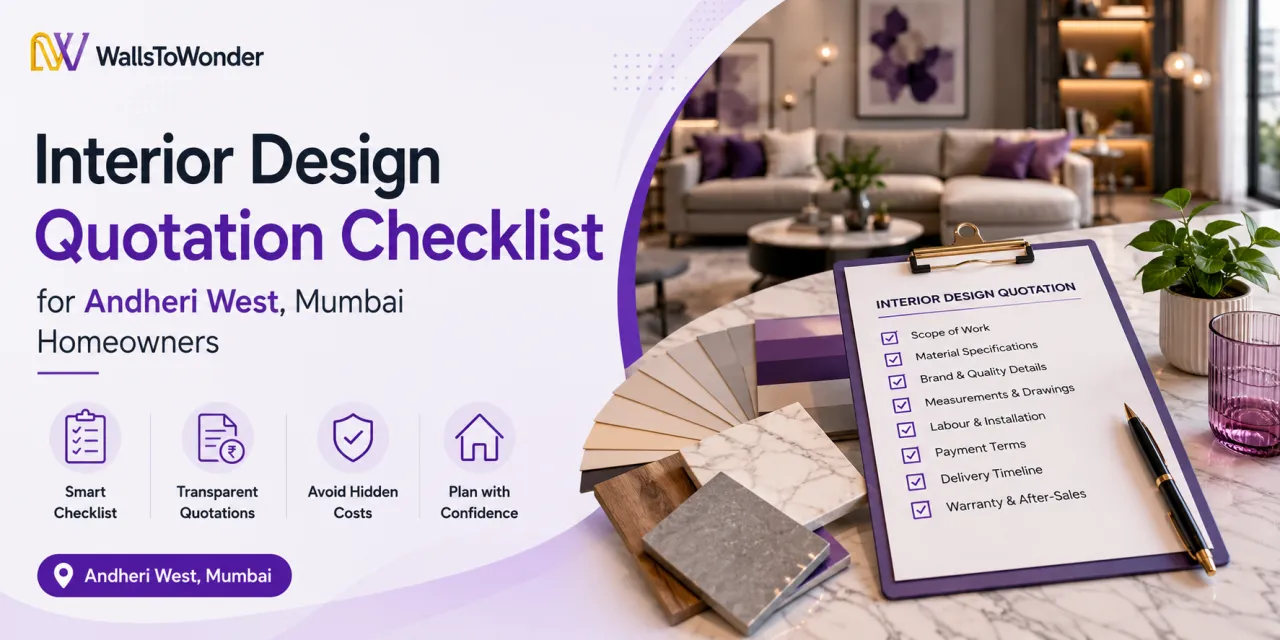
Interior Design Quotation Checklist for Andheri West, Mumbai Homeowners
The first quotation arrives in a neat PDF. One designer has listed “modular kitchen,” another has written “kitchen works,” and a third has quoted a low lump sum with almost no detail. For a homeowner in Andheri West, the difficult part is not collecting estimates. It is making sure the three documents describe the same home.
This interior design quotation checklist for Andheri West, Mumbai is designed for that comparison. It covers scope, materials, hardware, services, exclusions, payment stages and warranties so you can ask better questions before committing an advance. You can also browse designers and companies serving Andheri West and use the checklist while reviewing each proposal.
What to decide before asking for a quotation
A designer can price a project only after the brief has some boundaries. Start with the home rather than the style reference images.
- Property type and stage: rented flat, resale apartment, new possession, renovation or occupied home.
- Approximate carpet area, number of bedrooms and rooms that need work.
- Whether civil changes, electrical rewiring, plumbing, painting or false ceiling are included.
- Move-in date, building work-hour restrictions and any planned phased execution.
- Must-haves such as storage, a work-from-home desk, a pooja unit, child-safe details or accessibility needs.
- A realistic budget range, separated into essential work and optional upgrades.
Andheri West homes can vary considerably: compact apartments, larger family flats, older homes needing repairs, and newly handed-over properties with different base finishes. Do not assume a quotation for one property type can be transferred to another. Ask the designer to record the site condition and measurements used for the estimate.
Compare the scope before comparing the total
The top-line amount is useful only when the deliverables match. Place quotations side by side and mark every room, service and exclusion. A “complete interiors” label is not a scope of work.
Room-by-room scope card
- Kitchen: carcass material, shutters, internal accessories, countertop, backsplash, sink, plumbing connections, lights and appliances.
- Bedrooms: wardrobe width and height, lofts, drawers, dressing unit, bed or only the back panel, study table and electrical points.
- Living and dining: TV wall, storage, crockery unit, seating, ceiling work, curtains, paint and loose furniture.
- Bathrooms and utility: only if included; clarify waterproofing, accessories, storage, plumbing fixtures and washing-machine provisions.
- Entry, balcony or passage: shoe storage, safety grill, planters, lighting and any civil repair work.
Ask for quantities wherever possible: running feet of wardrobe, number of shutters, drawer count, square feet of countertop, number of lights and area of false ceiling. Exact measurements may change after a site survey, but the basis of measurement should be visible.
Services: what are you actually buying?
Two designers may offer different service models. One may provide design, procurement and installation. Another may provide drawings only, leaving you to appoint contractors. Both can be valid, but their quotations are not directly comparable.
- Design-only: concept, layouts, 3D views, material suggestions and drawings. Confirm whether revisions and detailed execution drawings are included.
- Design and build: design coordination, materials, fabrication, site supervision and installation. Check who manages vendors and rectifies defects.
- Turnkey or managed execution: a wider package that may include civil, electrical, painting, furniture and handover. Read the exclusions carefully.
- Consultation or partial renovation: useful when you want to retain existing furniture or appoint specialists separately.
When comparing designers from the Mumbai interior designer directory, ask each one to state the service model in the quotation title. A clear model prevents the common situation where a low design fee is compared with a full execution proposal.
Materials and finish details that change the quote
“Premium finish” is not a material specification. The quotation should name the product category and, where relevant, the brand, grade, thickness or finish. If a brand is not finalised, the document should state an allowance and explain how substitutions will be approved.
| Item | Details to request | Why it matters |
|---|---|---|
| Boards and carcass | Material type, thickness, edge banding and moisture-resistant use areas | Changes durability, appearance and suitability for kitchens or utility spaces. |
| Shutters and finishes | Laminate, acrylic, veneer, membrane, paint or glass; finish and colour reference | Surface finish affects maintenance, replacement and the final visual result. |
| Hardware | Hinges, channels, drawer systems, lift-ups, baskets, handles and soft-close provision | Hardware can be a major quality difference even when two cabinets look alike. |
| Countertop and fittings | Stone or solid-surface type, thickness, edge profile, sink cut-out and installation | Fabrication, cut-outs and accessories may be excluded from a headline kitchen price. |
| Paint, lights and electrical | Paint system and coats, fixture supply, wiring scope, switches and point count | “Electrical” can mean only wiring or a much broader package. |
Brand names should never appear without the exact product or series where that distinction affects price. For hardware, ask whether the quote includes a standard range or a specified model. Request physical samples or a sample board before approving colours and textures; screens do not reliably show sheen, grain or undertone.
Where quotations commonly differ
Look beyond cabinetry. Costs can move because of site access, demolition, design complexity, material selection, storage density, imported or specialist hardware, on-site fabrication, and the amount of civil or electrical work. In an occupied apartment, protection, shifting and phased work may also need to be discussed.
- Site measurement, design revisions, drawings or statutory and building permissions, if applicable.
- Demolition, debris removal, surface levelling, waterproofing or repairs discovered after dismantling.
- Delivery to the building, loading or unloading, stair access, parking and storage of materials.
- Temporary protection for floors and lifts, shifting of existing furniture and post-work deep cleaning.
- Appliances, loose furniture, mattresses, curtains, blinds, décor, mirrors and artwork.
- Taxes, installation of owner-supplied products, extra electrical points or changes after approval.
Ask for an exclusions list even when the quotation appears comprehensive. “As per discussion” is not a useful exclusion. If a cost is uncertain, have the designer state whether it is an allowance, a provisional item or an optional upgrade, along with the approval process.
Use a cost estimate and quotation checker before signing
A rough budget tool can help you set expectations before speaking to designers, while a quotation review tool can help surface missing line items. Neither replaces a site visit or a professional contract review, but both can make your questions sharper.

Start with a budget range
Use the interior design cost estimator to think through room scope and major cost drivers before comparing proposals.

Review the document
Run the proposal through the AI quotation checker to identify points you may want to clarify with the designer.
Before uploading any document, remove personal details you do not need to share. Treat a tool's output as a question list, not confirmation that the price is fair or that a company is suitable.
Payment stages, changes and warranty
A sensible payment plan should follow identifiable progress. The exact stages will depend on the project, but the quotation or agreement should connect each payment to a deliverable or completed work, not only to calendar dates.
- What does the advance reserve: design time, materials, production capacity or all three?
- Which drawings, samples and revisions are included before production starts?
- When do you approve final measurements, materials and shop drawings?
- What happens if the scope changes or you cancel before fabrication?
- How are delays, damaged items and rework recorded and resolved?
- What warranty period applies to cabinetry, hardware, electrical work and third-party products separately?
Look for a written change-order process. It should show the revised item, quantity, price impact and effect on schedule, with approval required before work proceeds. Warranty language should identify what is covered, what is excluded, how to raise a service request and whether the designer coordinates with the manufacturer.
Warning signs in an interior quotation
- A single lump sum with no room-wise scope, quantities or material schedule.
- Large brand claims without model numbers, samples or a substitution policy.
- Pressure to pay before the site is measured or the contract is shared.
- Very low pricing that excludes civil work, hardware, delivery or installation without saying so clearly.
- Verbal promises about extra storage, appliances, timelines or warranty that do not appear in writing.
- No named project contact, escalation route, handover process or defect-rectification procedure.
- Requests for cash-only payments or payments to an unrelated account without clear documentation.
A warning sign is a reason to pause and ask for clarification, not automatic proof of misconduct. Compare the response as carefully as the number. A designer who explains assumptions clearly is easier to work with than one who simply revises the total.
Your final quotation checklist
Before you approve a proposal for your Andheri West home, confirm that you have:
- A room-wise scope with quantities, drawings and a list of included services.
- Material, finish, brand and hardware specifications, or clearly labelled allowances.
- An itemised price with taxes, delivery, installation and known exclusions identified.
- A realistic timeline, site-access assumptions and responsibility for coordination.
- A written payment schedule and change-order procedure.
- Terms for cancellation, damage, delays, snagging and handover.
- Separate warranty details for workmanship, cabinetry, hardware and supplied products.
- Final samples or references for colours, laminates, veneers, stone and hardware.
- A record of every promise made during meetings, emails or messages.
Frequently asked questions
1. How many interior quotations should I compare?
There is no fixed number. Compare enough proposals to understand different service models, but prioritise equivalent scope and specifications over collecting many headline totals.
2. Should I choose the lowest quotation?
Not without reconciling exclusions, quantities, hardware and finish levels. A lower figure may represent a narrower scope rather than better value.
3. What should be included before paying an advance?
At minimum, request the scope, payment terms, exclusions, change process, cancellation terms and responsibilities. For execution work, also ask for the material schedule and warranty terms.
4. Can I supply my own appliances or materials?
Often this can be discussed, but confirm measurements, compatibility, delivery, installation responsibility, damage risk and warranty coordination in writing.
5. Can the quotation checker decide if a designer is trustworthy?
No. It can help flag unclear items or missing questions. Assess the designer through scope clarity, communication, references you can independently review, written terms and site-level coordination.
Get a personalised estimate for your home
Choose your rooms, materials and preferences to understand a practical interior budget before you commit.