
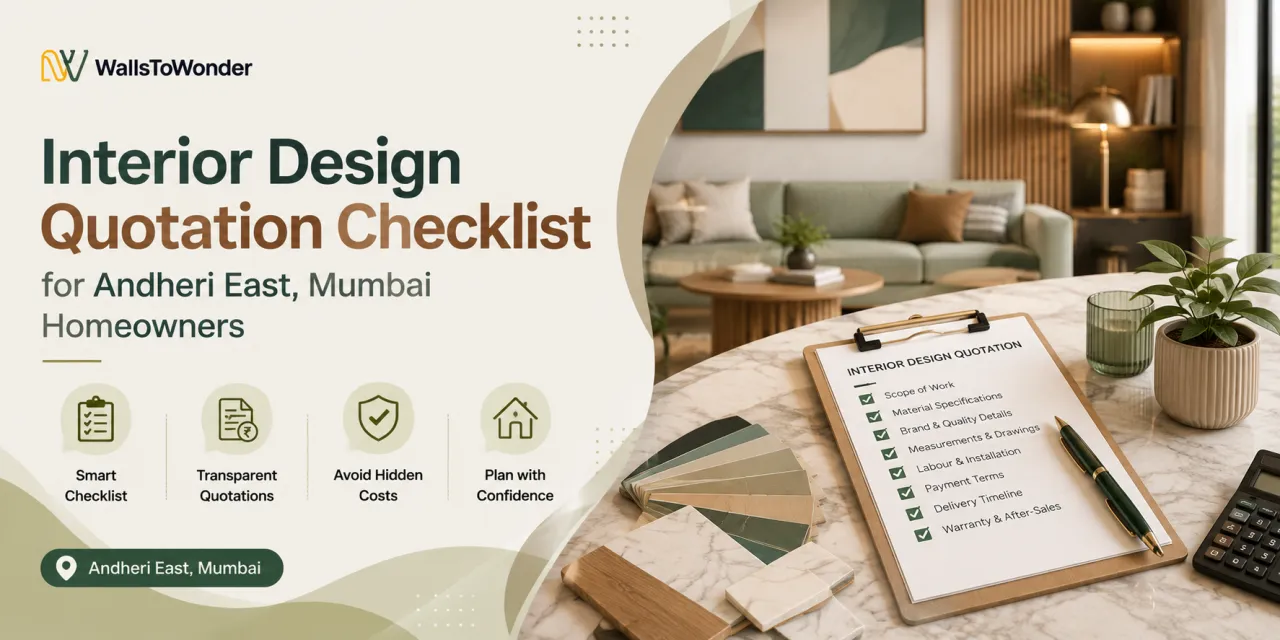
Interior Design Quotation Checklist for Andheri East, Mumbai Homeowners
A quotation is more than a total figure at the bottom of a PDF. It should show what will be designed, which materials and hardware will be used, what is excluded, and when you will be expected to pay. This interior design quotation checklist for Andheri East, Mumbai is designed for homeowners comparing designers and companies serving the area. You can also browse the Andheri East interior design directory before requesting proposals.
1. Understand your project before asking for a quote
Start with a one-page brief. Note the property type, approximate carpet area, possession or handover status, rooms to be covered, and your preferred completion window. In Andheri East, a homeowner may be comparing a compact apartment, a larger family flat, a resale renovation, or a partly furnished home. The quotation needs to reflect the actual condition of the property rather than an attractive generic package.
Record practical constraints too: society working hours, lift access, parking or loading rules, plumbing points, electrical capacity, and whether civil work is permitted. These details can affect labour planning and exclusions. Ask the designer to visit the home or clearly state which assumptions were made without a site inspection.
Step 1: Define the service scope
A designer may offer concept design only, drawings and material selection, turnkey execution, modular furniture, site supervision, or a combination. Ask for a line-by-line scope covering:
- Space planning, 3D views, working drawings and revisions.
- Modular kitchen, wardrobes, storage, TV unit, study, beds or other fixed furniture.
- False ceiling, lighting, painting, curtains, wallpaper, glass, mirrors and loose furniture, if included.
- Plumbing, electrical changes, civil repairs, demolition, masonry and waterproofing, where relevant.
- Measurements, procurement, delivery, installation, site coordination and snag rectification.
2. Shortlist designers on comparable evidence
Do not compare only by photographs or the first total you receive. Review portfolios for similar property sizes and project types, then ask who actually handled design, procurement and site execution. A company serving Andheri East may have experience with apartment layouts, but you still need to understand how it manages your specific building and scope.
- Have you seen work with a similar budget, room count and finish level?
- Is there a named point of contact for design and site coordination?
- Can the designer share a sample scope, quotation format and contract for review?
- Are revisions, site visits and handover support described in writing?
- Will the same scope be priced consistently for every shortlisted company?
Use the wider Mumbai interior designer directory to create a shortlist, then send each candidate the same brief, drawings and reference images. Comparable inputs make the comparison fairer.
3. Set a working budget, not just a headline number
Interior cost depends on the amount of work, room dimensions, material grades, hardware, design complexity, site condition, access, and the extent of customisation. A quote for a kitchen and two wardrobes cannot be compared directly with a turnkey quote for the full home.
Separate the available funds into core interiors, professional or design fees if charged separately, appliances and loose furniture, contingency for unknown site conditions, and taxes or statutory charges where applicable. For an early sense of the cost variables, try the WallsToWonder interior cost estimator. Treat its output as a planning aid, not a final offer.
Plan the budget first
Use the cost estimator to think through rooms, scope and finish preferences before you ask designers for detailed proposals.
Try the cost estimator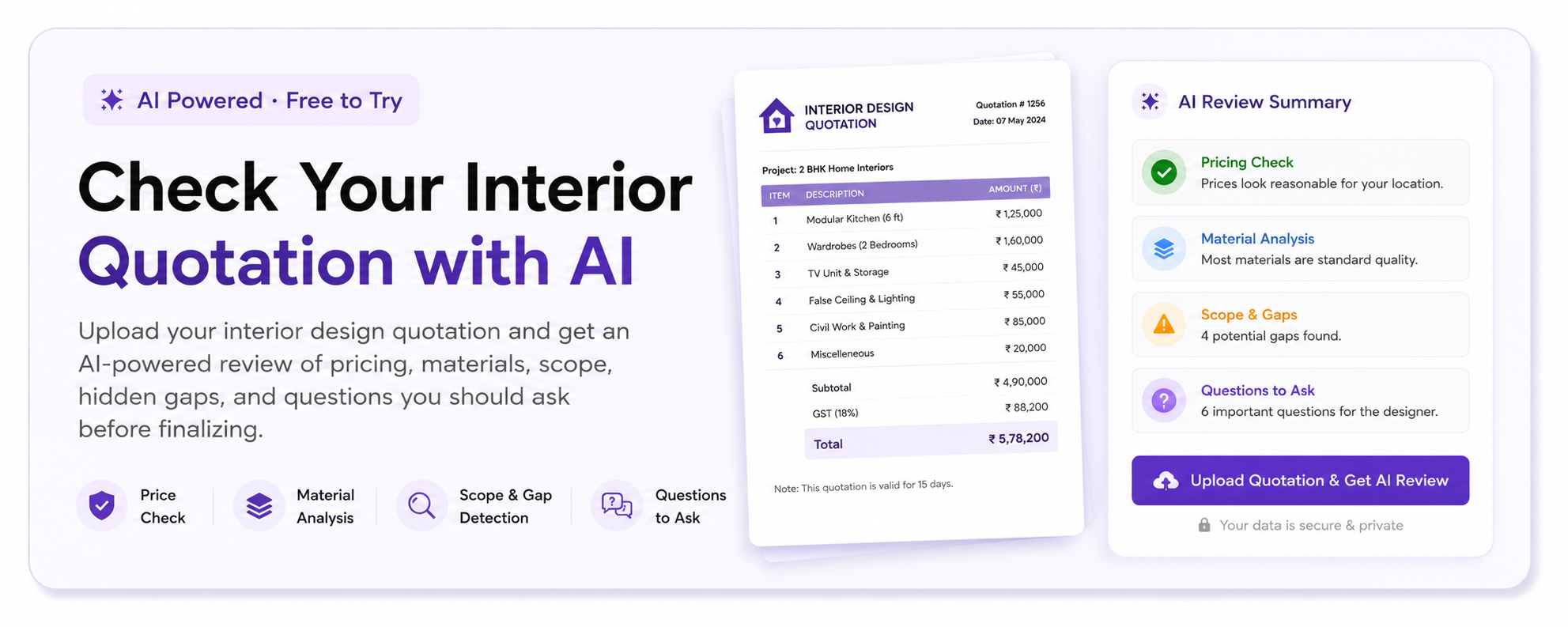
Check the quotation
Upload or review the proposal with a quotation checker to spot missing descriptions, unclear allowances and items that need questions.
Use the quotation checker4. Inspect materials, finishes and hardware
Words such as “premium,” “waterproof” or “high quality” are not specifications. Ask for the board type, thickness, finish, edge treatment and intended application. For kitchens and wet areas, clarify the material’s suitability and how exposed edges will be protected. For wardrobes, ask whether the back panel, loft shutters and internal partitions are included.
If a quotation names brands such as Hettich, Häfele or Blum for hardware, check the exact series, movement type and warranty. The same applies to boards and laminates: a reference to brands such as Greenply, CenturyPly or Merino is not enough without the product range and grade. For switches and electrical accessories, a named option such as Legrand, Schneider or Anchor by Panasonic should still be matched to the required specification. Brands may be proposed as alternatives, so ask what happens if a listed product is unavailable.
Room-by-room questions
- Kitchen: carcass and shutter materials, channel and hinge brands, baskets, corner solutions, countertop, sink, dado, skirting and appliance cut-outs.
- Wardrobes: internal layout, drawer count, lofts, handles or profiles, mirror shutters, soft-close fittings and provision for skirting.
- Living and dining: TV-unit storage, ceiling design, lighting points, paint or wallpaper, crockery storage and whether loose furniture is included.
- Bedrooms: bed and mattress exclusions, headboard, side tables, study storage, dressing mirror, curtain tracks and fan or light points.
5. Compare quotations line by line
Ask every designer to use the same room list and measurement basis. Then compare quantities, unit rates, finish descriptions, installation charges and taxes. A low total can simply mean that painting, electrical work, handles, delivery or internal accessories have been left out.
| Quotation section | What to verify | Question to ask |
|---|---|---|
| Design and drawings | Number of concepts, revisions, working drawings and site visits | What happens if the layout changes after approval? |
| Manufacturing and installation | Measurements, factory work, delivery, assembly and protection of existing areas | Are transport, loading and installation included? |
| Materials and finishes | Board, laminate, paint, glass, stone, edge banding and thickness | Can I see a physical sample or product reference? |
| Services and exclusions | Electrical, plumbing, civil work, appliances, curtains, loose furniture and taxes | Which items will I need to arrange separately? |
| Commercial terms | Validity, payment stages, variation method, warranty and cancellation terms | What written approval is needed before an extra cost is added? |
6. Look for hidden costs before execution
Request an exclusions page, not just a list of inclusions. Common cost gaps can include dismantling and debris removal, making good after electrical changes, extra plumbing, appliance installation, additional lights, delivery to a restricted building, storage, protection of flooring, touch-up painting and society-related permissions or deposits. The exact treatment differs by project, so do not assume any item is included.
7. Prepare for execution and payment
Payment stages should follow measurable progress. A sensible structure might link instalments to design approval, material procurement, manufacturing, delivery and installation, but the precise milestones must be agreed in the contract. Avoid paying the entire project value before work or material delivery, and keep invoices, drawings, sample approvals and change requests together.
Before paying an advance, ask:
- Is the advance refundable if the design does not proceed?
- When does the timeline begin, and what events can pause it?
- Who owns the drawings if the project is cancelled?
- How are changes priced and approved?
- What is the process for damaged items, delays and unfinished work?
8. Confirm warranty and handover details
Ask for warranty coverage by item rather than accepting a single broad promise. Clarify the duration, exclusions, service response process and whether the warranty covers hardware, installation, finish defects or only manufacturing faults. Get manuals, invoices, spare keys or remotes, paint codes, appliance documents and a final snag list at handover.
Keep a record of approved samples and the final material schedule. If a substitution is proposed, request the replacement’s specification and any price difference in writing before installation.
Make the final decision with a comparison sheet
Score each proposal against scope completeness, material clarity, design fit, communication, execution plan, exclusions, payment risk, warranty and total expected spend. The lowest initial figure is not necessarily the lowest project cost. A clear quote that exposes assumptions gives you a better basis for negotiation and planning.
For more ideas before you freeze the brief, browse Indian home interior design ideas. Once you have two or three comparable proposals, the WallsToWonder AI quotation checker can help identify areas that deserve clarification. It cannot replace a contract review or a site professional’s judgement, but it can make a long quotation easier to question.
Useful WallsToWonder tools and directories
Frequently asked questions
1. How many quotations should an Andheri East homeowner compare?
Two or three comparable quotations are usually more useful than many inconsistent ones. Give each designer the same brief and ask for assumptions in writing.
2. Should I choose a package or an itemised quotation?
An itemised quotation is easier to audit. A package can work if the inclusions, material grades, quantities, exclusions and upgrade costs are fully documented.
3. Are appliances normally included in interior quotations?
Not always. Ask specifically about refrigerators, ovens, hobs, chimneys, washing machines, fans and lights. Confirm whether the quote includes only cut-outs or supply and installation too.
4. What is the biggest quotation red flag?
A large total with vague descriptions is a serious concern. Missing quantities, unclear brands, no exclusions and verbal-only commitments make later cost disputes more likely.
5. Can an AI quotation checker approve my designer?
No. It can help organise questions and flag unclear line items, but you should still verify samples, contracts, execution capability, warranty terms and site conditions yourself.
When you are ready to compare local options again, return to the Andheri East designer listing with your completed checklist and a consistent project brief.
Get a personalised estimate for your home
Choose your rooms, materials and preferences to understand a practical interior budget before you commit.