
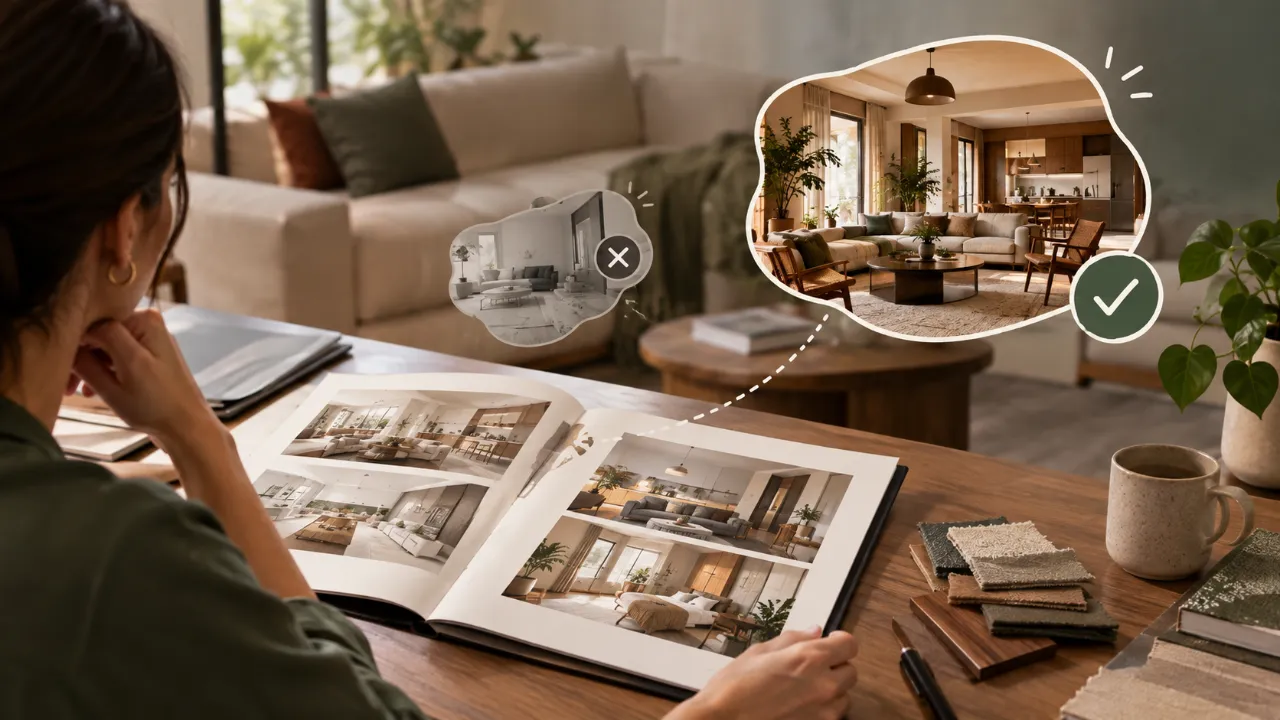
How to Tell if a Designer's Portfolio Matches Your Kind of Home
Choosing an interior designer can easily become a portfolio-scrolling exercise. You open one project after another, save beautiful bedrooms, admire living rooms and compare polished images.
But there is a problem with judging a designer only by how attractive their portfolio looks.
A portfolio can show that a designer creates beautiful spaces without telling you whether that designer understands your kind of home.
A compact apartment has different challenges from a large villa. A family that cooks heavily needs different kitchen planning from a household that rarely cooks. A home with children, elderly family members, pets, work-from-home requirements or extensive storage needs may need a completely different design approach.
So instead of asking, “Do I like this designer's portfolio?”, ask a better question:
“Does this designer's way of working look compatible with the way my home needs to function?”
Quick answer: Evaluate a designer's portfolio against your property type, home size, lifestyle, design preferences, storage requirements, kitchen needs, materials, budget and practical constraints. Look beyond wide-angle photographs and study room details, completed projects, difficult spaces, lighting, storage and evidence of real-world execution.
- Start with your own home
- Look for similar homes and project scales
- Study room-level details
- Check style compatibility
- Look for functionality and lifestyle thinking
- Evaluate kitchens and storage
- Study materials and lighting
- Look at difficult spaces and real projects
- Consider budget and project complexity
- Use a portfolio comparison framework
- Ask better questions during designer meetings
- A practical portfolio checklist
- Frequently asked questions
Start With Your Own Home, Not the Designer
Before evaluating a portfolio, define your project.
Write down the basic facts about your home:
Property
Property type, number of bedrooms, approximate size and whether it is a new home or renovation.
Lifestyle
Household size, work-from-home needs, cooking habits, children, elderly family members and everyday routines.
Design
Preferred style, colours, materials, level of decoration and overall atmosphere.
Budget & Constraints
Approximate budget, structural limitations, storage needs, existing furniture and other project restrictions.
This becomes your comparison framework. Without it, portfolios can be misleading because you may compare a designer's most photogenic project with a home that has completely different requirements.
1. Look for Homes Similar to Yours
One of the first things to examine is whether the designer has worked on homes that resemble your own.
Look at apartment versus villa projects, compact versus large homes, renovations versus new construction, similar room sizes, comparable ceiling heights and projects with similar layout constraints.
The closer the project conditions are to yours, the more useful the comparison becomes.
Look for evidence of relevant experience: Similar property type and project scale can tell you more about fit than a single spectacular showcase project.
2. Do Not Judge Only the Overall Photographs
A portfolio often leads with wide-angle photographs because they create the strongest visual impression. But these images are only part of the story.
Zoom in and look at wardrobes, kitchen storage, lighting placement, furniture scale, corners, awkward spaces, door and cabinet alignment, wall junctions, ceiling transitions, hardware, material combinations and finishing details.
A beautiful wide shot can hide practical weaknesses. The smaller details often tell you more about how carefully the designer thinks.
3. Check Whether Their Design Style Is Actually Close to Yours
You do not need to find a designer whose every project looks identical to your dream home. But you should look for a meaningful overlap.
If you prefer warm modern interiors, natural wood, soft neutrals, practical storage and clean lines while most of a designer's portfolio consists of highly ornate interiors and very bold colour schemes, there may be a style gap.
A designer may be talented, but talent alone does not guarantee that their natural design language matches your preferences.
You can also use the Walls to Wonder Interior Style Finder to clarify your own style direction before comparing designer portfolios.
4. Look for Consistency, Not Repetition
A designer's portfolio should not look like the same room copied ten times. Instead, look for consistency in how they solve design problems.
Across different projects, do you notice strong proportions, thoughtful lighting, good circulation, well-planned storage, controlled material palettes and consistent detailing?
A strong portfolio can show different styles while still revealing a consistent design approach. That can be more useful than a designer who produces one highly recognisable look but struggles when the brief changes.
5. See Whether They Design for Real Life
Interior design is not only about appearance.
Look for evidence that the designer understands everyday use.
- Does the kitchen look practical?
- Is there enough storage?
- Can people move comfortably around the furniture?
- Do bedrooms have realistic wardrobes?
- Does the living room leave enough circulation?
- Are frequently used objects accessible?
- Are lighting layers practical?
- Can the materials realistically handle the household's maintenance habits?
6. Pay Attention to Property Type
Property type can significantly change the design challenge.
A new apartment may have fixed plumbing points, electrical provisions, builder finishes and society rules. A resale apartment may require demolition, repairs and adaptation to existing conditions. A villa may offer more freedom but also involve larger spaces and additional coordination.
A compact 2 BHK may require much more aggressive storage and multifunctional planning than a large villa.
7. Compare the Scale of Their Projects
Scale matters more than many homeowners realise.
A designer who regularly works on very large homes may approach a compact apartment differently from a designer who regularly solves small urban layouts.
This does not automatically make one approach better. It simply means you should look for evidence of experience with your scale of problem.
In a compact home, pay particular attention to storage, narrow circulation, multipurpose rooms, small kitchens, compact bathrooms, limited daylight and furniture proportions.
8. Look at Materials, Not Just Colour
Two designers can create similar-looking beige interiors while using completely different materials.
Pay attention to wood and wood finishes, veneers and laminates, stone, tiles, metal details, upholstery, glass, wall treatments and cabinet finishes.
Ask whether their material choices seem appropriate for the way your home will be used. A family with children may have different maintenance priorities from a couple designing a formal second home.
9. Check Whether Their Kitchens Match Your Cooking Habits
For Indian homes, the kitchen deserves special attention.
Do not only look at how beautiful the cabinetry looks. Check whether the projects appear to account for preparation space, appliance storage, spice storage, large cookware, multiple users, ventilation, utility areas, easy-clean finishes and pantry requirements.
10. Look for Storage Thinking
Storage is one of the easiest areas to overlook when judging a portfolio.
Look for full-height wardrobes, practical drawers, kitchen organisers, utility storage, entryway storage, linen storage, shoe storage and a clear distinction between display and concealed storage.
Ask whether the storage seems designed around real belongings rather than simply around the appearance of a wall.
11. Notice How They Handle Difficult Spaces
Perfect rectangular rooms are easy to photograph. The more revealing projects are the difficult ones.
Structural Constraints
Columns, beams, structural walls and unusual ceiling conditions.
Awkward Geometry
Narrow rooms, odd corners, inconvenient windows and uneven walls.
Existing Conditions
Older finishes, existing furniture, fixed plumbing or electrical constraints.
Compact Spaces
Small balconies, kitchens, bedrooms and areas with limited circulation.
12. Check Their Lighting Approach
Lighting can reveal a designer's level of planning.
Look for more than decorative chandeliers and pendant lights. Check for ambient lighting, task lighting, accent lighting, bedside lighting, kitchen work lighting, wardrobe lighting and appropriate architectural highlights.
A portfolio with beautiful lighting can still be practical if different layers are supporting different activities.
13. Ask What the Images Actually Represent
Not every image in a portfolio tells the same story.
A project may be a concept, a 3D render, a completed project, a staged project or a project photographed after professional styling. Ask the designer what you are looking at.
Completed project photographs can provide useful evidence about actual materials, detailing and execution, while renders can help you understand design thinking.
14. Look for Before-and-After Evidence
Before-and-after documentation can be particularly useful for renovation projects.
It helps you see how the designer handled existing conditions, structural limitations, poor layouts, storage problems, dark rooms and outdated finishes.
The “after” image shows the final result. The “before” image shows what the designer had to solve.
15. Check Whether the Portfolio Matches Your Budget Level
A designer's portfolio can create unrealistic expectations if the projects shown are far beyond your intended budget.
Look at the apparent level of materials, custom carpentry, stone, lighting, loose furniture, decorative detailing and built-ins.
You do not need a designer whose portfolio exactly matches your spending level, but you do need someone who can demonstrate that they understand how to prioritise.
16. Look Beyond the “Luxury” Label
Luxury-looking images can be particularly persuasive. But luxury style is not the same thing as good planning.
Look for evidence that the designer can work within constraints, solve storage problems, adapt designs, coordinate practical requirements and manage different project scopes.
17. See Whether Their Style Changes When the Home Changes
Find several projects by the same designer and compare them.
Does every home use the same colour palette? Does every living room have the same furniture style? Are kitchens almost identical?
Or does the designer adapt the approach based on the homeowner and the property?
Adaptability can be valuable because your home should reflect your requirements rather than becoming another version of the designer's signature project.
18. Read the Portfolio for Lifestyle Clues
Try to understand the kinds of living patterns the designer appears accustomed to solving.
Some projects may be designed for young couples, families with children, multigenerational households, working professionals, frequent entertainers or homeowners with large storage needs.
The design choices can reveal whether the designer thinks beyond appearance and considers the lifestyle behind the room.
19. Ask for Real Project Evidence
Once you shortlist a designer, ask to see additional completed work that is similar to your project.
A focused question is often more useful than a generic one.
Instead of asking: “Can you design modern interiors?”
Ask: “I have a compact 3 BHK for a family of four. Can you show me a few completed homes with similar requirements?”
20. Your Portfolio Comparison Framework
| What to Check | What to Look For |
|---|---|
| Property type | Similar apartment, villa, renovation or new-home experience |
| Size | Comparable scale and spatial constraints |
| Style | Visual language close to your preferences |
| Layout | Practical circulation and proportion |
| Storage | Evidence of thoughtful storage planning |
| Kitchen | Suitable workflow and appliance planning |
| Materials | Finishes appropriate to your lifestyle |
| Lighting | Multiple layers, not only decorative fixtures |
| Details | Good hardware, edges, alignments and junctions |
| Real projects | Completed photographs, not only renders |
| Budget | Design level that can realistically be adapted to your budget |
| Adaptability | Ability to change the approach based on homeowner requirements |
21. Do Not Ask Only “Do I Like Their Work?”
A portfolio is most useful when you ask specific questions.
Instead of asking, “Do I like this room?”, ask: “Would this designer solve my home's storage problem well?”
Instead of asking, “Does this kitchen look beautiful?”, ask: “Could this kitchen support the way my family actually cooks?”
Instead of asking, “I love this luxury bedroom,” ask: “Can this designer create the same feeling at my home's size and budget?”
22. A Useful Three-Level Portfolio Test
Level 1: Visual Match
Do you consistently like their colours, materials, furniture, proportions and overall atmosphere?
Level 2: Functional Match
Do their projects demonstrate the storage, layout, kitchen planning, lighting and circulation your home requires?
Level 3: Project Match
Have they worked on similar property types, sizes, budgets and levels of complexity?
A designer who matches only the first level may look exciting but still require more investigation. The more evidence you can find across all three levels, the clearer your conversation with the designer can become.
23. Use Your Inspiration Photos More Intelligently
Once you shortlist designers, share a small, curated collection of inspiration images.
Do not send dozens of unrelated rooms. Choose a few examples and identify what you actually like: colour, lighting, furniture shape, material, storage, layout, mood or level of decoration.
This gives the designer a clearer brief and makes it easier to see whether they understand your preferences.
24. Your Goal Is Not to Find a Copy of Your Dream Room
A portfolio match does not mean you should find a designer whose past project already looks exactly like your dream home.
Your home will have its own layout, light, dimensions, architecture, budget, household routines, storage requirements and material needs.
The designer's job is to translate those requirements into a design.
So the strongest portfolio match may be a designer whose work demonstrates good problem-solving and adaptability, even when their previous homes do not look identical to what you imagined.
Find a Designer That Fits Your Home
Browse interior designers, compare portfolios and use your own style and project requirements to create a more focused shortlist.
Explore Interior Designers Find Your Interior Style Design My Room with AIFrequently Asked Questions
How do I know if an interior designer is right for my home?
Compare their portfolio against your property type, home size, lifestyle, preferred style, storage needs, budget and practical requirements. Look for completed projects that demonstrate similar problems being solved.
Should I choose a designer whose style matches mine exactly?
A meaningful style overlap can make communication easier, but exact duplication is not necessary. What matters is whether the designer can understand your preferences and adapt them to your actual home.
Should I look at renders or real project photographs?
Both can be useful. Renders help you understand design thinking, while completed project photographs give more evidence about actual materials, detailing and execution.
Why is project size important when choosing a designer?
Different project scales create different design problems. Compact homes may require more careful storage, circulation and multifunctional planning, while larger homes may involve different coordination and spatial challenges.
What details should I inspect in a designer's portfolio?
Look at storage, kitchens, lighting, furniture proportions, corners, materials, hardware, cabinet alignment, difficult spaces and finished details rather than only the main wide-angle photographs.
How can I judge whether a designer understands Indian homes?
Look for evidence of practical kitchen planning, storage, utility spaces, family-oriented layouts, maintenance considerations and projects with property types and requirements similar to yours.
Should a designer's portfolio match my budget?
It is useful to understand the apparent design and material level of their projects, but an exact visual match is not essential. Discuss how the designer would prioritise materials, custom work and design scope within your budget.
What is the biggest mistake homeowners make when viewing portfolios?
Focusing only on aesthetics. A portfolio should also be evaluated for functionality, property type, project scale, storage, materials, lighting, constraints and evidence of completed work.
Final Takeaway
A designer's portfolio should not only answer the question, “Is this beautiful?”
It should help you answer: “Can this designer understand and solve the kind of home I actually have?”
Look beyond the hero photographs. Study room proportions, storage, kitchens, lighting, materials, difficult spaces, property types, project scale and completed work.
Most importantly, compare the portfolio against your real requirements.
The right portfolio match is not necessarily the one with the most impressive images. It is the one that gives you useful evidence that the designer's design language, problem-solving approach and project experience can translate to your home.
Turn this idea into a plan for your home
Visualise your space, understand the likely budget, or find a professional who can bring the idea to life.