
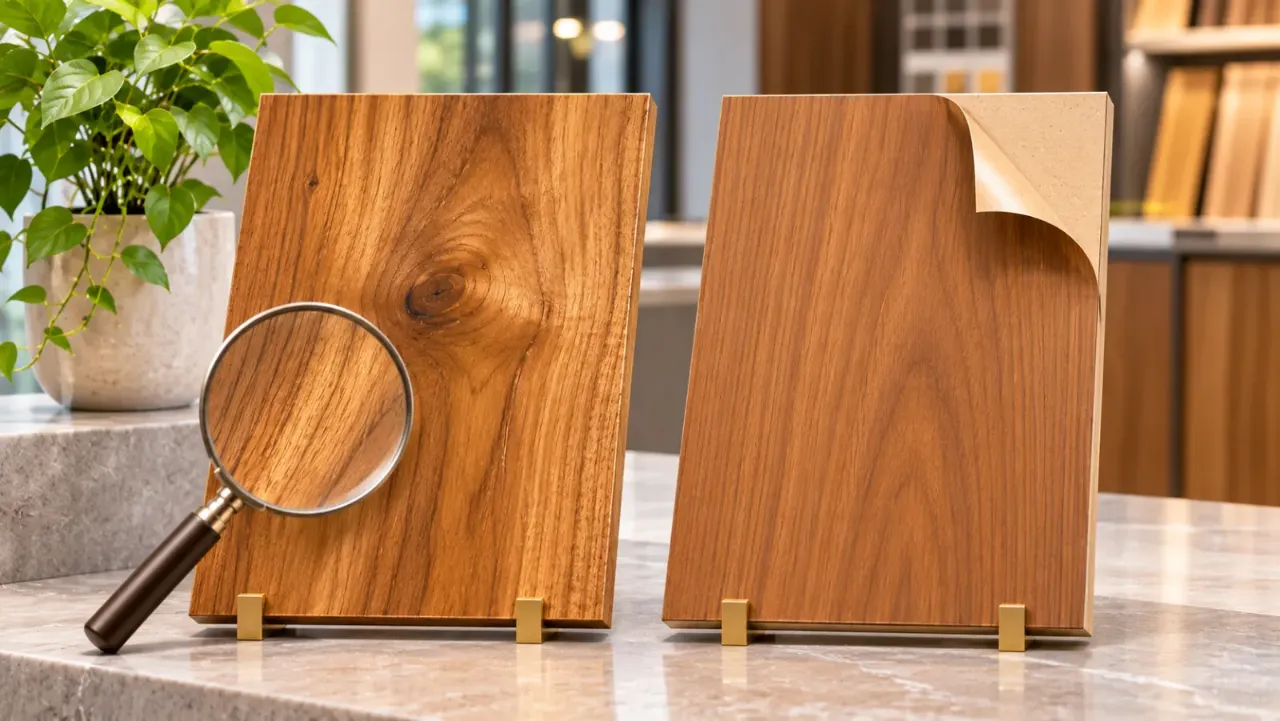
How to Spot Real Wood vs Veneer in a Showroom
A wooden dining table, wardrobe or bed may look beautifully crafted under showroom lighting, but its appearance alone does not tell you how it is made. Two pieces of furniture can have almost identical colours, grain patterns and finishes while using very different construction methods.
One may be made primarily from solid timber. Another may use a thin layer of natural wood veneer over plywood, MDF or another engineered board. Both can be attractive and suitable for a home, but their construction, repair options, price and maintenance requirements are different.
The difficulty is that showrooms often display finished surfaces. Edges, undersides, backs and internal construction may be concealed, polished or inaccessible.
Before buying, learn what to inspect and what to ask. A few simple checks can help you understand whether you are looking at solid wood, natural veneer or a wood-look surface.
1. First, Understand What You Are Comparing
Before inspecting furniture, understand the difference between the materials.
Solid Wood
Solid wood furniture is made from natural timber pieces. Depending on the design, different boards or sections may be joined together to create a tabletop, frame, legs or panels.
It has natural variations in colour, grain, knots and texture. These differences are part of the material rather than a printed pattern.
Solid wood can often be sanded and refinished, depending on its thickness, construction and condition. However, it can also respond to changes in humidity, temperature and moisture.
Natural Wood Veneer
Veneer is a thin slice of real wood applied to a supporting material such as plywood, MDF or another engineered board.
The visible surface is genuine wood, so it can have natural grain and colour variation. However, the furniture is not made entirely from solid timber.
Veneer is commonly used on wardrobes, cabinets, tables, sideboards and decorative furniture because it offers the appearance of natural wood while allowing more efficient use of timber.
Wood-Look Laminate
Laminate is different from natural veneer. It is a manufactured decorative surface designed to reproduce the appearance of wood.
Its grain and colour are printed or manufactured as part of the decorative layer. It does not have a surface layer of natural timber.
| Material | What Is on the Surface? | What Is Underneath? |
|---|---|---|
| Solid wood | Natural timber | Natural timber |
| Natural veneer | Thin layer of real wood | Plywood, MDF or another board |
| Wood-look laminate | Manufactured decorative layer | Usually an engineered board |
Remember: Natural veneer is real wood, but veneer-covered furniture is not the same as furniture made entirely from solid wood.
2. Check the Edges First
One of the most useful places to inspect is the edge of a furniture panel.
On a solid wood piece, the grain and wood structure may continue around the edge, depending on how the component has been constructed.
On veneered furniture, you may find a thin surface layer on the face, with a different material beneath it. Look closely at the edge, particularly around corners, cut-outs and exposed sections.
Check:
- Whether the grain appears to continue naturally around the edge.
- Whether a thin surface layer is visible.
- Whether the edge has a separate strip or banding.
- Whether the edge construction differs from the main face.
However, do not treat one edge as conclusive proof. Solid wood can have applied edge details, and veneer furniture can have matching veneer edge strips that make the construction difficult to identify.
3. Look at the Grain Pattern
Natural wood has individual grain characteristics. The pattern can change with the way the timber is cut and the direction in which it is used.
On solid wood furniture, different boards may show different grain patterns, knots and colour variations.
Natural veneer also displays genuine wood grain. In fact, veneer can be selected and arranged carefully to create attractive patterns across a large surface.
Look for:
- Natural variation in grain direction.
- Changes in colour between adjoining sections.
- Matching or mirrored grain patterns.
- Whether the same pattern repeats across several surfaces.
A repeated pattern may suggest a manufactured wood-look surface, but it is not a definitive test. Veneer sheets can also be arranged in repeating or book-matched patterns.
Important: A beautiful, continuous grain pattern does not automatically mean the furniture is solid wood. Veneer can look equally natural because its surface is real timber.
4. Inspect the Underside and Hidden Surfaces
The front of a wardrobe door or dining table may reveal very little about its construction. Hidden surfaces often provide better clues.
If the showroom permits, inspect:
- The underside of the tabletop.
- The back of a cabinet or sideboard.
- The inside of a drawer.
- The bottom of a shelf.
- The inner face of a door.
- Areas behind removable panels, where accessible.
Look for differences in material, visible board layers, veneer edges, unfinished surfaces or a contrasting backing material.
Some solid wood furniture may also use engineered panels for backs, drawer bottoms or internal shelves. A single engineered component does not mean the entire product is veneered. Ask for the construction details of each major component.
5. Examine the Joints and Construction
Furniture construction can tell you more than the surface finish.
Look at how the legs, frames, panels and corners are joined.
Solid wood furniture may use techniques such as mortise-and-tenon joints, dowels, dovetail joints or other woodworking methods. Veneered furniture can also use strong and well-designed joints, so joinery alone cannot establish whether the piece is solid wood.
Check:
- Whether the legs are separate solid timber components.
- How the tabletop connects to the frame.
- Whether the corners are cleanly joined.
- Whether drawer joints are visible.
- Whether the construction feels stable and properly finished.
A well-made veneered product can be structurally sound. A poorly made solid wood product can still have weak joints. Evaluate construction quality separately from the material label.
6. Do Not Rely on Weight or Sound Alone
A common showroom assumption is that heavier furniture must be solid wood.
That is not a reliable test. MDF and other engineered boards can be heavy, while some solid wood species are relatively light. Furniture size, internal framing, hardware and construction also affect weight.
Tapping the surface is equally unreliable. The sound changes with thickness, internal support, finish and the material underneath.
Use weight and sound only as minor observations. Do not make a buying decision based on either.
7. Ask the Salesperson These Questions
If the construction is not visible, ask direct questions. Avoid relying on broad descriptions such as "premium wood", "natural finish" or "wooden construction".
- Is the main body made from solid timber, plywood, MDF or another engineered board?
- Is the visible surface natural wood veneer or a decorative laminate?
- Which components are solid wood and which are engineered boards?
- What wood species is used?
- What is the veneer thickness, if applicable?
- Are the drawer fronts, sides, backs and shelves made from the same material?
- Can the furniture be sanded or refinished?
- What does the warranty cover, particularly for veneer peeling, surface damage and joints?
Ask for the answers in writing on the quotation, product specification or invoice. A verbal assurance may not be enough if there is a disagreement later.
8. Compare the Materials Before You Decide
Neither solid wood nor veneer is automatically the better choice. The right option depends on your budget, intended use, design expectations and maintenance preferences.
| Factor | Solid Wood | Natural Wood Veneer |
|---|---|---|
| Surface | Natural timber | Real wood layer |
| Appearance | Natural grain and variation | Natural grain, often carefully matched |
| Construction | Timber components | Veneer over a supporting board |
| Refinishing | Often possible | Limited by veneer thickness and condition |
| Moisture response | Can expand or contract | Depends on veneer, core, edges and finish |
| Repair | Can often be repaired or refinished | Surface damage can be harder to repair |
| Design flexibility | Depends on timber and construction | Allows consistent decorative patterns |
| Cost | Depends on species and craftsmanship | Often more economical than comparable solid timber |
9. Common Showroom Mistakes to Avoid
Mistake 1: Assuming Every Natural Grain Surface Is Solid Wood
Veneer is made from real wood, so its surface can look completely natural.
Mistake 2: Checking Only the Front
The front face may be finished to conceal the supporting material. Inspect edges and hidden surfaces as well.
Mistake 3: Treating Heavy Furniture as Solid Wood
Engineered boards can be heavy. Weight is not proof of timber construction.
Mistake 4: Confusing Veneer with Laminate
Veneer is a thin layer of real wood. Laminate is a manufactured decorative surface. Ask which one is being used.
Mistake 5: Ignoring the Internal Components
A product may have solid wood legs, veneered panels and engineered-board shelves. Ask about each major component rather than accepting one broad material description.
Mistake 6: Not Checking the Invoice
The material specification should be recorded clearly in the order documents. Do not rely only on the showroom display label.
10. A Quick Showroom Checklist Before You Buy
Use this checklist when inspecting a dining table, bed, wardrobe, cabinet or sideboard.
- Confirm whether the product is solid wood, veneer or laminate.
- Ask which wood species or board material is used.
- Inspect exposed edges and corners.
- Check the underside and back wherever possible.
- Look inside drawers and cabinets.
- Ask which components are solid timber.
- Check the joints, stability and finish quality.
- Ask about refinishing and repair options.
- Review the warranty and care instructions.
- Get the material specifications written on the quotation or invoice.
Final Thoughts
Spotting solid wood and veneer in a showroom is not about finding one magic visual clue. It is about understanding the construction and checking several details together.
Solid wood offers natural timber throughout the components made from it, while veneer gives you a real wood surface over a supporting material. Both can be good furniture choices when the construction is appropriate for the intended use.
Instead of judging furniture only by its appearance, inspect the edges, hidden surfaces, joints and product specifications. Most importantly, ask the showroom to document exactly what materials are used in the product you are ordering.
A clear material description today can prevent an expensive misunderstanding later.
Frequently Asked Questions
1. How can I identify solid wood furniture in a showroom?
Inspect exposed edges, undersides, drawer interiors and joints. Look for natural timber construction, but confirm the material with the product specification because veneer can also have a genuine wood grain.
2. Is wood veneer real wood?
Yes. Natural wood veneer is made from thin slices of real timber. It is attached to a supporting board, such as plywood or MDF, rather than forming the entire thickness of the furniture.
3. Is veneer furniture considered wooden furniture?
Yes. Veneer furniture has a real wood surface, but it should be described accurately as veneered furniture rather than entirely solid wood furniture.
4. Can veneer look exactly like solid wood?
Veneer can look very similar to solid wood because both have natural timber surfaces. Carefully selected veneer sheets can even create continuous or symmetrical grain patterns.
5. Is solid wood always better than veneer?
No. Solid wood may offer more scope for refinishing, but its performance depends on timber species, construction and care. Good-quality veneer furniture can be practical, stable and visually attractive.
6. Can veneered furniture be repaired?
Minor surface damage may be repairable, but the options depend on veneer thickness, damage depth and the supporting board. Deep scratches, peeling or water damage can be more difficult to fix than damage to solid timber.
7. How is veneer different from laminate?
Veneer is a thin layer of natural wood. Laminate is a manufactured decorative surface that imitates wood or other finishes. They may look similar from a distance, but they are different materials.
8. What should I check on the furniture invoice?
Ask for the material used in the main frame, panels, tabletop, drawer fronts, shelves and other major components. The invoice or product specification should clearly distinguish solid timber, natural veneer, plywood, MDF and laminate wherever applicable.
Make More Confident Interior Decisions with Walls to Wonder
Choosing furniture is easier when you understand the materials behind the finish. Explore Walls to Wonder tools to plan your space, compare design choices and make informed decisions for your home.
- Whole Home Visualizer – Visualise design ideas across your home.
- Design My Room – Explore design possibilities for an individual room.
- Interior Design Cost Estimate – Get an initial estimate for your interior project.
- Interior Quotation Checker – Review the details in an interior quotation.
- Rate My Room Design – Get feedback on your room design.
- Interior Style Finder – Explore styles that suit your preferences.
Explore more at Walls to Wonder.
Turn this idea into a plan for your home
Visualise your space, understand the likely budget, or find a professional who can bring the idea to life.