
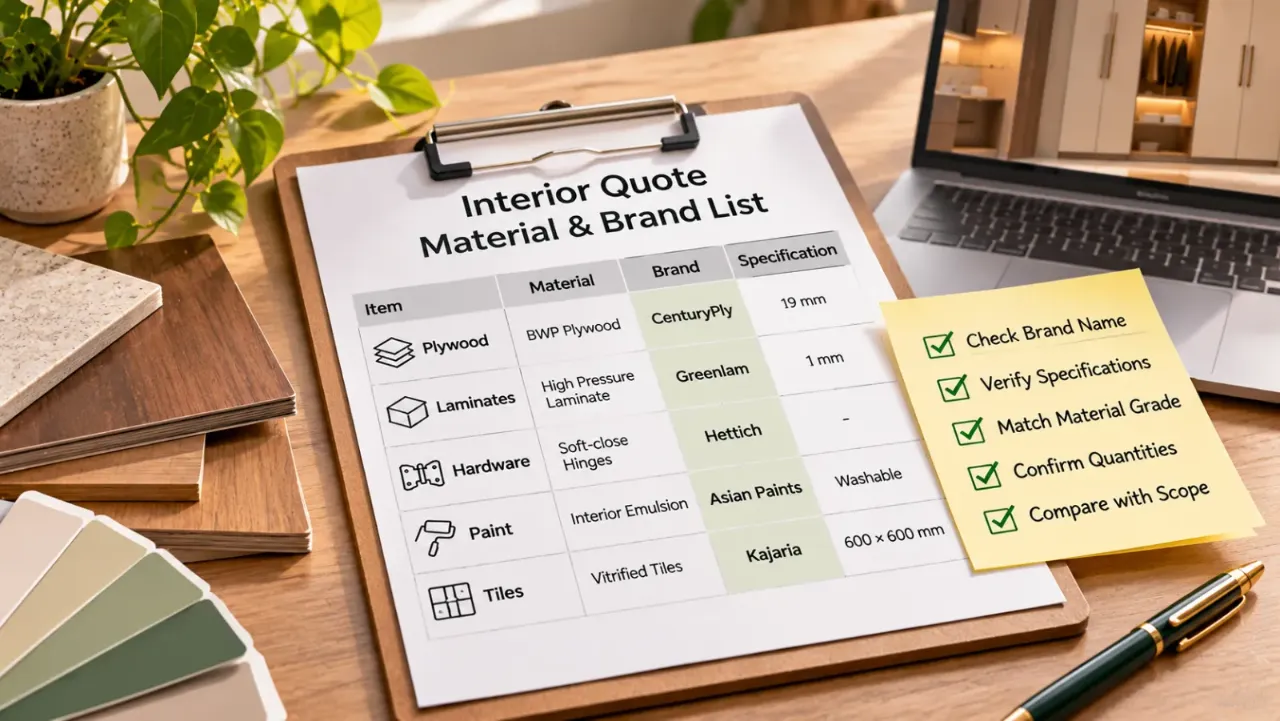
How to Read and Verify Material Brand Lists in an Interior Quote
An interior design quotation may include a list of recognised material brands, but knowing the names alone is not enough. A brand can offer several product ranges, grades, finishes and price levels. Two materials carrying the same brand name may not have identical specifications or performance.
This is why homeowners should look beyond the brand list before approving an interior project. You need to understand which product is being proposed, where it will be used, what specification has been agreed upon and how the supplied material will be verified.
1. Understand What a Material Brand List Actually Tells You
A material brand list identifies the manufacturers or brands proposed for different parts of your interior project. It may cover plywood, laminates, hardware, paints, tiles, lighting, electrical accessories, sanitaryware and other products.
However, a brand name is only the starting point.
For example, a quotation might mention a recognised plywood manufacturer without specifying the board grade, thickness or intended application. Similarly, listing a hardware brand does not tell you which hinge, drawer channel or product series will be installed.
A useful brand list should help you answer four questions:
- Who manufactures the product?
- Which product range, model or series is being supplied?
- What are its technical specifications?
- Where will it be used in the home?
If these details are missing, ask for clarification before treating the brand list as an approved material schedule.
2. Know the Difference Between a Brand, Product Range and Specification
These terms are often used interchangeably in casual discussions, but they mean different things.
- Brand or manufacturer: The company responsible for producing or marketing the material.
- Product range or series: A specific collection of products offered under that brand.
- Model or product code: The identifier used to distinguish a particular product.
- Specification: The technical details that describe the material, such as grade, thickness, dimensions, finish or performance characteristics.
Consider a quotation that simply states a branded soft-close hinge. It does not identify the exact hinge model, opening angle, overlay type or compatible cabinet application.
A more useful entry would mention the brand, product series or model, relevant specifications and quantity.
The same principle applies to boards, laminates, lighting and sanitaryware. A brand name should not be treated as a complete specification.
3. Check the Brand and Specifications by Material Category
Different interior materials require different information. Use the following guide when reviewing the quotation.
Plywood and boards
For plywood, MDF, particle board or other engineered boards, check:
- Manufacturer and product range.
- Board type and grade.
- Thickness.
- Intended application.
- Relevant standard or certification, where applicable.
- Whether the same specification applies to the entire unit.
For example, a wardrobe carcass, kitchen cabinet and bathroom vanity may require different material considerations because their exposure and usage conditions are not the same.
Do not assume that a brand name alone confirms moisture suitability or structural performance.
Laminates and decorative finishes
For laminates, verify:
- Brand and collection.
- Product code or design number.
- Colour and pattern.
- Surface texture and finish.
- Sheet thickness, where specified.
- Whether the approved sample matches the final selection.
A quotation that says only "premium laminate" leaves considerable room for interpretation. The final design may look different if the colour, texture or product range changes.
Hinges, channels and furniture hardware
Hardware can have a significant effect on how frequently used furniture performs.
- Brand and product series.
- Exact hinge or channel model.
- Soft-close mechanism, if included.
- Load rating where relevant.
- Dimensions and compatibility.
- Quantity and location of installation.
For example, a quotation that mentions branded drawer channels should clarify which product range is included. Standard and premium mechanisms should not be assumed to be interchangeable.
Paints and wall finishes
For paints, verify:
- Brand and product range.
- Interior or exterior suitability.
- Finish, such as matte, satin or sheen.
- Shade name or colour code.
- Number of coats included.
- Primer and surface preparation requirements.
For special finishes, ask whether the quoted product is a standard paint, washable finish or a decorative coating system. These are not necessarily equivalent.
Tiles and flooring
Check:
- Manufacturer and collection.
- Product code or design reference.
- Tile dimensions.
- Surface finish.
- Intended floor or wall application.
- Relevant technical properties for the location.
- Grout and installation specifications, where included.
For bathroom flooring, for example, check the product's slip-resistance suitability rather than selecting it only by appearance.
Electrical fittings and lighting
For switches, sockets, lights and related accessories, confirm:
- Brand and product series.
- Model or product code.
- Rated electrical specifications where relevant.
- Colour and finish.
- Quantity.
- Whether drivers, accessories and installation are included.
A quotation should not simply say "branded lights" if the fixture type and model have not been agreed upon.
Sanitaryware and bathroom fittings
For sanitaryware and faucets, check:
- Brand and product series.
- Exact model number.
- Dimensions and installation type.
- Finish and colour.
- Compatible fittings and accessories.
- Warranty terms.
A brand may offer products at several price points. The model number helps prevent confusion between visually similar options.
4. Watch Out for Vague Terms in Brand Lists
Certain expressions sound reassuring but do not establish what you will actually receive.
| Quotation wording | What you should ask |
|---|---|
| Premium plywood | Which grade, thickness and product range? |
| Branded hardware | Which brand and exact product series? |
| High-quality laminate | Which collection, code and finish? |
| Soft-close channels | Which model and load specification? |
| Branded paint | Which product range, shade and finish? |
| Equivalent brand | Who approves the alternative and what specifications must match? |
| As per availability | What happens if the selected product is unavailable? |
The phrase "or equivalent" deserves particular attention. It can be reasonable to allow alternatives, but the agreement should define what equivalent means.
For instance, an alternative should be assessed against the agreed technical requirements, intended use, finish and price allowance—not merely because it belongs to another recognised brand.
5. Ask for Samples Before Approving the Final Selection
A brand list cannot show you exactly how every material will look in your home.
Request physical samples for finishes that have a significant visual or functional impact. These may include:
- Laminate and veneer shades.
- Cabinet shutter finishes.
- Flooring and wall tiles.
- Paint colours.
- Upholstery fabrics.
- Countertop surfaces.
- Metal handles and hardware finishes.
Compare samples under the lighting conditions in which they will be used. A finish can look different under showroom lighting, daylight and warm artificial lighting.
Once you approve a sample, ask the designer to record its product code, finish and approval date. Keep a photograph or physical sample where practical.
This creates a clear reference if there is a disagreement during execution.
6. Create a Material Approval Sheet
Instead of relying on a long list of brand names, ask for a room-wise material approval sheet.
A simple format can look like this:
| Item | Brand/product | Specification | Approval status |
|---|---|---|---|
| Kitchen carcass | To be specified | Board type and thickness | Pending |
| Kitchen laminate | To be specified | Code, shade and finish | Pending |
| Drawer channels | To be specified | Model and mechanism | Pending |
| Wardrobe shutters | To be specified | Board, finish and thickness | Pending |
| Living room paint | To be specified | Product range and shade code | Pending |
| Bathroom tiles | To be specified | Size, finish and application | Pending |
The sheet should also include quantities, locations, agreed rates or allowances, and remarks where required.
You can use separate sheets for the kitchen, bedrooms, living room and bathrooms. This makes it easier to track changes without mixing up specifications from different rooms.
7. Verify the Materials During Procurement and Installation
Approval should not end when the quotation is signed.
Before installation, check that the products delivered match the approved material schedule.
Where practical, verify:
- Brand and product labels.
- Model numbers and product codes.
- Board thickness and grade markings.
- Packaging and batch details.
- Finish and colour against approved samples.
- Quantity supplied.
- Product invoices or purchase records, where agreed.
For materials that become concealed after installation, request photographs or inspection before the work is covered. This is particularly useful for boards, plumbing components, electrical wiring and other materials that may be difficult to verify later.
Keep invoices, product documents and warranty details with your project records.
8. Understand What Happens When a Brand or Product Changes
Material substitutions can happen because of stock shortages, discontinued products, delivery delays or changes in budget.
The important point is that a substitution should not happen without clear communication.
If the selected product is unavailable, ask the designer or contractor to provide:
- The reason for the proposed change.
- The alternative brand and exact product.
- A comparison of relevant specifications.
- Any difference in cost.
- Any impact on appearance, performance or warranty.
- The revised delivery or installation timeline, if affected.
Approve the alternative in writing before it is purchased or installed.
If the substitute costs less than the original selection, clarify whether the quotation total will be adjusted. If it costs more, ask for the revised amount and obtain approval before proceeding.
9. Compare Brand Lists Across Different Quotations
When comparing two interior design quotations, do not count the number of recognised brands in each document and assume the longer list represents better quality.
Instead, compare equivalent materials and specifications.
For example, one contractor may quote a particular board grade and thickness while another uses a different grade. Both may mention well-known manufacturers, but the proposals are not necessarily comparable.
Check the following:
- Is the material type identical?
- Are the grades and thicknesses comparable?
- Are the product ranges and models specified?
- Are finishes and colours the same?
- Are hardware quantities and mechanisms included?
- Are delivery and installation covered?
- Are warranties and exclusions clearly stated?
A lower quotation may be perfectly reasonable if the specifications suit your requirements. The goal is not to choose the most expensive brand, but to understand what you are paying for.
10. Common Mistakes to Avoid
Homeowners often focus on the total quotation and overlook the details that determine what will actually be supplied.
Avoid these mistakes:
- Accepting a brand name without checking the product range.
- Treating "premium" or "branded" as a technical specification.
- Assuming every product from one manufacturer has the same quality or application.
- Approving finishes based only on digital images.
- Ignoring product codes and model numbers.
- Allowing substitutions without written approval.
- Failing to record the final material selections.
- Discarding invoices, labels and warranty documents.
- Comparing quotations without checking whether the specifications match.
A few checks before execution can prevent misunderstandings and make the project easier to manage.
11. Homeowner Checklist Before Signing
Before approving the material section of an interior quotation, confirm:
- Brand or manufacturer is identified.
- Product range, series or model is specified where relevant.
- Board grade and thickness are documented.
- Laminate, veneer and paint codes are recorded.
- Hardware models and mechanisms are identified.
- Tiles and sanitaryware have confirmed product references.
- Physical samples have been approved where necessary.
- Quantities and locations are clear.
- Price allowances and upgrade costs are documented.
- Substitution rules are agreed upon.
- Delivery, installation and warranty responsibilities are clear.
- The final approved material schedule is attached to the agreement.
A Final Thought
A good material brand list should do more than display familiar company names. It should tell you exactly which products are proposed, where they will be used and what specifications you are approving.
Before signing an interior quotation, take time to verify the product ranges, grades, finishes and model numbers. Record approved samples and ask for written confirmation whenever a selection changes.
Clear material documentation helps you compare quotations fairly, manage your budget and check that the finished home reflects the materials you actually selected.
Frequently Asked Questions
Is mentioning a brand name enough in an interior quotation?
No. A brand may offer several product ranges and specifications. Ask for the exact product, grade, thickness, finish or model number wherever relevant.
Should an interior designer provide a material brand list?
A detailed material schedule is useful, particularly for a project involving custom furniture, modular kitchens, flooring, electrical fittings and bathroom products. It helps both parties understand what has been agreed.
How do I verify that the contractor has used the approved material?
Check product labels, model numbers, packaging, invoices and relevant markings where available. Compare delivered materials with the approved schedule and inspect items before they become concealed.
What does an equivalent brand mean in an interior quotation?
It refers to an alternative product proposed in place of the selected one. The agreement should define how equivalence will be judged, including specifications, intended application, finish and cost.
Can I change a material brand after approving the quotation?
Yes, but the change should be documented. Confirm the replacement product, price difference, specifications and any timeline impact before approving the revision.
Should I ask for material samples before signing?
For important visible finishes such as laminates, veneers, tiles, paint shades and upholstery, physical samples are helpful. Record the approved product codes and retain a reference.
What if the quotation lists a brand but not the product model?
Ask for the missing product details before signing. A brand name alone may not identify the exact material or price level included.
Why is a material approval sheet useful?
It records the selected products, specifications, quantities, finishes and approval status in one place. It also provides a reference for checking materials during procurement and installation.
Plan Your Home Design with Walls to Wonder
Explore these tools to visualise your spaces, understand costs and prepare before finalising your interior project.
- Whole Home Visualizer – Explore a coordinated look for your home.
- Design My Room – Experiment with room layouts and design ideas.
- Interior Design Cost Estimate – Explore an indicative interior budget.
- Interior Quotation Checker – Review quotation details and identify points that need clarification.
- Rate My Room Design – Get feedback on your room design.
- Interior Style Finder – Discover an interior style that suits your preferences.
Visit Walls to Wonder for more home design ideas and planning resources.
Get a personalised estimate for your home
Choose your rooms, materials and preferences to understand a practical interior budget before you commit.