
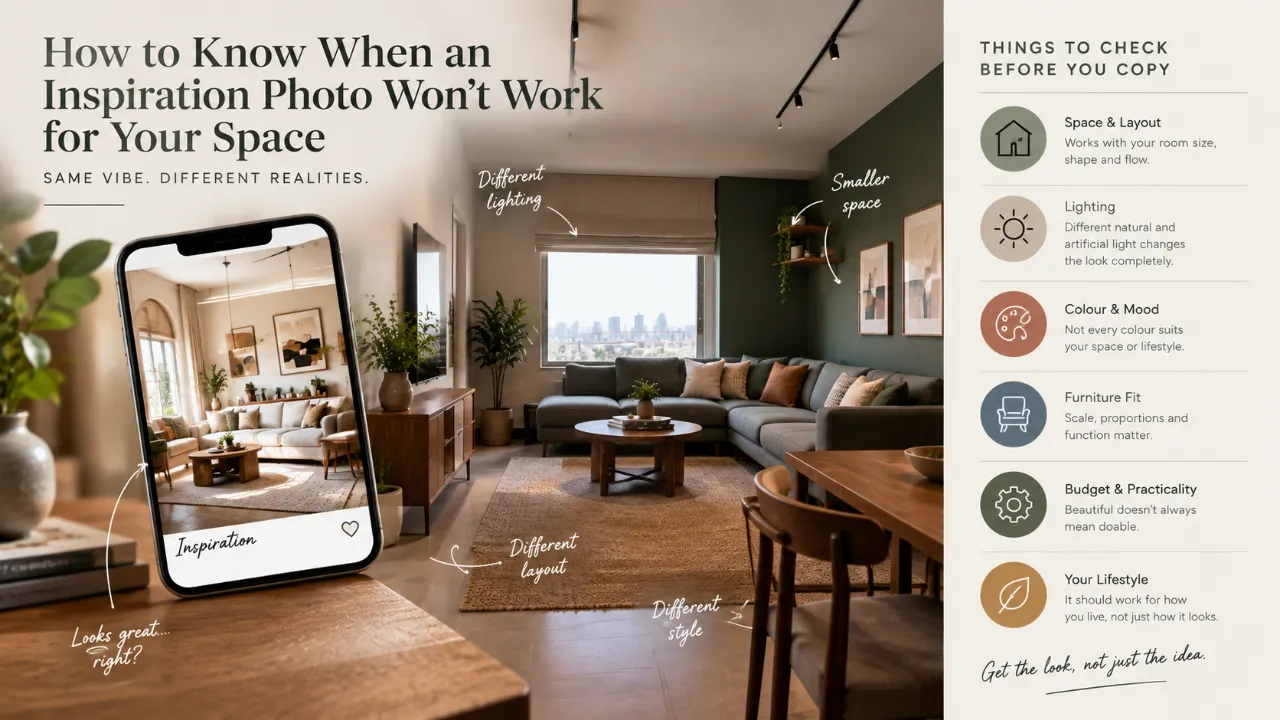
How to Know When an Inspiration Photo Won’t Work for Your Space
Saving an inspiration photo is easy. Making that photo work in your own home is much harder.
A room can look beautiful online and still be completely unsuitable for your space. The dimensions may be different. The ceiling may be lower. The windows may face another direction. The furniture may be custom-sized. The photograph may also use professional styling or wide-angle photography.
This does not mean you should stop collecting inspiration. It means you need to learn how to read an inspiration photo before trying to copy it.
The goal is not to recreate the image exactly. It is to understand what you like about it and determine whether those ideas can realistically translate into your home.
Quick answer: An inspiration photo may not translate directly when its room size, proportions, ceiling height, windows, architecture, furniture scale, lighting, storage, materials, maintenance needs, budget or lifestyle are significantly different from yours. Use the image as a design reference, then adapt the elements that actually fit your space.
- How to evaluate an inspiration photo
- Room size and furniture scale
- Negative space and circulation
- Ceiling height and windows
- Architecture and structural constraints
- Custom furniture and hidden storage
- Lifestyle and maintenance
- Colour, materials and flooring
- Photography and styling effects
- Budget considerations
- How to adapt instead of copy
- A three-part inspiration test
- A practical comparison table
- Frequently asked questions
The First Question Is Not “Do I Like It?”
A better first question is: “What exactly do I like about this image?”
Colour
Identify the palette, undertones and level of contrast.
Lighting
Look at natural light, ambient light and accent lighting.
Furniture
Identify shapes, proportions and visual weight.
Materials
Look for wood, stone, fabric, metal and surface combinations.
Layout
Study how furniture relates to circulation and focal points.
Mood
Identify whether you are drawn to warmth, calmness, drama or openness.
1. Check the Room Size First
One of the biggest reasons inspiration photos fail in real homes is scale.
Compare room length, room width, ceiling height, window size, furniture dimensions and walking space with your own room.
A sofa that looks perfectly balanced in a large living room may overwhelm a compact apartment. A dining table that looks comfortable in a spacious dining area may leave almost no circulation space in your home.
2. Compare Furniture Scale, Not Just Furniture Style
Finding a similar-looking sofa is not enough. Its dimensions also need to make sense for your room.
Look at sofa width and depth, chair proportions, coffee-table size, wardrobe depth, bed width and dining-table dimensions.
3. Look at the Empty Space Around the Furniture
One of the easiest details to miss in an inspiration image is negative space.
Ask whether people can walk comfortably, cabinet doors can open, dining chairs can move and furniture can be used without blocking circulation.
Important: The empty space around furniture is part of the design. If your room cannot provide that breathing room, copying the arrangement literally may not produce the same result.
4. Check the Ceiling Height
Ceiling height changes how a room feels and what it can visually support.
A high-ceilinged room may comfortably accommodate large pendants, full-height curtains, tall cabinetry and oversized artwork. The same choices may feel heavy in a lower room.
5. Look at Where the Windows Are
Windows affect natural light, furniture placement, curtain positioning, views, privacy and ventilation.
If your window is on a different wall from the inspiration image, the same layout may need to be reinterpreted.
6. Study the Direction and Quality of Natural Light
Lighting can completely change how colours and materials appear.
Your home may receive different amounts of daylight or stronger direct sunlight than the room in the image. This can change paint, wood, fabric, reflections and the overall atmosphere.
7. Check Whether Architecture Is Doing Some of the Work
Sometimes the feature you love is actually part of the architecture: high ceilings, large windows, arches, exposed beams, niches, full-height doors or large room proportions.
If your home does not have those features, simply copying the furniture and colour palette may not create the same result.
8. Look for Structural Elements You Cannot Move
Your home may have structural columns, beams, structural walls, service shafts, fixed plumbing or electrical constraints that are absent from the inspiration image.
If those elements affect the room, the design needs to work around them rather than assume a blank floor plan.
9. Check Whether the Design Depends on Custom Furniture
Some interiors look simple because every piece was designed specifically for the room.
A media unit may fit perfectly between two walls. A wardrobe may reach exactly from floor to ceiling. A bench may wrap around a corner.
Before purchasing similar-looking furniture, check whether its actual dimensions and construction are compatible with your home.
10. Look at the Hidden Storage
Photographs usually show what is visible, not what is behind cabinet doors.
Ask where everyday objects, appliances, cleaning supplies, linens, shoes, books and household items are actually stored.
11. Check Your Lifestyle Before Copying the Room
A beautiful room still has to work for the way you live.
Consider household size, children, pets, cooking habits, work-from-home needs, storage requirements and how much maintenance you are willing to do.
Ask yourself: “Would this room still work on an ordinary Tuesday?”
12. Think About How the Room Is Actually Used
Some inspiration images are designed primarily for visual impact.
A dining room may look beautiful with almost nothing on the sideboard, while your real dining area may need serving storage, crockery, linens and everyday objects.
The image can still provide inspiration; the functional layer simply needs to be added.
13. Look at Materials Under Real Conditions
Professional photography and controlled lighting can make materials appear different from how they will look in your home.
Consider natural light, dust, moisture, heat, cleaning, scratches and everyday wear before selecting finishes.
14. Do Not Ignore Maintenance
A photograph captures one moment. Your home has to work every day.
Think carefully about glossy finishes, open shelving, light upholstery, delicate fabrics and difficult-to-clean surfaces.
15. Compare the Colour Palette With Your Existing Home
Your home may already contain flooring, doors, window frames, kitchen finishes, bathroom tiles, existing furniture and fixed lighting.
Try to understand how the inspiration palette can work with those existing elements instead of assuming you are starting from an empty room.
16. Look at the Relationship Between Colours
Do not simply identify “beige” or “blue.” Look at whether the colours are warm or cool, light or dark, muted or saturated, and how those tones relate to one another.
17. Check the Flooring
Flooring occupies a large visual area and can influence the entire palette.
If the inspiration image depends on wide timber boards, large-format stone or a specific floor tone, a very different existing floor may change the result considerably.
18. Consider the Room's Focal Point
Ask what the inspiration image wants you to notice first.
It may be a television wall, artwork, window, statement light, feature wall or piece of furniture.
Then check whether your room has a comparable focal point. If not, adapt the idea instead of trying to duplicate it literally.
19. Some Photos Depend on Styling
Flowers, books, cushions, accessories and carefully arranged shelves can contribute strongly to a professionally photographed room.
Separate the core design from temporary photo styling before deciding what needs to be recreated.
20. Watch Out for Wide-Angle Photography
Wide-angle images can make rooms appear larger and furniture smaller than they actually are.
Walls may appear farther apart, circulation may seem more generous and furniture proportions may be difficult to judge.
When possible, use multiple photographs or plans instead of judging scale from one wide-angle image.
21. Compare the Budget Level
Some inspiration images rely on custom furniture, premium stone, imported lighting, bespoke cabinetry, high-end hardware or extensive built-ins.
Identify which elements actually create the visual effect you like rather than assuming every component needs to be reproduced at the same cost.
22. Ask What Can Be Adapted Instead of Copied
This is the most important shift.
You may love a room with a large curved sofa, floor-to-ceiling windows, a stone wall and sculptural lighting while your own room is smaller and has a structural column.
You can still borrow the curved furniture language, warm neutral palette, layered lighting and natural materials while adapting the scale and layout to your actual room.
23. The Three-Part Inspiration Test
Visual Fit
Do you genuinely like the colours, materials, forms and overall mood?
Spatial Fit
Can the proportions, furniture and circulation work in your room?
Lifestyle Fit
Can the room support the way you actually live?
If an image fails one test, adapt it. If it fails all three, look for a different source of inspiration.
24. Inspiration Photos That Need Extra Caution
| Photo Type | Why It Can Be Difficult to Copy |
|---|---|
| Extremely large room | Furniture proportions and circulation may be very different |
| Hotel-like interior | May prioritise visual impact over everyday residential use |
| Highly customised home | Furniture and architecture may be made specifically for the property |
| Heavily styled photograph | Temporary accessories may contribute strongly to the final image |
| Very high ceiling | Vertical proportions may not translate to a standard-height room |
| Large open windows | Experience may depend heavily on daylight and views |
25. A Quick Inspiration Photo Reality Check
| What to Check | Question |
|---|---|
| Room size | Is my room similar in scale? |
| Furniture | Are the dimensions realistic for my space? |
| Ceiling | Is my ceiling height comparable? |
| Windows | Do I have similar openings and daylight? |
| Architecture | Are there columns, beams or niches that change the layout? |
| Layout | Can people move comfortably around the furniture? |
| Storage | Where will everyday belongings go? |
| Materials | Can these finishes handle my lifestyle? |
| Maintenance | Can I realistically maintain this look? |
| Budget | Is the same design level realistic for me? |
| Lifestyle | Does the room support how I actually live? |
| Existing elements | Will it work with what I already have? |
26. What to Save From an Inspiration Photo
You do not need to save the entire room. Save individual ideas:
- A colour combination
- A lighting technique
- A furniture silhouette
- A material combination
- A storage idea
- A wall treatment
- A layout concept
- A proportion you like
27. How to Turn an Impossible Inspiration Into a Realistic Brief
Instead of saying: “I want this exact room.”
Explain what you actually like: “I like the warm neutral palette, layered lighting, curved furniture and natural wood. My room is smaller and has a structural column, so I want the same feeling adapted to my space.”
That gives a designer a much clearer brief because it identifies the important ideas instead of demanding a literal copy.
28. A Practical Test Before You Buy Anything
Before purchasing an inspiration-led product, check:
Exact dimensions, clearance requirements, material availability, colour under your lighting, maintenance, installation requirements, budget and compatibility with existing elements.
29. Use Inspiration as a Starting Point, Not a Blueprint
The most useful inspiration images do not tell you exactly what your room should look like. They help you identify a design direction.
That direction can then be translated into your home's actual dimensions, architecture, daylight, storage, budget and lifestyle.
See What Could Work in Your Own Space
Explore your design preferences, visualise ideas for your room and connect with interior professionals who can adapt inspiration to your actual home.
Design My Room with AI Find Your Interior Style Explore Interior DesignersFrequently Asked Questions
How do I know if an inspiration photo will work in my room?
Compare its room size, furniture scale, ceiling height, windows, architecture, circulation, storage, materials, budget and lifestyle with your own space.
Why does my room look different from the inspiration image?
Differences in dimensions, natural light, ceiling height, architecture, furniture proportions, materials, styling and photography can all change the final appearance.
Can I copy an inspiration room if my room is smaller?
You can often adapt the design direction, but the furniture, circulation, storage and proportions may need to change to suit the smaller space.
How important is furniture scale when recreating an inspiration image?
It is extremely important. Furniture that is too large or too small can change both the function and visual balance of the room even when the style is similar.
Should I copy the colours from an inspiration photo exactly?
Not necessarily. Consider undertones, natural light and existing finishes in your own home before selecting the closest workable palette.
Why should I check the architecture before copying a design?
Columns, beams, windows, doors, ceiling height and other fixed architectural elements can determine whether a particular layout or feature is physically possible.
How do I know whether an inspiration room uses custom furniture?
Unusually precise dimensions, built-ins fitted exactly between walls, floor-to-ceiling cabinetry and highly specific furniture shapes can be clues that the pieces were designed for that particular room.
Should an inspiration photo match my budget?
It does not need to match exactly. Identify which elements create the look you want and determine which can realistically be achieved within your budget.
What is the biggest mistake when using inspiration photos?
Trying to copy the entire room without understanding which visual and functional elements actually make the design work.
Final Takeaway
An inspiration photo does not have to work literally in your space to be useful.
It may give you the colour palette you love, the furniture shape you want, the lighting atmosphere you prefer or the material combination that catches your eye.
The important part is knowing what can actually translate.
Compare the size, proportions, architecture, natural light, furniture, storage, materials, maintenance, budget and lifestyle of the inspiration image with your own home.
Then take the parts that work and adapt the rest.
Good interior design is not about recreating someone else's room. It is about understanding why you love it—and making those ideas work in your own space.
Turn this idea into a plan for your home
Visualise your space, understand the likely budget, or find a professional who can bring the idea to life.