
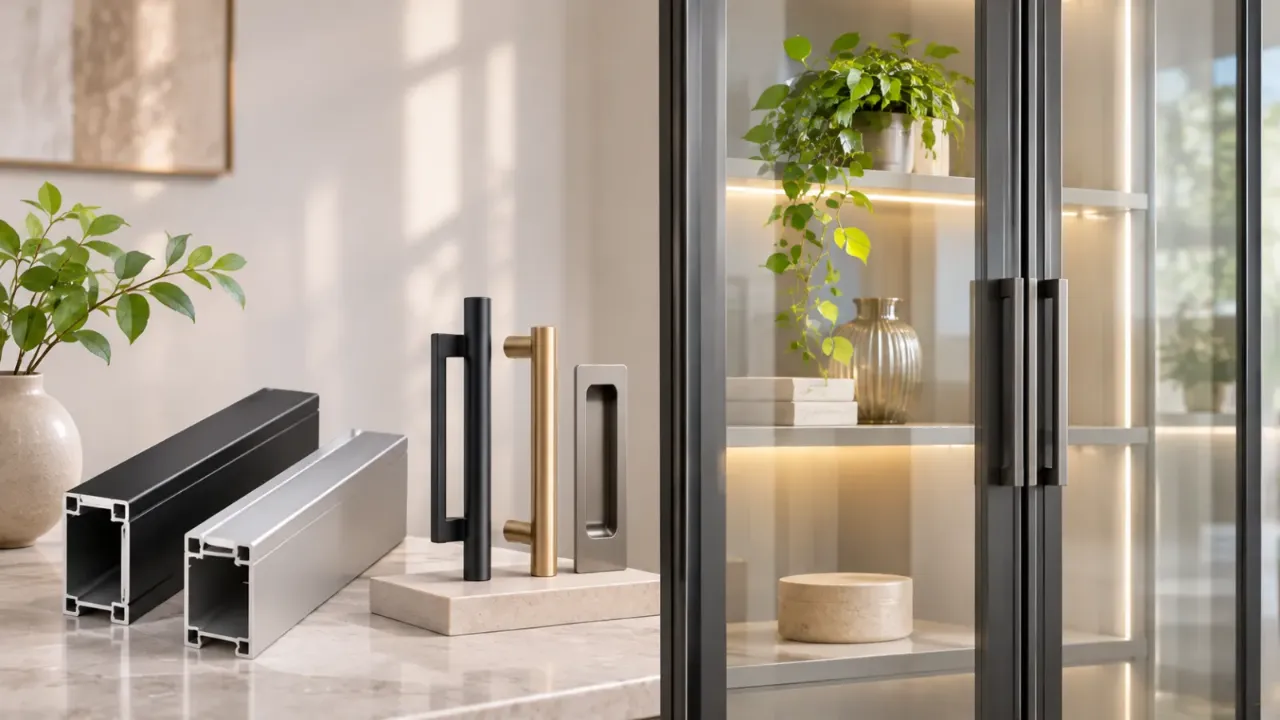
How to Choose Aluminium Profiles and Handles for Glass Doors
Glass doors can make a room feel brighter, more open and visually connected. But the glass itself is only one part of the door. The aluminium profile around it, the handle, hinges, locking arrangement and installation details all influence how the door looks and performs.
A slim frame may create a minimal appearance, while a wider profile can provide a more defined border and accommodate a different type of construction. Similarly, a handle that looks attractive in a catalogue may not be comfortable to use or compatible with the selected door system.
Before choosing a glass door, it helps to understand what the different aluminium profiles and fittings actually do. Here is what to consider before placing an order.
1. What Are Aluminium Profiles in Glass Doors?
Aluminium profiles are shaped metal sections used to frame, support or connect glass panels. They are manufactured in different cross-sectional shapes and sizes, depending on the door system and its intended use.
In a framed glass door, the aluminium sections may form the vertical sides, top and bottom rails. They hold the glass panel using a compatible glazing arrangement, such as gaskets, channels or another system-specific fixing method.
Depending on the design, profiles may also be used for:
- Sliding door tracks and interlocking sections
- Hinged door frames
- Partition frames
- Door stiles and rails
- Integrated handle sections
- Edge protection and connecting members
The important point is that an aluminium profile is not simply a decorative border. Its shape, material, dimensions and compatibility with the glass and hardware contribute to the complete door system.
2. Understand the Different Types of Glass Door Systems
The door mechanism should be decided before selecting the profile. A profile suitable for a sliding door may not be suitable for a hinged door.
Hinged Framed Glass Doors
These doors open on hinges attached to a frame, wall or another supporting structure. Aluminium profiles form the perimeter of the door and help hold the glass panel. They are commonly considered for internal room divisions, office cabins and selected entrance applications.
Sliding Glass Doors
Sliding doors move horizontally along a track. Their profiles may include top and bottom rails, rollers, interlocking sections and a handle arrangement. For these systems, pay attention to track design, roller compatibility, alignment and the provision for cleaning the track.
Aluminium-Framed Partition Doors
These doors are often part of a larger framed glass partition. The profile design needs to work with the fixed panels, adjoining sections and door opening. Check whether the door frame and fixed partition use compatible profile systems.
Frameless Glass Doors
A frameless door does not use a conventional aluminium perimeter frame. Instead, it relies on compatible glass hardware such as patch fittings, pivots, hinges, clamps and handles. Do not confuse hardware for frameless glass doors with fittings designed for aluminium-framed doors.
3. How to Choose the Right Aluminium Profile
The profile should be selected according to the size, weight, opening mechanism and application of the door. A profile that looks slim is not automatically suitable for every glass panel.
Profile Shape and Dimensions
Ask the supplier for the actual cross-section drawing rather than relying only on a product photograph or a description such as slim, heavy-duty or premium.
Check:
- Visible face width
- Overall section depth
- Wall thickness
- Glass-receiving channel or pocket
- Provision for gaskets
- Corner-joint arrangement
- Hardware fixing points
The visible width affects the design, but the full section geometry determines how it connects with the glass and fittings.
Aluminium Grade and Construction
Ask what aluminium alloy and temper are being supplied, and whether the manufacturer can provide relevant material documentation. Also clarify whether the profile is intended for the proposed door dimensions and expected use. Avoid choosing solely by weight or by a seller's claim that a section is heavy-duty.
Profile Compatibility
A profile must work with the other components in the system. Confirm compatibility with:
- Glass thickness and edge details
- Hinges or rollers
- Locks and latches
- Handle sections
- Corner connectors
- Gaskets and seals
A profile that is inexpensive on its own may become an unsuitable purchase if the required fittings are unavailable or need custom modifications.
4. Choose the Glass Before Finalising the Frame
The aluminium profile and glass panel must be specified together. Do not select a frame first and assume that any glass thickness can be fitted later.
| Glass Type | What to Consider |
|---|---|
| Clear glass | Allows visibility and light to pass through |
| Frosted glass | Offers greater visual privacy |
| Tinted glass | Changes the appearance and amount of light passing through |
| Toughened glass | A safety-glass option commonly used in doors |
| Laminated safety glass | Holds together with an interlayer when fractured, depending on the glass construction |
| Patterned glass | Adds texture and reduces direct visibility |
The required glass type and thickness depend on the panel dimensions, door design, fixing method and application. There is no single thickness that is suitable for every glass door.
Ask the fabricator to confirm the glass specification in writing, including the relevant safety-glass requirements, edge finishing and compatibility with the selected frame.
5. Glass Door Handle Options
Handles are used frequently, so comfort, grip and fixing quality matter as much as appearance.
Pull Handles
Best for: Doors where a clear, easy-to-grip handle is preferred.
Pull handles are available in straight, curved, tubular and rectangular designs. Check the handle length, projection and fixing method, especially if the door is used frequently.
Lever Handles
Best for: Doors with a compatible latch or locking mechanism.
Lever handles are convenient to operate and can be paired with suitable locks. Confirm that the handle, lock and frame are designed to work together.
Recessed or Flush Handles
Best for: Sliding doors and designs where a projecting handle could obstruct movement.
These handles sit within or close to the door surface. Check that there is enough room for a comfortable grip and that the handle does not interfere with the sliding mechanism.
Integrated Aluminium Handle Profiles
Some framed glass-door systems include a dedicated aluminium section that acts as the handle or provides a grip along the door edge. This creates a more continuous appearance, but the handle profile must be designed for the specific frame system. Confirm its grip depth, edge shape and compatibility with the door's closing arrangement.
Knob Handles
Knobs create a compact visual detail and may suit smaller doors or specific interior applications. Check the fixing method and whether the knob provides enough grip for the door's size and weight.
6. Which Handle Material and Finish Should You Choose?
Handles are available in aluminium, stainless steel and other metal finishes. The right choice depends on the environment, usage and appearance of the door.
| Handle Material or Finish | What to Check |
|---|---|
| Aluminium | Finish quality, surface wear and compatibility with the frame |
| Stainless steel | Grade, finish and suitability for the exposure conditions |
| Matte black | Coating durability, scratches and cleaning requirements |
| Brushed finish | Consistency of brushing and ease of maintenance |
| Polished finish | Fingerprints, water marks and regular cleaning |
| Matching aluminium finish | Colour and texture consistency between handle and frame |
If the frame and handle are purchased separately, compare physical finish samples. Two products described as champagne, black or silver may look noticeably different when installed next to each other.
7. Hinges, Locks and Other Hardware Matter Too
The handle is only one part of the hardware package. A glass door also needs fittings suited to its construction and opening mechanism.
For hinged doors:
- Check the hinge type and its approved door-weight range.
- Confirm the number and position of hinges.
- Check the fixing method and required glass preparation.
- Confirm whether a latch, lock or door closer is needed.
For sliding doors:
- Check the roller system and track arrangement.
- Ask about anti-jump or anti-lift provisions where applicable.
- Confirm the stopper and locking arrangement.
- Check whether the track can be accessed for cleaning and maintenance.
For all systems:
- Confirm the compatibility of screws, clamps, gaskets and connectors.
- Check whether exposed hardware is suitable for the environment.
- Ask which components are replaceable if they wear out.
Do not select hinges by appearance alone. Their capacity and suitability must be checked against the complete door system and the manufacturer's specifications.
8. Aluminium Profile Finishes: What Are Your Options?
Anodised Finish
Anodising creates a controlled oxide layer on the aluminium surface. It is available in different shades and can provide a clean metallic appearance. Ask for the finish specification and a sample, particularly if the door is exposed to moisture or outdoor conditions.
Powder-Coated Finish
Powder coating provides a coloured surface and is available in shades such as black, white, grey and champagne. Check the coating quality, colour consistency and suitability for the intended exposure. Avoid assuming that all powder-coated profiles have identical durability.
Wood-Finish Coating
Some aluminium profiles are available with wood-effect finishes. These can work when the door needs to coordinate with wooden flooring, furniture or other interior elements. Review a physical sample because printed or coated wood effects can vary in grain, shade and texture.
Natural or Mill Finish
A basic unfinished or mill-finish profile may be used in applications where the final appearance is not exposed or where further finishing is planned. For visible areas, confirm whether the supplied surface is suitable for the intended use rather than accepting it as a finished decorative product.
9. Where Can Aluminium-Framed Glass Doors Be Used?
- Living and dining areas: Glass doors can separate spaces while allowing light to pass through.
- Home offices: Framed glass doors can create a visual division, though acoustic privacy depends on the complete door and sealing system.
- Wardrobes and display units: Smaller framed glass panels can be used for shutters and display sections. These require hardware suited to cabinet-scale doors, not full-size architectural doors.
- Balconies and external openings: The system must be designed for relevant weather, wind, drainage and exposure conditions.
- Bathrooms and shower areas: Use hardware, finishes, seals and glass specifically suitable for wet-area applications. A standard interior partition profile should not automatically be used as a shower enclosure system.
10. What Affects the Cost of Aluminium Profiles and Glass Doors?
There is no single price for an aluminium-framed glass door. The final cost depends on the complete system rather than just the profile rate.
| Cost Factor | Why It Matters |
|---|---|
| Aluminium profile | Section design, alloy, dimensions and finish affect cost |
| Glass | Type, thickness, processing and size influence the price |
| Handles | Material, design and fixing arrangement change the cost |
| Hinges and rollers | Hardware type and load rating affect the system price |
| Locks and accessories | Additional fittings may be quoted separately |
| Fabrication | Cutting, machining, joining and assembly add to the cost |
| Installation | Site conditions, alignment and fixing requirements affect labour |
| Delivery | Large or delicate panels may require special handling and packing |
When comparing quotations, make sure both suppliers are pricing the same door dimensions, glass type, profile system, finish and hardware.
A low profile-only price should not be compared directly with a quotation for a complete installed door.
11. Questions to Ask Before Placing an Order
- What is the exact profile section and can I see its cross-section drawing?
- What aluminium alloy and finish are being supplied?
- Which glass type and thickness are included?
- Are the glass edges processed as required by the system?
- Which handle, hinge, lock or roller models are included?
- Are all the fittings compatible with the selected profile?
- Who is responsible for fabrication, installation and final alignment?
- What is covered by the product and installation warranty?
- Are replacement handles, rollers, gaskets and other parts available?
- Does the quotation include transport, installation and all accessories?
Ask for a sample or a completed demonstration unit wherever possible. A physical check can reveal sharp edges, poor finishing, loose fittings or an uncomfortable handle that may not be obvious in a catalogue.
12. Common Mistakes to Avoid
- Choosing a profile only because it looks slim.
- Assuming every aluminium profile can accommodate every glass thickness.
- Selecting a handle without checking the fixing method.
- Ignoring hinge or roller capacity.
- Mixing frame and hardware from incompatible systems.
- Comparing profile-only rates with complete-door quotations.
- Overlooking seals and gaskets in wet or external locations.
- Failing to confirm who is responsible for installation and adjustments.
- Approving the colour from a screen instead of checking a physical sample.
Final Thoughts
An aluminium-framed glass door is a combination of several components, and each one needs to work with the others. The profile provides the frame, the glass determines the panel specification, and the handle and hardware make the door practical to use.
Before buying, focus on the complete system rather than choosing individual components based only on appearance or price. Confirm the drawings, glass specification, hardware compatibility, finish and installation responsibility in writing. These checks can help you avoid mismatched fittings and expensive changes after fabrication.
Frequently Asked Questions
1. Are aluminium profiles suitable for glass doors?
Yes. Aluminium profiles are used in many hinged, sliding and partition-door systems. The selected section must be suitable for the door dimensions, glass specification and hardware.
2. Which aluminium profile is best for a glass door?
There is no universal best profile. Choose one designed for the specific door mechanism, panel size, glass thickness and expected use.
3. Can any glass thickness fit into an aluminium frame?
No. The profile has a specific glass-receiving space and fixing arrangement. Confirm the permitted glass type and thickness with the system manufacturer or fabricator.
4. Are aluminium handles better than stainless steel handles?
Neither is automatically better. Compare the material grade, finish, fixing quality, exposure conditions and comfort of use.
5. Can aluminium profiles be used for sliding glass doors?
Yes. Sliding systems use profiles and fittings designed for tracks, rollers, interlocking sections and the selected glass panel.
6. What is the difference between framed and frameless glass doors?
Framed doors use aluminium or another material around the glass panel. Frameless doors rely on specialised glass hardware, such as patch fittings, hinges and clamps, rather than a conventional perimeter frame.
7. Do aluminium profiles need maintenance?
They generally need routine cleaning and inspection. Check the finish manufacturer's cleaning instructions, and periodically inspect handles, hinges, rollers, seals and fasteners.
8. What should be included in a glass door quotation?
The quotation should clearly identify the aluminium profile, glass type and thickness, finish, handles, hinges or rollers, locks, fabrication, installation, delivery and warranty.
Explore More with Walls to Wonder
Planning a new interior or comparing design options? Explore Walls to Wonder's AI tools to visualise spaces, understand costs and make more informed design decisions.
- Whole Home Visualizer – Explore how design choices can work across your home.
- Design My Room – Explore ideas for a room you want to redesign.
- Interior Design Cost Estimate – Get an initial understanding of potential design costs.
- Interior Quotation Checker – Review an interior quotation more carefully.
- Rate My Room Design – Get feedback on your room design.
- Interior Style Finder – Explore interior styles that match your preferences.
Discover more ideas and tools at Walls to Wonder.
Turn this idea into a plan for your home
Visualise your space, understand the likely budget, or find a professional who can bring the idea to life.