
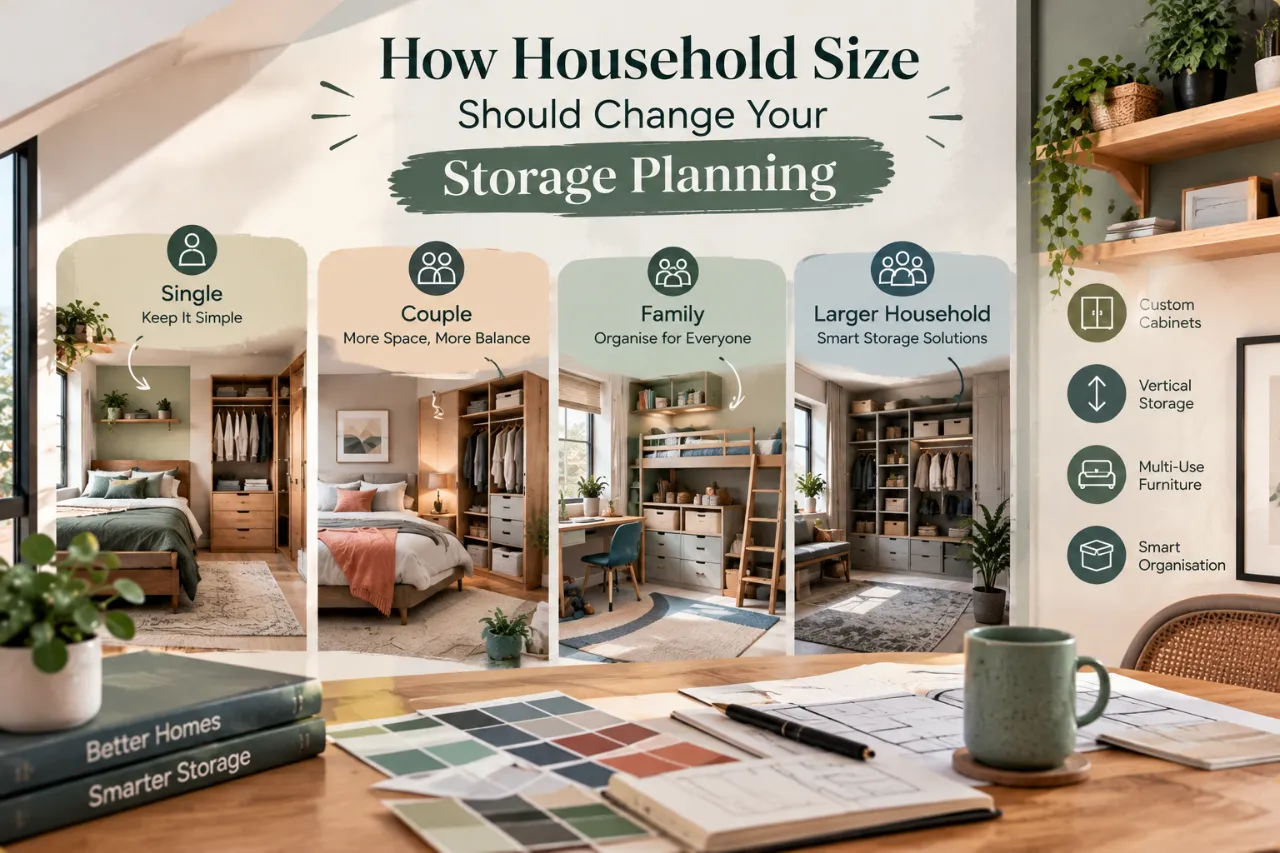
How Household Size Should Change Your Storage Planning
Storage planning is often treated as a question of how many cabinets, wardrobes or shelves a home can fit. But the more important question is how much storage the household actually needs.
A couple living in a compact apartment will have very different storage requirements from a family with children, a multigenerational household or a home where one room needs to serve multiple purposes.
Household size affects not only the amount of storage you need, but also where it should be placed, who can access it, how frequently it is used and how easily the system can adapt when the household changes.
The larger the household, the more important it becomes to divide storage by person, activity, frequency of use and room rather than simply adding more cabinets.
A well-planned home should provide enough everyday storage while keeping frequently used items accessible, seasonal belongings organised and shared spaces from becoming overcrowded.
- Start With Household Size
- Count Belongings, Not Just People
- Storage Planning for Couples
- Storage Planning for Families With Children
- Multigenerational Household Storage
- Shared vs. Personal Storage
- Bedroom and Wardrobe Storage
- Kitchen Storage for Larger Households
- Entryway and Everyday Storage
- Living Room Storage
- Utility and Cleaning Storage
- Seasonal and Infrequently Used Items
- Plan for Children's Changing Needs
- Think About Accessibility
- Storage Planning in Smaller Homes
- Plan for Future Household Changes
- Common Storage Planning Mistakes
- A Simple Storage Planning Framework
- FAQs
1. Start With Household Size
The number of people using a home is one of the first factors to consider when planning storage.
More people generally means more clothing, footwear, personal items, kitchenware, books, cleaning supplies, luggage and other belongings. But the relationship is not simply one person equals one additional cabinet.
Storage requirements also depend on age, lifestyle, hobbies, work arrangements, shopping habits and how much each person owns.
2. Count Belongings, Not Just People
Household size gives you a starting point, but possessions give you a better picture of actual storage demand.
Before designing storage, make a basic inventory of:
- Clothing
- Shoes
- Bags and accessories
- Books
- Kitchenware
- Appliances
- Cleaning supplies
- Documents
- Hobbies and equipment
- Luggage
- Seasonal items
- Children's belongings
This prevents the common mistake of designing storage based only on room size and discovering later that the cabinets are either insufficient or poorly allocated.
3. Storage Planning for Couples
A two-person household may need less total storage than a larger family, but that does not mean every storage system should be shared.
Separate zones can make everyday organisation easier. For example, a wardrobe can be divided into individual sections while shared storage can handle items such as luggage, household documents, bedding and cleaning supplies.
Couples should also consider whether both people have similar storage needs. One person may need more hanging space while another may need more drawers, shelving or accessory storage.
4. Storage Planning for Families With Children
Families with children often need storage that can change as children grow.
Clothing sizes change, school supplies increase, toys evolve into books and equipment, and hobbies can create new storage requirements.
Useful strategies include:
- Accessible lower storage for everyday children's items
- Dedicated wardrobe zones
- Storage for school supplies
- Organised toy storage
- Flexible shelving
- Closed storage for less frequently used belongings
Avoid making every storage element permanently specific to one stage of childhood. Adjustable shelves and flexible compartments can remain useful for longer.
5. Multigenerational Household Storage
When several generations share a home, storage planning becomes more about accessibility, privacy and organisation.
Different age groups may have different belongings and different access requirements.
A useful approach is to combine personal storage within bedrooms with shared storage in common areas.
- Individual wardrobes for personal clothing
- Shared linen storage
- Dedicated medicine or care-related storage where appropriate
- Common household storage
- Accessible everyday storage
- Higher or less accessible storage for infrequently used items
7. Bedroom and Wardrobe Storage
Bedrooms usually contain some of the highest concentration of personal belongings in a home.
As household size increases, wardrobe planning becomes more important. Instead of giving every person the same amount of storage, assess the actual requirements of each user.
Consider:
- Hanging clothing
- Folded clothing
- Footwear
- Accessories
- Bags
- Seasonal clothing
- Luggage
- Personal items
In shared bedrooms, define individual zones wherever possible. This makes the storage system easier to maintain and reduces the likelihood of belongings becoming mixed together.
8. Kitchen Storage for Larger Households
Household size can have a direct impact on kitchen storage because a larger household may use more cookware, serving dishes, groceries and appliances.
However, simply adding more cabinets is not always the answer. Storage should be organised according to frequency of use.
- Everyday cookware near the main work zones
- Frequently used ingredients within easy reach
- Bulk supplies in dedicated pantry storage
- Appliances grouped according to frequency of use
- Servingware stored where it can be accessed efficiently
Larger households can particularly benefit from separating everyday supplies from bulk or backup stock.
9. Entryway and Everyday Storage
Entryways can become clutter points when several people are using the same space.
Shoes, bags, keys, umbrellas, helmets and everyday accessories can quickly accumulate.
A larger household may benefit from clearly divided zones or compartments so that each person's everyday belongings have a defined place.
10. Living Room Storage
Shared living spaces often need to accommodate belongings from several people without looking overcrowded.
Consider storage for books, entertainment equipment, children's items, décor, documents and everyday objects.
Closed cabinets can help visually reduce clutter, while open shelves can be used selectively for items that contribute to the room's appearance.
The goal is not to fill every available wall with storage. It is to create enough capacity without making the shared room feel visually heavy.
11. Utility and Cleaning Storage
Cleaning equipment is easy to overlook during interior planning.
Larger households may require more space for cleaning supplies, laundry products, buckets, mops, vacuum equipment and other household tools.
Plan these items early instead of trying to hide them in leftover corners after the rest of the storage has been designed.
12. Plan for Seasonal and Infrequently Used Items
Not everything needs to occupy prime storage space.
Seasonal décor, luggage, occasional-use appliances, winter clothing and other infrequently used items can be placed in less accessible areas.
Higher shelves, loft storage or deeper cabinets can be useful for these categories, provided they remain safe and reasonably accessible when required.
13. Plan for Children's Changing Needs
Storage planning for children should account for change rather than only current belongings.
A young child's storage may focus on toys and clothing. Later, the same room may need more space for books, school materials, sports equipment, hobbies and personal belongings.
Adjustable shelves and movable storage components can help the room evolve without requiring a complete redesign.
14. Think About Accessibility
Storage quantity is only one part of good storage planning. Accessibility matters just as much.
Frequently used items should generally be stored in locations that are easy for the people using them to reach.
Less frequently used items can occupy higher, deeper or less convenient storage zones.
In households with older adults or people with different mobility requirements, storage placement should be planned around safe and comfortable access.
15. Storage Planning in Smaller Homes
A larger household does not necessarily require a larger home, but it does require more careful storage planning.
In compact homes, look for opportunities to combine functions without creating visual clutter.
- Storage under beds
- Full-height wardrobes
- Built-in cabinets
- Window-side storage where appropriate
- Storage integrated into furniture
- Entryway cabinets
- Vertical storage
- Multi-purpose furniture
The objective is to use available volume intelligently rather than simply adding more furniture.
16. Plan for Future Household Changes
A storage system should not only work on move-in day.
Household needs can change because of children growing up, parents moving in, changes in work arrangements, new hobbies or changing storage habits.
When possible, include adjustable and flexible elements rather than designing every compartment for one exact item.
17. Common Storage Planning Mistakes
- Planning storage based only on floor area
- Giving every household member identical storage
- Ignoring existing belongings
- Using prime storage areas for seasonal items
- Creating too much open shelving
- Forgetting cleaning and utility equipment
- Ignoring children's changing needs
- Putting everyday items in inconvenient locations
- Using every available wall for cabinets
- Not leaving any flexible storage capacity
18. A Simple Storage Planning Framework
Before finalising your storage design, work through these five questions:
| Question | What to Consider |
|---|---|
| Who uses it? | Individual household members, children, guests or everyone |
| What is stored? | Clothing, kitchenware, books, equipment, documents, cleaning supplies and more |
| How often is it used? | Daily, weekly, seasonal or occasional |
| Where is it used? | Bedroom, kitchen, entryway, living room, utility area or another space |
| Could the need change? | Children growing, household changes, new hobbies or changing routines |
Once these questions are answered, storage can be distributed according to actual household behaviour rather than simply filling available wall space.
Planning Storage for Your Home?
Start by understanding how your household uses each room, then design storage around those routines.
Use Walls to Wonder Design My Room to explore room design ideas, or find interior designers on Walls to Wonder for professional support.
Frequently Asked Questions
Does a larger household always need more storage?
Generally, more people create more storage requirements, but the exact amount depends on belongings, lifestyle, room usage and how efficiently the storage is organised.
Should every person have separate storage?
Not necessarily. Personal belongings such as clothing can benefit from individual storage, while household supplies, bedding, luggage and cleaning equipment can often be shared.
How should storage change when children grow?
Use flexible shelves, adjustable compartments and adaptable furniture wherever possible so storage can accommodate changing clothing, books, school supplies, hobbies and equipment.
How can a large family manage storage in a small home?
Prioritise vertical storage, built-ins, multifunctional furniture, under-bed storage and clearly defined personal and shared storage zones.
Where should seasonal items be stored?
Seasonal and infrequently used belongings can generally occupy less accessible storage such as higher shelves, lofts or deeper cabinets, while everyday items should remain easier to reach.
What is the biggest storage planning mistake?
Designing storage based only on the size of the room rather than understanding what the household owns, how often items are used and who needs access to them.
Final Takeaway
Household size should influence storage planning, but the number of people is only the starting point.
The better approach is to understand each person's belongings, daily routines, accessibility requirements and future needs, then divide storage into personal, shared, seasonal and flexible zones.
Good storage is not about fitting the maximum number of cabinets into a home. It is about making the right things easy to store, easy to find and easy to access.
Turn this idea into a plan for your home
Visualise your space, understand the likely budget, or find a professional who can bring the idea to life.