
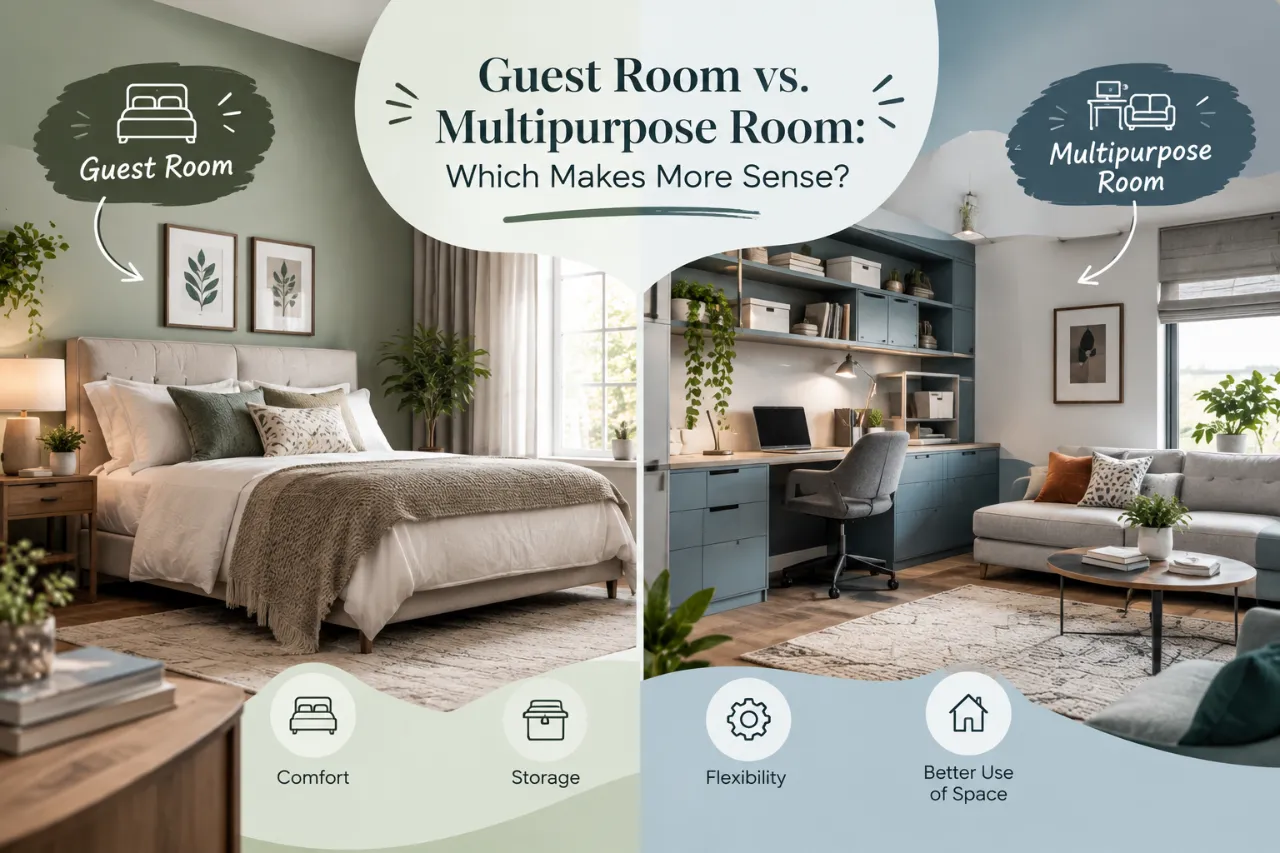
Guest Room vs. Multipurpose Room: Which Makes More Sense?
An extra room can look like a luxury when you first move into a home. But once daily life begins, the question changes: What should this room actually do?
Should it remain a dedicated guest bedroom that is always ready when family or friends visit? Or would it be more useful as a multipurpose room that works as a home office, study, hobby room, storage area or occasional guest space?
There is no universal answer. The right choice depends on how often you host guests, how much work or study happens at home, how much storage you need, how large the room is and how much flexibility you want in the future.
1. Start With How Often the Room Will Actually Be Used
The first question is simple: How often will someone sleep in this room?
If relatives or friends stay overnight regularly, a dedicated guest bedroom may be worthwhile.
But if the room is likely to remain empty for weeks or months between visits, dedicating the entire space to occasional guests may not be the most efficient use of your home's floor area.
- How many times do guests stay overnight in a typical year?
- Do they usually stay for one night or several days?
- Do you have family members who visit frequently?
- Do elderly parents or relatives need a dedicated room?
- Do you regularly host children or groups of guests?
- Does your family need a home office or study more often?
2. When a Dedicated Guest Bedroom Makes Sense
A guest bedroom becomes more practical when overnight visitors are a regular part of your household routine.
- Parents or relatives visit frequently
- Friends stay overnight often
- Guests stay for several days at a time
- Guests need privacy
- Your home has enough rooms for everyday activities
- You want visitors to have dedicated storage
- You do not need the room for another daily function
A dedicated guest room also has a practical advantage: you do not have to clear a desk, move equipment or reorganise storage every time someone visits.
3. When a Multipurpose Room Makes More Sense
A multipurpose room can provide more value when your everyday needs are greater than your guest requirements.
The same room could function as:
- Home office
- Study room
- Reading room
- Hobby space
- Yoga or exercise room
- Creative studio
- Storage room
- Kids' activity room
- Media room
- Guest room when required
This can be particularly useful in compact apartments where every square metre needs to perform more than one function.
4. Think About the Next Five Years, Not Just Today
Your family may change. Children may grow older. Someone may start working from home. Parents may move in. A hobby may become a business. You may need additional storage.
This is why flexibility can be valuable.
| Current Need | Possible Future Need |
|---|---|
| Home office | Guest room |
| Study | Teenager's bedroom |
| Guest room | Elderly parent's room |
| Hobby room | Home office |
| Kids' activity room | Study room |
| Storage + workspace | Guest bedroom |
5. Look at the Room's Size
Room dimensions can influence the decision.
A larger room may comfortably accommodate a bed, wardrobe, desk and seating area. A smaller room may become difficult to use if you try to fit every function permanently.
Instead of asking, "Can I fit a bed?", ask, "Can I fit a bed without destroying the room's everyday function?"
For a compact room, a sofa bed, daybed, wall bed or other flexible sleeping solution may make more sense than a permanently installed double bed.
6. Don't Let the Guest Bed Take Over the Room
A common mistake is designing the entire room around a bed that may only be used occasionally.
If the room is intended to be multipurpose, consider furniture that can support more than one use.
- Sofa beds
- Daybeds
- Foldable desks
- Wall-mounted desks
- Murphy or wall beds
- Movable side tables
- Modular storage
- Sliding partitions
7. Storage Can Decide the Entire Layout
Storage is often the hidden reason a multipurpose room becomes useful.
If the room needs to function as a study and guest room, you need to decide where everyday items will go when guests arrive.
Storage can be planned through:
- Full-height wardrobes
- Overhead cabinets
- Under-bed storage
- Built-in shelving
- Closed storage units
- Window-side storage where appropriate
- Multi-use furniture
8. Consider Privacy
A guest bedroom is not only about providing a bed. Guests may want a space where they can change, sleep, work or relax without feeling like they are occupying a family's everyday workspace.
- Bedroom location
- Bathroom access
- Door position
- Noise
- Visibility from common areas
- Storage
- Window placement
- Privacy from daily household activity
9. Think About Bathroom Access
Bathroom access can significantly affect the guest experience.
A guest room with an attached bathroom offers a different level of privacy from one where visitors need to use the common family bathroom.
If the room is used mainly as an office or study and only occasionally as a guest room, a nearby bathroom may be sufficient.
10. Work From Home Changes the Calculation
For many households, a home office can be used every weekday while a guest room may be occupied only occasionally.
If someone in your home works remotely, the room may need:
- A proper desk
- Comfortable seating
- Good lighting
- Background for video calls
- Storage
- Power points
- Internet access
- Acoustic privacy
A multipurpose room can combine these requirements with occasional guest accommodation.
11. Consider the People Who Will Use the Room
The right solution also depends on who your guests are.
A young friend staying for one night may have very different requirements from elderly parents staying for several weeks.
Consider accessibility, bed height, bathroom distance, storage, seating, lighting, night-time movement, privacy and ease of use.
12. Don't Forget Natural Light and Ventilation
A multipurpose room needs to feel comfortable for everyday use.
Think about window position, daylight, ventilation, glare, curtain placement, artificial lighting and desk orientation.
13. Design the Room Around a Primary Function
One of the biggest mistakes in a multipurpose room is trying to make everything equally important.
Instead, choose:
For example:
- Primary: Home office Secondary: Guest room + storage
- Primary: Study room Secondary: Guest room
- Primary: Guest bedroom Secondary: Reading and work space
14. Plan for the Conversion
If the room needs to switch between functions, decide exactly how that transformation will happen.
Desk in use, storage accessible and sofa or daybed available for seating.
Sleeping surface opened, work items stored away and guest storage made available.
The easier the conversion, the more likely you are to actually use the room for both purposes.
15. Use Furniture That Supports Flexibility
| Furniture | Possible Functions |
|---|---|
| Sofa bed | Seating + sleeping |
| Wall bed | Bedroom + open floor area |
| Foldable desk | Work + open space |
| Storage ottoman | Seating + storage |
| Built-in wardrobe | Guest storage + everyday storage |
| Nesting tables | Daily use + flexible floor area |
| Modular shelving | Storage + display |
16. Think About the Visual Identity of the Room
A multipurpose room does not need to look like a temporary compromise.
You can design it with a consistent colour palette, lighting scheme and material language that works for both functions.
- Warm neutral walls
- Built-in storage
- Soft layered lighting
- A comfortable sofa bed
- A clean work desk
- Minimal décor
- A few personal accents
17. Budget Matters Too
A dedicated guest bedroom can require a bed, mattress, wardrobe, bedside tables, lighting, curtains, seating and décor.
A multipurpose room may require flexible sleeping furniture, a desk, storage, task lighting, comfortable seating and cable management.
Neither approach is automatically cheaper.
The better comparison is: How much are you spending, and how often will the room actually be useful?
18. A Simple Decision Framework
| Question | Guest Bedroom | Multipurpose Room |
|---|---|---|
| Guests stay frequently | Strong fit | Possible |
| Guests stay occasionally | Possible | Strong fit |
| Work from home | Limited | Strong fit |
| Need a study | Limited | Strong fit |
| Need additional storage | Possible | Strong fit |
| Elderly relatives visit frequently | Strong fit | Possible with planning |
| Very limited space | May be inefficient | Often more flexible |
| Need maximum everyday use | Limited | Strong fit |
| Need permanent guest privacy | Strong fit | Requires planning |
| Expect future needs to change | Less flexible | Strong fit |
19. The Hybrid Option: Guest Room + Everyday Room
You do not always have to choose one extreme.
A well-planned hybrid room can function as an office, study or hobby space most of the time and become a guest bedroom when necessary.
A desk occupies one wall while a sofa bed or wall bed provides sleeping space.
A compact study desk sits beside a daybed, with closed storage keeping the room visually clean.
A flexible worktable and storage occupy the room, while a convertible bed allows occasional overnight use.
20. Make the Room Future-Ready
If you are designing the room from scratch, plan for changes even if you do not need them today.
- Extra electrical points
- Internet access
- Flexible lighting
- Sufficient storage
- Appropriate power near the desk
- Space for a future bed
- Curtain provisions
- Flexible furniture placement
21. Use the Room's Location to Your Advantage
Location within the home matters.
A room close to the entrance may work well as a guest room because visitors do not need to move through private family spaces.
A room deeper inside the home may work better as a family study or home office.
- Proximity to bathrooms
- Noise from living areas
- Access from the entrance
- Privacy
- Natural light
- View
- Family circulation
22. What Should You Choose?
The decision becomes simpler when you stop asking:
Instead ask:
Choose a dedicated guest bedroom when regular overnight guests, privacy and permanent sleeping comfort are important.
Choose a multipurpose room when everyday functions such as working, studying, hobbies or storage are more important.
Choose a hybrid when you need both but cannot justify dedicating the entire room to occasional guests.
Frequently Asked Questions
Is a guest bedroom worth having if guests visit only a few times a year?
It depends on your available space and priorities. If you have enough rooms and value dedicated guest privacy, it can still make sense. In a compact home, a multipurpose room may provide more everyday value.
Can a home office also be used as a guest room?
Yes. A sofa bed, wall bed or daybed can allow the room to function as an office most of the time and a guest room when required.
Is a multipurpose room harder to keep organised?
It can be if every function is given equal priority. Choosing one primary function and using closed, organised storage can make the room much easier to manage.
What is better for a small home?
A flexible room can often make better use of limited space because it allows one room to support multiple activities. The exact solution depends on room dimensions and household needs.
Should I use a sofa bed or a wall bed?
Both can work. A sofa bed is generally useful when seating is the primary everyday function, while a wall bed can preserve more usable floor area when the room needs to switch between functions frequently.
How do I make a multipurpose room look cohesive?
Use a consistent colour palette, material language, lighting scheme and storage approach. Avoid making each function look like a separate room.
Explore Your Room Before You Decide
Use Walls to Wonder's tools to explore room concepts, understand your interior direction and plan your space before investing in furniture or renovation.
Design My Room | Estimate Interior Cost | Find Interior Designers
Final Takeaway
An extra room does not automatically need to become a guest bedroom.
If guests visit frequently and need privacy, a dedicated guest room can be a practical investment.
If the room sits empty most of the year while your family needs a home office, study, hobby area or additional storage, a multipurpose approach may make better use of the space.
And if you need both, you can design a hybrid room that changes function when required.
Turn this idea into a plan for your home
Visualise your space, understand the likely budget, or find a professional who can bring the idea to life.