
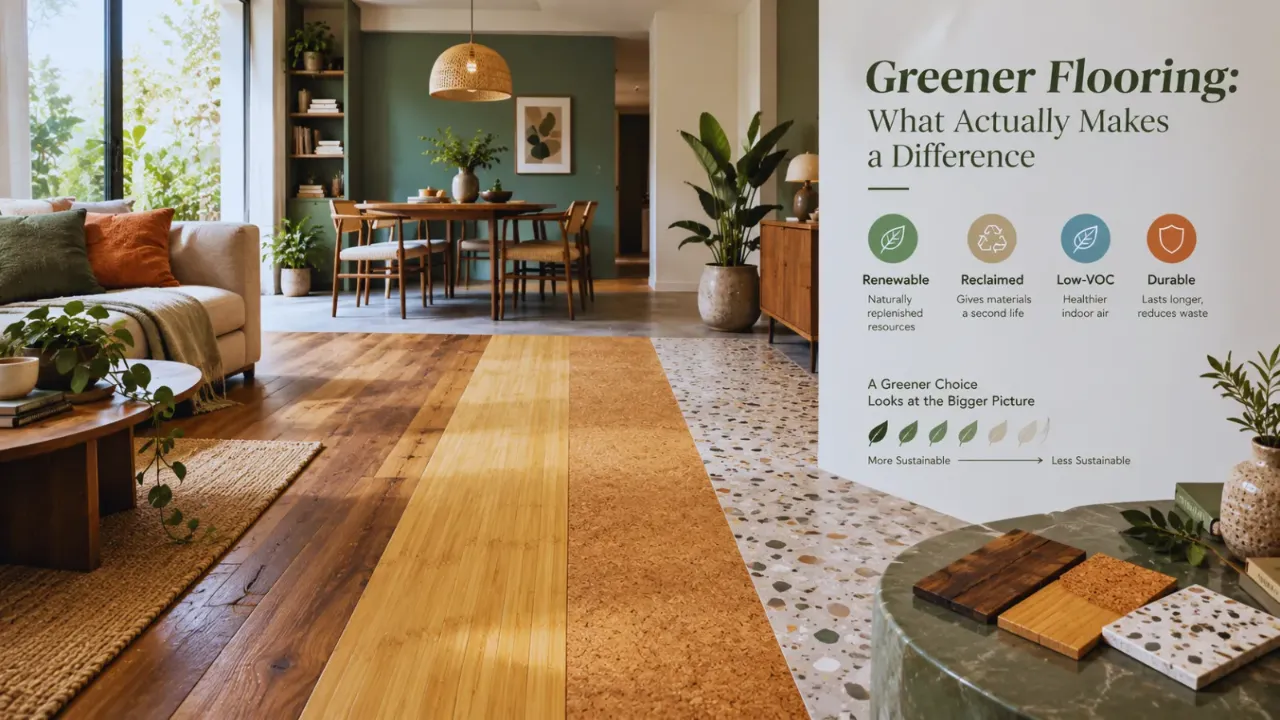
Greener Flooring: What Actually Makes a Difference
When homeowners hear “sustainable flooring,” the first instinct is often to look for a material that sounds natural. Wood. Bamboo. Cork. Stone. Maybe something labelled recycled or eco-friendly.
But choosing a greener floor is not quite that simple.
A material can be renewable and still involve intensive processing. A recycled product may still need significant energy to manufacture. A natural floor may last for decades, while a fashionable alternative may need replacement much sooner.
And sometimes, the most sustainable decision is not to replace the floor at all.
It is: “Which flooring makes the most sense for this room, this household, this lifespan and this maintenance routine?”
Start With the Floor You Already Have
Before choosing a new material, ask whether you actually need a new floor.
If the existing floor is structurally sound, safe, functional and visually acceptable, keeping it avoids the environmental cost of removing, transporting and replacing a material that may still have years of useful life left.
- Clean it properly
- Regrout it
- Refinish it
- Repair damaged sections
- Polish it where appropriate
- Reuse it within a larger redesign
Sometimes the greener option is simply better at knowing what not to replace.
Think in Terms of the Full Life of the Floor
The environmental story of flooring does not begin when the product reaches your home.
Raw materials have to be extracted or grown. The material has to be processed. It may be transported over long distances. It has to be manufactured into flooring. It may need adhesives, underlayments, finishes or other installation materials.
Then it has to be maintained throughout its life.
Eventually, it may be repaired, reused, recycled or discarded.
That means a greener decision needs to look beyond the product itself.
Durability Is One of the Most Important Green Decisions
One of the simplest ways to reduce environmental impact is to avoid unnecessary replacement.
A floor with a lower-impact manufacturing story but a short useful life may need repeated replacement. A more durable floor can sometimes stay in service for decades with appropriate maintenance.
Ask how long the flooring is realistically going to stay in your home under actual household conditions.
Think about children, pets, heavy furniture, frequent movement, wet areas, daily cleaning and sun exposure.
Choose by Room, Not by Sustainability Trend
A flooring material that works beautifully in one room may be completely wrong for another.
The entryway deals with dirt and high traffic. The kitchen sees spills and frequent cleaning. The bathroom has regular moisture exposure. A bedroom may prioritise warmth and comfort. A balcony has outdoor weather conditions.
This means there is no single “green floor” for the entire home.
Look at What the Material Is Made From
When evaluating a flooring product, ask: What is the main material? Is it virgin, recycled, reclaimed or rapidly renewable? How much processing does it require? Are resins, binders, adhesives or coatings a significant part of the product? Does the manufacturer disclose what is inside it?
A sustainability claim without material transparency tells you much less than a clear product specification.
Recycled Content Can Be Useful but It Is Not the Whole Story
Recycled content can reduce demand for virgin material in some products, but it should not be treated as an automatic sustainability score.
- How much of the product is actually recycled?
- Is the recycled content pre-consumer or post-consumer?
- What material is being recycled?
- Can the finished floor itself be recycled later?
- How durable is it?
Reclaimed Materials Can Be Different From “New but Natural”
Reclaimed flooring has an important advantage: the material already exists.
Reclaimed wood is the obvious example. But inspect the condition, understand what treatment or refinishing is needed, and make sure the material is appropriate for the room.
The greener option is still the one that works well enough to stay in place.
Bamboo Sounds Green. Look Closer.
Bamboo can have renewable-resource advantages, but “bamboo” is not a complete sustainability assessment.
Look at how the finished flooring is made, what adhesives or binders are used, what finish is applied, where it was manufactured, how far it travelled, and what product documentation is available.
Wood Needs Responsible Sourcing
Wood can be a durable and renewable material, but sourcing matters.
Third-party forest certifications can be useful. FSC uses independent certification and chain-of-custody systems to verify responsible forest management and track certified material through the supply chain.
Also consider the amount of wood in the finished product, backing layers, adhesives, stains, finishes and expected lifespan.
Cork Can Be Interesting—But Suitability Comes First
Cork comes from a renewable biological source and can offer a softer, warmer floor experience.
Check moisture suitability, surface protection, maintenance requirements and expected lifespan for the specific product.
Natural Stone Is Not Automatically “Eco”
Stone is a natural material. That does not mean every stone floor is automatically a low-impact choice.
Extraction, cutting, finishing, transport and installation all require resources.
The practical advantage of stone is often durability. A well-chosen stone floor can remain in place for a very long time.
It is: “Does this stone make sense for the application, and is its long service life likely to justify the material and transport impacts?”
Tile Can Be a Very Practical Long-Life Choice
Ceramic and other tile floors are not automatically sustainable simply because they are durable.
But tile can perform well in areas where durability, moisture resistance and easy cleaning are important.
Look for credible product information rather than assuming that a “green tile” label tells the whole story.
Be Careful With Flooring That Depends Heavily on Adhesives
Sometimes the visible flooring is only one part of the material system.
- Adhesive
- Underlayment
- Backing
- Sealant
- Finish
- Primer
- Installation compounds
Flooring itself may not be the only source of emissions in the finished assembly.
Low-VOC Is Worth Checking
Indoor air quality is part of a sustainable home.
When product documentation is available, look for credible low-emission testing or third-party certification rather than relying on vague phrases such as “healthy,” “natural,” “non-toxic” or “eco-friendly.”
EPA guidance for flooring procurement identifies low or no VOC emissions as an important consideration and points to recognised flooring-related certifications and standards.
Don't Forget the Finish
Two floors made from similar materials can have very different environmental profiles because of how they are finished.
Ask what was added after the basic flooring material was manufactured, and how often it will need to be recoated, resealed or otherwise maintained.
Installation Matters Too
A floor is not sustainable simply because the tile, timber or resilient material is sustainable.
Consider removal of the old floor, substrate preparation, adhesives, underlayments, fasteners, cutting waste, packaging, transport, contractor waste, cleaning and disposal.
Design for Repair, Not Immediate Replacement
Can individual planks or tiles be replaced? Can sections be repaired? Can a surface be refinished? Can scratches be restored? Can damaged pieces be salvaged for another use?
A floor designed for repair can stay in service longer, reducing the need for full replacement.
Maintenance Can Change the Sustainability Equation
Ask how often the floor needs sealing, whether it requires specialised cleaning products, whether ordinary maintenance can keep it looking good, whether water damages it, and whether it needs frequent refinishing.
The best floor is the one whose maintenance requirements realistically match what you are willing and able to do.
Local Availability Can Matter
A locally available product may be easier to inspect, replace, repair and source again later.
Imagine a floor that looks perfect today but comes from a distant manufacturer and is discontinued after a few years. A more readily available material may be easier to match when a damaged section needs replacing.
Ask for Evidence, Not Just Claims
Phrases such as “eco-friendly,” “green,” “sustainable,” “natural” and “earth-friendly” are not enough to compare products properly.
Depending on the product, useful documentation may include:
- Environmental Product Declarations, or EPDs
- Verified recycled-content information
- Responsible-sourcing certification
- Low-emission certifications
- Manufacturer environmental data
- Product composition information
- End-of-life or take-back information
An EPD Can Tell You More Than an “Eco” Badge
Environmental Product Declarations communicate quantified environmental information for specific products across defined life-cycle stages.
They can be useful when comparing similar products, but an EPD is not a simple “good” or “bad” score.
Use it to understand and compare products rather than assuming that having an EPD automatically makes a product better.
Don't Make “Natural” the Only Filter
Natural materials can be excellent choices. But natural does not automatically mean low impact, low emission, locally sourced, long lasting, easy to maintain or easily recyclable.
Similarly, synthetic does not automatically mean unsustainable, toxic, short-lived or unrepairable.
Material selection needs context.
Consider the Whole Floor, Not Just the Material
How long is the flooring likely to remain useful under your actual household conditions?
Is the raw material responsibly sourced, reclaimed, recycled, renewable or locally available?
Do the flooring, adhesives and finishes have credible low-emission information?
How much cleaning, sealing, refinishing or replacement does the floor require?
How much adhesive, underlayment, cutting waste and packaging are involved?
Can the material be repaired, reused, reclaimed, recycled or taken back?
A Simple Way to Compare Common Flooring Options
Solid or Responsibly Sourced Wood
Potential strengths include long service life and the possibility of refinishing. Check responsible sourcing, finish, adhesives, maintenance, local availability and reuse potential.
Bamboo
Potential strengths include a plant-based raw material and contemporary appearance. Check manufacturing, adhesives and binders, finish, sourcing, transport and product documentation.
Cork
Potential strengths include renewable sourcing, comfort underfoot and a distinctive aesthetic. Check moisture suitability, surface protection, maintenance and durability.
Ceramic or Porcelain Tile
Potential strengths include durability and suitability for high-use or moisture-prone areas. Check manufacturing impacts, local availability, installation waste, adhesives and grout, and individual replacement options.
Natural Stone
Potential strengths include potentially very long service life. Check extraction, processing, transport distance, sealing, maintenance and whether the application justifies the material intensity.
Reclaimed Flooring
Potential strengths include reuse of existing material. Check condition, cleaning and treatment, refinishing requirements, room suitability and the availability of matching pieces.
Don't Replace a Good Floor Just to Get a “Greener” One
Suppose you already have a durable tile floor. You discover a beautiful flooring product marketed as sustainable, remove the existing floor and install the new one.
Have you really made the home greener?
Not automatically.
You have created another cycle of material use, transportation, installation and waste.
Sometimes the most environmentally responsible flooring decision is to keep the floor that already exists and redesign the room around it.
Budget and Sustainability Can Work Together
Greener flooring does not have to mean paying the highest possible price.
A more durable floor may cost more upfront but reduce replacement costs. A local product may simplify repairs. A floor that can be refinished may postpone full replacement.
Sustainability is often less about buying premium everything and more about choosing carefully.
A Five-Question Test Before Buying
2. How long will this new floor realistically last in this room?
3. What is it made from, and where did those materials come from?
4. What else is required to install and maintain it?
5. What happens to it when I no longer need it?
The Greener Floor Is Not Always the Most “Eco-Looking” Floor
A sustainable home does not have to look rustic.
You can use greener material choices in contemporary apartments, luxury interiors, minimalist homes, traditional Indian homes, warm modern spaces, compact homes and high-use family spaces.
The visual style comes from the complete design. Sustainability comes from making better decisions about materials and how long they are expected to stay useful.
The Goal Is Better Decisions, Not Perfect Materials
There is no universally perfect flooring material.
Every option has trade-offs. Some are stronger on durability, some on renewable content, some on recycled content, some on indoor emissions, some on repairability, and some on local availability.
Bring Your Flooring Choice Into the Whole Design
Flooring should never be selected in isolation. Look at it alongside furniture, wall colour, lighting, maintenance habits and the architecture of the room.
Visualise Your Flooring Direction
With Walls to Wonder's AI Design My Room tool, you can upload a room photo and explore different design directions around your existing space before committing to a visual direction.
When you are ready to work with a professional, you can explore designers through Walls to Wonder's designer platform.
Final Thought
Choosing greener flooring is not about finding a magic material.
It is about asking better questions: How long will it last? Where did it come from? What does it contain? How is it installed? What does it need to stay in good condition? And what happens when its useful life is over?
The greenest flooring decision may not be the material with the best sustainability story on the label. It may be the floor you choose carefully, install once, maintain well, and keep for a very long time.
Frequently Asked Questions
1. What is the most sustainable flooring material?
There is no single answer. Sustainability depends on factors including durability, sourcing, manufacturing, installation, maintenance, indoor emissions and end-of-life. The best choice depends on the room and the specific product.
2. Is wood flooring environmentally friendly?
It can be a strong option when the wood is responsibly sourced, durable and appropriately finished. Look for credible sourcing information and certifications such as FSC rather than assuming that any wood product is sustainable.
3. Is bamboo better than wood for sustainable flooring?
Bamboo has renewable-resource advantages, but the finished product still needs to be assessed for manufacturing, adhesives, finishes, transport, durability and documentation.
4. Is tile a sustainable flooring option?
Tile can be a practical long-life choice, particularly where durability and moisture resistance are important. But manufacturing, transport, installation waste and the full flooring assembly should also be considered.
5. What flooring has the lowest VOC emissions?
It depends on the exact product and installation system. Some materials can be inherently low-emitting, while others depend on the flooring, adhesives, underlayments and finishes used together. Look for credible product-specific emissions information or third-party certification.
6. What does an EPD tell me about flooring?
An Environmental Product Declaration provides quantified environmental information for a specific product based on defined life-cycle stages and assumptions. It is useful for comparison, but an EPD itself does not automatically mean a product is environmentally superior.
7. Should I choose flooring made from recycled material?
Recycled content can be an advantage, but it is only one factor. Also consider durability, emissions, installation, maintenance and whether the flooring can itself be recovered or recycled later.
8. Is keeping my existing floor really a sustainable choice?
Often, yes. When an existing floor is structurally sound and still suitable for the home, keeping and updating the surrounding design can avoid the material use, removal, transport and installation associated with replacement.
Turn this idea into a plan for your home
Visualise your space, understand the likely budget, or find a professional who can bring the idea to life.