
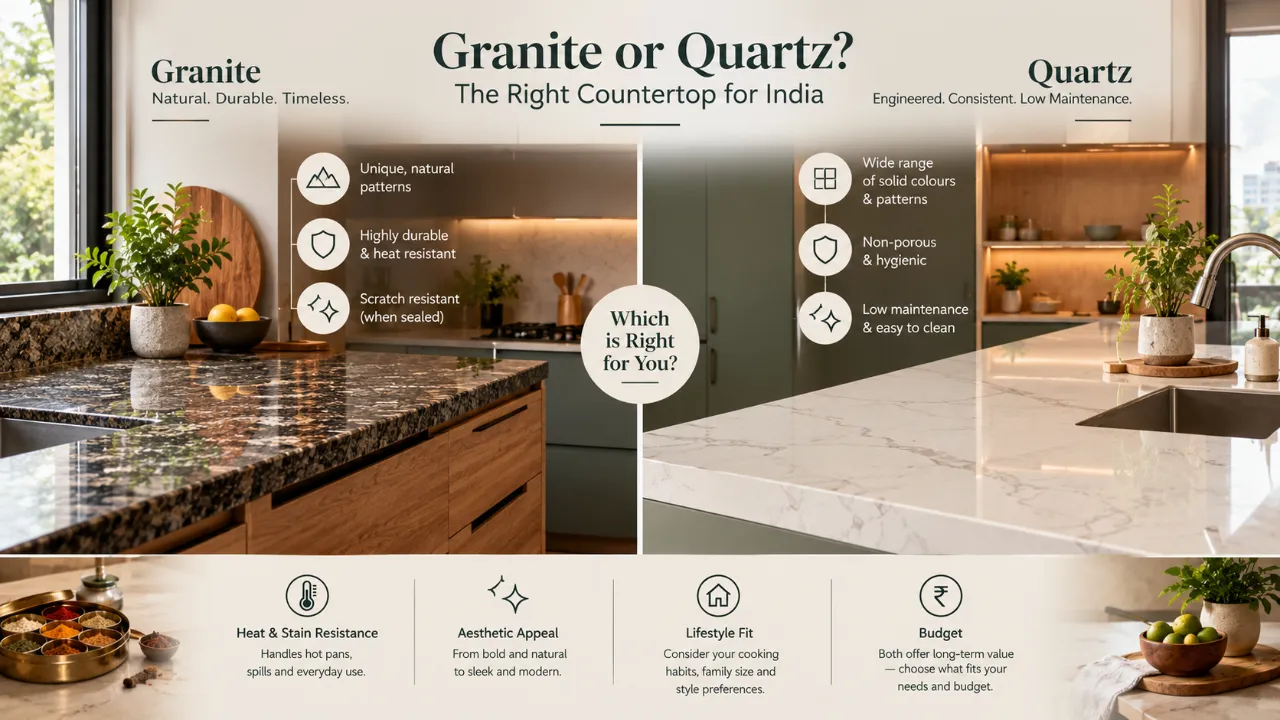
Granite or Quartz? The Right Countertop for India
The kitchen countertop is one of those decisions that looks simple until you actually have to make it.
Granite or quartz?
Both can look premium. Both can be durable. And both can work beautifully in an Indian kitchen.
But they are not the same material, and their differences become more important once the kitchen is used heavily.
Granite and Engineered Quartz Solve the Same Problem Differently
Granite is a natural stone. Its colour, veining and texture come from natural geological formation, so every slab can have variation.
Engineered quartz is manufactured to create a more controlled and consistent surface. Depending on the manufacturer, it can offer a wide range of colours and stone-inspired patterns with more predictable visual repetition.
Granite brings natural variation. Engineered quartz generally gives you more predictability.
Here, “quartz” means engineered quartz surfacing, not natural quartzite.
First Question: How Hard Is Your Kitchen Used?
Before comparing colours, think about your cooking habits.
For a busy Indian kitchen, consider whether you regularly use:
- Pressure cookers
- Tawas
- Karahis
- Heavy stainless-steel vessels
- Large serving pots
- Hot pans
- Oil-heavy cooking
- Spices and masalas
- Citrus, tomato and other acidic ingredients
- Small countertop appliances
The more intensive the kitchen use, the more important the countertop's heat behaviour, stain resistance, ease of cleaning and edge durability become.
Heat: This Is Where Granite Has an Important Advantage
Granite is highly heat resistant and is generally more tolerant of hot cookware than engineered quartz.
However, even granite should not be treated as indestructible. Trivets remain sensible practice for appliances that emit heat for prolonged periods.
If your habit is cook → lift hot pan → place it directly on the counter, you need to be especially careful with engineered quartz.
Stains: Quartz Has a Strong Practical Advantage
Engineered quartz is generally nonporous and nonabsorbent. That is one of its biggest everyday advantages.
Granite is also highly stain resistant, particularly when properly sealed, but natural stone porosity varies.
Some granite is denser than others, and some varieties may require more attention to sealing.
Maintenance: Quartz Is Simpler, Granite Is Still Manageable
Engineered quartz generally has a straightforward maintenance routine. Major manufacturers recommend routine cleaning with water and mild soap or approved cleaners, with no sealing required for their quartz surfaces.
Granite is also relatively low maintenance, but the routine depends on the particular stone and whether it should be sealed or resealed.
What About Oil and Masala?
A countertop may look beautiful in a sample showroom. Your kitchen has oil splashes, masala, turmeric, coffee, tea, tomato, moisture and frequent wiping.
Quartz's nonporous surface can be a practical advantage because it is less absorbent and does not require sealing.
Granite can also perform very well, particularly when the stone is appropriately sealed and maintained.
Scratches: Both Are Durable, But Neither Is Unbreakable
Granite is highly scratch resistant, and engineered quartz is also scratch resistant.
But quartz manufacturers note that quartz is not scratch-proof, and impacts near vulnerable edges can cause chips.
The same principle applies to granite.
This is particularly relevant around sink cut-outs, dishwasher areas, cooktop cut-outs, external corners and thin edge profiles.
Edge Detail Matters More Than People Think
A countertop is not just a flat surface. The edges matter.
A very sharp, thin edge may give a modern appearance but can be more vulnerable to impact than a more protected profile.
When discussing your countertop with the fabricator, ask to see the proposed edge profile.
Appearance: Granite Gives You Natural Variation
Granite is a natural material. Patterns can vary from slab to slab, sometimes significantly.
You may get stronger movement, natural mineral variation, unique veining and different grain patterns.
For large islands, inspect the actual slab rather than relying only on a small sample.
Engineered Quartz Gives You More Visual Predictability
Engineered quartz is manufactured, which gives manufacturers greater control over colour and pattern.
This can be useful when you want a clean minimal look, a uniform white surface, marble-inspired appearance or a controlled contemporary palette.
White Quartz vs White Granite
If you want a clean, controlled white surface, engineered quartz can offer predictable designs and stone-inspired patterns.
If you want natural movement and variation, granite offers a different visual character.
In either case, inspect the actual slab or exact product.
Quartz Can Look Like Marble, But It Is Still Quartz
Many engineered quartz products are designed to resemble marble or natural stone.
That gives you the visual language of veining with the manufacturing consistency of engineered surfacing.
But do not assume all quartz products behave identically. Different brands, formulations, finishes and product lines can have different care requirements.
What About Cost?
There is no universal rule that granite is always cheap or quartz is always expensive.
Pricing can change based on brand, slab selection, thickness, colour and pattern, finish, edge profile, cut-outs, installation, wastage, transportation, fabrication complexity and location.
Do Not Forget Fabrication
A countertop is not finished when the slab is chosen.
It needs to be measured, cut, finished, fabricated, joined where necessary, cut around sinks and cooktops, and installed.
Special features such as large islands, curved edges, waterfall sides, integrated grooves and complex edge treatments can affect the final cost.
Seams Matter
Large countertops should be discussed in terms of slab size and seam placement.
Ask where the seam will occur, how visible it will be, how the pattern will align and whether the slab can accommodate the required dimensions.
Indian Cooking Makes Counter Layout Important
The countertop material is only one part of kitchen functionality.
For a kitchen with frequent cooking, consider having enough continuous preparation space near the sink and cooking zone.
A beautiful countertop that is broken into tiny working areas may be less useful than a simpler material with better planning.
Granite Can Suit Heavy, High-Heat Kitchens
If your kitchen sees a lot of direct heat, heavy cookware and intensive cooking, granite's natural heat resistance can be an important advantage.
But you still need to consider the stone's porosity, sealing, colour, pattern, fabrication, maintenance and availability of the exact slab.
Quartz Can Suit Low-Maintenance Priorities
If your biggest priority is a surface that is nonporous, stain resistant and does not require sealing, engineered quartz has a strong practical case.
But you must be willing to follow the heat-care instructions and use trivets or hot pads rather than treating the countertop as a heat-proof landing surface.
Which One Works Better for a Busy Family Kitchen?
A busy family kitchen usually benefits from prioritising easy daily cleaning, good stain resistance, adequate preparation space, heat awareness, strong edge detailing and durability.
If low maintenance and nonporosity are especially important, engineered quartz has a strong case.
If high heat tolerance and natural-stone character are major priorities, granite offers meaningful advantages.
Which One Works Better for a Minimal Modern Kitchen?
If the design relies on large clean surfaces, minimal seams, consistent colour, subtle veining and integrated cabinetry, engineered quartz can fit this visual language particularly well.
That does not mean granite cannot look modern. A carefully selected granite slab can be equally contemporary.
Which One Works Better for a More Natural Interior?
Granite can work beautifully when the interior relies on natural materials, wood, stone, earthy colours, organic variation and layered textures.
Its natural variation can become part of the visual story.
Think About the Exact Slab, Not Just the Material Category
“Granite” is not one appearance. “Quartz” is not one appearance.
Two granite slabs can look completely different. Two quartz products can have different patterns, finishes and care instructions.
Before approving the material, inspect the exact slab or product specification.
- Product name
- Manufacturer
- Colour
- Finish
- Thickness
- Edge detail
- Fabrication method
- Care instructions
- Warranty terms where applicable
What If You Love Quartz but Cook Heavily?
You do not necessarily have to abandon quartz. You simply need to design your habits around the material.
- Use trivets.
- Use cutting boards.
- Avoid direct high heat.
- Avoid harsh chemicals.
- Follow the manufacturer's care guidance.
What If You Love Granite but Hate Maintenance?
Ask the fabricator about the specific stone.
Do not assume every granite has identical porosity or identical sealing needs. A good fabricator should be able to explain the care requirements of the exact slab you are buying.
A Practical Comparison
| Factor | Granite | Engineered Quartz |
|---|---|---|
| Material type | Natural stone | Manufactured engineered surface |
| Appearance | Natural variation | More controlled and consistent |
| Heat tolerance | Very high | Good, but direct high heat should be avoided |
| Stain resistance | High when appropriately treated | Very high due to nonporous surface |
| Sealing | May be required depending on stone | Generally not required |
| Daily cleaning | Relatively simple | Relatively simple |
| Scratch resistance | High | High |
| Edge vulnerability | Can chip at vulnerable areas | Can chip at vulnerable areas |
| Design flexibility | Natural slab variation | Broad manufactured colour and pattern range |
| Maintenance | Low, but stone-specific | Generally lower |
| Cost | Highly variable | Highly variable |
| Key advantage | Natural character and heat tolerance | Consistency and low-maintenance surface |
This is a practical comparison, not a universal performance guarantee. Exact properties depend on the particular granite, quartz product, finish, fabrication and installation.
A Better Decision Framework
Heat Tolerance
Look closely at granite if direct heat tolerance is a major priority.
Low Maintenance
Look closely at engineered quartz if nonporosity, stain resistance and avoiding sealing are major priorities.
Natural Variation
Granite offers the natural movement and individuality of a real stone slab.
Visual Consistency
Engineered quartz provides more controlled manufactured patterns and colour.
Five Questions to Ask Your Fabricator
1. What is the exact material and product name?
2. Does this specific surface require sealing?
3. What does the manufacturer say about direct heat?
4. How will the seams and edges be fabricated?
5. What care and warranty instructions come with the product?
Do Not Make the Countertop Decision at the End
The countertop affects cabinet colour, backsplash, hardware, sink selection, cooktop relationship, lighting, island proportions and the overall kitchen palette.
Choose it early enough for the rest of the kitchen to respond to it.
Caesarstone — Quartz Care & Heat Guidance
Cambria — Quartz Product Care
Cosentino — Silestone Maintenance
Use Natural Stone — Granite vs Quartz Surfacing
Use Natural Stone — Caring for Granite
Use Natural Stone — Pros & Cons of Granite
Plan the Kitchen Around How You Cook
The right countertop is only one part of a well-planned kitchen. Explore room ideas, estimate your project cost and find interior professionals through Walls to Wonder.
Explore Design My Room, estimate your Interior Design Cost, or explore Interior Designers.
The Final Takeaway
Granite and engineered quartz can both be excellent kitchen countertop materials.
Granite brings natural variation, strong heat tolerance and the character of real stone. Engineered quartz brings a highly nonporous surface, strong stain resistance, visual consistency and a generally simpler maintenance routine.
But neither material should be selected from a sample name alone.
For an Indian kitchen, think about how you actually cook: how much heat reaches the counter, how often you clean it, how much oil and masala gets around the work surface, whether you want natural variation or visual consistency, whether you are comfortable using trivets and whether you want to manage sealing.
It is the one whose performance, maintenance and appearance fit the kitchen you are actually going to use.
Frequently Asked Questions
Both can work well. Granite has an important advantage in high-heat tolerance, while engineered quartz offers a nonporous surface, strong stain resistance and generally simpler maintenance.
Major engineered-quartz manufacturers recommend using a trivet or hot pad rather than placing very hot cookware directly on the surface.
It depends on the specific granite. Some stones are denser than others, so ask the stone supplier or fabricator about the exact slab and its recommended sealing schedule.
Engineered quartz generally has a simpler routine because its nonporous surface does not require sealing. Granite is also relatively low maintenance when appropriately selected, sealed and cared for.
Granite has naturally occurring variation from slab to slab. Engineered quartz is manufactured for greater control and consistency in colour and pattern.
No. Engineered quartz is a manufactured surface containing natural quartz and other components. Quartzite is a different natural stone with different properties and care requirements.
Not by itself. Compare the complete installed cost, including slab selection, thickness, fabrication, edge details, cut-outs, wastage, transportation and installation.
Turn this idea into a plan for your home
Visualise your space, understand the likely budget, or find a professional who can bring the idea to life.