
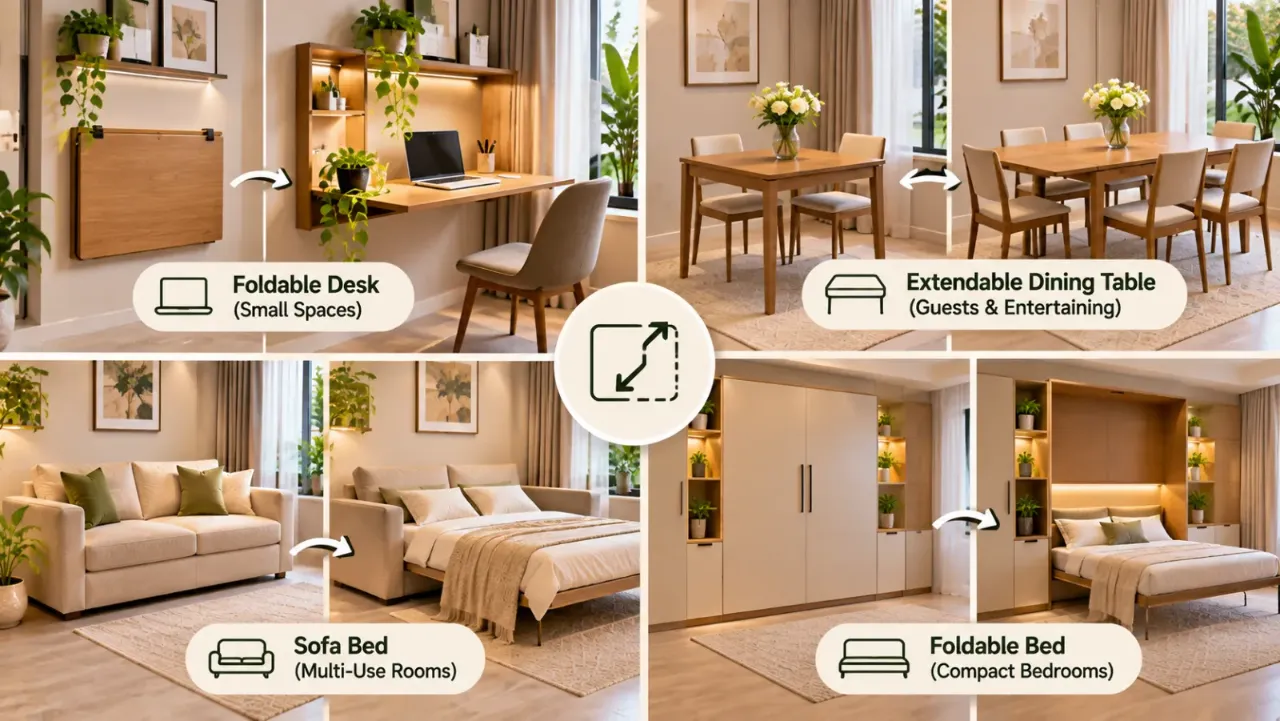
Foldable and Extendable Furniture: Where It Works Best
Furniture does not always need to occupy the same amount of space throughout the day. A dining table may need to seat six people during a family gathering but only two people for everyday meals. A study desk may be useful during working hours and unnecessary once the workday ends. A spare room may need to function as a bedroom, workspace and occasional guest room.
This is where foldable and extendable furniture can make a difference.
These designs allow furniture to change its size, position or function according to the situation. They can help make compact homes more flexible, reduce unused floor space and support rooms that serve multiple purposes.
However, a folding mechanism does not automatically make a piece of furniture practical. Stability, ease of operation, storage space, durability and everyday comfort all matter.
Quick answer: Foldable and extendable furniture works best in rooms where space requirements change regularly. Consider extendable dining tables for occasional guests, fold-down desks for compact work areas, folding tables for flexible activities and wall beds for rooms that need to serve more than one purpose. Choose designs with reliable mechanisms, suitable dimensions and enough clearance for safe operation.
1. Understand the Difference Between Foldable and Extendable Furniture
Although both types help save space, they work differently.
Foldable furniture reduces its footprint by folding one or more parts of the product. A wall-mounted desk, folding chair or drop-leaf table can be closed or tucked away when not in use.
Extendable furniture increases its usable size when required. An extendable dining table, for example, can have additional leaves or sliding sections that create more seating space.
Convertible furniture can go a step further by changing its function. A sofa bed, wall bed or storage ottoman may serve more than one purpose.
| Furniture Type | How It Works | Common Examples |
|---|---|---|
| Foldable | Parts fold away to reduce the footprint | Folding chairs, wall desks, folding tables |
| Extendable | Sections expand to increase usable size | Dining tables, console tables, extendable desks |
| Convertible | Changes from one function to another | Sofa beds, wall beds, storage seating |
| Nesting | Smaller pieces fit inside or beneath larger ones | Nesting tables, nesting stools |
The right choice depends on whether you need to reduce the furniture's footprint, increase its capacity or use one item for different activities.
2. Extendable Dining Tables for Flexible Dining Areas
An extendable dining table is one of the most useful options for homes where the number of people using the dining area changes.
A compact table can serve everyday meals, while an extension leaf creates additional seating for family gatherings or guests.
Where it works best:
- Small dining areas where a large permanent table would feel crowded.
- Open-plan living and dining rooms.
- Homes that regularly host guests.
- Dining corners that need to remain easy to move around.
What to check before buying:
- Closed and fully extended dimensions.
- Extension mechanism and locking system.
- Whether the extension leaf is stored inside the table or separately.
- Leg placement and stability when extended.
- Number of chairs that can fit comfortably.
- Clearance around the table in both configurations.
An extendable table should feel stable in both its compact and expanded forms. Check how the extension operates and whether one person can manage it comfortably.
3. Fold-Down Desks for Compact Workspaces
A permanent desk can occupy valuable floor space, especially in a bedroom, passage-side nook or compact apartment.
A wall-mounted fold-down desk creates a work surface when needed and folds away after use. Some designs include shelves, concealed storage and cable openings.
Where it works best:
- Bedrooms without a separate study area.
- Compact apartments.
- Occasional work-from-home spaces.
- Study corners used for limited hours.
- Multi-use guest rooms.
What to check before buying:
- Desk height and usable depth.
- Wall type and suitable fixing method.
- Weight capacity of the brackets and mechanism.
- Space required to fold the desk down.
- Legroom and chair position.
- Cable access and nearby electrical points.
- Whether the folded unit blocks switches, doors or circulation.
A fold-down desk should be securely fixed to a suitable wall. The fixing system must match the wall construction and the manufacturer's load requirements. A decorative cabinet-style appearance should not take priority over safe support.
4. Folding Tables for Flexible Everyday Activities
Folding tables are useful when a home needs an occasional surface without dedicating a permanent area to it.
They can support activities such as studying, crafts, temporary dining, hobbies or additional serving space.
Where they work best:
- Multipurpose rooms.
- Balconies or utility areas, where the product is suitable for the environment.
- Temporary work or study areas.
- Homes that need occasional additional dining space.
- Activity corners that are cleared after use.
What to check before buying:
- Tabletop dimensions and height.
- Leg-locking mechanism.
- Stability on the intended floor.
- Folded thickness and storage location.
- Weight capacity.
- Ease of carrying and opening.
- Resistance to moisture if used in a utility or semi-outdoor area.
A folding table should not wobble when opened. Check the locking points and make sure the legs cannot collapse accidentally during normal use.
5. Wall Beds and Fold-Down Beds for Multi-Use Rooms
A wall bed, often called a Murphy bed, folds vertically or horizontally into a cabinet when not in use.
It can help a room function as a workspace, hobby room or sitting area during the day and a sleeping area when required.
Where it works best:
- Guest rooms that are not used as bedrooms every day.
- Studio apartments.
- Rooms shared between work and sleeping.
- Compact homes with limited dedicated bedroom space.
What to check before buying:
- Open and closed dimensions.
- Ceiling height and wall width.
- Mattress compatibility.
- Mechanism quality and safety locks.
- Wall and floor fixing requirements.
- Space for bedside access and movement.
- Professional installation and maintenance requirements.
Wall beds involve more substantial hardware and installation than an ordinary folding table. Use a suitable system designed for the intended mattress and installation conditions. Do not improvise the mounting or counterbalance mechanism.
6. Folding Chairs and Stackable Seating for Extra Guests
Extra seating is useful during gatherings, but keeping several chairs around all the time can make a small home feel crowded.
Folding chairs can be stored in a cupboard, utility area or designated storage corner when not required.
Stackable chairs offer another option: they do not fold, but their shape allows multiple chairs to occupy a smaller storage footprint.
Where they work best:
- Dining areas that occasionally need extra seats.
- Balconies and covered outdoor spaces, with suitable materials.
- Home offices that sometimes host visitors.
- Compact living rooms.
- Flexible family or activity rooms.
What to check before buying:
- Seat width and height.
- Back support and sitting comfort.
- Frame strength and weight capacity.
- Locking mechanism, if foldable.
- Floor protection on chair legs.
- Folded or stacked storage dimensions.
A chair that is easy to store but uncomfortable to sit on may not be useful during a long gathering. Test comfort as well as convenience.
7. Extendable Consoles and Tables for Changing Needs
Some extendable tables are designed to serve more than one role. A compact console can become a larger table when opened, making it useful in homes where a permanent dining table is not practical.
Depending on the design, it may serve as an entry console, occasional work surface or dining table.
Where it works best:
- Studio apartments.
- Compact living-dining spaces.
- Homes with limited dining requirements.
- Rooms that need occasional extra tabletop space.
What to check before buying:
- Fully extended length and width.
- Number of extension sections.
- Support provided to the extended tabletop.
- Storage requirements for removable leaves.
- Ease of opening and closing.
- Stability under the intended load.
Do not assume every console-to-dining design is suitable for daily dining. Check the manufacturer's intended use and load rating.
8. Choose the Right Furniture for the Room
Not every foldable or extendable product belongs in every room. The most useful choice is the one that solves a real space problem without creating inconvenience.
| Room | Suitable Furniture | Main Benefit |
|---|---|---|
| Living room | Nesting tables, folding stools, convertible seating | Flexible seating and surface space |
| Dining area | Extendable dining table, folding chairs | Extra capacity when required |
| Bedroom | Wall bed, fold-down desk, storage bed | More usable floor area |
| Study area | Wall-mounted desk, folding chair | Workspace that can be tucked away |
| Guest room | Wall bed, foldable luggage stand | Room can serve other purposes |
| Balcony or utility area | Folding table and chairs | Temporary surface without permanent occupation |
Consider how frequently the furniture will be opened and closed. A mechanism used several times every day needs to be easy to operate and durable enough for regular use.
9. Check the Mechanism Before You Buy
The mechanism is what makes foldable and extendable furniture useful. It is also one of the most important parts to inspect.
- Hinges: They should move smoothly without excessive looseness.
- Locks: Folding legs and extension sections should remain securely in position.
- Sliders: Extendable sections should move evenly without catching.
- Support: Open furniture should have adequate support for its intended load.
- Hardware: Ask about the material, finish, replacement availability and warranty.
- Operation: Check whether opening and closing require one person or two.
- Maintenance: Understand whether the mechanism needs periodic adjustment or lubrication.
If possible, watch a demonstration of the exact product model rather than relying on a photograph.
For wall-mounted or heavy convertible furniture, confirm installation requirements and load limits with the seller or manufacturer.
10. Understand the Trade-Offs Before Choosing
Foldable and extendable furniture can save space, but it is not automatically better than conventional furniture.
| Factor | Potential Advantage | Possible Trade-Off |
|---|---|---|
| Space | Reduces the footprint when closed | Needs storage or operating clearance |
| Flexibility | Supports changing room uses | May need repeated setup |
| Convenience | Can provide extra capacity | Mechanisms may take effort to operate |
| Appearance | Can keep rooms visually uncluttered | Hardware or joints may be visible |
| Cost | One item can serve multiple needs | Mechanisms and installation may increase cost |
| Durability | Useful for long-term flexible layouts | Moving parts need appropriate care |
For furniture used every day, comfort and ease of operation should be priorities. A conventional table or desk may be a better choice if it is used continuously and there is enough room for it.
11. Common Mistakes to Avoid
- Buying foldable furniture without planning where it will be stored.
- Checking only the closed dimensions and ignoring the open footprint.
- Choosing a mechanism that is difficult to operate.
- Ignoring the furniture's weight capacity.
- Buying an extendable table without checking stability at full extension.
- Selecting a wall-mounted desk without checking the wall and fixing system.
- Forgetting chair movement and walking clearance.
- Assuming every convertible bed is suitable for everyday sleeping.
- Choosing a product only because it looks compact in photographs.
- Ignoring replacement parts, warranty and after-sales support.
12. Homeowner Checklist Before Buying
Space and Dimensions
- Closed dimensions recorded
- Fully open or extended dimensions recorded
- Operating clearance checked
- Storage space identified
- Doorways and walking routes checked
Mechanism and Safety
- Hinges and sliders inspected
- Locking system checked
- Weight capacity confirmed
- Wall fixing requirements understood
- Opening and closing operation tested
Everyday Use
- Comfort and ergonomics considered
- Frequency of use considered
- Setup effort is manageable
- Furniture suits the room's purpose
- Maintenance and replacement support checked
Purchase Details
- Material and finish reviewed
- Assembly and installation confirmed
- Warranty terms checked
- Return policy reviewed
A Final Thought
Foldable and extendable furniture is most useful when it responds to a genuine change in how a room is used. An extendable dining table can accommodate guests without occupying the same space every day. A fold-down desk can create a workspace without permanently taking over a bedroom. A wall bed can make an occasional guest room more useful throughout the year.
The best choice is not necessarily the most complicated convertible design. It is the one that operates smoothly, feels comfortable, fits the room in every position and is practical enough to use regularly.
Before buying, think about the space it saves, the effort it requires and how often you will actually use its folding or extension feature.
Frequently Asked Questions
1. Is foldable furniture suitable for everyday use?
Yes, if it is designed for frequent operation, has a suitable load capacity and uses reliable hardware. Check comfort and ease of opening and closing before choosing it for daily use.
2. What is the difference between foldable and extendable furniture?
Foldable furniture reduces its footprint by folding away parts of the product. Extendable furniture increases its usable size by adding or sliding out sections.
3. Which extendable furniture is best for small homes?
Extendable dining tables are useful when seating requirements change. Extendable consoles and desks can also work where a permanent large surface is not needed.
4. Are wall-mounted fold-down desks practical?
They can be practical for occasional or regular work in compact rooms, provided the desk has adequate depth, comfortable working height, secure wall fixing and suitable cable access.
5. What should I check before buying a foldable table?
Check the tabletop size, open and folded dimensions, leg-locking system, stability, weight capacity and storage location.
6. Are wall beds suitable for everyday sleeping?
Some wall beds are designed for regular use, but suitability depends on the product, mattress support, mechanism, installation and manufacturer's specifications. Check these details before buying.
7. Does foldable furniture always save money?
No. Some folding and convertible designs cost more because of specialised hardware and installation. Compare the total cost with a conventional piece of furniture and consider how often the additional function will be used.
8. How do I maintain foldable and extendable furniture?
Keep moving parts clean, follow the manufacturer's maintenance instructions, check hinges and locking points periodically, and avoid exceeding the stated load capacity.
Plan Your Home Interiors with Walls to Wonder
Explore ideas, visualise different layouts and plan your home interiors with the Walls to Wonder AI tools.
- Whole Home Visualizer – Explore design ideas for your entire home.
- Design My Room – Experiment with different room styles and layouts.
- Interior Design Cost Estimate – Get an indicative estimate for your interior project.
- Interior Quotation Checker – Review and understand your interior quotation.
- Rate My Room Design – Get feedback on your room design.
- Interior Style Finder – Discover an interior style that suits your preferences.
Explore more ideas and tools at Walls to Wonder.
Turn this idea into a plan for your home
Visualise your space, understand the likely budget, or find a professional who can bring the idea to life.