
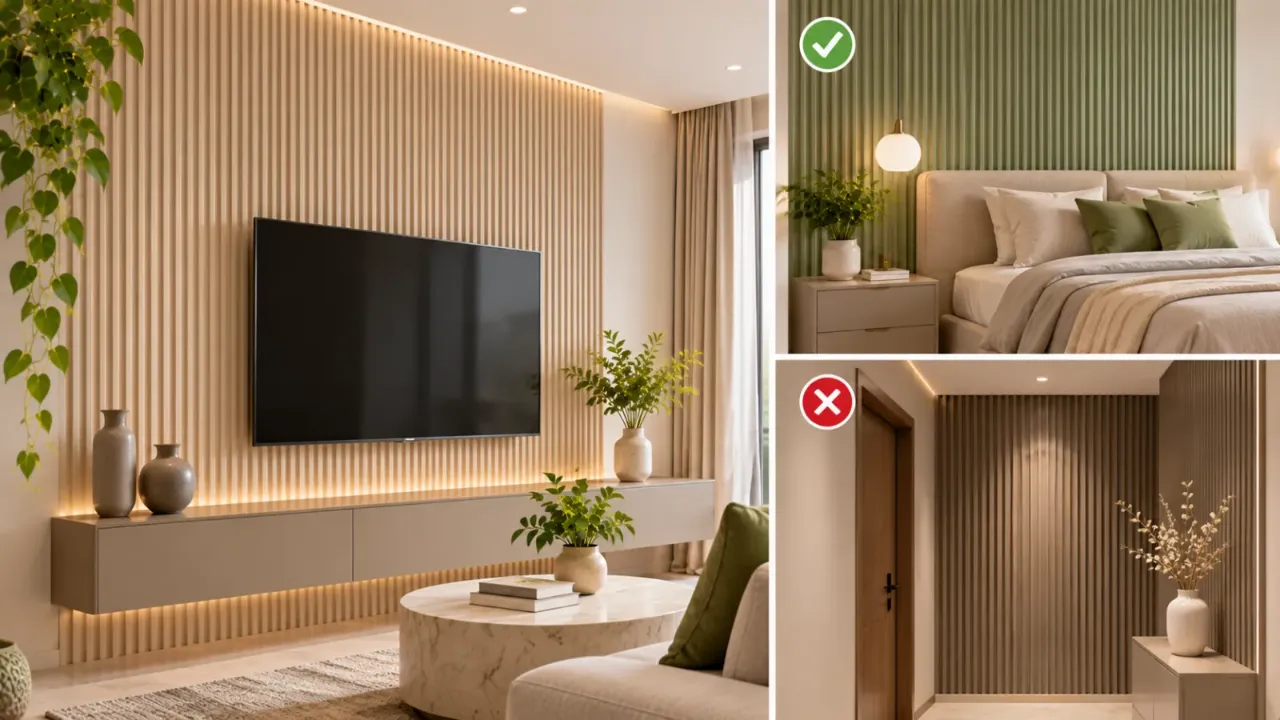
Fluted Panels in Interiors: Where They Work and Where They Do Not
Fluted panels have become a familiar feature in contemporary interiors. Their repeated vertical grooves create depth, add texture and make a plain wall feel more detailed without relying on elaborate decoration. They are used behind televisions, around entrance consoles, on bedroom walls, in dining areas and even on furniture.
However, a finish that looks attractive in a photograph may not be equally practical in everyday use. Fluted surfaces can collect dust, require more careful cleaning and become visually overwhelming when used across large areas. Their performance also depends on the material, installation method and conditions of the room.
The important question is not simply whether fluted panels look good. It is whether the selected wall, room and material are suitable for them.
1. What Makes Fluted Panels Different?
Fluted panels have a repeated pattern of raised and recessed lines. Depending on their profile, these grooves may be narrow, wide, rounded, deep or shallow.
They are available in different materials, including:
- MDF and engineered wood panels: Commonly used for decorative indoor wall treatments. Their suitability depends on moisture resistance, surface finish and installation details.
- Solid wood: Offers natural grain and variation, but requires attention to movement, finishing and maintenance.
- Wood-look laminates and decorative boards: Provide a consistent appearance and may be easier to coordinate with furniture.
- PVC and polymer panels: Can be lightweight and moisture-tolerant, depending on the product specification and installation system.
- Metal and other decorative materials: Used for selected architectural or furniture details.
The profile itself also affects the result. Deep, closely spaced grooves create a stronger pattern and more shadow, while shallow fluting gives a subtler appearance.
2. Where Fluted Panels Work Well
Fluted panels are most effective when they have a clear purpose. They can highlight a particular area, add texture to a large plain surface or help visually organise an open-plan space.
Living Room TV Wall
A TV wall is one of the more suitable locations for fluted panelling. It creates a defined backdrop and can make the television area feel integrated with the rest of the living room.
A practical approach is to use fluted panels behind or beside the television rather than covering the entire wall. The TV mounting arrangement, cable access, ventilation and placement of electrical points should be planned before installation.
Works well when:
- The panel forms a defined feature rather than competing with multiple finishes.
- The grooves are not excessively deep or difficult to clean.
- The television and other wall-mounted equipment can be securely fixed.
- There is access to wiring and service points.
Entrance and Foyer Walls
A fluted panel can give an entrance wall more character, particularly when there is no separate foyer. It can visually distinguish the entrance from the living area and provide a backdrop for a console, mirror or lighting.
It works best on a selected section of the wall. If the entrance is narrow, a very dark finish or deep profile may make the space feel more enclosed.
Works well when:
- The panel defines the entrance without obstructing movement.
- It coordinates with the main door, console and flooring.
- The finish can handle the amount of contact and dust expected in the entrance.
Bedroom Headboard Wall
Fluted panels can create a structured backdrop behind a bed. They can be combined with an upholstered headboard, bedside lighting or a simple painted wall.
However, the panel should not be selected only for its decorative appearance. Check the bed's final position, bedside clearances, switchboards, reading lights and cleaning access.
Works well when:
- The panel is limited to the bed-back area.
- The profile is comfortable to maintain.
- Lighting and electrical fittings are planned around the panel.
- The material and finish are suitable for the bedroom environment.
Dining Area
A dining wall can benefit from the vertical rhythm of fluted panels, especially in an open-plan home where the dining area needs its own visual identity.
Use the panels behind a dining table, sideboard or a carefully selected decorative feature. Avoid placing a delicate or difficult-to-clean finish where chairs regularly rub against it.
Works well when:
- There is sufficient space around the dining furniture.
- The panel is protected from frequent knocks and spills.
- The texture complements rather than competes with other decorative elements.
Room Dividers and Furniture Details
Fluted detailing can also be used on partial partitions, cabinet fronts, kitchen islands and furniture surfaces. These applications can introduce texture without requiring an entire wall treatment.
For partitions, check stability, fixing and whether the design blocks light or interrupts circulation. For furniture, consider how frequently the surface will be touched and cleaned.
3. Where Fluted Panels May Not Work Well
A fluted finish is not automatically suitable for every room. Some locations create practical challenges that should be considered before choosing the material.
Narrow Corridors and Compact Spaces
Deep grooves and dark finishes can make a narrow passage feel visually busy. A long wall covered in strong vertical lines may also draw attention to the corridor's limited width.
If you want to introduce texture, consider a smaller section, a lighter finish or a shallower profile. In a compact passage, a simple painted wall may be more effective.
High-Dust Areas
The recessed grooves in fluted panels can trap dust, particularly when the profile is deep and closely spaced. This can make regular cleaning more time-consuming than on a smooth wall.
Avoid complicated profiles in areas where dust accumulation is likely and cleaning access is limited. A shallow design with a suitable finish is usually easier to maintain.
Areas Exposed to Water and Persistent Moisture
Standard MDF or untreated wood panels should not be assumed suitable for bathrooms, wet zones or walls exposed to regular splashing.
Moisture can affect the panel, its backing, adhesive and joints. Even when a decorative surface appears intact, water may reach vulnerable edges or the substrate.
If you want fluted detailing in a bathroom, select a product specifically rated for the intended exposure. Follow its installation instructions and keep it away from direct water contact unless the complete system is approved for that use.
Areas Close to Cooking Heat and Grease
Fluted panels near a hob can collect cooking residue and grease. Deep grooves make cleaning more difficult, while some decorative materials may not be suitable for heat exposure.
For kitchen applications, use a surface that is explicitly rated for the location. Avoid placing ordinary decorative wood or MDF fluting directly behind a hob simply because it matches the cabinetry.
Walls Already Carrying Multiple Design Elements
If a room already has textured paint, patterned wallpaper, decorative lighting, stone cladding and detailed furniture, adding fluted panelling may create visual competition.
The panel should have a clear role. If the wall already attracts enough attention, a simpler finish may produce a more balanced appearance.
4. Fluted Panels by Room: A Practical Comparison
| Location | Suitability | What to Consider |
|---|---|---|
| Living room TV wall | Good | Cable access, ventilation and cleaning |
| Entrance wall | Good | Width, contact and dust |
| Bedroom headboard | Good | Lighting, switches and profile depth |
| Dining feature wall | Good | Chair movement, spills and knocks |
| Open-plan divider | Conditional | Stability, light and circulation |
| Narrow corridor | Limited | Visual weight and cleaning |
| Bathroom wet zone | Usually unsuitable for ordinary panels | Moisture-rated product and installation |
| Behind a hob | Usually unsuitable for ordinary decorative panels | Heat, grease and cleaning |
| Full-room panelling | Conditional | Proportion, cost and visual repetition |
The suitability of any location depends on the actual product and its installation system. A panel designed for dry indoor walls should not be treated as interchangeable with one rated for humid or high-temperature environments.
5. How Panel Profile and Colour Change the Result
Not all fluted panels create the same visual effect.
- Shallow fluting: A restrained choice for smaller rooms and subtle feature walls. It adds texture without making the grooves dominate the space.
- Deep fluting: Creates stronger shadows and a more pronounced architectural appearance. It is better suited to selected areas where cleaning access is manageable.
- Narrow, closely spaced grooves: Produce a detailed and rhythmic surface, but can make dust removal more demanding.
- Wide grooves: Create a bolder, simpler pattern and may be easier to wipe, depending on the finish and profile.
Colour matters too. Light shades can keep a panel visually subtle, while dark colours create stronger contrast and make the texture more prominent. Check the sample under the room's actual lighting before finalising it.
6. Choosing the Right Material
The appearance of a fluted panel is only one part of the decision. Its core material, surface finish and installation system affect how it performs.
Before selecting a product, check:
- Whether it is intended for interior or exterior use.
- Whether it is suitable for the room's moisture and temperature conditions.
- Whether the substrate is appropriate for the intended application.
- How the panel edges and joints will be finished.
- Which adhesive or mechanical fixing system is specified.
- Whether damaged sections can be repaired or replaced.
- What cleaning products and methods the manufacturer recommends.
For wood-based panels, pay particular attention to moisture exposure and edge protection. For polymer or decorative products, check heat limitations and the manufacturer's cleaning instructions.
7. Maintenance: What Homeowners Should Expect
Fluted panels generally need more attention than smooth surfaces because their grooves create additional areas where dust can settle.
A practical maintenance routine includes:
- Remove loose dust regularly using a soft brush or suitable vacuum attachment.
- Follow the manufacturer's instructions for wiping the surface.
- Avoid soaking the grooves or allowing water to collect around joints.
- Do not use abrasive pads or strong cleaning chemicals unless the product permits them.
- Check edges, joints and corners periodically for damage or separation.
The cleaning method should match the panel material. A routine suitable for sealed laminate may not be suitable for unfinished wood or a painted decorative surface.
8. Common Mistakes to Avoid
| Mistake | Why It Can Be a Problem |
|---|---|
| Covering every wall | Makes the room visually crowded and increases cost. |
| Choosing deep grooves everywhere | Adds cleaning effort. |
| Using ordinary MDF in damp areas | Can lead to swelling or damage. |
| Ignoring heat exposure | May affect the panel or adhesive. |
| Selecting only by appearance | Overlooks material suitability. |
| Skipping sample checks | The final profile and colour may look different at full scale. |
| Ignoring electrical planning | Can make switches, cables and fittings difficult to access. |
| Poor edge finishing | Leaves vulnerable joints and an untidy appearance. |
9. A Checklist Before Installing Fluted Panels
Before approving the design, check the following:
- Is there a clear reason for adding fluted panels to this wall?
- Is the wall large enough to accommodate the pattern?
- Will the grooves be easy to clean?
- Is the material suitable for the room's conditions?
- Are moisture and heat exposure within the product's limits?
- Have electrical points, lights and wall-mounted fittings been planned?
- Are the panel edges, joints and corners properly detailed?
- Have you checked a full-size or representative sample?
- Does the panel work with the room's other finishes?
- Is the installation and maintenance cost within budget?
Explore your interior design ideas
Use Design My Room to explore wall treatments and room concepts, or try the Whole Home Visualizer to coordinate finishes across your home.
Final Thought
Fluted panels can add depth and structure to a home, but their success depends on where and how they are used. A carefully selected TV wall, entrance feature or bedroom headboard can benefit from the texture, while a damp wall, greasy cooking zone or narrow corridor may be better served by a simpler finish.
Instead of using fluted panels simply because they are popular, evaluate the room, the wall condition, the material and the maintenance involved. A selective application often creates a more balanced and practical interior than covering every available surface.
Plan Your Home Interiors with Walls to Wonder
Explore design ideas, compare materials and plan your interiors with the Walls to Wonder AI tools.
- Whole Home Visualizer – Explore coordinated design ideas for your home.
- Design My Room – Visualise different room styles and finishes.
- Interior Design Cost Estimate – Get an initial estimate for your interior project.
- Interior Quotation Checker – Review and understand an interior quotation.
- Rate My Room Design – Get feedback on your room design.
- Interior Style Finder – Discover an interior style that suits your preferences.
Visit Walls to Wonder to explore more interior design ideas and tools.
Frequently Asked Questions
1. Are fluted panels suitable for small rooms?
Yes, but the profile and coverage matter. Shallow grooves, lighter colours and limited applications can add texture without overwhelming a compact room.
2. Do fluted panels collect dust?
Yes. Their recessed grooves can collect dust, particularly when they are deep or closely spaced. Regular dusting is important.
3. Can fluted panels be used in bathrooms?
Only products specifically suitable for the intended moisture exposure should be considered. Ordinary MDF and wood-based decorative panels should not be used in wet areas without appropriate product approval and installation protection.
4. Are fluted panels suitable for kitchen walls?
They can work on selected dry, low-heat areas if the material is suitable. Areas behind hobs or exposed to grease and frequent splashing need more careful product selection.
5. Are fluted panels better than plain wall panels?
Neither is universally better. Fluted panels create texture and shadow, while plain panels offer a simpler appearance and are often easier to clean.
6. Can fluted panels be used on ceilings?
Some lightweight systems are designed for ceiling applications. Check the manufacturer's approval, fixing method, weight and installation requirements before using them overhead.
7. Are fluted panels expensive to maintain?
Maintenance costs depend on the material, finish, panel profile and cleaning requirements. Deep grooves may require more time to clean than smooth surfaces.
8. Should fluted panels cover an entire wall?
They can, if the wall and room proportions support the treatment. In many homes, a partial feature section gives a more balanced result and reduces material and installation costs.
Turn this idea into a plan for your home
Visualise your space, understand the likely budget, or find a professional who can bring the idea to life.