
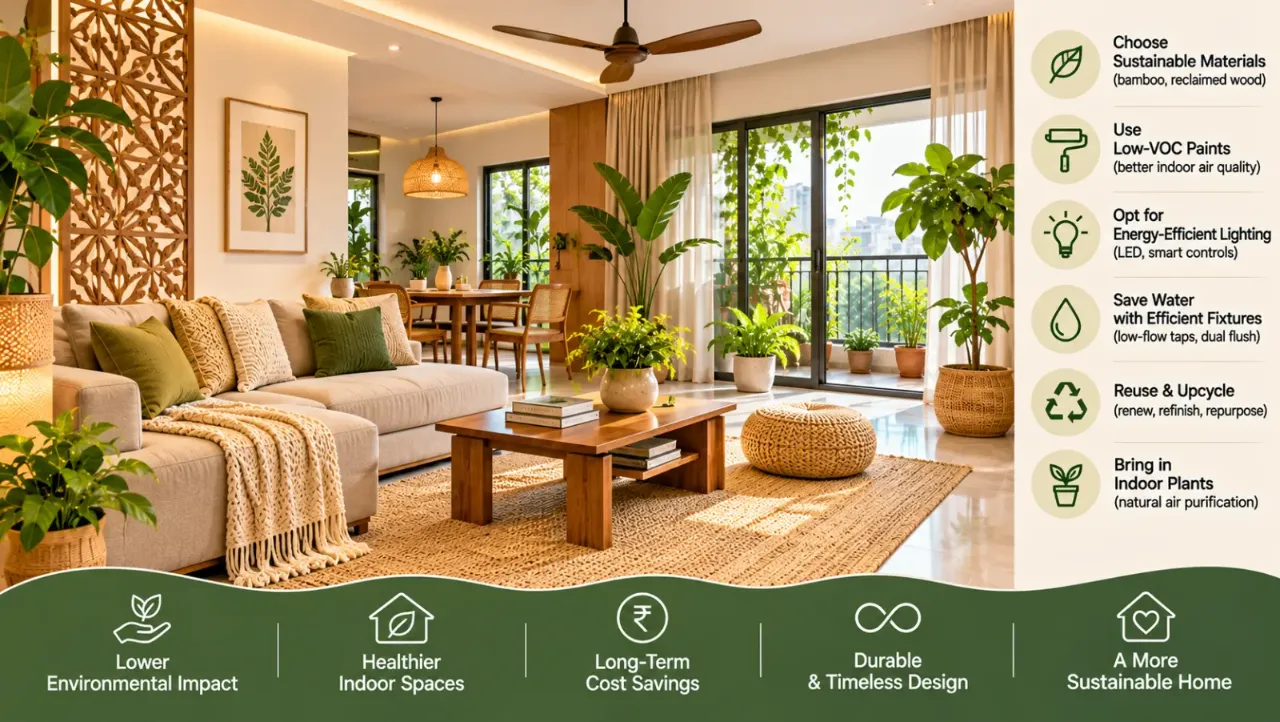
Eco-Friendly Interior Design Ideas for Indian Homes
Sustainable interior design is often associated with recycled furniture, indoor plants and natural-looking materials. While these elements can contribute to a more responsible home, sustainability involves much more than appearance.
A home becomes more sustainable when its materials last longer, its resources are used thoughtfully, unnecessary replacements are avoided and everyday spaces are designed around actual needs.
For Indian homes, these decisions also need to account for local climate, family routines, dust, humidity, water use, maintenance and budget. A material that performs well in a dry region may not be the right choice for a humid coastal home. Similarly, an expensive natural finish is not automatically more sustainable if it requires frequent replacement or intensive maintenance.
The objective is to create interiors that remain comfortable, functional and visually appealing over time, while reducing avoidable waste and resource consumption.
Here are practical ways to approach sustainable interior design when planning or renovating an Indian home.
1. Understand What Makes an Interior Sustainable
Sustainable interior design considers the environmental impact of a space across its useful life, rather than focusing on one product or decorative feature.
This includes the resources used to manufacture materials, their transportation, installation, maintenance, expected lifespan and eventual disposal or reuse.
A sustainable home interior generally considers:
- Durability: Choosing products and finishes that can withstand everyday use.
- Repairability: Selecting furniture, fittings and materials that can be maintained or repaired instead of immediately replaced.
- Responsible sourcing: Considering where materials come from and how they are manufactured.
- Indoor air quality: Paying attention to emissions from paints, adhesives, coatings and composite products.
- Energy efficiency: Making better use of daylight, ventilation, shading and efficient lighting.
- Water efficiency: Selecting suitable fixtures and planning for responsible water use.
- Waste reduction: Avoiding unnecessary demolition, over-ordering and short-lived design choices.
No single product makes an entire home sustainable. The overall impact comes from how different decisions work together.
2. Choose Materials Based on Durability, Not Just Appearance
Material selection is one of the most important parts of sustainable interior design.
A material may look natural or environmentally friendly, but its real suitability depends on its source, manufacturing process, durability, maintenance requirements and intended use.
Before selecting a material, ask:
- How long is it expected to last in this application?
- Can it be cleaned and maintained easily?
- Can damaged sections be repaired or replaced?
- Is it suitable for the local climate and moisture conditions?
- Is information available about its composition and manufacturing?
- Can it be reused or recycled at the end of its useful life?
Materials worth considering
Solid wood and responsibly sourced timber
Wood can be used for furniture, doors, shelving and selected wall treatments. Consider the source, finish, moisture protection and maintenance requirements. Certified sourcing may provide additional assurance where credible certification is available.
Bamboo
Bamboo can be used in selected furniture, screens, panels and decorative applications. Its suitability depends on the product's processing, adhesives, finish and construction quality.
Reclaimed wood
Reclaimed timber can give old material a new purpose in furniture, shelving, doors and decorative features. Check its condition, treatment, structural suitability and whether it has been properly cleaned and prepared.
Natural stone
Stone can be durable in suitable applications, including flooring, countertops and selected wall surfaces. However, extraction, transportation, finishing and installation also affect its overall environmental impact.
Recycled and recycled-content materials
Some tiles, panels, fabrics and surfaces incorporate recycled content. Ask manufacturers for details about the percentage, source and product performance rather than relying only on a general eco-friendly label.
Cork and natural fibres
Cork, jute and other natural fibres can be considered for selected flooring, accessories, rugs and soft furnishings. Their performance depends on the product, backing, treatment and exposure to moisture.
The best material is not necessarily the most expensive or the most natural-looking. It is the one that performs well in the location where it will be used and does not need premature replacement.
3. Select Low-Emission Paints, Adhesives and Finishes
Indoor air quality is an important part of a healthy home. Paints, adhesives, sealants, coatings and some composite wood products can release volatile organic compounds (VOCs) into indoor air.
When selecting finishes, consider products with clearly stated emissions information and suitable certifications or test documentation.
What to check before buying
- Look for clearly identified low-VOC or low-emission products.
- Read the technical data sheet and product label.
- Check whether the claim applies to the paint alone or to the complete coating system.
- Ask about emissions from adhesives, sealants and surface treatments.
- Follow the manufacturer's application and ventilation instructions.
- Allow suitable curing and ventilation time before occupying the space.
A low-VOC label should not be treated as proof that a product has zero emissions. Product specifications and credible testing information provide a better basis for comparison.
Also remember that indoor air quality depends on more than finishes. Ventilation, cleaning practices, moisture control and the selection of furniture and composite boards all matter.
4. Make Better Use of Daylight and Natural Ventilation
Reducing unnecessary energy consumption is another important part of sustainable home design.
Before adding more artificial lighting or relying heavily on air conditioning, examine how the home receives daylight and how air moves through it.
Plan windows and furniture together
Avoid blocking windows with tall wardrobes, bulky storage units or unnecessary partitions. Position frequently used areas where they can benefit from available natural light.
For example, a study desk near a suitable window can reduce the need for artificial lighting during the day. However, direct sunlight and screen glare should also be controlled.
Use suitable shading
Curtains, blinds, external shading devices, balconies and overhangs can help manage direct sunlight and heat gain.
The right solution depends on window orientation, local climate, glazing and the amount of sun exposure.
Support natural ventilation
Where the building layout and outdoor conditions allow, plan openings that support useful airflow. Cross-ventilation may be possible when there are suitable openings on different sides of a space.
However, natural ventilation is not always practical. Outdoor pollution, noise, humidity, security and the building's layout can limit its usefulness. Mechanical ventilation or air conditioning may still be necessary.
Choose efficient lighting
Use efficient LED lighting and plan separate lighting for general illumination, reading, cooking and other tasks. Controls such as dimmers, timers or occupancy sensors may be useful in appropriate areas.
The objective is to provide the light needed without wasting energy.
5. Invest in Furniture That Can Last and Be Repaired
Furniture replacement creates material waste, especially when products are difficult to repair or do not suit changing household needs.
Instead of selecting furniture only for its immediate appearance, consider how it will perform over several years.
Look for:
- Strong construction and suitable hardware.
- Replaceable handles, hinges, runners and other components.
- Finishes that can be maintained or refinished.
- Standardised components where practical.
- Comfortable dimensions that suit everyday use.
- Designs that can adapt when household requirements change.
A solidly constructed dining table that can be refinished may offer longer service than a cheaper product that cannot be repaired. Similarly, a sofa with replaceable upholstery can remain useful even when its fabric becomes worn.
Modular and adaptable furniture can also help. A flexible study unit, extendable dining table or storage system that can be reconfigured may reduce the need to purchase entirely new furniture when requirements change.
6. Renovate What You Can Instead of Replacing Everything
One of the simplest ways to reduce renovation waste is to assess what can be retained before beginning demolition.
A home may not need a complete redesign just because some finishes look dated.
Consider whether you can:
- Refinish existing wooden furniture.
- Replace damaged hardware instead of an entire cabinet.
- Repaint walls rather than install new wall cladding.
- Retain suitable flooring and update the surrounding finishes.
- Reupholster a structurally sound sofa.
- Reuse doors, shelves or storage units where their condition permits.
- Upgrade lighting and fittings without changing the entire layout.
This does not mean keeping elements that are unsafe, damaged beyond repair or unsuitable for the space. Electrical systems, plumbing, waterproofing and structural concerns must be assessed properly.
The important step is to distinguish between what genuinely needs replacement and what can continue serving its purpose.
7. Reduce Waste During Interior Design and Execution
Waste can build up before installation even begins. Poor measurements, late design changes, incorrect orders and unnecessary material offcuts can increase both project costs and environmental impact.
A more organised project can reduce these problems.
Finalise drawings before ordering
Confirm measurements, furniture dimensions, electrical points, plumbing requirements and material specifications before placing orders.
Plan material quantities carefully
Order based on measured requirements and the manufacturer's recommended wastage allowance. Avoid excessive over-ordering, but allow a sensible margin for cuts, breakage and future repairs where appropriate.
Reuse offcuts where practical
Suitable leftover wood, stone, tiles and other materials may be used for shelves, small counters, ledges or decorative details.
Separate construction waste
Where facilities are available, separate reusable materials, recyclable packaging and general construction waste. Check local disposal requirements for materials that cannot be reused.
Avoid unnecessary design changes
Changes after fabrication or installation has started can lead to discarded materials and repeated work. Clear approvals and coordinated drawings help reduce this risk.
8. Consider Water Use in Kitchens and Bathrooms
Sustainable home design also involves everyday water consumption.
Kitchens and bathrooms are useful places to review water use because fixtures are used frequently.
Consider:
- Water-efficient taps and shower fittings with verified flow specifications.
- Dual-flush or appropriately rated toilets.
- Leak-resistant plumbing connections.
- Easy access to shut-off valves and service points.
- Fixtures that can be repaired without replacing the entire unit.
- Suitable water storage and plumbing planning for the home.
Do not choose a fitting based only on a water-saving claim. Check its actual flow rate, performance and compatibility with the home's water pressure.
Good maintenance also matters. A leaking tap or faulty flush mechanism can waste water over time, even in a home with efficient fixtures.
9. Design for the Indian Climate and Local Conditions
Sustainable choices need to work with the climate and daily conditions of the location.
India has different climate zones, from humid coastal regions to dry interiors, cold winters and areas with heavy seasonal rainfall. Material selection should reflect these differences.
For humid regions
Pay attention to moisture-resistant construction, ventilation, suitable coatings and mould prevention. Avoid materials that are likely to swell or deteriorate when exposed to persistent moisture.
For hot regions
Consider shading, roof and window heat gain, daylight control and ventilation. Select finishes and window treatments that support comfort without creating unnecessary cooling demand.
For dusty environments
Prioritise finishes that are easy to clean and maintain. Open shelving and highly textured surfaces may require more frequent upkeep.
For areas with heavy rainfall
Check external water protection, window detailing, drainage and the suitability of interior materials near damp-prone walls.
Local sourcing can also reduce transportation requirements and support nearby suppliers and craftspeople. However, locally available materials should still be assessed for quality, durability, processing and environmental impact.
10. Avoid Greenwashing When Selecting Products
Terms such as green, natural, eco-friendly and sustainable are often used in product marketing. These words alone do not establish how environmentally responsible a product actually is.
Before accepting a sustainability claim, ask for specific information.
- Is the material made with recycled or renewable content?
- Is the source documented?
- Are emissions or safety test details available?
- Does the product have a credible third-party certification?
- What is its expected lifespan?
- Can it be repaired or recycled?
- Does the claim apply to the complete product or only one component?
Be cautious of broad claims without supporting documentation.
A natural material is not automatically low-impact, and a manufactured material is not automatically unsustainable. The complete product and its intended use need to be considered.
11. A Practical Sustainable Interior Checklist
Before finalising your home interior project, review these decisions:
- Have existing furniture and finishes been assessed for reuse?
- Are the selected materials durable and suitable for their intended use?
- Can important components be repaired or replaced?
- Have low-emission paints, adhesives and finishes been considered?
- Are daylight and ventilation being used effectively where possible?
- Have suitable shading and energy-efficient lighting been planned?
- Are water-efficient fixtures being considered?
- Have local material and furniture suppliers been evaluated?
- Are material quantities based on proper measurements?
- Is there a plan for sorting and reducing construction waste?
- Can the design adapt to changing household requirements?
- Are sustainability claims supported by product information?
Final Thoughts
Sustainable interior design is not about making every element in a home natural, recycled or expensive. It is about making better decisions at each stage of planning, purchasing, installation and everyday use.
For Indian homes, the most practical starting points are often straightforward: choose durable materials, retain what is still useful, select suitable low-emission finishes, make better use of daylight, reduce unnecessary waste and plan for easy maintenance.
A home that is designed to last can reduce the need for repeated replacements while remaining comfortable and visually appealing. Ultimately, sustainability is not a single design feature. It is the result of thoughtful choices that continue to make sense long after the renovation is complete.
Frequently Asked Questions
1. What is sustainable interior design?
Sustainable interior design considers the environmental impact of materials, furniture, energy, water, maintenance and waste throughout the useful life of a home.
2. Which materials are suitable for sustainable Indian home interiors?
Depending on the application and local conditions, options may include responsibly sourced timber, reclaimed wood, bamboo products, natural stone, recycled-content surfaces and natural fibres. Their sourcing, processing, durability and maintenance should all be evaluated.
3. Are natural materials always more sustainable?
No. Natural materials can still involve resource-intensive extraction, processing, transportation or maintenance. Compare the complete product and its expected lifespan rather than relying on appearance or labels.
4. How can I make my existing home more sustainable without a complete renovation?
Retain usable furniture, repair damaged components, improve lighting efficiency, manage daylight and ventilation, replace inefficient fixtures where appropriate and choose durable finishes when updates are necessary.
5. What are low-VOC interior finishes?
Low-VOC finishes are products formulated to contain or release lower levels of volatile organic compounds than relevant alternatives. Check product specifications and emissions information because claims and testing standards can vary.
6. Does sustainable interior design cost more?
Not always. Some responsibly sourced or specialised products may have a higher initial cost, but retaining existing items, selecting repairable furniture, reducing waste and choosing durable finishes can help manage long-term spending.
7. How does local sourcing support sustainable interiors?
Local sourcing can reduce transportation requirements and support nearby manufacturers, craftspeople and suppliers. However, material quality, production methods, durability and sourcing practices still need to be considered.
Explore More With Walls to Wonder
Planning a home renovation or exploring sustainable interior choices? Use Walls to Wonder's AI tools to visualise design possibilities, compare ideas and make more informed interior decisions.
- Whole Home Visualizer – Explore an overall interior direction and visualise how different spaces can work together.
- Design My Room – Experiment with room layouts, styles and design possibilities.
- Interior Design Cost Estimate – Get an initial estimate to help plan your interior budget.
- Interior Quotation Checker – Review an interior quotation and understand its cost breakdown.
- Rate My Room Design – Get feedback on a room design and explore possible improvements.
- Interior Style Finder – Explore interior styles that match your preferences.
Discover more ideas, tools and inspiration at Walls to Wonder.
Turn this idea into a plan for your home
Visualise your space, understand the likely budget, or find a professional who can bring the idea to life.