
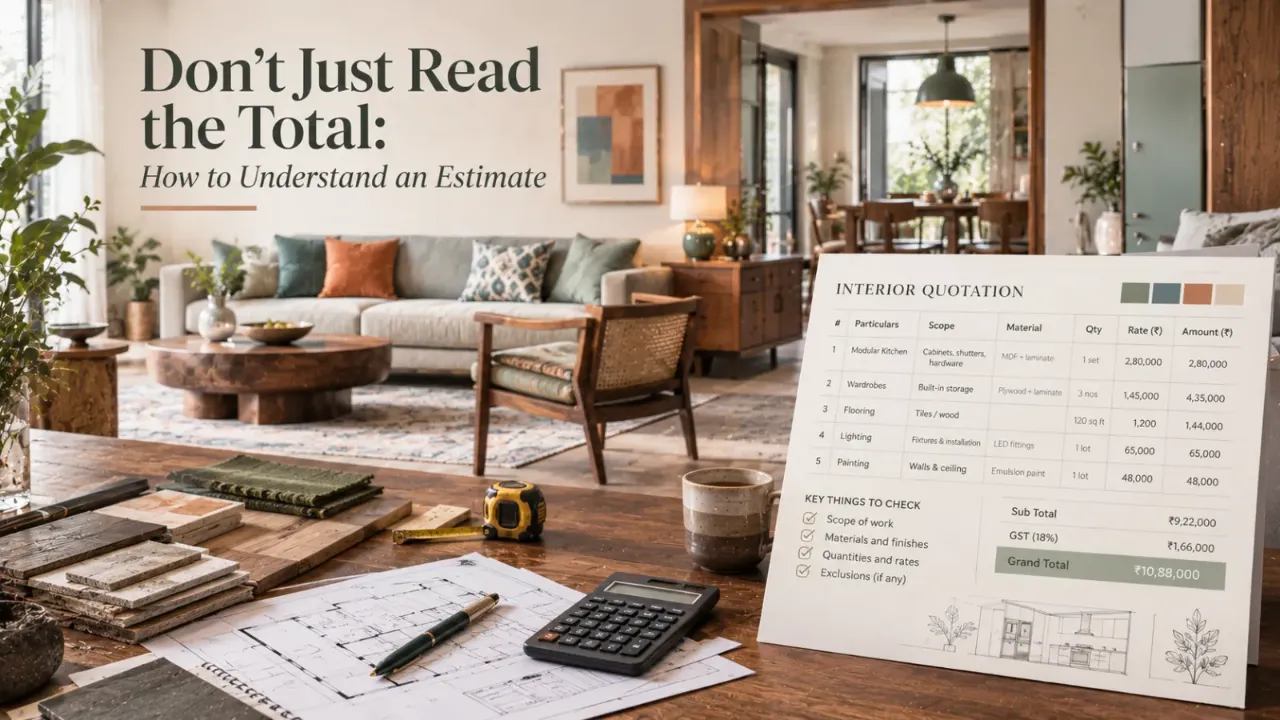
Don't Just Read the Total: How to Understand an Estimate
The first thing most homeowners look at in an interior estimate is the last line: Total: ₹9,84,500. But the more important information is usually above it. What exactly is included? How much material are you getting? What rate is being charged? Which brand or specification is being used? Does labour include installation? Are electrical changes included? Is GST included? What has been excluded?
First, Understand What an Estimate Is Actually Telling You
An interior cost estimate is essentially a financial description of the proposed work.
It may be presented as a room-wise estimate, a detailed BOQ, a quotation, a package price or a combination of these. The format can change. The questions do not.
- What is being done?
- How much is being done?
- What is each part priced at?
- What material or specification is being used?
- What is included in that price?
- What is not included?
Once you start reading every line through those six questions, an intimidating quotation becomes much easier to understand.
Don't Start With the Total. Start With the Units.
An estimate may price work using square feet, running feet, pieces, units, sets, jobs or lump-sum amounts.
The unit tells you what the rate actually applies to.
The calculation is simple. The important question is whether the 12 sq ft is actually correct and whether ₹2,000 per sq ft refers to the complete specified work or only one part of it.
A low-looking rate may simply be covering less work. A high-looking rate may include additional components. Never compare rates until you understand what the rate includes.
Quantity × Rate = Amount
Most itemised lines follow some version of Quantity × Rate = Amount.
For example, 20 pieces × ₹1,500 = ₹30,000, or 15 running ft × ₹4,000 = ₹60,000.
The difficult part is checking whether the quantity and rate are based on the same scope you think they are.
Read the Material Specification, Not Just the Material Name
A quotation might simply say: “Wardrobe — laminate finish.”
That sounds specific. It is not.
You may still need to know:
- What board or substrate is being used?
- What laminate specification?
- What thickness?
- Which brand, if relevant?
- What hardware?
- What internal accessories?
- What edge treatment?
- What installation is included?
You do not need to memorise every technical specification. But you should know enough to compare like with like.
Separate the Material From the Hardware
A cabinet is not only a board and a laminate. There may also be hinges, drawer systems, handles, lift mechanisms, channels, baskets or other internal accessories.
These can be included in the base rate, priced separately or excluded completely.
Look for the Word “Including”
A line that says “TV unit ₹X including installation” means something different from simply “TV unit ₹X.”
Ask what the stated amount actually covers: installation, delivery, hardware, finishing, electrical work or civil preparation.
“Excluded” May Be More Important Than “Included”
Common exclusions can include electrical modifications, plumbing changes, appliances, civil repairs, demolition, painting, curtains, loose furniture, decor, transportation and certain hardware or accessories.
The exclusion list is not necessarily a problem. The problem is discovering an exclusion after you assumed it was part of the price.
Learn to Spot Lump-Sum Lines
A line saying “Electrical work — ₹45,000” is easy to understand. It is also difficult to evaluate without more information.
What does the ₹45,000 cover? How many points? Which fixtures? Does rewiring form part of it? Are switches and plates included? Is concealed wiring included? Is installation included?
A lump-sum figure is not automatically bad. It simply deserves more questions.
Check Whether the Estimate Is Room-Wise
Room-wise breakup makes an estimate easier to understand.
Living Room
TV unit, sofa, lighting, curtains and other agreed living-room items.
Master Bedroom
Wardrobe, bed, side tables and other agreed bedroom items.
Kitchen
Cabinetry, countertop, hardware and other kitchen scope.
Other Areas
Second bedroom, utility, entryway, dining, passage, storage or bathrooms as applicable.
A single line saying “Complete interiors — ₹8.5 lakh” tells you much less.
Look for Missing Rooms, Not Just Missing Items
You may carefully review the living room, kitchen and master bedroom. But what about the second bedroom, utility area, entryway, dining space, passage, storage or bathrooms?
Every project is different, so not every area has to be included. But every excluded area should be excluded deliberately.
Check the Scope Against Your Actual House
Ask whether the quotation is based on actual site measurements, a floor plan, a rough assumption, an inspiration image or a standard package.
Real homes have beams, columns, windows, doors, existing furniture, service shafts and electrical constraints. The estimate should eventually relate to the actual conditions of your space.
Don't Compare Two Quotations by Total Alone
Excludes wardrobes, hardware and painting.
Quote B: ₹9 lakh
Includes those items.
Instead of comparing totals, compare scope + quantity + material + hardware + labour + exclusions + taxes.
Watch for Different Measurement Methods
One vendor may quote by square feet, another by running feet, and another using a lump-sum amount.
None is automatically wrong. But comparing the numbers directly can be misleading.
Ask: “What exactly is this unit measuring?”
Check the Brand and Grade Where It Matters
You do not need a brand name for every screw. But for important materials, the specification should be clear enough to prevent substitutions that materially change what you receive.
Depending on the project, this may include boards or panels, laminates, veneers, hardware, countertop materials, fittings, paint systems and lighting fixtures.
Understand Labour Separately When Possible
Labour can be built into the product rate, priced separately or presented as a package.
For example, “Wardrobe ₹X inclusive of fabrication and installation” is different from “Wardrobe material ₹X + labour ₹Y.”
Clarity matters more than the format.
Ask About Taxes
Never assume that the final number automatically includes every applicable tax or charge.
This is especially important when comparing two quotations.
Read the Payment Schedule Carefully
A quotation is not only about the final price. It also tells you how the money is expected to move.
- Advance amount
- Procurement payments
- Execution milestones
- Installation payments
- Final payment
The important question is whether the payment schedule corresponds reasonably with the stage of work and what is actually being delivered.
Check the Timeline and Warranty
Look for whether the quotation or accompanying terms mention expected timeline, installation period, warranty terms, what the warranty covers and who handles defects or service requests.
Understand “As per Actuals”
You may come across wording such as “Electrical work as per actuals” or “Civil work charged as per actuals.”
This generally means the final amount may depend on what is actually required or executed rather than being completely fixed in advance.
Ask: What is the basis of the actual? How will it be measured? What rate will be applied? Who approves additional work?
Watch for the “Starting From” Trap
A promotional price may say “Interiors starting from ₹X.”
That is not the same as a quotation for your home.
A starting price tells you the lowest advertised entry point under defined assumptions. An actual estimate should reflect your project's scope.
Look for Double-Charged Items
A component may appear once under one heading and then partially appear again under another.
Installation may be built into one product line and then added separately as labour. A finish may be included in a cabinet rate and also listed separately.
This does not necessarily mean someone is intentionally charging twice. It may simply be a formatting issue. But it deserves clarification.
What a Clear Estimate Should Let You Understand
What?
What exactly are you buying?
How Much?
What quantity or measurement is being priced?
At What Rate?
What is the unit rate and how is it calculated?
What Specification?
Which material, brand, hardware or finish is included?
You should also be able to identify what labour and installation include, what is excluded, whether taxes are included, what the payment milestones are and what happens if something changes.
Red Flags to Pause On
Very Little Breakup
A large total with almost no itemisation makes meaningful comparison difficult.
Vague Materials
Terms such as “premium material” without a usable specification need clarification.
Unclear Quantities
Major items without a clear measurement basis deserve a closer look.
Unclear Commercial Terms
Taxes, payment milestones, warranty, timeline or “actuals” should not be left ambiguous.
The Five Questions to Ask Before You Sign
2. What is excluded?
3. What material, brand and hardware specification is being used?
4. What happens if the quantity or scope changes?
5. Is the final total inclusive of taxes and all stated charges?
If the answers are clear, you are already in a much better position.
Read the Estimate Like a Detective, Not an Accountant
You do not need to be good at spreadsheets. You need to be good at noticing gaps.
A homeowner's job is not to calculate every screw. It is to understand whether the document gives a fair and complete picture of what they are paying for.
Do not just ask: “Is this ₹8 lakh or ₹9 lakh?”
Ask: “What do I get for ₹8 lakh, and what do I still have to pay for?”
Use the Estimate to Ask Better Questions
Suppose you notice that the wardrobe rate is higher than another quote.
Instead of saying, “Your wardrobe is expensive,” ask:
Now you are comparing scope.
And Remember: The Cheapest Quote Is Not Always the Cheapest Project
A low initial quotation can become expensive if important items are excluded, quantities are underestimated, specifications change, or additions are repeatedly introduced during execution.
A slightly higher but clearer quotation may be easier to manage because you understand what you are actually buying.
Final Thought
You do not need to become an expert in interiors to read an estimate well.
You need to become comfortable asking: What? How much? At what rate? Using what material? Included or excluded? And what happens if it changes?
Once you learn to read an estimate this way, the document stops looking like a wall of numbers.
It starts looking like what it really is: a map of what your money is supposed to buy.
Ready to Check a Quotation?
Before approving an interior quotation, Walls to Wonder's Interior Quotation Checker can help you review pricing clarity, materials, missing scope, payment terms, taxes and potential risk areas.
You can also use Design My Room to visualise your design direction and explore interior professionals through the Walls to Wonder designer directory.
Frequently Asked Questions
1. What is the most important thing to check in an interior estimate?
Do not look only at the total. Start with the scope, quantities, unit rates, material specifications and exclusions so you understand exactly what the quoted amount covers.
2. What does quantity × rate mean in a quotation?
It is the basic calculation used for many itemised works. The quantity tells you how much work or material is being priced, and the rate tells you the price applied to each unit.
3. Why do two interior quotations with the same item have different prices?
They may use different materials, quantities, hardware, labour assumptions, brands, finishes or inclusions. A rate cannot be compared fairly without comparing the scope behind it.
4. What does “as per actuals” mean?
It generally means the final amount depends on the actual quantity or work executed rather than being completely fixed at the quotation stage. Ask how that actual amount will be measured and charged.
5. Should GST or other taxes be included in the quoted total?
Do not assume. Check the quotation and ask whether the displayed total is tax-inclusive or whether applicable taxes will be added separately.
6. How should I compare two interior quotations?
Compare scope, quantity, material specification, hardware, labour, installation, exclusions, taxes, warranty, timeline and payment terms rather than looking only at the final total.
7. What is a BOQ in interior design?
A BOQ, or Bill of Quantities, is a structured list of items or work quantities used to describe and price a project. It can make detailed comparison and scope checking easier.
8. Should I approve an estimate if some items are still unclear?
It is better to clarify important unclear items first, especially major materials, quantities, exclusions, taxes, payment terms and work that could significantly affect the final cost.
Get a personalised estimate for your home
Choose your rooms, materials and preferences to understand a practical interior budget before you commit.