
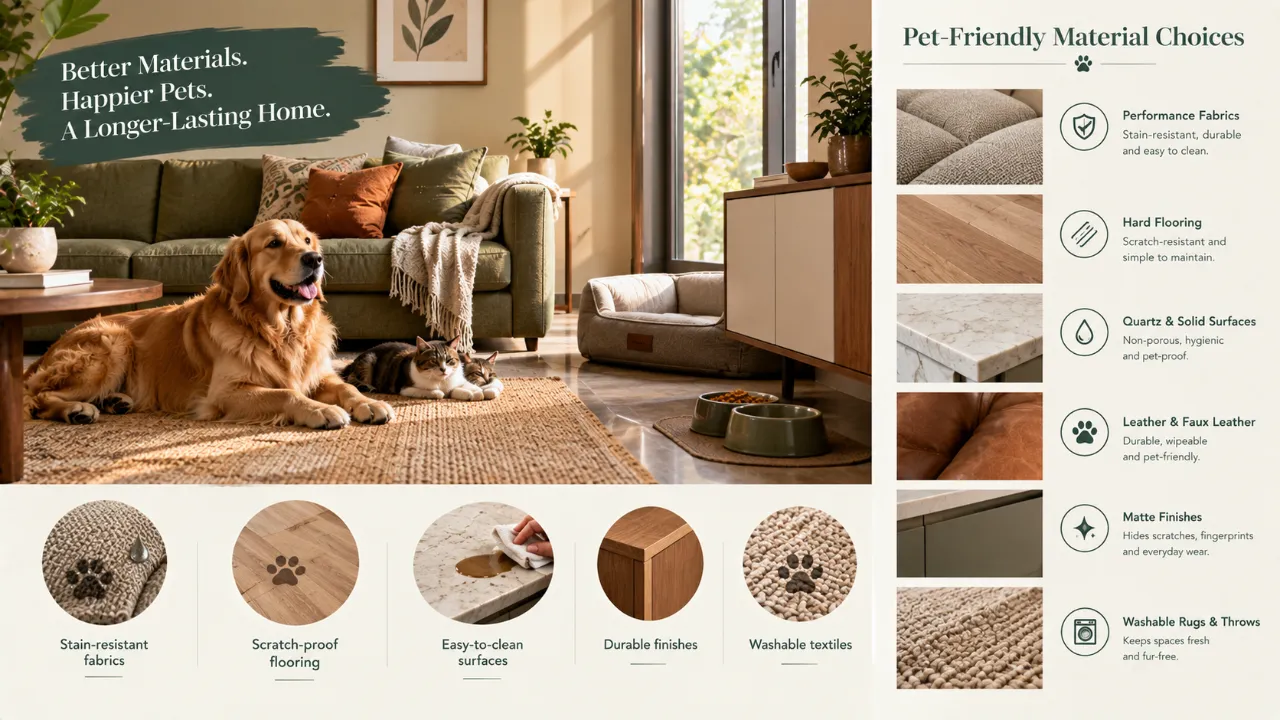
Designing for Paws: Material Choices That Work Better With Pets
A beautiful home and a pet-friendly home do not have to be two different things. But living with a dog or cat does change how certain materials behave.
Flooring sees more traffic. Upholstery collects fur. Rugs deal with spills, scratching and muddy paws. Finishes that look perfect in a showroom may become difficult to maintain once everyday life begins.
That does not mean you need to sacrifice style. It means material selection should consider how the home will actually be used.
The right question is not simply, "Does this material look good?" It is: "Will this material still work after living with my pet every day?"
- Start With the Pet, Not Just the Room
- Flooring Is One of the Biggest Decisions
- Think About Scratch Visibility
- Wood Flooring
- Stone and Tile
- Upholstery for Pet Owners
- Choosing Fabrics
- Performance Fabrics
- Rug Selection
- Paint and Wall Finishes
- Cabinetry and Furniture
- Entryway Materials
- Create a Dedicated Pet Zone
- Design Around Maintenance
- Use Materials Strategically by Zone
- Common Material Mistakes
- Pet-Friendly Material Checklist
- A Better Way to Choose Materials
- FAQ
Start With the Pet, Not Just the Room
Different pets create different design challenges. A large active dog has different needs from a small indoor dog. A cat that rarely scratches furniture creates a different environment from one that regularly climbs, sheds or scratches.
Before selecting materials, think about your pet's actual habits.
- Does your pet shed heavily?
- Do they scratch?
- Do they track dirt indoors?
- Are spills or accidents a concern?
- Do they spend most of their time on upholstered furniture?
- Do they chew corners or exposed materials?
- Do they frequently move between indoor and outdoor spaces?
Flooring Is One of the Biggest Decisions
Pets interact with the floor constantly. That makes flooring one of the most important materials to evaluate.
Look at resistance to everyday wear, ease of cleaning, slip considerations, scratch visibility, stain resistance and maintenance requirements.
Think About Scratch Visibility, Not Just Scratch Resistance
People often ask whether a floor can be scratched. A better question is: How visible will everyday marks be?
Some finishes can show every small mark because of a highly uniform or reflective surface. A more textured or visually varied finish may make minor wear less noticeable.
High-Gloss Surfaces Need More Thought
Highly polished surfaces can look sophisticated, but they may make every footprint, smudge or small mark more obvious.
In homes with pets, a lower-sheen finish can sometimes be easier to live with visually. This applies to flooring, cabinetry and other high-touch surfaces.
Wood Flooring Can Work—With the Right Expectations
Wood can be warm, attractive and comfortable underfoot. But pets can introduce scratches, dirt, moisture and repeated traffic.
The finish, surface treatment and maintenance approach therefore matter.
Stone and Tile Offer Different Advantages
Hard flooring can be practical in homes with pets because it is generally straightforward to clean.
Tile and stone also offer many visual possibilities. But remember that grout is part of the floor too, so the complete floor system should be considered.
Very Slippery Floors Need Attention
A highly polished floor may be easy to wipe but can create a different practical experience for a pet moving quickly across it.
Texture and finish can influence how the floor feels underfoot. For homes with older pets or pets that struggle with mobility, this becomes an especially important consideration.
Upholstery Is Where Pet Ownership Becomes Very Visible
Sofas, chairs and beds can collect fur, dirt and occasional spills.
Look at fabric texture, weave, colour, cleanability, durability, fur removal and how easily marks become visible.
Choose Fabrics by Their Maintenance Reality
A fabric sample may look perfect in a showroom. But imagine it covered with pet hair.
Can the fur be removed easily? What happens when a muddy paw touches it? Can the upholstery be professionally cleaned when needed?
Consider Performance Fabrics for High-Use Areas
Performance-oriented upholstery can be worth considering in homes where sofas and chairs receive heavy pet use.
The advantage is not necessarily that the fabric is indestructible. It is that the material may be better suited to repeated use and easier maintenance.
Texture Can Hide Fur—But Colour Matters Too
Pet hair is more visible when it strongly contrasts with the upholstery.
This does not mean your furniture needs to match your pet's coat. It simply means contrast affects visibility, and texture and colour can be considered together.
Rugs Need More Thought Than They Get
In a pet-friendly home, think about pile height, weave, cleanability, stain visibility, edge construction, fur removal and whether the rug catches claws.
Very loose or delicate constructions may require more care in homes where pets dig, scratch or move aggressively across surfaces.
Consider Machine-Washable or Easily Cleaned Textiles
Smaller washable rugs, throws and removable covers can be extremely useful in high-use areas.
Paint Finish Matters Too
Active pets can leave marks through rubbing, scratching or accidental contact.
A practical paint finish can make regular cleaning easier, while delicate finishes may require more care.
Cabinetry Should Consider Curious Pets
Lower cabinets are often within easy reach of pets. This can matter particularly in kitchens, utility areas and storage zones.
- Exposed corners
- Loose hardware
- Open shelves
- Easily accessible cleaning products
- Low-level storage
- Finishes that show scratches
Pay Attention to Furniture Edges
Sharp corners can become more noticeable when pets move quickly around the home.
In high-traffic areas, consider the relationship between furniture corners, walking paths, pet movement and seating positions.
Entryways Deserve Their Own Material Strategy
The entry is often where outdoor dirt first enters the home.
- Easy-clean flooring
- Washable runner
- Closed shoe storage
- Dedicated pet towel area
- Storage for leads and accessories
Create a Dedicated Pet Zone
Not every pet item needs to be hidden. A defined pet zone can actually make the home feel more organised.
This might include space for food and water bowls, bedding, toys, grooming items, leads and towels.
Let the Pet Bed Become Part of the Design
A pet bed does not have to look like something added after the interior was finished.
Repeat fabric tones, wood finishes, accent colours, patterns or textures from the surrounding room.
Do Not Choose Materials Only for Durability
Durability matters, but a material can be extremely durable and still be wrong for your home.
Maintenance Should Influence the Design
Think about day 365, not only day one.
How often will the surface need cleaning? How will stains appear? Will the finish age gracefully? Can individual elements be replaced? Can upholstery be cleaned?
Use Materials Strategically by Zone
Entryway, living room and balcony access.
Feeding area, kitchen and utility space.
Sofa, bedroom and pet bed zone.
Formal spaces or areas your pet rarely enters.
This lets you spend more attention on the areas where materials actually experience the most stress.
Do Not Forget Outdoor and Balcony Materials
Balconies and terraces can become favourite pet areas. Think about cleanability, heat, drainage, furniture stability, exposed textiles, plant placement and accessible edges.
The Bathroom and Utility Area Can Help Too
For households that bathe, groom or clean pets at home, the utility area can become particularly important.
Easy-clean surfaces, organised storage and accessible water connections can make these tasks easier.
Common Material Mistakes in Pet-Friendly Homes
Choosing materials based only on appearance
A showroom sample tells you very little about everyday pet use.
Assuming "durable" means maintenance-free
Durability and cleanability are different qualities.
Ignoring contrast
High contrast can make fur and marks much more noticeable.
Selecting delicate rugs for high-traffic areas
Beautiful does not always mean practical.
Forgetting the entryway
Outdoor dirt can travel surprisingly far into the home.
Designing pet storage at the end
Pet-related objects are still part of everyday storage requirements.
A Simple Pet-Friendly Material Checklist
Upholstery — How will it behave with fur, spills and repeated use?
Rugs — Can they be cleaned easily and do they suit your pet's habits?
Walls — Is the finish practical for occasional marks and cleaning?
Cabinetry — Are accessible areas safe, durable and easy to maintain?
Furniture — Do edges, proportions and placement work with pet movement?
Entryway — Is there a controlled transition for outdoor dirt?
Storage — Does every recurring pet item have a place?
A Better Way to Choose Materials
Does it fit the design you want?
Can it handle how your pet interacts with the room?
Can you realistically clean and care for it?
Will it still work well after years of everyday use?
The best choice is usually the material that performs reasonably well across all four—not necessarily the one that wins in only one category.
Design Around Real Life
Explore room visualisation and designer resources to think through materials, layouts, storage and everyday use before making major interior decisions.
Final Thought
Designing for pets does not mean designing a home that looks like a pet facility.
It means accepting that pets are part of everyday life and choosing materials accordingly.
A floor may need to handle muddy paws. A sofa may need to handle fur. A rug may need to survive repeated cleaning. A cabinet may need to hide pet supplies.
These are not compromises that make a home less beautiful. They are part of making the home work.
The most successful pet-friendly interiors do not hide the fact that animals live there. They simply make sure the design is ready for real life—including the four-legged members of the household.
FAQ
There is no single best option for every household. Look for flooring that suits your pet's activity level, is practical to clean, provides appropriate traction and fits the home's maintenance routine.
Look for upholstery that suits your cleaning routine, does not show every mark immediately and can handle repeated everyday use. Performance-oriented fabrics can be useful in high-contact areas.
Not at all. Choose rugs based on your pet's habits, cleaning needs, pile, construction and how much traffic the area receives.
It does not need to. But strong contrast between pet hair and upholstery can make shedding much more noticeable, so texture and colour are worth considering together.
Keep the overall design language intact while choosing durable and maintainable materials in high-use areas. Conceal pet supplies through integrated storage and use coordinated bedding, rugs and accessories so pet zones feel intentional.
Both matter, but they solve different problems. A durable material may resist wear, while an easy-clean material reduces the effort required to maintain it. Ideally, consider both together.
Turn this idea into a plan for your home
Visualise your space, understand the likely budget, or find a professional who can bring the idea to life.