
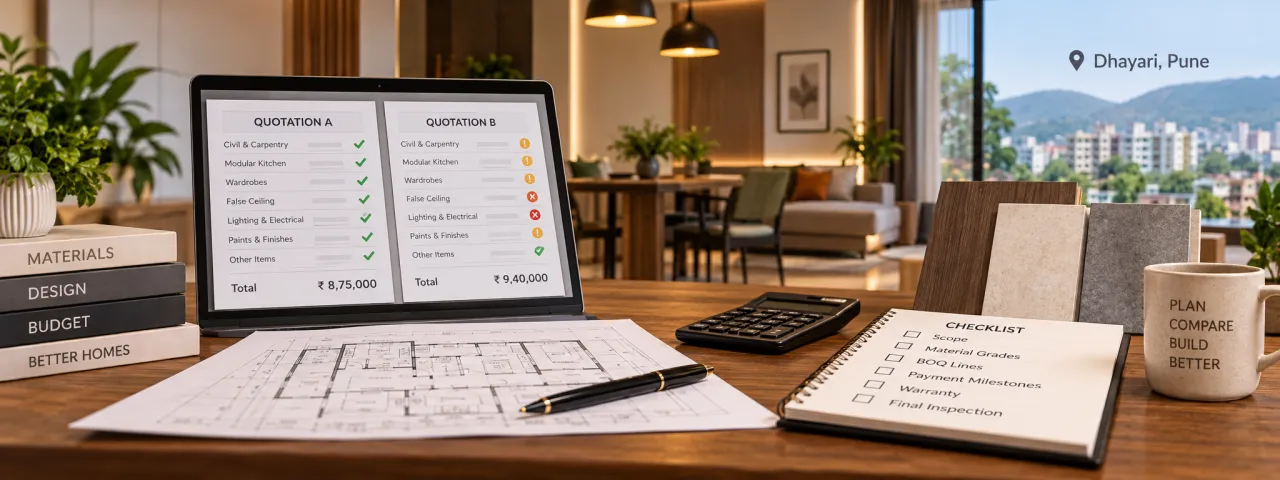
How to Compare Interior Quotations in Dhayari, Pune
Two interior quotations can describe the same two-bedroom home and still represent very different purchases. One may include carcass material, hardware, site protection and installation; another may leave several of these as assumptions. For homeowners researching interior quotation comparison Dhayari Pune, the safest starting point is not the lowest total. It is a clear specification that can be priced, coordinated and accepted.
Dhayari homeowners may compare designers and companies serving the area alongside options connected with Sinhagad Road, Narhe, Ambegaon Budruk and Vadgaon Budruk. The locality matters for coordination, but the quotation must stand on its own. Use the Dhayari interior designer directory to build a shortlist, then ask each contender to price the same brief.
What should the quotation be designed to prove?
Performance objective: the document should tell you exactly what will be made, from what material, with which fittings, by whom, and under which payment and warranty terms. A polished 3D view is useful for intent; it is not a substitute for a bill of quantities (BOQ), drawings or an exclusions list.
Ask for one consolidated quotation with a room-wise scope, quantities or dimensions where practical, unit rates, taxes, transport, installation and a validity period. “Modular kitchen” is not a sufficient line item. A usable description might identify cabinet types, board grade, finish, edge treatment, drawer channels, hinges, handles, countertop, sink and installation.
Which scope gaps create the biggest surprises?
Start by separating design services, manufacturing, site work and procurement. Some designers offer concept layouts and detailed drawings; some also coordinate execution. A company may price modular furniture but exclude painting, electrical changes, plumbing relocation, false ceiling, civil breaking, appliance installation or debris removal.
Included scope
Look for room names, furniture units, dimensions, finish, hardware, installation, delivery, site protection, supervision and handover cleaning. Check whether lofts, skirting, fillers, cornice, lighting and internal accessories are individually listed.
Excluded or provisional scope
Insist on a separate section for exclusions and allowances. “As per site condition” should be explained: does it refer to wall levelling, concealed wiring, plumbing, waterproofing or a structural issue? Provisional sums should state what triggers revision.
For a resale apartment or a home being renovated, civil and service coordination deserves extra attention. Confirm who will protect flooring and lifts, remove waste, arrange measurements, coordinate with the building’s permitted work hours and reinstate disturbed surfaces. These are execution responsibilities, not decorative extras.
How can two material specifications be compared fairly?
Material names are often too broad. “Commercial plywood,” “HDHMR,” “MDF,” “laminate” and “premium hardware” do not, by themselves, define performance. Ask for the exact board category and thickness, finish brand or approved equivalent, edge-banding method, hardware range, warranty terms and location of use.
| Quotation line | Clarify before comparing | Acceptance check |
|---|---|---|
| Carcass and shutters | Board type, thickness, moisture exposure, finish and edge treatment | Visible edges are sealed; panels match the approved sample and drawings |
| Drawers and hinges | Brand, load rating where relevant, soft-close inclusion and quantity | Doors align, drawers run smoothly and clear adjacent units |
| Countertop and sink | Material, thickness, cut-outs, upstand, sealing and installation | Level surface, sealed joints and tested drainage without leakage |
| Electrical and lighting | Point count, wire and switch specifications, conduits and fixtures | Points match the electrical drawing and circuits are identified |
| Paint and ceiling | Surface preparation, coats, product range and repair responsibility | Even finish in normal light, with no obvious patching or cracks |
A higher grade is not automatically the correct choice everywhere. Moisture-prone areas, frequently used drawers and long spans may justify a different specification from a dry, low-load decorative panel. Ask the designer to explain the reason for each upgrade rather than accepting a blanket “premium” package.
What pricing factors should be visible?
The total depends on more than carpet area. Layout complexity, number of shutters and drawers, loft height, finish type, hardware quantity, countertop cut-outs, electrical rewiring, ceiling work, civil changes, site access and the level of supervision can all alter the final scope. Taxes, freight, installation and temporary protection should not be hidden inside an unexplained lump sum.
Compare totals only after normalising the scope. Request a revised side-by-side sheet if one quotation includes appliances, lights or loose furniture and another does not. A lower number may simply have fewer internals, basic hardware or more exclusions. For an independent planning reference, the interior cost estimator can help you think through scope categories; it should not replace a site-specific BOQ.
When should payment milestones be released?
Payment should follow measurable progress, not a calendar date or a verbal promise. The written schedule should state the amount or percentage, trigger, deliverable and whether taxes are included. Keep a modest balance linked to snag closure and handover, subject to the agreed contract.
- Design and measurement: release against the agreed brief, site measurements, layout options and approved drawings.
- Material approval and production: tie payment to the final BOQ, finish samples, hardware schedule and production confirmation.
- Delivery and installation stages: define what must arrive, what is installed and what remains pending before each invoice.
- Completion: link the final amount to functioning hardware, service testing, touch-ups, cleaning, documents and an agreed snag list.
Ask what happens if you change a finish, add a unit or alter a point after approval. A change-order process should record the revised drawing, cost or credit, tax impact and schedule effect before work proceeds. This protects both sides from “small” changes accumulating without consent.
Which questions belong in the pre-advance meeting?
Use the meeting to test coordination, not just design taste. Ask who is the contract party, who supervises the site, who measures, who approves substitutions and who communicates delays. Confirm whether the designer uses subcontractors and how workmanship issues are escalated.
- Can you mark every included and excluded item on the floor plan?
- Which brands or grades are named, and what is the written equivalent-substitution rule?
- Are transport, installation, taxes, protection, debris removal and touch-ups included?
- What warranty applies to boards, finishes, hardware, electrical work and installation separately?
- What documents will I receive at handover: drawings, product details, care instructions and warranty contacts?
- What is the cancellation, delay and change-order process before I pay an advance?
Do not pay solely because a quotation is marked “limited period.” Pay only after the scope, commercial terms, payment schedule and contracting entity are clear in writing.
Where can digital tools improve the comparison?
Digital tools are most useful for organising decisions before a designer is appointed. They cannot inspect a wall, validate a concealed service or guarantee a brand substitution, so treat their output as a discussion aid.
Budget structure
Use the AI interior cost estimator to organise rooms, work categories and likely decision points before requesting comparable proposals.
Quotation review
Run a draft through the AI quotation checker to spot missing descriptions or questions to take back to the designer. Verify every result against the actual document.
For visual direction, browse Indian interior design ideas, read relevant expert stories and projects, or use Design my room and the Find my style tool to clarify preferences. The AI interior assistant can help frame questions, but the signed scope remains the controlling document.
What are the warning signs of an unreliable quotation?
Be cautious when a proposal has one attractive total but no quantities, no exclusions, no tax treatment or no validity period. Other warning signs include “best quality” without a grade, unnamed hardware, drawings that do not match the quote, pressure for a large advance, verbal warranty promises and substitutions controlled only by the vendor.
A quote that changes materially after a site visit is not automatically a problem; the visit may reveal real work. The concern is an unexplained change without a marked-up scope and approval record. Ask for the reason, evidence, revised BOQ and programme impact.
What should acceptance look like at handover?
Acceptance is easier when it is observable. Walk room by room against the approved drawings and samples. Check shutter gaps and alignment, drawer movement, soft-close action, edge sealing, laminate joints, countertop level, sink drainage, light operation, switch locations and paint touch-ups. Test doors and drawers under normal use, not only by looking at them.
Record incomplete items with photographs, location, responsible party and target date. Handover should include keys, spare hardware where agreed, care instructions, warranty documents and a final list of approved changes. Keep the final payment conditional on the agreed completion criteria rather than on a general statement that the work is “substantially done.”
Shortlist designers and companies serving the locality through the Dhayari directory. Share the same room list, drawings, material expectations and exclusions with each contender so the differences become meaningful.
Frequently asked questions
1. Should I choose the cheapest interior quotation?
No. First normalise scope, material grades, hardware, taxes, site work and warranties. A lower total may reflect exclusions rather than efficiency.
2. Is a BOQ necessary for a small apartment interior?
Yes. It can be concise, but it should still identify units, quantities or dimensions, materials, fittings, installation and exclusions. This reduces ambiguity during changes.
3. How much advance should I pay?
There is no universal safe percentage. Agree milestones that match deliverables and retain a defined amount for snag closure. Review the contract before paying.
4. Can a designer substitute a listed brand?
Only under a written rule that preserves the agreed performance, grade, warranty and value. Require your approval before a substitution is purchased or installed.
5. Can WallsToWonder verify my quotation?
WallsToWonder provides discovery and planning tools, including a quotation checker and locality directory. Use these to structure questions; confirm site conditions and contractual terms directly with the appointed designer.
Get a personalised estimate for your home
Choose your rooms, materials and preferences to understand a practical interior budget before you commit.