
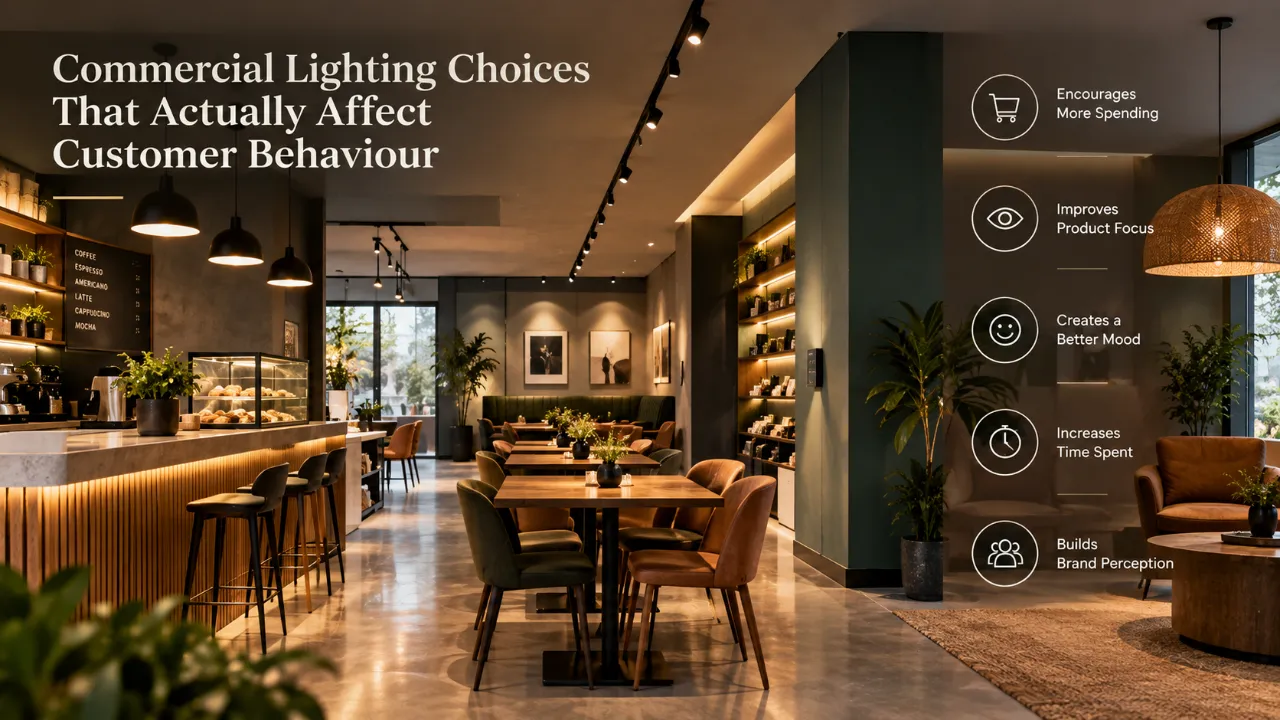
Commercial Lighting Choices That Actually Affect Customer Behaviour
Walk into two shops selling similar products and the experience can feel completely different.
One may feel inviting, calm and easy to navigate. Another may feel harsh, confusing or visually tiring.
The difference is not always the furniture, the display units or even the products. Sometimes it is the lighting.
Commercial lighting does more than allow customers to see what is in front of them. It can help shape how a space is perceived, which areas attract attention and how comfortably people move through the environment.
The goal is not to find one magical lighting setting that guarantees purchases. It is to use light to make the customer's experience clearer, more comfortable and more intentional.
Quick answer: Commercial lighting can influence attention, spatial perception, product visibility and the overall atmosphere of a space. Use ambient light for general comfort, accent light for visual hierarchy, appropriate colour temperature for the brand and product, and controlled contrast to guide attention without creating glare or discomfort.
- How lighting shapes customer experience
- Brightness and visual attention
- Contrast and visual hierarchy
- Colour temperature
- Product and display lighting
- Colour rendering and material perception
- Dwell time and browsing
- Wayfinding and customer movement
- Spatial perception and atmosphere
- Lighting for retail, hospitality and showrooms
- Common commercial lighting mistakes
- A practical lighting strategy
- A zone-by-zone checklist
- Frequently asked questions
Lighting Is Part of the Customer Experience
Customers rarely analyse lighting consciously. They simply experience the environment.
A commercial space may feel bright, calm, energetic, premium, intimate, spacious, dramatic, clinical, crowded or comfortable. Lighting contributes to those impressions alongside colour, materials, layout, sound and temperature.
This means lighting should be designed as part of the commercial experience rather than treated as an electrical requirement added at the end.
1. Brightness Changes What Customers Notice
One of the most direct roles of commercial lighting is directing visual attention.
A display that is visually stronger than its surroundings naturally becomes more prominent. This can be useful for new arrivals, hero products, promotional displays, feature walls, artwork or brand elements.
Design principle: Use brightness strategically rather than making every part of the store equally bright.
2. Even Lighting Is Not Always Better
A common commercial-lighting mistake is trying to make every part of the store equally bright.
Uniform illumination can support visibility, but it can also flatten the visual hierarchy. If everything is equally illuminated, nothing feels particularly important.
Create relationships between general illumination, display illumination, architectural highlights, decorative lighting and transitional areas.
3. Contrast Helps Build a Visual Hierarchy
Lighting contrast can tell customers where to look first.
A floor may have moderate ambient illumination while a feature product receives stronger accent lighting and the wall behind it receives a softer wash.
Without a sign telling customers what matters, the lighting has already created a visual hierarchy.
4. Colour Temperature Changes the Character of the Space
Lighting colour temperature can influence how a commercial interior feels and how users perceive the environment.
Lower colour temperatures generally appear warmer, while higher colour temperatures generally appear cooler or whiter.
Neither is automatically correct. The appropriate choice depends on the brand, products, materials, daylight, desired atmosphere and customer expectations.
5. The Same Light Does Not Work Everywhere
Entrance
Establishes the first impression and makes the transition from outside more comfortable.
Main Display
Uses controlled emphasis so important products are easy to notice.
Circulation
Needs consistent enough illumination for comfortable movement.
Consultation Area
Prioritises comfortable communication and appropriate task visibility.
6. Product Lighting Should Support Product Perception
Lighting can affect how customers see colour, texture, material, shape, shine and depth.
This is particularly important in fashion, furniture, jewellery, cosmetics, food, tiles, surfaces and decorative products.
A product should be evaluated under lighting that supports the visual qualities customers actually need to assess.
7. Colour Rendering Matters
Colour rendering affects how accurately colours appear under a light source. This can matter when customers are comparing clothing, furniture, finishes, surfaces or other colour-sensitive products.
The lighting system should therefore be considered alongside the products being displayed rather than chosen independently.
8. Accent Lighting Can Encourage Examination
Accent lighting does not automatically create a purchase. What it can do is make selected products more visually noticeable and encourage attention toward particular areas.
A better question than “Will brighter light increase sales?” is: “What deserves attention here, and how can lighting help customers notice it?”
9. Lighting and Dwell Time Need Context
Different studies have found different relationships between lighting, browsing and time spent in retail environments. This means there is no universal rule that brighter or darker stores automatically produce better customer behaviour.
The practical goal is to match the lighting atmosphere to the experience the business wants customers to have.
10. Retail Lighting Should Guide Movement
Lighting can support wayfinding without relying entirely on signs.
Brighter zones, feature lighting, repeated lighting patterns, illuminated displays and carefully positioned ceiling fixtures can help establish a visual route through a commercial space.
11. Balance the Entrance Transition
The transition from outdoors to indoors affects visual comfort.
A dramatically dark interior after a bright exterior can be uncomfortable, while an excessively bright interior can feel harsh.
Entrance lighting should therefore be considered as a transition between environments.
12. Lighting Can Affect Spatial Perception
Lighting contributes to whether a customer experiences a space as open, compact, focused, relaxed, dramatic or expansive.
The effect is created through the relationship between light, shadow, ceiling, walls, materials and circulation rather than brightness alone.
13. Shadow Is a Design Tool
Commercial interiors do not need to eliminate every shadow.
Controlled shadow can add depth, define architecture, separate products, emphasise texture and make feature displays more memorable.
The objective is not darkness. It is controlled variation.
14. Lighting Can Reinforce Brand Positioning
| Commercial Character | Possible Lighting Direction |
|---|---|
| Premium | Controlled contrast, focused accents and refined decorative fixtures |
| Mass Retail | Clear, consistent illumination and straightforward product visibility |
| Boutique | More dramatic hierarchy with stronger feature areas |
| Hospitality | Layered and atmospheric lighting with emphasis on comfort |
15. Avoid Lighting That Makes Customers Work Too Hard
A space can look dramatic while still being uncomfortable.
- Glare on reflective surfaces
- Deep shadows where customers need to read
- Poorly lit steps or aisles
- Excessive contrast
- Distracting decorative fixtures
- Lighting that makes labels difficult to read
Customer comfort should remain the central test.
16. Match Lighting to the Customer's Task
Fashion
Support clear evaluation of colour, texture, shape and fit-related visual information.
Furniture
Help customers understand surface, material, finish and scale.
Food & Dining
Balance food presentation, facial visibility, atmosphere and comfort.
Showrooms
Support comparison and closer inspection of materials and finishes.
17. Use Lighting to Build Focal Moments
A commercial space does not need every area to be equally visually important.
A sequence such as Entrance → Hero Display → Main Collection → Secondary Display → Checkout can create a clear visual rhythm.
Each stage can have its own lighting emphasis while remaining part of the same overall lighting language.
18. Display Lighting Should Work With the Background
The product, background, viewing angle and light source need to be considered together.
A bright product against a bright background may lose contrast, while a slightly darker backdrop can make the same product more visually prominent. Reflective materials also need careful positioning to avoid distracting reflections.
19. Do Not Forget the Ceiling
The ceiling often carries a significant portion of the commercial lighting infrastructure.
Fixture placement can establish rhythm, direction, zones and visual identity while supporting the architectural design.
20. Restaurant Lighting Has a Different Job From Retail Lighting
Restaurants are not primarily browsing environments. Customers are there to eat, talk, relax and spend time.
Lighting may therefore need to balance table-level comfort, food appearance, facial visibility, ambient atmosphere, circulation and architectural emphasis.
21. Showrooms Need Material Accuracy
Furniture and interior showrooms often involve considered purchases. Customers may need to evaluate wood grain, upholstery, stone, finishes and textures before making a decision.
The lighting should help customers understand the material rather than simply making the room look dramatic in photographs.
22. Hospitality Spaces Need Emotional Comfort
Hotels, cafés, lounges and restaurants depend heavily on atmosphere. Lighting can contribute to whether an environment feels intimate, energetic, relaxed, formal or social.
The appropriate balance depends on the type of venue, customer expectations, time of day and the activities taking place.
23. The Indian Context Matters
There is no universally correct commercial lighting formula for every market.
Daylight conditions, store positioning, architecture, product category and local customer expectations can all affect how a space is experienced.
A lighting scheme developed for one retail category or market should therefore be evaluated again when applied to another context.
24. More Light Does Not Automatically Mean Better Lighting
Higher illuminance can improve visibility, but maximum brightness is not the same as good design.
Excessive illumination can contribute to glare, visual fatigue, loss of contrast, a flattened atmosphere and unnecessary energy use.
Good commercial lighting is about distribution and hierarchy, not simply quantity.
25. A Practical Lighting Strategy
| Step | Question |
|---|---|
| 1. Customer Journey | Where do customers enter, pause, browse, compare and pay? |
| 2. Visual Priorities | Which products or features deserve emphasis? |
| 3. Ambient Layer | How bright and comfortable should the overall space feel? |
| 4. Accent Layer | Where should additional light create visual focus? |
| 5. Comfort Check | Are glare, reflections, shadows and readability under control? |
26. Common Commercial Lighting Mistakes
Lighting Everything the Same
Identical illumination everywhere can remove visual hierarchy.
Making the Store Excessively Bright
High brightness can create glare and flatten the experience.
Using Decorative Fixtures Everywhere
A beautiful fixture is not automatically effective functional lighting.
Ignoring Product Colour
Lighting should support accurate enough visual judgement for the product category.
Forgetting Customer Viewing Angles
A fixture can look perfect on a plan and still create glare from the customer's actual position.
Choosing Colour Temperature Only Because It Is Trending
The best choice depends on the brand, products, architecture and customer experience.
Failing to Test the Finished Space
Lighting should be evaluated in the completed environment and from actual customer viewpoints.
27. Commercial Lighting: What Each Layer Does
| Lighting Layer | Primary Role | Customer Effect to Aim For |
|---|---|---|
| Ambient | General visibility | Comfortable overall environment |
| Accent | Visual emphasis | Notice selected products or features |
| Task | Activity-specific visibility | Easy reading, comparison or interaction |
| Decorative | Atmosphere and identity | Strengthen brand and spatial character |
| Architectural | Define form and circulation | Understand the space more easily |
28. A Practical Commercial Lighting Checklist
Before finalising the lighting design, ask:
Is the entrance visually clear? Can customers navigate the space comfortably? Are hero products easy to notice? Are shelves and displays sufficiently visible? Are product colours represented appropriately for the task? Is glare controlled from likely customer viewpoints? Is the lighting hierarchy obvious? Does each zone support its actual function? Does the lighting match the brand atmosphere? Does the store remain comfortable during extended browsing? Has the finished lighting been tested in the real space?
The Biggest Lesson: Light the Journey, Not Just the Space
The most useful way to think about commercial lighting is not as a switch that turns customers into buyers.
Lighting works earlier in the journey. It can help determine what customers notice first, how they perceive the space, which products attract attention, how easily they navigate and whether the environment feels comfortable enough to explore.
This makes lighting a customer-experience tool as much as a technical requirement.
Design Commercial Spaces With More Intention
Explore interior professionals and commercial design resources to build spaces where lighting, layout, materials and customer experience work together.
Explore Design Companies Explore Interior DesignersFrequently Asked Questions
Can lighting really affect customer behaviour?
Research indicates that lighting can influence attention, spatial perception, emotional responses and behavioural intentions. Direct effects on actual sales are more context-dependent and should not be assumed from lighting alone.
Does brighter lighting make customers buy more?
Not necessarily. Some research has linked brighter lighting with greater merchandise examination, while other measures such as sales did not necessarily change. Lighting needs to be matched to the product, space and customer journey.
What colour temperature is best for retail stores?
There is no single best colour temperature. The appropriate choice depends on the product category, brand, materials, desired atmosphere, daylight and customer expectations.
What is accent lighting in a commercial space?
Accent lighting provides additional emphasis to selected products, architectural features, displays, artwork or brand elements so they stand out from the surrounding environment.
Why is colour rendering important in retail lighting?
Colour rendering affects how products appear under the light. It can be particularly important in categories where customers need to compare clothing, furniture, finishes, surfaces or other colour-sensitive items.
How can lighting improve wayfinding?
Changes in brightness, illuminated displays, repeated light patterns and strategically positioned fixtures can create a visual sequence that helps customers understand where to move next.
Should every area in a commercial space have the same lighting?
Usually not. Different areas support different tasks, so entrance, display, circulation, consultation, checkout and feature zones can benefit from different lighting roles.
What is the biggest commercial lighting mistake?
Treating lighting as a purely technical installation rather than part of the customer experience. Good commercial lighting starts with what customers need to see, do and experience in each zone.
Final Takeaway
Commercial lighting is not just about visibility.
Brightness, contrast, colour temperature, beam direction, display lighting, shadow and fixture placement can all influence how customers read a commercial environment.
The strongest lighting strategy starts with the customer journey and the job of each space.
Light what matters. Guide attention. Protect comfort. Let the customer experience the space naturally.
Turn this idea into a plan for your home
Visualise your space, understand the likely budget, or find a professional who can bring the idea to life.