
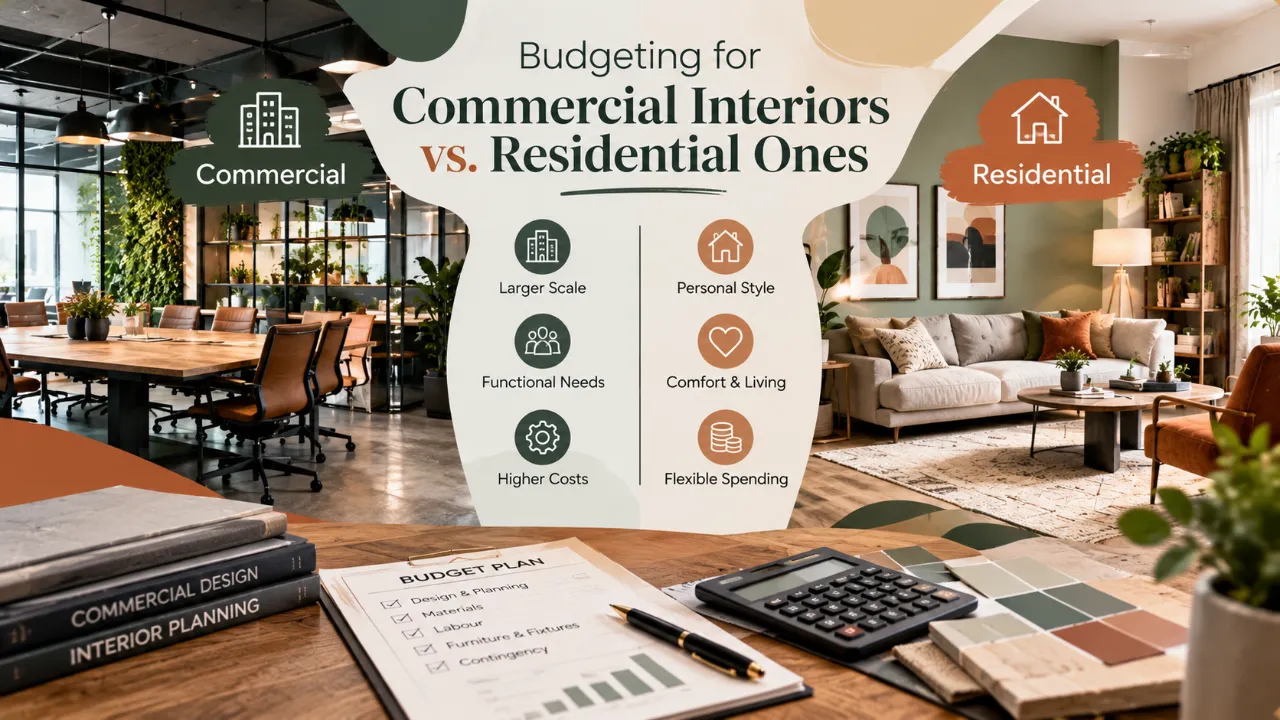
Budgeting for Commercial Interiors vs. Residential Ones
At first glance, budgeting for a commercial interior and a residential interior can seem similar. Both involve design, materials, labour, furniture, lighting and installation. But the way the budget is built can be very different.
A home is usually designed around lifestyle, comfort, storage and personal preferences. A commercial space has to work around business operations, customer or employee movement, durability, brand identity, services and sometimes a strict opening deadline.
That means the same budget-per-square-foot approach cannot always be applied to both. The better approach is to understand what the space needs to do, what work is included and which costs have the greatest impact on the final project.
Residential interiors are generally budgeted around rooms, lifestyle requirements, storage, finishes, furniture and personal preferences. Commercial interiors are generally budgeted around business function, usable area, customer or employee experience, durability, services, branding, furniture, equipment coordination and project timelines.
Neither category automatically costs more or less. The final budget depends on the size, scope, specifications, existing condition and level of finish.
- Start With the Purpose of the Space
- Why Residential Interior Budgets Work Differently
- Why Commercial Interior Budgets Work Differently
- Compare Scope Before Comparing Prices
- How Materials Affect Commercial and Residential Budgets
- Labour and Installation Costs
- MEP and Service Requirements
- Branding in Commercial Interiors
- Furniture Budgeting
- Why Timeline Matters
- Existing Site Conditions
- Design and Project Management Costs
- Planning for Contingency
- Commercial vs Residential Budget Comparison
- Why Cost Per Square Foot Isn't Enough
- Build the Budget by Category
- Decide Where to Spend More
- Check Quotation Exclusions
- Where Commercial and Residential Budgets Overlap
- Build a Better Interior Budget
- FAQs
1. Start With the Purpose of the Space
Before putting a number against the project, define what the interior needs to achieve.
Residential Priorities
- Comfortable bedrooms
- Functional kitchens
- Adequate storage
- Family seating
- Work-from-home areas
- Personalised finishes
Commercial Priorities
- Workstations
- Reception and waiting areas
- Meeting spaces
- Customer circulation
- Display areas
- Branding and signage
The budget should follow the function of the space rather than starting with a generic price per square foot.
2. Why Residential Interior Budgets Work Differently
Residential projects are usually highly personal. Two apartments with exactly the same carpet area can have completely different budgets because one homeowner may want basic finishes and modular furniture while another may choose premium surfaces, custom carpentry, designer lighting and extensive built-ins.
Common residential budget categories include:
- Civil modifications
- Electrical work
- Plumbing changes
- Flooring
- False ceiling
- Painting
- Modular kitchen
- Wardrobes and storage
- Custom furniture
- Lighting
- Soft furnishings and décor
- Installation and finishing
The biggest residential budget variables are often material specifications, amount of custom work, number of rooms and level of finish.
3. Why Commercial Interior Budgets Work Differently
Commercial interiors have another layer of complexity because the space has to support an operating business.
An office, retail store, restaurant, clinic, salon or hospitality space may require specialised planning that would not normally appear in a residential project.
- Space planning
- Reception and customer areas
- Workstations
- Display systems
- Commercial-grade furniture
- Electrical distribution
- HVAC coordination
- Plumbing
- Data and networking
- Branding and signage
- Storage and back-of-house areas
- Equipment coordination
- Site and project management
4. Compare Scope Before Comparing Prices
One of the biggest budgeting mistakes is comparing two quotations simply because both provide a total amount.
A lower quotation may exclude electrical upgrades, lighting fixtures, installation, painting, project management or other essential work. A higher quotation may simply include a broader scope.
The better comparison is:
5. How Materials Affect Commercial and Residential Budgets
Residential interiors can often prioritise appearance, comfort and personal preference. Commercial spaces usually need to consider how frequently the space will be used and how much wear the materials will experience.
A retail store with constant customer movement may need different flooring and furniture specifications from a private bedroom. Restaurant surfaces may need easier maintenance, while hospitality spaces may require materials selected for both appearance and durability.
The material specification should therefore be connected to the operating conditions of the space.
6. Labour and Installation Can Change the Budget
Labour is not simply about the number of workers on site. Cost can also be influenced by installation complexity, custom fabrication, number of trades, site access, working hours, coordination requirements and finishing standards.
Commercial projects can involve coordination between electrical, HVAC, networking, furniture, signage and other services. Residential projects can also become labour-intensive when there is extensive custom carpentry, civil modification or detailed finishing.
7. Services and MEP Requirements Matter
MEP — mechanical, electrical and plumbing — can become an important part of a commercial interior budget.
- Air conditioning
- Ventilation
- Electrical loads
- Data and networking
- Plumbing
- Lighting controls
- Fire and safety-related systems
- Equipment connections
Residential projects can also involve significant MEP work, especially during renovation, but the scale and operational requirements can be very different.
8. Branding Is a Commercial Cost That Homes Usually Don't Have
A commercial space often needs to communicate the identity of a business.
- Reception branding
- Signage
- Logo applications
- Feature walls
- Brand colours
- Display systems
- Wayfinding
- Product presentation
For retail stores, restaurants, clinics and offices, these elements can form part of the customer or employee experience rather than simply being decorative additions.
9. Furniture Budgeting Is Also Different
In a home, furniture is selected around the people using the space. Commercial furniture may be purchased in larger quantities and according to operational requirements.
Residential Furniture
- Sofas
- Dining tables
- Beds
- Wardrobes
- Study desks
- TV units
Commercial Furniture
- Workstations
- Office chairs
- Meeting tables
- Conference chairs
- Reception furniture
- Storage systems
The commercial furniture budget depends not only on the price of an individual item but also on quantity, specification and usage.
10. Timeline Can Affect Commercial Budgets
For a home, a project delay can be frustrating and inconvenient. For a business, a delay can potentially affect when the space can begin operating.
Commercial projects may therefore require tighter control over procurement, installation, contractor coordination, furniture delivery, equipment coordination and final handover.
A material that is slightly cheaper but significantly slower to procure may not necessarily be the better budgeting decision if it affects the project schedule.
11. Existing Conditions Can Change the Budget
Before finalising a budget, check the existing condition of the property:
- Existing flooring
- Walls and ceilings
- Electrical capacity
- Plumbing
- Doors and windows
- Existing furniture
- Air-conditioning provisions
- Structural constraints
- Site access
- Building restrictions
Commercial properties may also have landlord or building requirements that affect what can be changed. A budget prepared without understanding existing conditions can become unreliable once work begins.
12. Don't Forget Design and Project Management Costs
The interior budget is not always limited to materials and labour. Depending on the project, the overall cost may include:
- Design consultation
- Space planning
- Drawings
- 3D visualisation
- Material selection
- Vendor coordination
- Site supervision
- Project management
- Procurement support
- Installation coordination
When comparing quotations, check whether these services are included or charged separately.
13. Build a Contingency Into the Budget
Interior and renovation projects can uncover conditions that were not visible at the beginning.
- Hidden plumbing issues
- Uneven walls
- Existing electrical limitations
- Damaged flooring
- Additional civil work
- Measurement changes
- Material wastage
- Required site adjustments
14. Commercial vs Residential Budget Comparison
| Budget Factor | Residential Interior | Commercial Interior |
|---|---|---|
| Primary objective | Comfort and lifestyle | Business function and operations |
| Planning focus | Rooms and daily routines | Users, workflow and business activity |
| Furniture | Personal and household use | Often larger quantities and operational use |
| Materials | Comfort, appearance and preference | Appearance, durability and usage |
| Branding | Usually limited | Often an important component |
| MEP | Project-dependent | Can be extensive depending on business |
| Lighting | Comfort and ambience | Task, display, branding and operational needs |
| Timeline | Lifestyle-driven | Often linked to business opening or operations |
| Customisation | Personal preferences | Business requirements and spatial efficiency |
15. Don't Rely Only on Cost Per Square Foot
Cost per square foot can be useful as an early planning reference, but it should not become the entire budgeting method.
Two projects with the same area can have very different requirements. A 1,500 sq ft home with a kitchen, wardrobes, ceilings and standard furniture is not equivalent to a 1,500 sq ft office requiring workstations, meeting rooms, networking, electrical upgrades, HVAC coordination, branding and specialised lighting.
Area + scope + specifications + services + project conditions
16. Create a Budget by Category
Residential
- Civil work
- Electrical
- Plumbing
- Flooring
- Ceiling
- Painting
- Kitchen
- Wardrobes
- Furniture
- Lighting
- Décor
- Installation
- Contingency
Commercial
- Space planning
- Workstations
- Reception
- Display systems
- Branding and signage
- Networking
- HVAC coordination
- Fire and safety-related requirements
- Commercial furniture
- Equipment coordination
- Project management
- Installation
- Contingency
17. Decide Where to Spend More
A good budget does not mean making every item as cheap as possible. Instead, identify the elements that have the greatest impact on the space.
In residential interiors, priorities may include kitchen functionality, wardrobe hardware, storage, frequently used furniture, electrical work and water-prone areas.
In commercial interiors, priorities may include high-use surfaces, workstations or customer-facing furniture, lighting, electrical and data infrastructure, HVAC, branding, reception or display areas and installation quality.
The right priorities depend on how the space will actually be used.
18. Watch Out for Exclusions in Quotations
Before approving an interior quotation, ask what is not included.
- Appliances
- Loose furniture
- Decorative lighting
- Civil repairs
- Electrical upgrades
- Plumbing changes
- HVAC
- Networking
- Signage
- Delivery
- Installation
- Taxes
- Building charges
- Approval-related costs
An apparently low quote can become much higher if several essential items are excluded. Compare inclusions, exclusions, quantities, specifications and applicable charges before making a decision.
19. Commercial and Residential Budgets Can Also Overlap
The distinction is not always absolute. A home office may need some commercial-style infrastructure. A boutique retail space may have a relatively simple interior. A luxury residence may involve extensive custom fabrication and complex services.
Instead of asking, “Are commercial interiors more expensive than residential interiors?”, ask:
20. A Better Way to Build Your Interior Budget
Before requesting quotations, prepare a basic project brief.
- Property type
- Area
- Number of spaces
- Existing condition
- Required civil work
- Electrical requirements
- Plumbing requirements
- Furniture requirements
- Storage requirements
- Material preferences
- Finish level
- Branding requirements, if applicable
- Timeline
- Must-have items
- Nice-to-have items
- Budget range
For an early estimate, you can use the Walls to Wonder Interior Cost Calculator. It allows project details, property type, spaces, services, finishes and budget preferences to be considered when generating an estimate.
If you are looking for professional help, explore interior designers on Walls to Wonder and compare professionals based on their services and project experience.
Planning an Interior Project?
Start with a clearer understanding of your space, budget and design requirements before moving into execution.
Explore Design My Room to visualise ideas for your space, or use the Interior Cost Calculator for an early budgeting reference.
Frequently Asked Questions
Is commercial interior design always more expensive than residential interior design?
Not necessarily. Cost depends on size, scope, materials, services, complexity, specifications and the existing condition of the property.
Can I use a residential interior cost estimate for a commercial project?
It can provide a very rough starting reference, but commercial projects often involve different furniture, services, branding, durability and operational requirements. A project-specific scope is more useful.
What is the biggest difference in commercial interior budgeting?
Commercial budgeting often has to account for business operations, higher usage, specialised services, branding, larger quantities and project timelines in addition to design and construction.
Should furniture be included in the interior budget?
Yes, if furniture forms part of the project scope. Always clarify whether loose furniture, built-in furniture and installation are included in the quotation.
Why do two interior quotations for the same space vary so much?
Differences can come from materials, hardware, quantities, labour, design fees, services, installation, project management and exclusions. Compare the scope before comparing the final price.
Should I keep a contingency budget?
A contingency can help manage unexpected site conditions, additional work or changes. The appropriate amount depends on the property and project scope.
What should I ask before accepting an interior quotation?
Ask for a clear scope, material specifications, quantities, inclusions, exclusions, taxes, installation details, payment milestones, timeline, warranty terms and variation charges.
Final Takeaway
Commercial and residential interiors should be budgeted differently because they solve different problems.
A home budget is primarily about lifestyle, comfort, storage and personal choices. A commercial budget has to consider business operations, durability, services, branding, user movement, quantities and timelines.
The most reliable approach is to compare scope rather than just price. When the scope, specifications, quantities and exclusions are clear, the budget becomes much easier to understand and control.
Get a personalised estimate for your home
Choose your rooms, materials and preferences to understand a practical interior budget before you commit.