
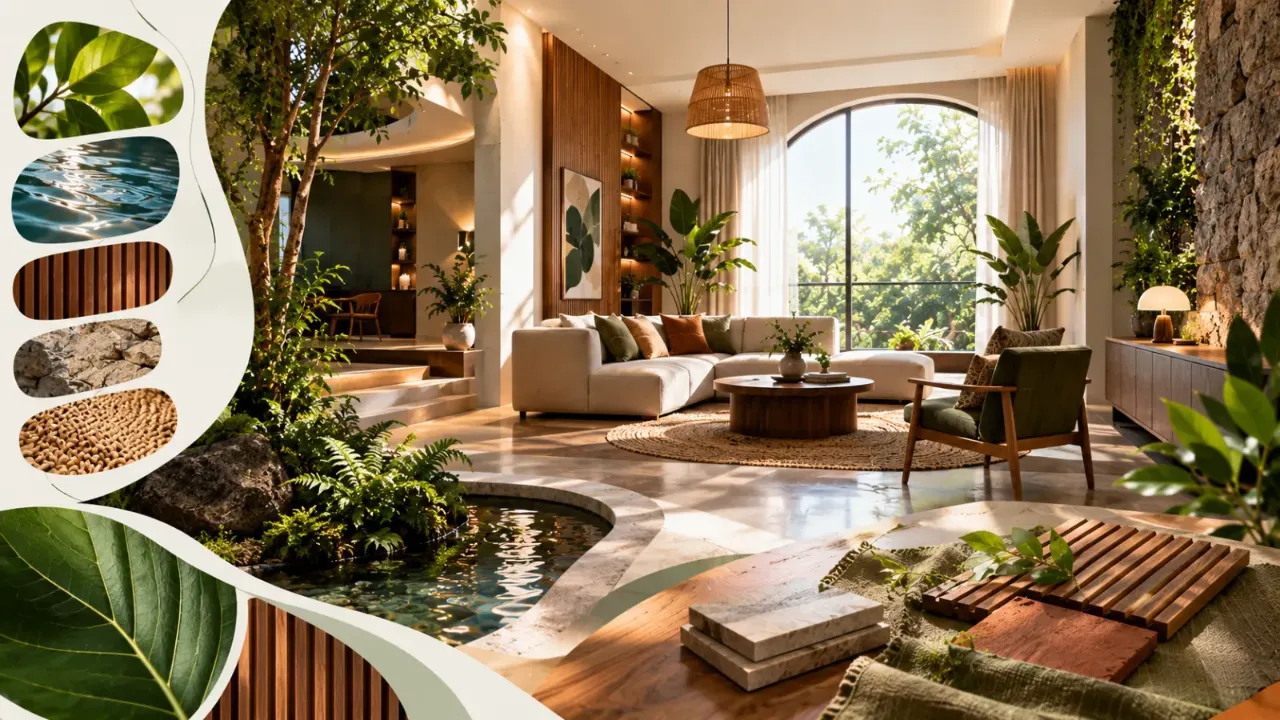
Beyond Greenery: How Biophilic Design Really Works
Biophilic design is often reduced to one simple idea: add plants. But greenery is only one way to create a stronger relationship between people and nature.
A truly biophilic home also considers daylight, views, airflow, materials, textures, patterns, spatial planning and the way a room changes throughout the day.
The goal is not to decorate a room with nature. It is to design the room with nature in mind.
- What Biophilic Design Actually Means
- Why Plants Are Only One Part
- Natural Light as a Design Tool
- Let Nature Be Something You Can See
- Natural Materials and Sensory Experience
- Think About Airflow, Not Just Air-Conditioning
- Bring Nature In Through Patterns and Forms
- Use Texture to Create Visual Depth
- Create Moments of Prospect and Refuge
- Water Can Be Subtle
- Biophilic Design Is Not Just Green
- Design for Change Throughout the Day
- Biophilic Design in Small Indian Homes
- Common Mistakes in Biophilic Interiors
- A Simple Biophilic Design Framework
- FAQ
What Biophilic Design Actually Means
Biophilic design is an approach to architecture and interiors that intentionally incorporates connections to nature into the built environment.
Those connections can be direct, such as plants, water, daylight, views and fresh air. They can also be indirect, such as timber, stone, natural textures, organic patterns and forms inspired by nature.
Then there is the spatial side of biophilic design. The way a room offers openness, shelter, privacy, framed views or a gradual transition between spaces can also influence how connected it feels to the natural world.
This means biophilic design is not one fixed visual style. A contemporary apartment, traditional Indian home, compact flat or large villa can all use biophilic principles differently.
1. Plants Are Only One Part of the Picture
Plants are probably the most recognisable element of biophilic interiors because they are visible, accessible and relatively easy to add.
They can soften hard architectural lines, introduce colour and texture, and bring living elements into a room.
But adding more plants cannot solve a room that receives almost no daylight, has poor airflow and is filled with visually harsh materials.
- Plant Décor
Plants are added mainly as decorative elements to introduce greenery, colour and texture
- Biophilic Thinking
The room is planned around daylight, views, materials, airflow, sensory variation and a meaningful connection to nature
2. Natural Light Is One of the Strongest Tools
Good biophilic design begins long before the planter arrives.
Daylight changes throughout the day. Morning light, afternoon brightness and softer evening conditions create a room that feels dynamic rather than visually static.
Instead of treating windows simply as openings for light, think about how they frame and distribute it.
- Where are the windows positioned?
- How deeply can daylight reach into the room?
- Does furniture block the opening?
- How do curtains filter the available light?
- Do finishes reflect or absorb the light?
- Are partitions preventing light from reaching deeper into the home?
Even a small home can benefit from thoughtful daylight planning. A translucent partition, lighter finish, internal opening or strategically placed mirror may help distribute available daylight.
3. Let Nature Be Something You Can See
A connection with nature does not always require bringing nature indoors. Sometimes the better design decision is to make the outside more visible.
A window overlooking trees, a balcony garden, a courtyard, a terrace or even a patch of sky can become an important visual element in the room.
Furniture placement matters here. Seating does not always need to face the television. In some spaces, orienting a chair or sofa toward a garden, window or balcony can make the outdoor view part of the interior composition.
4. Natural Materials Create a Different Sensory Experience
Biophilic design also works through touch.
Timber, stone, cane, clay, linen, jute, wool, cotton and other tactile materials can introduce visual and physical qualities that feel less synthetic.
This does not mean every surface needs to be raw, rustic or unfinished. A modern home can still use polished stone, refined wood finishes, subtle textured fabrics and carefully selected natural materials.
Combine quiet smooth surfaces with tactile fabrics, woven details or natural textures.
Balance stone, timber and tile with upholstery, rugs and softer materials.
Subtle material variation can create depth without making the space feel overly decorative.
Let different surfaces work together instead of relying on one material throughout the room.
5. Think About Airflow, Not Just Air-Conditioning
Fresh air is another overlooked part of nature-connected design.
Cross ventilation, operable windows, high-level openings, internal courtyards and carefully planned openings can help create movement within a home.
Airflow can also change how a room feels over the course of the day. A gentle breeze, shifting curtains and changing indoor temperatures create a more dynamic experience than a completely sealed environment.
Ventilation strategies still need to respond to local climate, pollution, noise, privacy and comfort. Biophilic design does not mean keeping every window open all day. It means considering natural environmental conditions as part of the design.
6. Bring Nature In Through Patterns and Forms
You do not always need real wood or living plants to reference nature.
Biophilic interiors can use patterns inspired by leaves, branches, waves, cells, stones, curves and other organic structures.
- Wallpaper and wall coverings
- Rugs and upholstery
- Tiles and surface patterns
- Screens and partitions
- Furniture silhouettes
- Lighting fixtures
- Decorative details
The goal is interpretation rather than creating a literal nature theme. A curved partition can reference an organic form without actually looking like a leaf.
7. Use Texture to Create Visual Depth
Nature is rarely perfectly flat and repetitive. Bark has variation. Stone has irregularity. Leaves have different shapes, tones and layers.
Interiors can borrow that sense of variation through texture.
This kind of layering is especially useful in minimalist interiors, where a restricted colour palette can otherwise make the room feel visually flat.
8. Create Moments of Prospect and Refuge
Biophilic design is also about how a person experiences space.
Some positions feel comfortable because they offer a clear view across the room or toward the outside. Others feel comfortable because they provide a degree of shelter and privacy.
A position with a useful visual connection across the room or toward the outdoors.
A more sheltered position that creates comfort, privacy or a sense of retreat.
A reading chair tucked into a corner can create a sense of refuge. A window seat overlooking a garden can provide prospect. A partially screened balcony can offer both.
These spatial conditions are created through planning, which is why biophilic design belongs as much to architecture and space planning as it does to styling.
9. Water Can Be Subtle
Water is another natural element that can contribute to a biophilic experience, but not every home needs an indoor fountain.
In larger homes, a courtyard water feature, garden pond or small outdoor installation may become part of the overall experience.
In smaller homes, the reference can be much more restrained. A view toward water outside, an appropriate balcony feature or the sound of moving water may provide another sensory layer.
10. Biophilic Design Is Not Just a Green Colour Palette
Another common misunderstanding is that biophilic interiors must be green.
Green is associated with vegetation, but nature also contains sand, clay, timber, stone, sky, earth and water.
Beige, ivory, sand and soft cream can create a calm natural base.
Terracotta, clay, mocha and muted brown can introduce warmth.
Olive, sage and deeper botanical tones can work as controlled accents.
Deep blue, stone grey and timber tones can add depth without creating a themed room.
11. Design for Change Throughout the Day
Nature is constantly changing. Light shifts, shadows move, leaves move in the wind and temperatures change.
Interiors can reflect some of this variation.
- Sheer curtains can soften morning light.
- A shaded balcony can change the character of a room during the afternoon.
- Layered lighting can support different moods after sunset.
- Plants can change seasonally.
- Natural materials can develop variation and patina over time.
The result is a home that does not look exactly the same at 10 a.m. and 10 p.m.
12. Biophilic Design Can Work in Small Indian Homes Too
Biophilic design is sometimes associated with large villas, courtyards and expansive glass walls. That can make it seem unrealistic for an apartment or compact urban home.
But the principles can be scaled down.
Treat it as a visual focal point rather than an isolated outdoor area.
Place greenery where the available light and maintenance routine actually support it.
Use timber, cane, woven details and tactile fabrics selectively.
Use light-filtering window treatments and layouts that do not unnecessarily block openings.
A small home can also benefit from framed outdoor views, better airflow between connected spaces, compact herb-growing zones and translucent partitions where appropriate.
13. The Best Biophilic Spaces Do Not Look Like “Biophilic Spaces”
A successful biophilic interior should not feel as though every design decision was made to demonstrate a trend.
You should not enter a room and immediately think about the number of plants, botanical prints or natural materials being used.
Instead, the space should simply feel comfortable, alive, balanced and connected to its surroundings.
The View supports the furniture layout.
The Materials support the palette and tactile experience.
The Ventilation supports comfort.
The Lighting supports changing conditions through the day.
The Plants support the composition rather than carrying the entire concept.
14. Common Mistakes in Biophilic Interiors
- Treating plants as the entire concept: Greenery cannot replace good planning, light or ventilation.
- Adding too much greenery: Plants need appropriate light, scale and maintenance.
- Creating a themed room: Too many botanical prints and nature-inspired accessories can make the result feel forced.
- Ignoring practicality: Natural materials and open windows still need to work with the home's climate, privacy and maintenance needs.
- Repeating one natural element everywhere: Too much timber, cane or green can become visually predictable.
- Forgetting the layout: Biophilic design is not only about finishes. It also depends on how people move, sit, look and live in the space.
15. A Simple Way to Think About Biophilic Design
Instead of asking, “Where can I add plants?” ask:
Can the room make better use of daylight, greenery, sky or outdoor views?
Can natural textures and comfortable materials improve the sensory experience?
Can air move through the space more effectively?
Can quieter, more natural sensory experiences be encouraged?
Can materials become more tactile and varied?
Can light, shadow and airflow change throughout the day?
Can the layout create both openness and comfortable retreat?
Can the design work with the home's climate, maintenance needs and everyday habits?
Biophilic Design Is Ultimately About the Whole Experience
Plants are easy to photograph, which may be one reason biophilic design is often reduced to Instagram-friendly greenery.
But the deeper idea is much broader.
It is about daylight entering a room. It is about looking out toward a tree-lined balcony. It is about feeling timber under your hand. It is about fresh air moving through a well-planned space. It is about natural patterns, changing shadows, tactile materials and moments of quiet.
Most importantly, it is about designing homes that acknowledge that people do not live separately from nature.
They live alongside it.
Bring the Idea Into Your Own Space
Start by exploring how your existing room could be reimagined around your preferences, layout and design direction.
Final Thought
Biophilic design is not about counting how many plants are inside your home. It is about creating meaningful connections between the people using the space and the natural environment around them.
Daylight. Airflow. Views. Natural materials. Texture. Organic forms. Changing shadows. Comfortable places to retreat.
Plants can certainly be part of the picture. But they should not have to carry the entire design idea.
The most successful biophilic spaces are often the ones where nature feels integrated rather than added.
FAQ
No. Plants are only one part of biophilic design. Daylight, outdoor views, airflow, natural materials, textures, organic patterns and spatial planning can all contribute.
Yes. Biophilic design is not a fixed aesthetic. A modern home can combine clean lines with natural materials, daylight, greenery, outdoor views and organic forms.
No. The principles can be adapted to apartments and smaller homes through daylight planning, balcony views, natural materials, compact planting and better airflow.
Not by itself. Colour can support a nature-inspired palette, but the broader experience of light, materials, views, air and space matters much more.
Start by looking at daylight, outdoor views, ventilation, materials, textures and furniture placement. Then add plants where they genuinely improve the space.
Turn this idea into a plan for your home
Visualise your space, understand the likely budget, or find a professional who can bring the idea to life.