
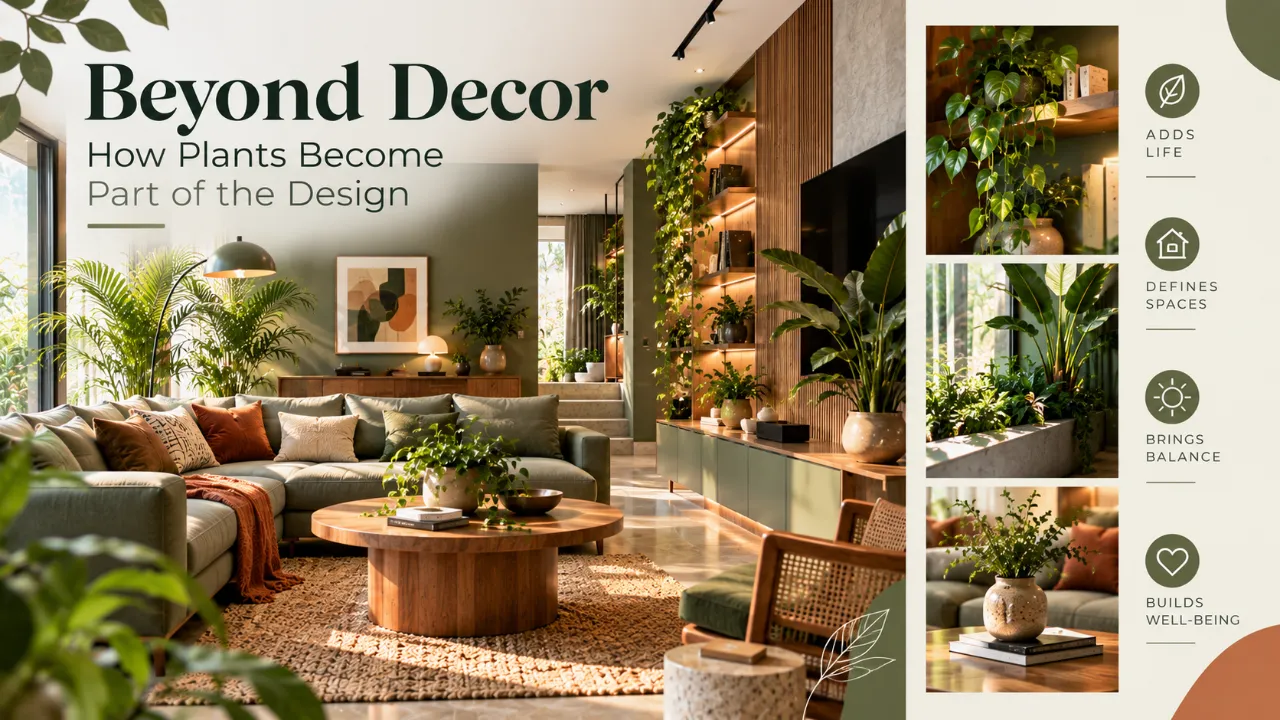
Beyond Décor: How Plants Become Part of the Design
Plants are often treated as the finishing touch of a room — something added after the furniture, lighting and décor are already decided.
But plants can do much more than simply decorate an empty corner.
Used thoughtfully, they become a genuine interior styling tool. They can change how a room feels, guide the eye, soften hard architectural lines, add height, create balance, bring in colour and even help visually separate different parts of an open space.
- Add a vertical layer
- Balance furniture and visual weight
- Create a softer focal point
- Soften hard architectural lines
- Use plants as part of the colour palette
- Define zones without walls
- Layer plants at different heights
- Treat planters as part of the design
- Match plant styling to the interior style
- A simple plant styling formula
Plants Can Add a Vertical Layer
One of the simplest ways plants influence a room is through height.
Interiors often contain plenty of horizontal elements — sofas, coffee tables, consoles, beds and cabinets. Without enough vertical variation, a room can feel visually heavy or flat.
A tall indoor plant can break that pattern.
Place a taller plant beside a low sofa, near a console or in an otherwise empty vertical corner to create another layer within the composition. Plants with upright growth can also draw the eye upward and make a room feel more visually balanced.
This works particularly well in interiors with lower furniture, clean lines or large amounts of uninterrupted wall space.
The goal is not to fill every tall corner. It is to introduce height where the composition needs it.
Use Plants to Balance Furniture
Plants can act almost like visual counterweights.
Imagine a large sofa occupying one side of a living room while the opposite side feels relatively empty. Instead of adding another piece of furniture just to fill the space, a substantial plant can create enough visual weight to balance the composition.
The same principle works with cabinets, beds, dining tables and accent chairs.
A large planter beside a bulky furniture piece creates a different relationship from a tiny plant sitting beside it. Scale matters.
Think about the overall visual weight of the room and choose plant size accordingly.
Create a Focal Point Without Making It Feel Forced
Not every focal point needs to be a television wall, artwork or statement light.
A striking plant can become a softer focal element, especially in interiors that already have a calm, neutral palette.
A sculptural plant placed in the right location can naturally attract attention without making the room feel overly decorated.
This can work beautifully near an entryway, beside a lounge chair, in a reading corner or against a quiet wall.
The key is to give the plant enough breathing space.
A statement plant surrounded by clutter loses much of its visual impact.
Soften Hard Architectural Lines
Modern interiors often rely heavily on hard surfaces and geometric forms — stone, glass, metal, cabinetry and straight-edged furniture.
Greenery introduces a completely different visual language.
Leaves bring organic shapes, irregular edges and softer movement into the room.
That contrast can make an interior feel more layered.
For example, a room with a sharp marble coffee table, linear sofa and sleek cabinetry can benefit from plants with naturally flowing foliage. The greenery creates a visual break without requiring major changes to the architecture or furniture.
This is one reason plants can be particularly effective in contemporary and minimalist interiors: they add softness without adding visual clutter.
Use Plants to Introduce Colour
Green is technically a colour, but in interiors it often behaves like a natural bridge between different tones.
Plants can connect wooden furniture, neutral walls, warm finishes and earthy materials while adding a fresh visual note.
The advantage is that greenery can introduce colour without committing the room to a permanent colour scheme.
This makes plants especially useful when the base palette is neutral.
A beige, ivory, taupe or warm-grey interior can gain depth through different shades and textures of green. Darker foliage can create stronger contrast, while lighter or more delicate greenery can keep the space feeling airy.
Think of plants as part of your colour palette, not as something separate from it.
Define Zones Without Building Walls
Plants can also help organize a room.
In open-plan homes, visual zoning is important because several activities often happen within one continuous space.
A carefully positioned plant can help create a soft boundary between the living and dining areas, between a workspace and a bedroom, or between a seating area and a passage.
A tall plant, for example, can create a subtle visual pause without blocking the openness of the room.
For compact homes, this is particularly useful because the same styling element can provide personality while helping the space feel more organized.
Layer Plants Instead of Using Just One
A common mistake is treating every plant as an isolated object.
Better styling often comes from variation.
Try combining different heights, leaf shapes and planter sizes rather than placing identical plants throughout the room.
For example, a tall floor plant could anchor one corner, a medium-sized plant could sit on a console, and a smaller plant could add detail to a shelf.
This creates depth.
The plants do not have to match perfectly. They simply need to feel visually related.
Think about creating a composition rather than collecting individual plants.
Choose the Plant According to the Space
Styling should always work with the room rather than against it.
Before selecting a plant, consider:
- Available floor or surface space
- Ceiling height
- Natural light
- Existing furniture scale
- Colour palette
- Visual density of the room
- Maintenance requirements
A large leafy plant might look beautiful in a spacious living room but feel overwhelming in a narrow passage.
Similarly, a delicate plant that works on a bedside table may disappear visually next to a large sectional sofa.
The plant has to suit the scale of the space.
Planters Are Part of the Styling
The plant is only half of the composition.
The planter also contributes to the overall look.
A sculptural ceramic planter can support a refined interior. A simple matte planter can suit a contemporary space. A woven basket may introduce softness and texture into a relaxed setting.
This means planters should be selected with the room's materials and finishes in mind.
Consider the relationship between the planter and nearby elements such as wood, stone, metal, fabrics and wall colours.
Sometimes the planter should blend quietly into the room. At other times, it can become an accent.
Use Plants to Connect Different Materials
A well-styled room usually contains more than one material, but those materials still need to feel connected.
Plants can help create that connection.
Greenery works naturally with timber, rattan, stone, marble, ceramic, brass and many other interior materials.
For example, a warm wood-heavy room can use leafy plants to reinforce its connection with nature, while a marble-and-metal interior can use greenery to soften a more polished material palette.
Plants become the visual link between otherwise different surfaces.
Placement Matters More Than Quantity
Adding more plants does not automatically make a room look better.
In many interiors, one thoughtfully positioned plant can have more impact than five small plants scattered around the room.
Look for areas that genuinely benefit from greenery:
- An empty vertical corner
- A visually heavy furniture arrangement
- A transition between two zones
- A quiet area that needs a focal element
- A shelf that needs a softer organic layer
- A window-side seating area that already has suitable light
Styling is about intention, not quantity.
Match Plant Styling to the Interior Style
| Interior Style | Plant Styling Approach |
|---|---|
| Modern | Sculptural plants, simple planters and clean placement |
| Minimal | Fewer but more impactful plants |
| Japandi | Soft foliage, natural materials and restrained compositions |
| Classic | Large statement plants with elegant planters |
| Bohemian | Layered greenery, varied heights and textured baskets |
| Contemporary Luxury | Structured plants with refined ceramic or stone planters |
| Warm Modern | Natural foliage combined with wood, soft textiles and earthy finishes |
The plant itself does not define the style. The combination of plant, planter, placement and surrounding elements does.
Avoid the “Plant in Every Corner” Approach
One of the easiest ways to lose the styling effect is to distribute greenery too evenly.
If every corner contains the same amount of green, the eye stops noticing individual compositions.
Leave some areas intentionally quiet.
Contrast creates importance.
A room with one strong plant arrangement and several calmer areas can feel more sophisticated than a room where greenery is everywhere.
Let Plants Complement the Architecture
The best plant placement often responds to the existing architecture.
A tall plant can emphasize a double-height space.
A trailing plant can soften a shelf.
A sculptural plant can complement a curved wall.
A cluster of smaller plants can create interest around a window.
A large planter can visually anchor the end of a passage.
Rather than placing plants randomly, look for architectural moments that can benefit from an organic element.
Plants Can Also Support the Mood of a Room
Beyond visual balance, greenery can influence the emotional character of a space.
Large leafy foliage can make a room feel lush and relaxed.
Sparse, sculptural greenery can support a more refined and minimal mood.
Trailing plants can create softness and informality.
Compact greenery on a desk or shelf can make a workspace feel less rigid.
This means plant selection becomes part of the mood-setting process.
Think of Plants as Design Layers
A thoughtfully designed room usually contains several layers:
- Architecture creates the foundation.
- Furniture defines function.
- Lighting shapes atmosphere.
- Textiles add softness.
- Art and accessories introduce personality.
- Plants bring an organic layer that connects many of these elements together.
That is why plants should not be treated as an afterthought.
They can help complete the visual composition of a space.
A Simple Plant Styling Formula
Before adding greenery, look at your room and ask five questions:
Does the room need height?
Consider a taller floor plant.
Does one side feel visually heavier?
Use greenery as a counterweight.
Does the room feel too hard or geometric?
Add softer foliage.
Does an open area need subtle zoning?
Use a strategically positioned plant.
Does the palette need another layer?
Choose foliage and a planter that complement the existing finishes.
This approach is much more effective than simply buying a plant because you like how it looks in a store.
Make the Whole Room Work Together
Plants are just one layer of a well-planned interior. Explore more ways to bring together layout, colour, furniture and styling with Walls to Wonder.
Explore Design My Room, discover Interior Designers, or estimate your Interior Design Cost.
The Final Takeaway
Plants do not have to be the final decorative item added to a finished interior.
They can be part of the design process from the beginning.
Used thoughtfully, they can add height, soften lines, balance furniture, create focal points, introduce colour, define zones and connect different materials throughout a room.
The question is no longer simply, “Where should I keep my plants?”
It becomes:
Frequently Asked Questions
Plants can add height, texture, colour, softness and visual balance while also helping define spaces and create focal points.
No. Plants work best where they solve a visual or functional styling need and suit the available light, scale and maintenance requirements.
Yes. A smaller number of carefully selected plants can add organic contrast without making a minimalist room feel cluttered.
Yes. The planter contributes colour, texture, shape and material, so it should relate to the furniture, finishes and overall interior style.
Turn this idea into a plan for your home
Visualise your space, understand the likely budget, or find a professional who can bring the idea to life.