
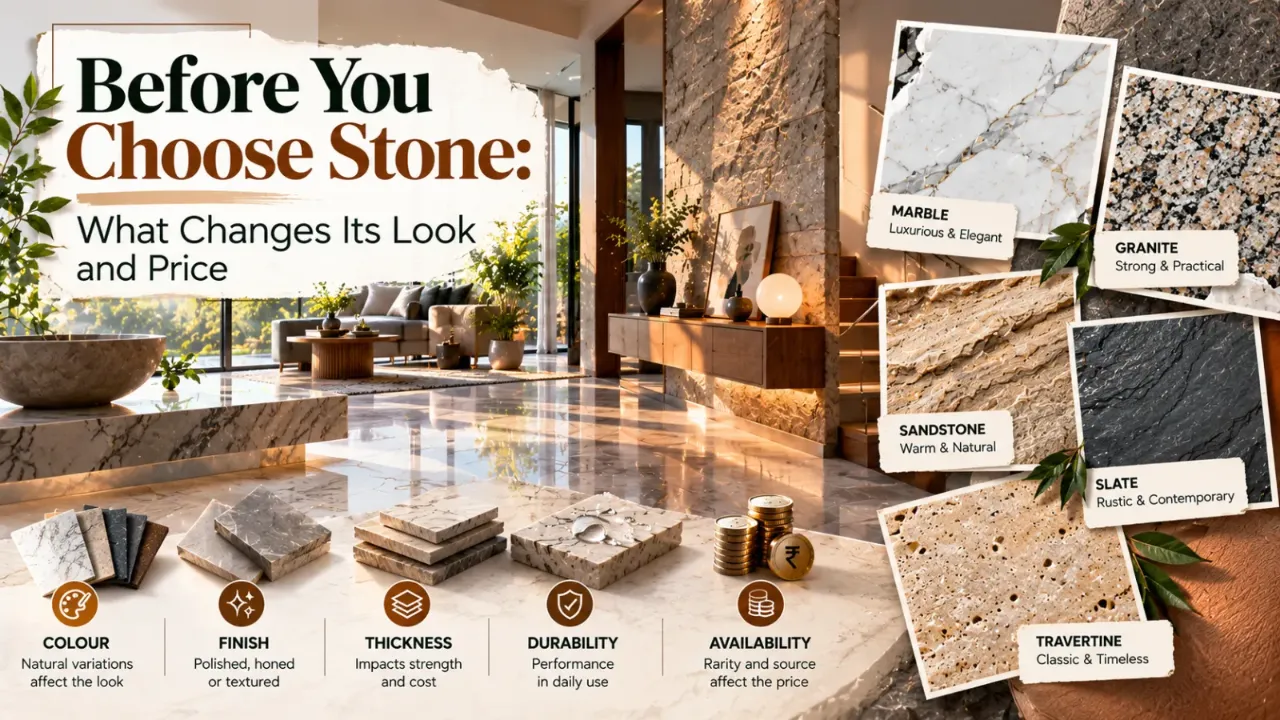
Before You Choose Stone: What Changes Its Look and Price
Stone can add depth, texture and a sense of permanence to an interior. From marble flooring and granite countertops to textured stone walls, it offers a wide range of design possibilities. Yet two stone surfaces that look similar in a showroom can perform differently once installed and used every day.
The difference often comes down to the stone itself, its natural characteristics, the finish applied to its surface, the quality of fabrication and the conditions in which it is installed.
Quick takeaway: Stone type, finish, porosity, fabrication, installation and maintenance all influence the appearance, performance and total cost of a stone surface.
1. Start With the Type of Stone
The first decision is the material. Different stones have different strengths, limitations and visual characteristics.
- Marble: Known for its veining and distinctive appearance. It can create an elegant look for floors, feature walls and selected countertops, but many varieties are vulnerable to acids, etching and staining.
- Granite: Commonly used for kitchen countertops, flooring and other hard-wearing surfaces. Its performance depends on the specific stone, finish, fabrication and maintenance.
- Limestone: Often has a softer, understated appearance. Some varieties are relatively porous and sensitive to acidic products.
- Sandstone: Offers natural texture and colour variation. Suitability depends on the particular stone, its porosity, intended location and protective treatment.
- Slate: Often provides a layered, textured appearance. Surface variation and maintenance needs depend on the variety and finish.
These categories are not performance guarantees. Even stones sold under the same broad name can differ in hardness, porosity, consistency and maintenance requirements.
What to check: Ask for the stone's exact identification, technical specifications, recommended applications and care instructions. Do not choose a slab based only on its colour or showroom label.
2. Understand How the Surface Finish Changes the Result
The finish affects how stone looks, feels, reflects light and responds to everyday use.
Polished finish
A polished surface has a smooth, reflective appearance that can highlight colour and veining. It may suit feature walls, selected floors and countertops. However, polishing does not make every stone stain-proof or maintenance-free. Some polished surfaces show fingerprints, water marks and scratches more clearly, while suitability for wet floors depends on the specific product and conditions.
Honed finish
A honed surface is generally smooth but less reflective than a polished one. It can create a quieter appearance and may make certain marks less noticeable. Honed stone is not automatically stain-resistant; its performance depends on the stone and any protective treatment.
Flamed, brushed or textured finish
Textured finishes can create a tactile, natural appearance and may suit selected outdoor or high-grip applications. Actual slip performance varies. Textured surfaces can also collect more dirt and require additional cleaning.
What to check: Request a sample of the exact stone and finish. View it in the lighting of the intended room and ask how the surface should be cleaned, sealed and maintained.
3. Consider Porosity, Staining and Everyday Performance
Stone is a natural material, and its ability to absorb liquids varies. Porosity influences how a surface responds to spills, moisture and some cleaning products.
In a kitchen, oils, food spills and acidic liquids can affect certain stones. In bathrooms, repeated moisture and cleaning products create different demands. On floors, foot traffic and tracked-in grit can gradually wear or scratch some surfaces.
Before selecting stone, consider:
- How frequently the surface will be used.
- Whether it will contact food, oils, cosmetics or cleaning chemicals.
- Whether it is exposed to water or outdoor weather.
- How easily spills can be removed.
- Whether a suitable sealer is recommended.
- How much routine maintenance you are willing to undertake.
A sealer can reduce the absorption of some liquids in suitable stone, but it does not make every surface completely stain-proof or prevent etching, scratching and all forms of damage.
4. Match the Stone to Its Intended Application
The right stone for one application may not be the right choice for another.
- Flooring: Check abrasion resistance, surface finish, slip suitability, thickness and the condition of the supporting base.
- Kitchen countertops: Consider staining, acid sensitivity, heat exposure, edge design, support and care guidance.
- Bathroom surfaces: Check moisture exposure, slip suitability for floors, sealing requirements and compatibility with cleaning products.
- Feature walls: Consider weight, fixing method, panel size, joints and the condition of the supporting wall.
- Staircases: Check tread thickness, edge detailing, slip performance, structural support and exposed edges.
- Outdoor applications: Confirm suitability for weather, temperature variation, drainage and intended foot traffic.
Do not assume that a stone suitable for a vertical wall will automatically be suitable for a wet floor or an exposed outdoor surface.
5. Look Beyond the Sample: Natural Variation Matters
Stone is formed naturally, so variations in colour, veining, grain, mineral inclusions and pattern are part of its character. A small sample may not show the full variation of a large slab or a complete floor.
- Inspect the actual slabs or the closest available full-size samples.
- Check whether colour and pattern vary significantly between pieces.
- Confirm the quantity available from the same batch or lot.
- Review how the slabs will be cut and arranged.
- Agree on the direction of veining and the placement of visible joints.
- Discuss preferred or unacceptable natural characteristics with the supplier.
For highly veined stone, cutting and placement can make a major difference to the final appearance. If matching patterns across adjoining pieces matters, discuss the layout before fabrication begins.
6. Understand What Drives the Final Cost
The price of stone is only one component of the completed installation. Total cost can vary according to material availability, thickness, finish, dimensions, cutting requirements and site conditions.
- Stone type and grade: Some varieties, colours or patterns may be harder to source or more expensive.
- Slab size and thickness: Larger or thicker pieces can affect material cost, handling and installation.
- Surface finish: Specialised finishes or additional processing may increase the price.
- Cutting and fabrication: Custom shapes, edge profiles, cut-outs and detailed work require additional labour.
- Pattern matching: Bookmatching or carefully aligned veining can increase material selection and fabrication effort.
- Transport and handling: Heavy slabs may require specialised equipment and careful movement.
- Installation preparation: Levelling, structural support, adhesives, fixing systems and substrate repairs may add to the cost.
- Sealing and finishing: Some stones need protective treatment or additional finishing work.
- Wastage and replacements: Natural variation, cutting layouts and breakage allowances can affect the quantity required.
Ask for a written, itemised quotation rather than comparing only the price per square foot. Confirm whether the quoted amount includes measurement, fabrication, delivery, installation, edge finishing, sealing, taxes and waste.
For an initial project budget, the Interior Design Cost Estimator can help you plan the broader interior scope. Stone-specific rates and fabrication charges should still be confirmed with suppliers and installers.
7. Check Fabrication and Installation Before Work Begins
Even good-quality stone can disappoint if it is cut, supported or installed poorly.
Before fabrication, confirm the final measurements and the location of joints, edges, sink cut-outs, taps, electrical openings and other details. For large or heavy stone pieces, the installer should assess the support and fixing requirements for the specific application.
- Are the measurements confirmed on site?
- Is the slab thickness appropriate for the application?
- Are edge profiles and cut-outs documented?
- Are joints and pattern alignment agreed upon?
- Is the substrate level and suitable?
- Are the adhesive, fixing system and support appropriate for the stone?
- Is sealing required before or after installation?
- How will the installed surface be protected during the remaining work?
Do not rely on a visual mock-up alone to confirm structural support or installation suitability. Technical details should be checked by a qualified professional.
8. Plan for Maintenance Before You Buy
Different stones require different care routines. The best choice is one whose maintenance needs suit your household and the way the surface will be used.
- Clean spills promptly with a soft cloth.
- Use a cleaner approved for the specific stone and finish.
- Avoid acidic cleaners on acid-sensitive stones such as many types of marble and limestone.
- Avoid abrasive pads unless the supplier confirms they are suitable.
- Use suitable mats or protective pads in areas exposed to grit and heavy objects.
- Follow the manufacturer's guidance on sealing and resealing.
- Inspect joints, sealant and exposed edges periodically.
- Address cracks, loose pieces or recurring dampness before the problem spreads.
Sealing requirements and intervals vary. Some stone surfaces need regular protective treatment, while others may need little or none. Follow product-specific guidance rather than applying a universal schedule.
9. Make the Final Choice With a Practical Checklist
Before approving a stone design, make sure you have checked the material's appearance and practical requirements.
- Is the exact stone type identified?
- Is the finish appropriate for the intended location?
- Have you inspected the actual slab or representative full-size samples?
- Are porosity, staining, scratching and cleaning requirements understood?
- Is the stone suitable for moisture, weather or foot traffic where relevant?
- Have thickness, measurements, cut-outs and edge details been confirmed?
- Is the fabrication and installation scope clearly written down?
- Does the quotation include transport, labour, finishing and any required sealing?
- Are natural variations and pattern placement agreed upon?
- Do you know how to clean and maintain the finished surface?
Taking time to confirm these details can help you avoid choosing a material that looks right but proves difficult to maintain or expensive to install.
A Final Thought
Stone designs offer a wide range of possibilities, but appearance alone does not determine whether a surface is the right choice. Stone type, finish, porosity, fabrication, installation and maintenance all influence the final result.
Choose the material for the conditions in which it will be used, inspect the actual stone where possible and compare complete quotations. A well-informed selection can help you achieve the desired look while keeping performance and long-term costs in view.
Frequently Asked Questions
1. Which stone is best for home interiors?
There is no single best stone for every application. Marble, granite, limestone, sandstone and slate each have different characteristics. The right option depends on where it will be installed, expected use, maintenance needs and budget.
2. Does a polished stone finish last longer than a honed finish?
Not necessarily. Polish and honing describe surface finishes, not a universal durability ranking. The stone's characteristics, traffic, cleaning and maintenance influence how the surface performs.
3. Does natural stone need sealing?
Some natural stones and applications benefit from sealing, while others may not require it. Confirm the stone's absorption characteristics and follow the supplier's recommendations for the specific product.
4. Why can two stone slabs have different prices?
Prices can vary because of stone type, rarity, colour and pattern, slab dimensions, thickness, finish, availability and fabrication requirements. Compare equivalent specifications before deciding.
5. Is natural stone suitable for bathrooms?
Some natural stones can be used in bathrooms when the stone, finish, installation and maintenance are suitable. For floors, check slip performance and moisture requirements carefully.
6. What should a stone installation quotation include?
It should clearly identify the material and quantity, measurements, fabrication, edge profiles, cut-outs, transport, installation, fixing materials, finishing, sealing where required, taxes and any other applicable charges.
7. How can I maintain stone surfaces?
Use a cleaner approved for the stone and finish, remove spills promptly, avoid incompatible chemicals and follow recommended sealing and maintenance instructions. Address damage or persistent moisture early.
Get a personalised estimate for your home
Choose your rooms, materials and preferences to understand a practical interior budget before you commit.