
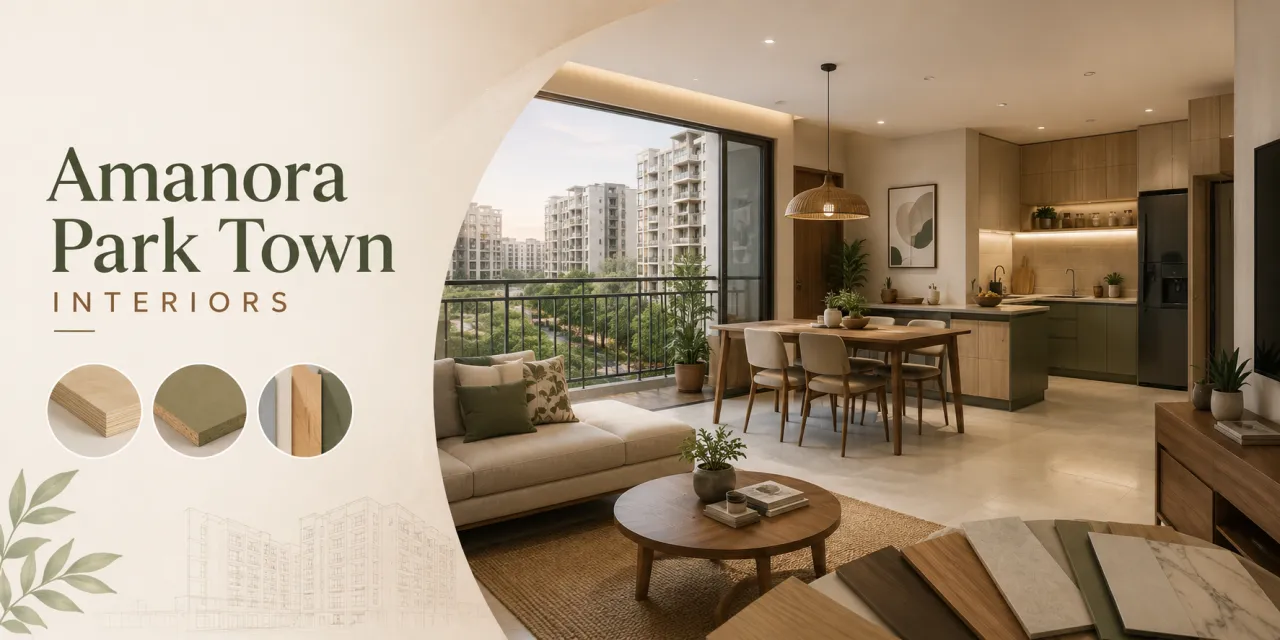
Amanora Park Town Interiors: Choosing Plywood, HDHMR and Finishes Room by Room
At the entrance of an Amanora Park Town home, a materials decision is already waiting: should the storage be built for occasional use, daily shoes and bags, or the dampness that can arrive with a Pune monsoon? A useful interior materials guide for Amanora Park Town, Pune is less about choosing the costliest board and more about matching every substrate, finish and edge to the work it must do.
Homes in and around Amanora Park Town may include compact apartments, larger family layouts, rental-ready interiors or a partial refresh of an existing home. The right specification can therefore change from room to room. Before comparing designers and companies serving the area, browse the Amanora Park Town interior design directory to understand the available service context, then ask each professional to explain the material logic behind the quotation.
At the foyer, the first test is abuse, not appearance
An entrance unit handles footwear, keys, delivery parcels and repeated contact with hands. A practical combination may be plywood or HDHMR for the carcass, laminate on exposed faces and a durable edge band on every visible board edge. If the foyer includes a pooja niche, the backing and shelves need a separate conversation: heat, oil, dust and cleaning habits matter more than a fashionable finish.
Commercially, plywood is not one uniform product. Its grade, thickness, core construction and bonding quality affect stability and suitability. HDHMR is a dense engineered board that can give a smooth surface for painted shutters and storage, but its performance still depends on correct sealing, support and installation. Do not accept a quotation that says only premium board.
In the kitchen, moisture changes the hierarchy
Move next to the kitchen and the material conversation becomes more demanding. Sink-base cabinets, plumbing-adjacent shutters and areas exposed to wet cleaning deserve closer attention than a tall dry-storage unit. Plywood may be preferred for selected carcasses where dimensional stability and repairability are priorities. HDHMR can make sense for painted shutters or dry zones when the designer has detailed the sealing and edge treatment. The choice should follow exposure, not a blanket promise that one board is best everywhere.
Laminates are often practical for busy kitchen faces because they are available in many textures and are generally easier to maintain than delicate decorative surfaces. Yet the installation details remain visible over time. Edges around the sink, cut-outs, skirting and appliance openings should be sealed properly. A narrow or poorly bonded edge band can allow moisture ingress even when the main board specification sounds impressive.
| Material or finish | Where it can make sense | What to examine before approval |
|---|---|---|
| Plywood | Carcasses or shutters needing a strong, stable substrate, subject to grade and exposure | Grade, thickness, core quality, bonding, support spacing and edge sealing |
| HDHMR | Painted shutters, dry storage and applications needing a dense, smooth surface | Moisture exposure, cut-edge sealing, thickness, hardware fixing and paint system |
| Laminate | Kitchen, utility and high-contact surfaces where maintenance is important | Surface texture, joint direction, adhesive, edge band and cleaning compatibility |
| Paint or veneer | Shutters and feature panels where colour continuity or natural grain is central | Base preparation, repair expectations, sample approval and site touch-ups |
The living room reveals where finish decisions become expensive
In the living room, homeowners often spend more attention on the visible finish than on what supports it. That is understandable, but a fluted panel, veneer, laminate or painted shutter still needs a suitable substrate and a realistic maintenance plan. A television unit may combine a stable carcass, laminate interiors and a decorative front. Open shelves need adequate thickness and support; otherwise visual lightness can create practical sagging or hardware problems.
Ask the designer to separate fixed carpentry from loose furniture, wall treatments, electrical work and civil changes. These services are often bundled in conversation but not always in the written scope. A company offering design, material procurement, installation, lighting coordination or project management may be useful, but compare the actual deliverables rather than the service labels.
When plywood is worth specifying
Consider it for applications where the structure, fixing strength or exposure justifies the choice. Confirm the exact grade and use it selectively rather than assuming every internal partition needs the same board.
When HDHMR is a sensible alternative
It can suit smooth painted surfaces and dry storage, provided the design controls water exposure and protects cut edges. It is not a universal substitute for every kitchen or utility application.
When laminate earns its place
Use it where repeated touching, dust and routine cleaning make a resilient surface valuable. Texture, colour variation and joint alignment should be approved on a larger sample.
When a decorative finish needs caution
Veneer, high-gloss paint, textured panels and specialty laminates can bring a distinct look, but may require better preparation, more careful handling or future touch-ups.
Bedrooms need a different balance between touch and structure
Wardrobes and dressing units are usually opened daily, so hardware, shutter alignment and edge durability deserve as much attention as the finish. A laminate wardrobe may be straightforward to maintain. Painted HDHMR shutters can provide a seamless colour field, but the quotation should state the paint preparation and number or type of coats rather than simply saying PU or acrylic finish.
For a dressing table, pay attention to the front edge of the top, drawer runners and the junction with the wall. For lofts, ask how the board will be supported and whether the design allows access for future repairs. A lower-cost internal board is not automatically poor value if it is used in a dry, lightly handled location; an expensive board is not automatically appropriate for a poorly sealed edge.
Bathrooms, utility zones and balconies demand honest exclusions
Moisture-prone areas expose weak specifications quickly. A bathroom vanity should not be treated like a bedroom cabinet simply because both have shutters. Plumbing access, ventilation, splash protection, wall dampness, cleaning products and the position of the cabinet all influence the material choice. In a utility area, washing-machine vibration, detergent storage and occasional water contact may affect both board selection and hardware.
For balconies, first clarify what is allowed by the building’s rules and what is exposed to rain or strong sunlight. Indoor-grade finishes may not be suitable for an open edge or wet storage. A designer should mark these boundaries in the scope instead of presenting a balcony cabinet as equivalent to internal carpentry.
Use the quotation to compare judgement, not just board names
Material cost is only one part of an interior budget. Quantity, shutter complexity, drawer count, internal accessories, hardware quality, finish preparation, electrical changes, false ceiling work, delivery conditions and installation time can all alter the final amount. Scope also changes when a home needs dismantling, debris removal, wall repairs or protection of existing flooring.
Request a room-wise or component-wise schedule. It should distinguish carcass, shutters, backs, shelves, edge bands, hardware, finishes and installation. Clarify measurement units and wastage assumptions. If a designer gives a substitution option, ask what changes in durability, appearance, warranty handling and maintenance.
Two checks that can sharpen your budget conversation
Before paying an advance, use independent checks to understand the commercial detail. The interior cost estimator can help you frame a preliminary budget conversation, while the quotation checker can help you inspect omissions and unclear line items. These tools support questions; they do not replace a site measurement or a written specification.
Estimate the scope before committing
Use the cost estimator to organise your requirements and identify which choices need a designer’s detailed quotation.
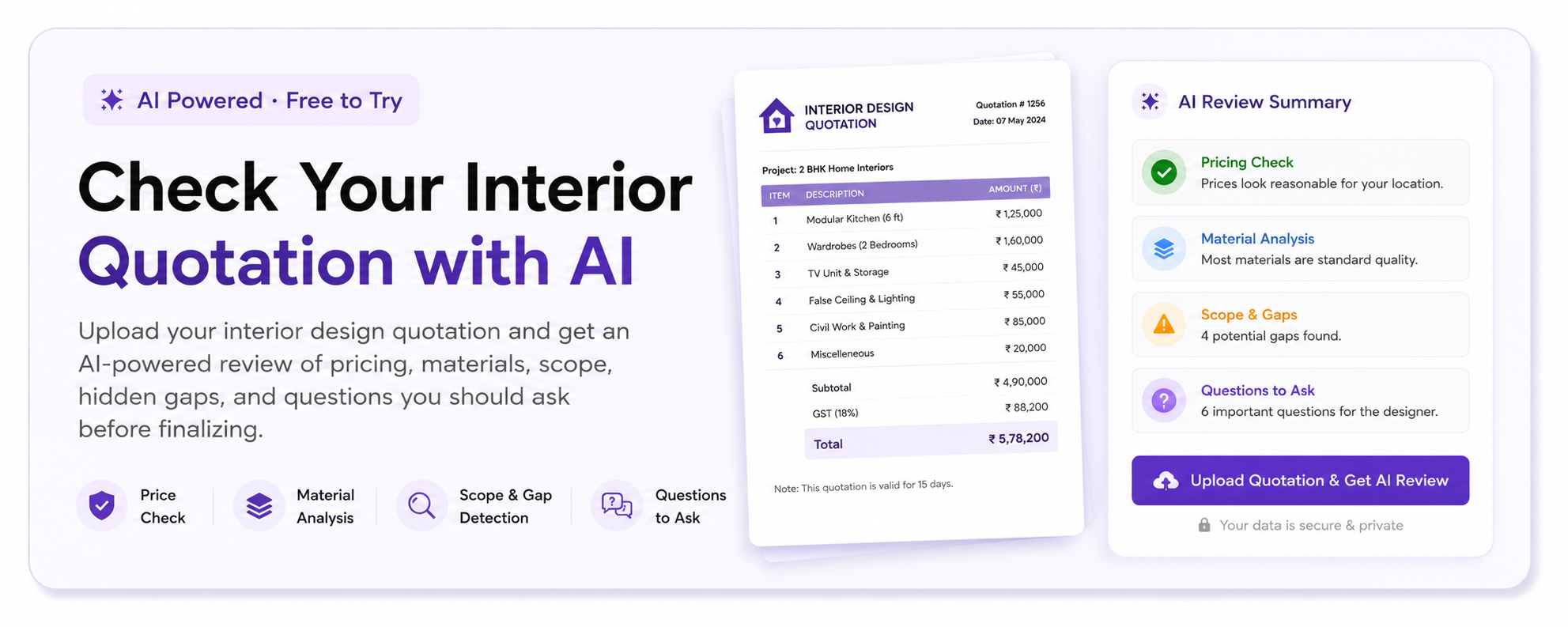
Read the fine print more carefully
Run a draft through the quotation checker and follow up on missing specifications, exclusions and payment milestones.
Before the advance, ask questions that expose execution risk
- Which board, thickness, finish and edge band are specified for each room?
- What happens if the approved material is unavailable, and who approves a substitution?
- Are site measurement, dismantling, transport, installation, debris removal and touch-ups included?
- How are moisture-related defects, hardware failures and finish repairs handled?
- What are the design freeze, payment and handover milestones?
- Which work depends on the building’s permissions or other vendors?
Red flags include vague phrases such as premium material without a grade, a single lump-sum carpentry line, pressure to pay before scope approval, refusal to show a sample board or hardware schedule, and a warranty promise that does not say what it covers. Another warning sign is a designer who recommends the same material for the sink unit, bedroom loft and open balcony without discussing exposure.
Where WallsToWonder fits into the search
WallsToWonder helps homeowners move from inspiration to a more informed brief. Explore design ideas to collect references, read practical projects and expert stories, and browse interior posts for planning context. You can also use Design my room, Find my style and the AI interior assistant to organise preferences before speaking with designers.
For local discovery, return to the Amanora Park Town listing. Designers and companies serving nearby Hadapsar, Magarpatta, Mundhwa and Kharadi may also be relevant for comparison, but confirm their scope, site coverage and availability directly rather than assuming locality presence.
Take a room list, preferred finishes, moisture concerns and a normalised quotation template to the designers you shortlist. That is usually more useful than asking which single board is best for the whole home.
Frequently asked questions
Is plywood always better than HDHMR?
No. The better choice depends on exposure, fixing requirements, finish, support and budget. Specify the board for the application rather than using one material everywhere.
Can HDHMR be used in an Amanora Park Town kitchen?
It may suit selected dry or painted applications, but sink areas and cut edges need careful detailing. Ask for sealing, support and moisture-protection details in the quotation.
What should a laminate specification include?
It should identify the laminate category or product reference, surface, thickness where relevant, adhesive approach, edge band, joint treatment and the board beneath it.
Why do two interior quotations differ so much?
Differences may come from quantities, hardware, finish preparation, internal accessories, electrical or civil work, installation and exclusions. Normalise the scope before judging the total.
How can I compare designers before paying an advance?
Ask for room-wise drawings, a material schedule, milestone payments, exclusions, substitution rules, warranty terms and the person responsible for site coordination.
Turn this idea into a plan for your home
Visualise your space, understand the likely budget, or find a professional who can bring the idea to life.