
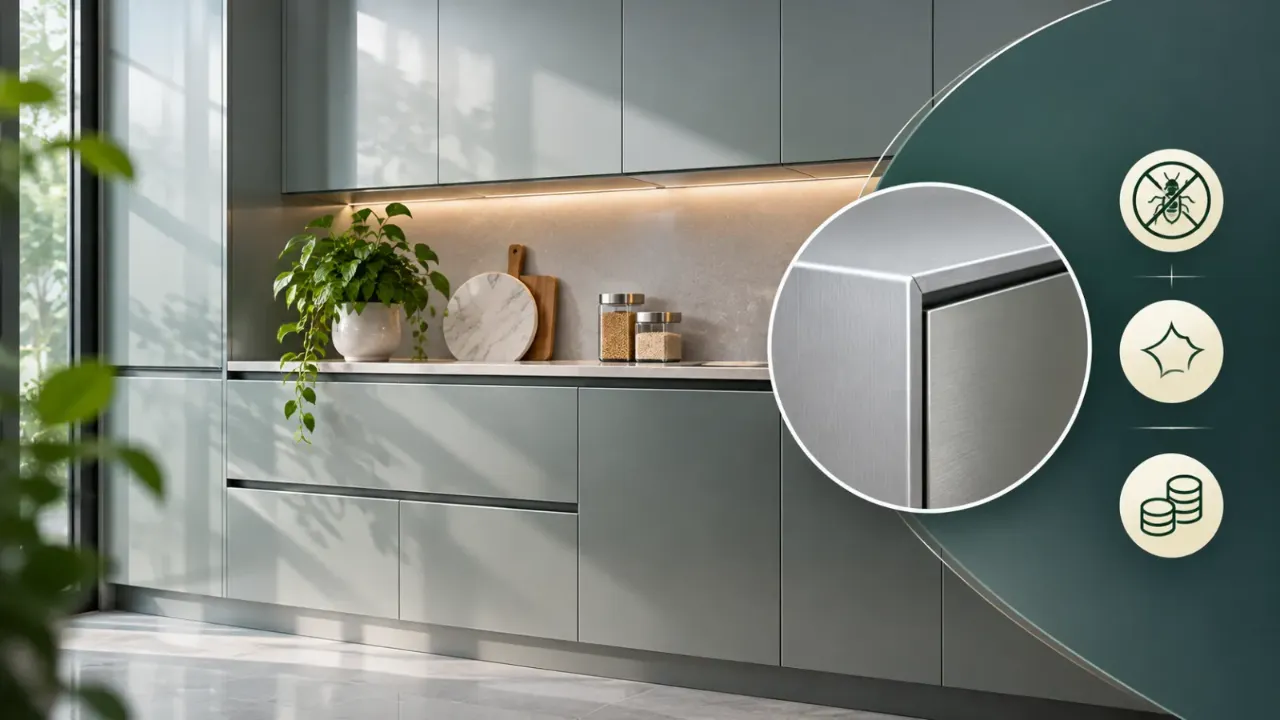
Aluminium Kitchen Cabinets: Termite-Proof, but What About Dents and Cost?
Aluminium kitchen cabinets are often promoted as a solution to some of the biggest problems homeowners face with conventional kitchen storage: termites, moisture damage and swelling. Since aluminium is not a wood-based material, it does not provide termites with food, and it does not absorb water in the same way as plywood or particle board.
That sounds like an easy decision, particularly for kitchens exposed to humidity, plumbing leaks or frequent cleaning. But there is more to cabinet performance than termite resistance.
Aluminium can dent under impact, thin panels may sound hollow, and the final price depends on the profiles, shutters, hardware and finish selected. It also has a different appearance and repair process from a conventional plywood kitchen.
So, is an aluminium kitchen worth considering? Here is what homeowners should understand before choosing one.
1. What Are Aluminium Kitchen Cabinets Made Of?
An aluminium kitchen is not necessarily made from solid aluminium sheets throughout. Most systems use a combination of aluminium profiles, panels, shutters, connectors and hardware.
The exact construction depends on the fabricator and the system being offered.
- Aluminium profiles: These form the cabinet frame and provide structural support.
- Aluminium panels: Used for cabinet sides, backs, shelves or shutter construction in certain systems.
- Honeycomb panels: Lightweight panels with a cellular core, used in some cabinet and shutter systems.
- ACP panels: Aluminium composite panels may be used as shutter or infill material, depending on the product.
- Glass inserts: Glass can be fitted into aluminium frames for a more open or contemporary appearance.
- Hardware: Hinges, drawer channels, handles, connectors and soft-close mechanisms complete the cabinet system.
The important point is that two kitchens described as aluminium modular kitchens may have very different construction quality.
Ask the fabricator to explain which components are aluminium, which are composite or glass, and how the cabinet is assembled.
2. Why Aluminium Cabinets Are Considered Termite-Proof
One of the strongest reasons homeowners consider aluminium is its resistance to termites.
Termites feed on cellulose-based materials such as wood. Aluminium does not contain cellulose, so it is not a food source for termites.
This can make aluminium useful in homes where termite activity is a recurring concern, particularly around the lower cabinets, utility areas and damp sections of the kitchen.
There are other practical advantages:
- Aluminium does not swell like wood-based boards when exposed to water.
- It does not rot in the same way as untreated wood.
- It is not affected by wood-boring insects.
- Its non-porous surface is generally easy to wipe clean.
- It can be useful around areas where minor splashes and frequent cleaning are expected.
However, termite resistance should not be confused with complete protection against every kitchen problem. Wall dampness, leaking plumbing, poor installation, weak joints and damaged finishes can still affect the overall kitchen.
3. Can Aluminium Kitchen Cabinets Get Dented?
Yes. This is one of the most important limitations to understand before buying.
Aluminium is lightweight and reasonably strong for its weight, but thin panels can dent when struck by heavy utensils, appliances or other hard objects.
The likelihood of denting depends on the panel construction, thickness, profile design, support and the type of impact.
Pay particular attention to:
- Cabinet shutters near frequently used work areas.
- Exposed side panels at the ends of cabinet runs.
- Lower drawers that may be struck by feet, stools or heavy cookware.
- Tall pantry shutters that are opened and closed frequently.
- Thin decorative panels with little internal support.
A dent may be difficult to restore perfectly, especially if it affects a coated or finished surface. In some cases, replacing the affected panel or shutter may be more practical than attempting a repair.
Before approving the kitchen, ask the fabricator to show you a finished sample. Inspect the edges, corners and panel rigidity rather than judging the system from a small colour sample.
4. Do Aluminium Cabinets Scratch or Lose Their Finish?
Aluminium does not rust in the same way as iron, but its surface finish still needs attention.
Depending on the system, cabinets may have powder-coated, anodised, laminated, film-covered or other decorative surfaces. Each finish has different characteristics.
- Powder-coated surfaces: Ask about coating quality, surface preparation and the warranty against peeling or coating defects.
- Anodised surfaces: Check the specified anodising quality and whether the finish is sealed appropriately.
- Decorative films: Ask whether the film is suitable for kitchen conditions, particularly near heat and steam.
- Glass inserts: Check the glass specification, edge protection and replacement process.
- ACP or composite shutters: Confirm the panel's construction, finish and suitability for the intended application.
Avoid abrasive scrubbers and harsh chemicals unless the manufacturer specifically approves them. A soft cloth and suitable mild cleaner are usually a better starting point.
5. Are Aluminium Kitchen Cabinets Noisy?
They can be.
A poorly assembled aluminium cabinet may rattle, vibrate or produce a hollow metallic sound when shutters and drawers are used. This is more likely when the profiles are light, panels are not supported properly or buffers and fittings are inadequate.
The hardware and assembly quality make a noticeable difference.
- Hinges suited to the shutter's weight.
- Good-quality drawer channels.
- Soft-close mechanisms where appropriate.
- Rubber buffers or suitable damping components.
- Secure panel fixing and well-finished joints.
- Accurate alignment of shutters and drawers.
Do not assume that every aluminium cabinet will be noisy. A well-designed system can feel controlled in use, but it is worth testing a working sample before placing the order.
6. Aluminium vs Plywood: Which Performs Better?
Aluminium and plywood solve different problems. Aluminium offers strong resistance to termites and water absorption, while good-quality BWP plywood offers a more familiar solid feel, a wider range of finishes and easier local repair in many markets.
The comparison should be based on the complete cabinet system, not simply the material name.
| Factor | Aluminium cabinets | BWP plywood cabinets |
|---|---|---|
| Termite resistance | Not a food source for termites | Requires appropriate treatment and protection |
| Moisture behaviour | Does not swell from water absorption like wood-based boards | Water-resistant, but exposed or poorly sealed edges can be vulnerable |
| Dents and impact | Thin panels can dent | Surface and edges can chip or get damaged |
| Noise | Can sound hollow or rattle if poorly assembled | Usually has a more solid, quieter feel |
| Finish choices | Depends on profiles, coatings, films, glass and panel options | Wide choice of laminate, acrylic, veneer, PU and other finishes |
| Repairs | May require matching profiles, connectors or replacement panels | Local carpenters can often replace or repair board components |
| Hardware fixing | Depends on profile design and suitable inserts or fixing points | Good-quality plywood generally offers reliable screw holding |
| Appearance | Can look sleek and contemporary | Can suit traditional, modern and warm interiors |
Neither option is automatically better for every home.
For a kitchen with recurring termite problems or moisture exposure, aluminium may be worth the additional consideration. For a homeowner who prioritises finish variety, a solid feel and easier local repairs, a well-specified plywood system may be more suitable.
7. What Does an Aluminium Kitchen Cost?
There is no single standard price for an aluminium kitchen. A basic profile-based system and a premium system with heavier profiles, specialised shutters and branded hardware can have very different quotations.
The price usually depends on the following:
1. Profile Quality and Construction
The section size, wall thickness, alloy, finish and overall design of the aluminium profile affect the cost and rigidity of the cabinet.
2. Shutter and Panel Material
A simple panel, honeycomb construction, ACP infill or glass-front shutter will not have the same price. The size and finish of each shutter also matter.
3. Hardware
Hinges, drawer channels, pull-outs, lift-up systems and soft-close fittings can add substantially to the final amount.
4. Cabinet Configuration
A kitchen with many drawers, tall units, corner mechanisms and customised storage will generally cost more than a straightforward cabinet layout.
5. Finish and Detailing
Powder coating, anodised finishes, decorative films, glass and special colours may change the price.
6. Installation and Additional Work
Transport, site measurement, installation, countertop work, sink cut-outs, electrical modifications and finishing details should be checked separately.
What Should You Compare in a Quotation?
Do not compare two quotations only by the price per square foot. Ask both fabricators to provide the same scope of work.
| Quotation item | What to verify |
|---|---|
| Aluminium frame | Profile type, section size, wall thickness and finish |
| Cabinet panels | Material, thickness and construction |
| Shutters | Panel type, finish and edge detailing |
| Hardware | Brand, model, load rating and soft-close provision |
| Drawers | Channel type, load capacity and internal dimensions |
| Accessories | Baskets, corner units, organisers and pull-outs |
| Installation | Labour, transport, levelling and site adjustments |
| Countertop | Included or excluded, material and thickness |
| Warranty | Coverage for profiles, coating, hardware and workmanship |
8. Where Do Aluminium Kitchen Cabinets Work Best?
Aluminium can be a practical choice in specific parts of a home, especially when moisture and pest resistance are priorities.
Under-Sink Cabinets
The area below the sink is exposed to plumbing connections, cleaning products and occasional splashes. Aluminium can be useful here because it does not absorb water like a wood-based board.
However, the cabinet still needs proper installation and access to plumbing connections. A leak should always be repaired rather than hidden behind a moisture-resistant cabinet.
Utility Areas
Utility spaces often accommodate washing machines, cleaning supplies and wet-use equipment. Aluminium storage can be useful where frequent splashing or dampness is expected.
Kitchens With Recurring Termite Problems
Where termite activity has damaged previous wood-based cabinetry, aluminium is worth evaluating. It removes the cabinet material itself as a food source, although surrounding wooden elements and the building still need appropriate pest management.
Coastal or Humid Locations
Aluminium may be suitable in humid environments, but the grade, coating, sealing and hardware should be selected carefully. Do not assume every aluminium finish is equally resistant to corrosion or surface deterioration.
Complete Modular Kitchens
A full aluminium kitchen can work when the homeowner likes the available appearance, understands the impact and repair trade-offs, and receives a well-specified quotation.
9. What to Check Before Ordering an Aluminium Kitchen
Before finalising the design, ask for more than a catalogue and a price estimate.
- Ask for the aluminium profile specification and wall thickness.
- Confirm the construction of the cabinet sides, backs and shelves.
- Check whether shutters use aluminium, ACP, honeycomb panels or glass.
- Inspect the finished corners, joints and edges.
- Open and close sample shutters and drawers several times.
- Test the soft-close mechanism if included.
- Check drawer load capacity against your intended storage.
- Ask how a dented shutter or damaged panel can be replaced.
- Confirm the finish warranty and hardware warranty separately.
- Ask for a written breakdown of installation, accessories and exclusions.
- Check the fabricator's previous installations, not just catalogue photographs.
If possible, inspect a completed kitchen using the same profile and shutter construction that has been quoted for your home.
10. Common Mistakes to Avoid
Choosing aluminium only because it is termite-proof: Termite resistance is valuable, but it does not automatically make the cabinet suitable for every kitchen. Consider impact resistance, noise, hardware and repairability too.
Ignoring profile and panel specifications: A quotation that simply says aluminium cabinets does not tell you how rigid or durable the construction will be. Ask for exact details.
Comparing incomplete prices: One quote may include shutters, hardware and installation, while another may cover only the basic cabinet structure.
Overlooking the repair process: Ask whether individual panels and shutters can be replaced and whether matching profiles and finishes will remain available.
Assuming all aluminium is corrosion-proof in every condition: The finish, quality of the material, exposure and maintenance all matter. Check the product specification, particularly in coastal or demanding environments.
Not testing the working sample: A cabinet may look attractive in a catalogue but feel noisy or flimsy when used. Test the actual hardware and construction before approval.
Final Thoughts
Aluminium kitchen cabinets offer a genuine advantage where termites and moisture are recurring concerns. They do not swell like wood-based boards, and they can be relatively easy to maintain.
But they are not immune to dents, scratches, noisy fittings or poor installation. Their value depends on the quality of the profiles, panels, hardware and finishing, as well as the price of the complete installed system.
For some homes, aluminium may be the right choice for the entire kitchen. For others, it may make more sense in selected wet or utility areas, with plywood used elsewhere.
The best decision is not the cabinet that makes the biggest promise. It is the one whose construction, performance, appearance and repair options suit the way your kitchen will actually be used.
Frequently Asked Questions
1. Are aluminium kitchen cabinets completely termite-proof?
Aluminium is not a food source for termites, so the cabinet material itself is not consumed by them. However, termites can still affect surrounding wooden elements in the home.
2. Do aluminium kitchen cabinets get dents?
Yes. Thin aluminium panels can dent when struck by heavy objects. Panel construction, profile design and thickness influence how well the cabinet withstands impact.
3. Are aluminium kitchen cabinets waterproof?
Aluminium does not absorb water or swell like wood-based boards. However, the complete cabinet system still has joints, fittings, coatings and hardware that need suitable protection and installation.
4. Are aluminium cabinets better than plywood cabinets?
Aluminium offers stronger resistance to termites and water absorption, while BWP plywood usually offers more finish choices, a solid feel and easier local repairs. The better option depends on the kitchen's conditions and the homeowner's priorities.
5. Are aluminium kitchen cabinets expensive?
The price varies according to the profile, panel construction, shutter finish, hardware, accessories and installation. Compare complete itemised quotations rather than relying on a single per-square-foot rate.
6. Do aluminium kitchen cabinets make noise?
They can rattle or sound hollow if the profiles, panels or fittings are poorly assembled. Proper hinges, buffers, damping components and accurate installation can improve the experience.
7. Can aluminium kitchen cabinets be customised?
Yes. The available colours, profiles, shutters, glass inserts and internal arrangements depend on the fabricator's system. Confirm the design options before finalising the order.
8. Can I use aluminium cabinets only below the kitchen sink?
Yes. A mixed-material kitchen can use aluminium in selected wet or moisture-prone areas and plywood in other sections. The two systems need to be planned carefully so that the finishes, dimensions and installation details work together.
Plan a Kitchen That Works for Your Home
Choosing the right cabinet material is only one part of a successful kitchen. Explore Walls to Wonder's AI tools to visualise your space, estimate costs and compare design ideas.
- Whole Home Visualizer – Explore ideas for your entire home.
- Design My Room – Try different looks for your kitchen and other rooms.
- Interior Design Cost Estimate – Get an initial estimate for your interior project.
- Interior Quotation Checker – Review and understand an interior quotation.
- Rate My Room Design – Get feedback on a room design.
- Interior Style Finder – Discover an interior style that suits your preferences.
Explore more ideas and tools at Walls to Wonder.
Get a personalised estimate for your home
Choose your rooms, materials and preferences to understand a practical interior budget before you commit.