
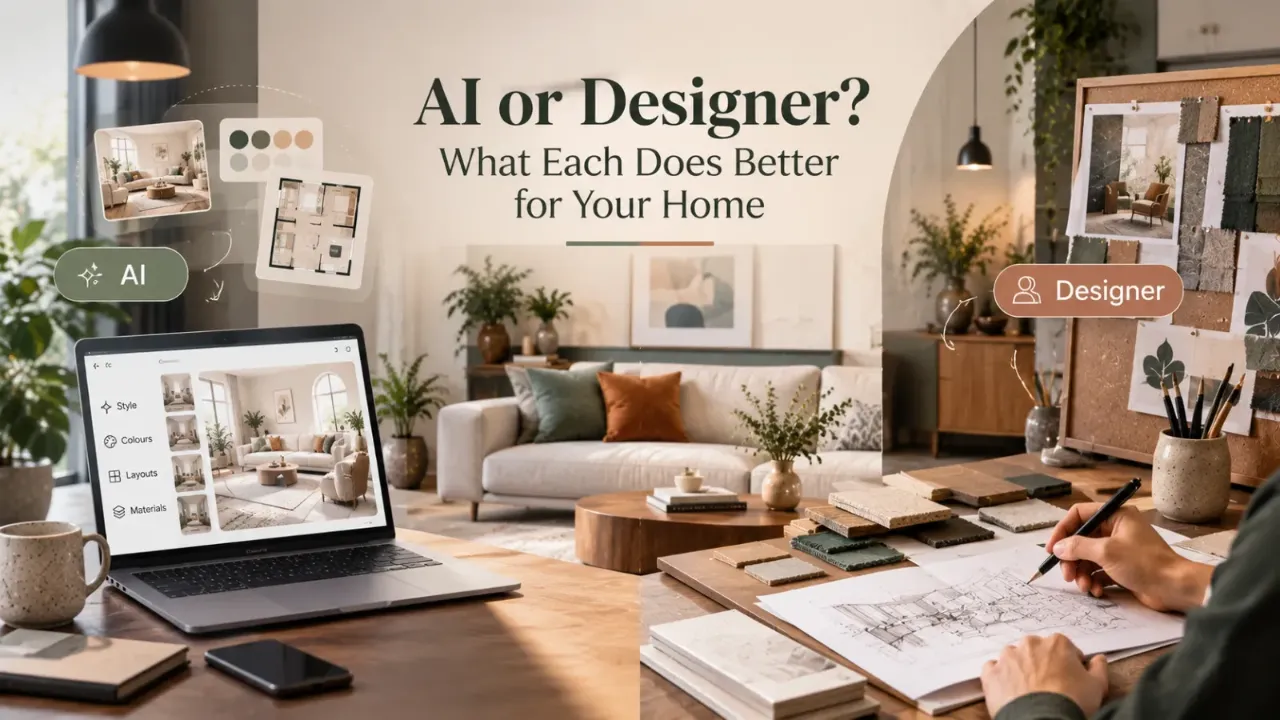
AI or Designer? What Each Does Better for Your Home
There is a new question appearing in interior-design conversations: “Do I actually need a designer anymore?” With AI tools able to turn a room photo into a completely different-looking interior, it is easy to understand why homeowners are asking.
Upload a picture. Choose a style. Change the colour. Try a different sofa. Make the room more luxurious. See another option. All without beginning a renovation.
But there is an important distinction here.
What AI Room Design Does Really Well
The biggest strength of AI is speed.
You can move from “I wonder what my living room would look like in a warm modern style” to a visual concept without spending days preparing mood boards.
That makes AI particularly useful during the exploration stage.
You can test different directions before committing.
Do you prefer lighter wood or darker wood? Would a neutral palette feel too plain? Would a larger rug work? Should the television wall be minimal or more detailed? What happens if the room moves from contemporary to Japandi-inspired?
Instead of imagining every possibility in your head, you can see different interpretations.
That is powerful.
AI Is Excellent at Creating a Starting Point
Many homeowners struggle with the first step because they do not know how to explain what they want.
They may know they like “warm modern” interiors. They may save dozens of inspiration images. They may have a vague idea about beige, wood and soft lighting.
But they do not know what all those preferences look like together in their own room.
An AI room-design tool can turn that vague direction into something visual.
That gives you something to react to. And sometimes reacting to a visual is much easier than trying to describe an idea from scratch.
AI Is Good at Exploring Styles
Another advantage is comparison.
Instead of looking at one design concept and assuming that is the answer, you can explore several.
Minimal
Useful for testing how much visual simplicity feels comfortable in your space.
Modern
Helps explore cleaner furniture, stronger lines and contemporary finishes.
Warm Neutral
Useful for testing softer colours, timber tones and layered textures.
Luxury
Can help visualise richer materials, deeper tones and more dramatic compositions.
The value is not necessarily finding the final design immediately. It is discovering what you like — and just as importantly, what you do not like.
AI Is Also Useful Before You Talk to a Designer
This is where the conversation becomes more interesting.
AI does not have to replace the designer. It can improve the conversation with one.
Imagine arriving at a consultation with:
“This is roughly the mood I want.”
versus:
The second conversation starts much further ahead.
You are giving the designer something visual to interpret, critique and improve.
AI can therefore become a briefing tool.
But AI Does Not Live in Your Home
This is where the human designer becomes much more important.
A room is not just a photograph. People use it.
A family may cook heavily every day. Someone may work from home. Children may need storage that changes over time. A parent may want fewer sharp edges. A homeowner may host large family gatherings. Someone may hate visible clutter. Someone else may need everything easily accessible.
A photograph cannot fully communicate these behaviours.
A human conversation can.
Good design starts with understanding how the space is actually lived in.
A Human Designer Sees the Problems Behind the Picture
An AI visual can make a narrow living room appear more spacious.
But a designer has to ask:
- Where do people actually walk?
- Does the sofa block the circulation?
- Can the cabinet doors open properly?
- Is there enough storage?
- Will the dining chairs interfere with the passage?
- Where will the wiring go?
- Where will the air-conditioner be?
- Does the proposed furniture actually fit the measurements?
- What happens when the room is being cleaned?
Those questions are not nearly as glamorous as choosing a colour palette.
But they determine whether a room works.
Designers Bring Context
Interior design rarely happens inside a perfect rectangle.
There may be beams, columns, existing plumbing, electrical points, doors that cannot move, windows that determine furniture placement, uneven walls, building restrictions, service ducts or existing flooring that needs to stay.
A human designer can account for these conditions while developing the design.
The image is not the design. The relationship between the design and the actual space is the design.
Human Designers Are Better at Trade-Offs
This is one of the most important differences.
Real projects involve compromises.
You have a fixed budget. You want a large kitchen. You also want more wardrobe storage. You love marble-look finishes. But you need money for furniture. You want a dramatic ceiling. But you also need better lighting.
AI can generate another attractive option.
Budget Is More Than a Number
A beautiful design is not useful if the project cannot be executed within the available budget.
Human designers can think in terms of priorities:
- What should be customised?
- What can be bought ready-made?
- Where is premium hardware worth paying for?
- Which finish can be simplified?
- What should be done now?
- What can wait?
- Where could a design decision create additional civil, electrical or plumbing work?
That kind of thinking goes beyond visualisation. It is project strategy.
Human Designers Think About Execution
There is a major gap between “This would look beautiful.” and “This can actually be built here.”
A designer may need to coordinate measurements, carpentry, lighting, electrical work, ceiling details, materials, furniture and other execution requirements.
That means the designer is constantly translating an idea into something physical.
The visual may change during that process. That is normal. In fact, it is often necessary.
AI Is Better at Volume. Humans Are Better at Judgement.
AI
Fast visual exploration, multiple possibilities, style comparison, colour experimentation and a quick starting point.
Human Designer
Personal context, spatial judgement, practical constraints, trade-offs, coordination, budgeting and execution thinking.
This may be the simplest way to think about the difference.
AI can generate many possibilities quickly. A human can help decide which possibility is appropriate.
AI can show you what a room might look like. A designer can ask whether that room makes sense for you.
AI can help you explore. A designer can help you resolve.
AI can suggest. A designer can interpret, adapt and coordinate.
What AI Can Do Before a Designer Gets Involved
There is a very useful workflow for homeowners.
- Start with your actual room.
- Explore a few styles.
- Try different colours.
- Look at furniture directions.
- Identify what immediately attracts you.
- Identify what does not.
- Save the concepts that feel closest to your taste.
- Take those ideas into a designer conversation.
Instead of asking the designer to invent your entire taste from scratch, you are giving them a visual starting point.
The designer can then challenge it.
Maybe the colour works but the furniture layout does not. Maybe the material combination looks good but is impractical for the kitchen. Maybe the television wall needs to be simplified. Maybe the room needs more storage than the inspiration image suggests.
That is where the collaboration becomes valuable.
Where AI Can Mislead You
There is one thing homeowners should never forget:
Furniture can appear perfectly proportioned. Storage can seem endless. A complicated ceiling can look effortless. Materials can look interchangeable. Electrical requirements can disappear. Construction limitations are invisible.
And the image does not show what happens six months after you start using the space.
That does not make AI useless. It simply means you should treat AI output as visual exploration, not a construction drawing.
Where a Human Designer Can Also Go Wrong
Choosing a human does not automatically guarantee a perfect result either.
A designer may have a style you do not connect with. A portfolio may look beautiful but not match the kind of home you need. A designer may prioritise aesthetics differently from you. Communication can become difficult. The budget may not align.
This is why choosing a designer still requires judgement.
Look beyond attractive photographs. Consider whether their portfolio matches your kind of home, whether they understand your needs and whether they can work within your practical and financial constraints.
Sometimes the Best Answer Is Both
The “AI versus human” question assumes you need to pick one.
You often do not.
You decide what resonates.
The designer turns that direction into a realistic plan.
Execution turns the plan into the actual home.
That is a far more useful relationship than treating technology and designers as competitors.
When AI May Be Enough
For a homeowner who mainly needs inspiration, visual direction or help deciding between styles, AI can be extremely useful.
It can help answer:
- What could my room look like?
- Would this colour work?
- Which style do I prefer?
- What kind of furniture might suit this space?
That alone can remove a lot of uncertainty.
But as the project becomes more complicated, the need for human judgement increases.
When You Should Bring in a Designer
The more your project involves structural constraints, major customisation, multiple trades, detailed space planning, extensive renovation or complex execution, the more valuable professional involvement becomes.
The same applies when you simply do not want to manage dozens of interconnected decisions yourself.
A designer's value is not only in making a room look good. It is in helping you make many decisions that need to work together.
The Smartest Homeowner May Use AI Differently
Perhaps the biggest shift is not that AI is replacing designers.
It is that homeowners can arrive at the design conversation better prepared.
You can test your instincts before spending money. You can discover your preferences. You can communicate visually. You can compare directions.
And then you can use professional expertise where the decisions become real.
That changes the role of AI from “designer replacement” to something more useful:
The Bottom Line
AI room design and human designers are good at different things.
AI is fast. AI is visual. AI is useful for experimentation. AI can help you discover a direction.
A human designer brings observation, questioning, spatial judgement, practical experience and the ability to connect many real-world decisions.
So the better question is not:
“Should I choose AI or a designer?”
It is:
Use AI when you need possibilities.
Use a designer when you need decisions.
And when the two are used together, the homeowner can enter the process with clearer ideas while still having professional judgement where it matters most.
Final Thought
Technology is changing how people begin designing their homes.
But a home is still a physical, personal and highly individual space.
AI can help you imagine what is possible. A good designer helps you understand what is appropriate.
The smartest approach may simply be to let each do what it does best.
Ready to Start With Your Own Room?
Walls to Wonder's Design My Room tool lets you upload a room photo and explore AI-generated design directions based on your preferences.
Once you have a clearer idea of what you like, you can explore interior professionals through the Walls to Wonder designer directory and take those ideas further.
Frequently Asked Questions
1. Is AI room design better than a human interior designer?
Neither is universally better. AI is particularly useful for fast visual exploration, while a human designer is better suited to practical decisions, personal requirements, coordination and execution planning.
2. Can AI replace an interior designer?
AI can replace some early-stage visualisation and idea-generation tasks, but it does not remove the need for human judgement when a project involves real-world measurements, constraints, budgets, coordination and execution.
3. What is AI room design best used for?
It is especially useful for exploring styles, colours, furniture directions and visual concepts before making larger design decisions.
4. Should I show AI-generated images to my interior designer?
Yes. They can be useful as visual references for explaining your preferences. A designer can then assess which parts are realistic and adapt the ideas to your actual space.
5. Can AI understand how my family uses the room?
A room photo provides visual information, but it cannot fully understand personal habits, routines, priorities and changing household needs. Those are best explained through a conversation with the homeowner.
6. When should I involve a human designer?
Bring in a designer when you need detailed space planning, significant customisation, renovation coordination, complex layouts, budget decisions or help managing the transition from concept to execution.
7. Can I use AI before choosing a designer?
Absolutely. Exploring ideas first can help you understand your own preferences and make the later design conversation more specific and productive.
Turn this idea into a plan for your home
Visualise your space, understand the likely budget, or find a professional who can bring the idea to life.