
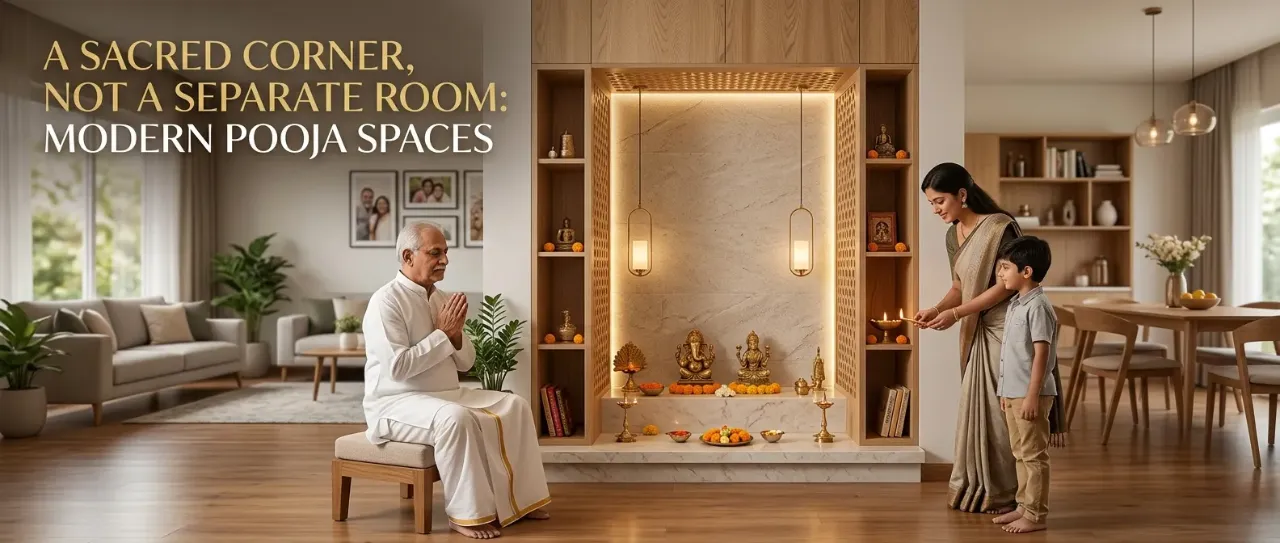
A Sacred Corner, Not a Separate Room: Modern Pooja Spaces
A modern apartment does not always have the luxury of a large room dedicated to every purpose.
There may be one room for living, another for sleeping, a compact kitchen, limited storage, and barely enough wall space left for anything extra.
Yet for many Indian families, a pooja space remains important.
The answer is not to treat it as something that only works in a large traditional home.
A thoughtfully designed pooja space can fit beautifully into a modern apartment without looking forced, bulky, or disconnected from the rest of the interior.
It is to give it a place that feels natural within the way the home is designed today.
Start by Asking What the Pooja Space Needs to Do
Before choosing the mandir, backdrop, or decorative details, think about how the space will actually be used.
Will one person pray there every morning? Will the whole family gather during festivals? Will lamps or incense be used regularly? Will you need space for flowers, prayer books, diyas, offerings, or other ritual items?
These questions matter because a pooja space is not simply a decorative wall. It is a working part of the home.
A beautiful unit that has nowhere to place everyday items may look good in a photograph but quickly become inconvenient.
You Do Not Always Need a Separate Room
The phrase "pooja room" can make people imagine a fully enclosed space. In an apartment, that may not be practical.
Instead, think of the pooja area as a dedicated zone.
- A wall-mounted pooja unit
- A recessed niche
- A compact corner
- A partitioned section of the living area
- A space near the dining area
- A niche integrated into existing cabinetry
- A small enclosure created with a screen or sliding panels
The important part is that the space should feel intentional.
Even a compact area can feel distinct when its proportions, lighting, backdrop, and detailing clearly establish its purpose.
Let Zoning Create the Sense of Separation
A pooja space can have visual privacy without requiring a full wall.
This is especially useful in open-plan apartments.
A decorative screen can separate it from the living room. Fluted panels can create a soft boundary. Glass with a suitable level of visual filtering can maintain openness while giving the space its own identity.
A timber partition, jaali-inspired panel, or partial-height divider can do the same.
The pooja space should feel set apart, but not necessarily cut off.
This allows the apartment to remain visually open while giving the prayer area a stronger sense of place.
Choose the Location Around Everyday Life
Where the pooja space sits can affect how naturally it becomes part of the daily routine.
You may want it in a place that is easy to reach but does not sit directly in the middle of constant movement.
Think about nearby doors, circulation paths, furniture placement, and how the space will be used at busy times.
Also consider what happens when guests are present.
The pooja area should feel comfortable as part of the home rather than becoming a point where people constantly walk through or place unrelated objects.
Respect Family Traditions Without Making the Design Rigid
Different families have different rituals, preferences, and ways of using a pooja space.
Some may want a fully enclosed mandir. Others may prefer an open shelf-style unit.
Some may use traditional materials and decorative detailing. Others may want something understated and contemporary.
That means there is no single visual formula for a modern pooja room.
Instead of following a trend blindly, start with what is meaningful to your family and then translate that into the language of your home.
Traditional symbolism can remain present through proportion, material, craftsmanship, colour, or decorative elements without requiring the entire unit to look like a miniature temple.
Think Vertically When Floor Space Is Limited
In apartments, floor area is often the first constraint.
That is why wall-mounted and vertically organised pooja units can be so effective.
A compact wall unit can use the vertical surface for the shrine itself while incorporating shelves or concealed storage below or beside it.
This keeps the footprint small while still giving you enough room for everyday essentials.
A pooja space benefits from some visual breathing room. The shrine should remain the focal point rather than becoming buried among shelves, boxes, and decorative objects.
Storage Should Be Quietly Built In
Pooja spaces often need more storage than they appear to.
There may be prayer books, incense, diya accessories, matchboxes, flowers, containers, cloths, and festival-specific items.
Leaving everything visible can quickly make the area feel cluttered.
A better approach is to combine open display with concealed storage.
Keep the central shrine and a few meaningful objects visible and visually clear.
Use drawers and cabinets for incense, books, diya accessories and everyday supplies.
Reserve a practical location for occasional ritual items without permanently crowding the shrine.
Keep frequently used items within comfortable reach so the space remains practical.
Lighting Can Completely Change the Mood
Lighting deserves special attention in a pooja space.
A harsh ceiling light can make the area feel like any other corner of the apartment.
A warmer, more layered approach can make the same space feel calm and intentional.
Consider combining soft ambient lighting, a focused light on the idol or central element, concealed lighting behind a backdrop, and subtle shelf lighting where appropriate.
The important thing is control.
The pooja space should feel peaceful when used quietly and still remain visually connected to the rest of the home when the main lights are on.
Let the Backdrop Do the Visual Work
Because a pooja unit is often compact, the wall behind it becomes extremely important.
You do not need a complicated decorative treatment.
A carefully chosen material or texture can be enough.
Natural stone, warm wood, soft neutral finishes, handcrafted details, subtle patterns, or a restrained traditional motif can create a strong backdrop without overwhelming a small apartment.
The backdrop should support the focal point. It should not compete with it.
Think Carefully About Materials
Pooja spaces are associated with warmth, craftsmanship, and tactile details, which makes material selection particularly noticeable.
Wood can bring warmth. Stone can create visual grounding. Metal details can add a traditional touch. Glass can make a compact enclosure feel lighter.
The best combination depends on the wider interior.
A pooja unit that looks beautiful by itself may still feel disconnected if its materials have no relationship to the living room, flooring, cabinetry, or furniture around it.
Try to create a visual connection rather than treating the pooja space as an entirely separate design language.
Modern Does Not Mean Plain
There is sometimes a misconception that a modern pooja room has to be extremely minimal.
It does not.
Modern design can still include traditional motifs, carved or patterned panels, brass or other metal accents, decorative bells, warm wood, textured backdrops, and soft colours.
The difference is usually in how these elements are used.
Instead of layering everything together, choose a few details and give them enough space to stand out.
Consider Doors Only When They Serve a Purpose
Some apartment owners assume that an enclosed pooja room is automatically more appropriate.
Not necessarily.
Doors can provide visual separation, help define the area, and offer a sense of enclosure. But they also take up space.
In a small apartment, sliding panels or folding screens may work better than conventional hinged doors.
An open niche may be even more effective when the apartment already has a clear transition between public and private areas.
The question is whether enclosure improves the way your family uses the space.
Think About Cleaning From the Beginning
Pooja spaces are often maintained frequently, so the design should make cleaning straightforward.
Avoid creating unnecessary ledges where dust can collect.
Choose surfaces that are practical to wipe.
Keep decorative detailing intentional rather than overly complicated.
Make sure storage can contain small ritual items instead of leaving them scattered across the platform.
A space that is easy to clean is much more likely to remain calm and beautiful over time.
Plan Around Lamps, Flowers and Daily Rituals
The visual design should support the physical actions that happen there.
Where will a diya be placed? Where will flowers go? Where will offerings temporarily sit?
Where can a prayer book be kept? Where can a person stand or sit comfortably? Where will used items go afterward?
These small decisions are what turn a decorative unit into a functional pooja space.
It is worth designing around the ritual rather than adding ritual objects after the cabinet has already been finalised.
Small Apartments Benefit From Flexible Pooja Designs
An apartment may change over time.
Furniture gets rearranged. Children grow. Storage needs increase. Work-from-home arrangements appear.
That is why a flexible pooja unit can be useful.
A wall-mounted design can remain visually light. A niche can adapt to changing decor. Sliding panels can open or close the space depending on the occasion.
Good design leaves room for life to change.
The Pooja Space Should Belong to the Home
One of the most common mistakes is making the pooja area look as though it has been inserted into the apartment after everything else was finished.
Instead, look for common threads.
A wood finish used elsewhere in the home can continue here. A metal detail can echo hardware or lighting. The same wall colour can provide continuity. Similar textures can help the area feel like part of the larger interior.
The pooja space can have its own identity while still belonging to the home.
Open, Enclosed or Integrated? Choose Based on Your Apartment
Open Pooja Niche
Best when you want the area to remain visually connected to the rest of the home. It works particularly well in compact living rooms where physical barriers may make the space feel smaller.
Semi-Enclosed Pooja Space
A screen, partial partition, or sliding panel creates stronger separation while keeping some visual openness.
Integrated Pooja Unit
The pooja space becomes part of a larger wall, storage system, or furniture composition for a clean contemporary appearance.
None of these approaches is automatically better.
The right choice depends on your apartment, your family routines, and how much visual separation you actually need.
Do Not Let the Pooja Area Become a Storage Dump
This is especially important in a small apartment.
Because the pooja unit may have shelves and cabinets, it can quickly become an attractive place to store unrelated items.
Once that happens, its visual and emotional importance starts to disappear.
Keep the storage purpose-specific. Give everyday ritual items dedicated locations. Keep the central shrine visually clear.
Sometimes the most important part of the design is the empty space around the sacred element.
Design for the Everyday Version, Not Only the Festival Version
A pooja space often looks its most elaborate during festivals.
But that is not how it will look every day.
Ask yourself what the unit will feel like on an ordinary weekday morning.
Will it be easy to access? Will the diya and other essentials have a place? Will the surrounding area remain clear? Will the lighting still feel appropriate?
The everyday version of the pooja space is the one that deserves the most attention.
A Modern Pooja Space Can Be Both Contemporary and Traditional
This is the balance many apartment owners are actually looking for.
You do not have to choose between a very traditional mandir and a completely minimal shelf.
There is a wide middle ground.
You can combine contemporary proportions with traditional materials. You can use a clean architectural backdrop with a more traditional centrepiece. You can use subtle detailing instead of excessive ornament.
The result can feel rooted without feeling outdated.
Before Finalising the Design, Ask These Questions
- Does the location work with the everyday circulation of the apartment?
- Is there enough space for the rituals your family actually performs?
- Is the shrine easy to access and maintain?
- Where will prayer items be stored?
- Is the lighting comfortable and intentional?
- Does the unit feel visually connected to the rest of the home?
- Would an open, semi-enclosed, or enclosed design work best?
- Are you designing for everyday use rather than only festive occasions?
- Is the space calm, or have too many decorative elements been added?
- Will the design still work if your family's needs change?
Bring the Idea Into Your Own Apartment
A pooja space does not have to dominate the floor plan to become an important part of the home.
Start with your available wall or corner. Then think about rituals, storage, lighting, privacy, maintenance, and how the space connects to the rooms around it.
From there, visualising different possibilities can make the decision much easier.
Visualise Your Pooja Space
With Walls to Wonder's AI Design My Room tool, you can upload a room photo and explore different interior directions around your existing space.
When you are ready to take the concept into a full interior project, you can also explore professionals through Walls to Wonder's designer platform.
Final Thought
A pooja space in a modern apartment does not have to be large to feel meaningful.
It does not need excessive decoration to feel special. And it does not need to look disconnected from the rest of the home.
The best designs understand what the space represents, how the family actually uses it, and how to give it a natural place within a contemporary floor plan.
A sacred space does not need more square footage. It needs more intention.
Frequently Asked Questions
1. Can I create a pooja room without a separate room in my apartment?
Yes. A dedicated niche, wall-mounted unit, compact corner, partitioned zone, or integrated cabinet can create a meaningful pooja space without requiring a fully separate room.
2. What is best for a small apartment: open or enclosed pooja space?
It depends on how much separation you need. Open designs save visual space, while semi-enclosed solutions can provide more privacy without making the apartment feel heavily divided.
3. How much storage does a pooja unit need?
There is no universal amount. Plan according to the rituals and items your family actually uses, with dedicated storage for everyday supplies and additional space for occasional or festival-related items.
4. How can I make a modern pooja space feel traditional?
Use selected traditional elements such as warm wood, metal details, familiar motifs, handcrafted textures, or lamps while keeping the overall proportions and composition contemporary.
5. What kind of lighting works well in a pooja space?
A combination of soft ambient lighting, focused illumination, and subtle concealed lighting can create a calm atmosphere while highlighting the central shrine.
6. How do I keep a compact pooja space from looking cluttered?
Use concealed storage, keep the shrine visually clear, limit decorative elements, and give important objects enough breathing room instead of filling every available shelf.
Turn this idea into a plan for your home
Visualise your space, understand the likely budget, or find a professional who can bring the idea to life.