
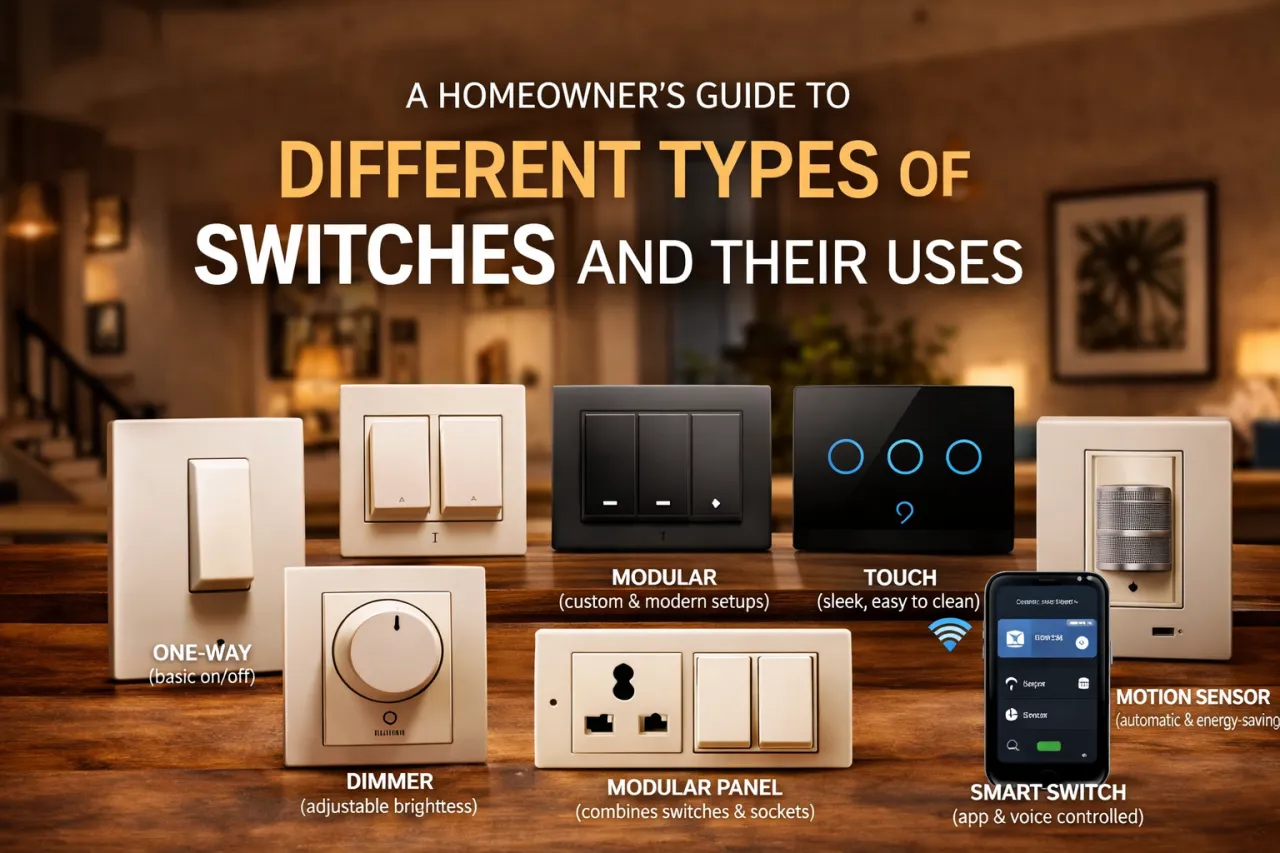
A Homeowner’s Guide to Different Types of Switches and Their Uses
When people think about home design, they usually focus on flooring, furniture, wall finishes, lighting, and décor. But one of the most frequently used features in any house is the electrical switch. From turning on bedroom lights and ceiling fans to operating kitchen appliances and controlling ambient lighting, switches are part of daily life in every room.
Today, homeowners can choose from many different types of switches depending on the function, room, and level of convenience they want. Some switches are simple and essential, while others are designed for better safety, energy efficiency, and modern automation. Understanding the different types of switches used in a home helps in making better choices during construction, renovation, or interior planning.
In this guide, we will look at the most common types of switches used in homes, their practical uses, and how to choose the right switch for each area of the house.
Why Choosing the Right Switch Matters in a Home
Switches may look like small details, but they have a direct impact on daily comfort and safety. The right switch can make a room easier to use, reduce energy waste, and support better appliance control.
A well-planned switch setup improves:
- Ease of use in everyday life
- Electrical safety for appliances and fittings
- Better control of lights and fans
- A cleaner and more modern switchboard design
- Convenience for children, elderly family members, and guests
In modern homes, switches are no longer limited to basic on and off functions. They can also help manage brightness, fan speed, heavy appliances, and even smart automation.
1. One-Way Switch
A one-way switch is the most common electrical switch found in homes. It controls a light, fan, or device from one location only.
This type of switch is widely used in bedrooms, kitchens, bathrooms, utility areas, and balconies. If a room light is controlled from just one switchboard near the entrance, it is usually a one-way switch.
Uses of a One-Way Switch
- Bedroom lights
- Bathroom lights
- Kitchen lights
- Balcony lights
- Simple fan control points
Benefits
- Easy to use
- Simple to install
- Cost-effective
- Ideal for basic household use
For most standard lighting points in a house, the one-way switch remains the most practical option.
2. Two-Way Switch
A two-way switch allows one light or fixture to be controlled from two different points. This is especially helpful in spaces where people move from one end to another.
For example, staircase lighting is commonly operated using two-way switches. You can switch the light on at the bottom and turn it off at the top. The same concept works well in long hallways and large bedrooms.
Uses of a Two-Way Switch
- Staircases
- Corridors
- Large bedrooms
- Rooms with two entrances
- Passage lighting
Benefits
- More convenient movement
- No need to walk back to the first switch
- Better usability in large spaces
This type of house switch adds convenience and is a smart choice for homes with multi-access areas.
3. Bell Push Switch
A bell push switch is a momentary switch that works only while being pressed. Once released, it returns to its original position.
This switch is mainly used for doorbells and internal calling systems. Since it is designed for temporary contact, it is not used for regular lighting or fan points.
Uses of a Bell Push Switch
- Doorbells
- Calling bells
- Alert systems
- Temporary signal switches
Benefits
- Simple and practical
- Designed for quick operation
- Reliable for bell systems
It is a small but essential switch type in residential electrical design.
4. Dimmer Switch
A dimmer switch controls the brightness of a light. Instead of only switching the light on or off, it allows homeowners to increase or reduce the light level according to the mood or function of the room.
Dimmer switches are popular in living rooms, bedrooms, dining areas, and decorative lighting zones.
Uses of a Dimmer Switch
- Living room mood lighting
- Bedroom ambient lighting
- Dining area lighting
- Decorative wall lights
- False ceiling lights
Benefits
- Better lighting control
- Creates a softer atmosphere
- Helps save electricity
- Enhances interior ambience
If you want flexible lighting in your home, a dimmer switch is a very useful addition.
5. Fan Regulator
A fan regulator is used to control the speed of a ceiling fan. In many homes, it is placed next to the fan switch on the same board.
Modern modular regulators are much sleeker than older models and fit neatly into contemporary switchboards.
Uses of a Fan Regulator
- Bedroom ceiling fans
- Living room fans
- Dining area fans
- Study room fans
Benefits
- Adjustable comfort
- Better airflow control
- Supports energy saving
- Easy to integrate in modular panels
This is one of the most important switch accessories in Indian homes, especially in warm climates.
6. Socket Switch
A socket switch controls the power supply to an electrical outlet. It is usually paired with a plug point and improves both convenience and safety.
Instead of unplugging the appliance every time, the user can simply turn the socket switch on or off.
Uses of a Socket Switch
- TV units
- Phone chargers
- Kitchen appliances
- Laptops and computers
- Small home appliances
Benefits
- Safer appliance use
- Reduces unnecessary power flow
- Convenient for daily use
- Important in kitchens and workspaces
Socket switches are essential in every room where plug points are installed.
7. Double Pole Switch
A double pole switch, also called a DP switch, disconnects both the live and neutral wires together. This makes it safer for heavy electrical appliances.
DP switches are commonly used for geysers, air conditioners, washing machines, and other high-load devices.
Uses of a Double Pole Switch
- Geysers
- Air conditioners
- Washing machines
- Heavy kitchen equipment
- High-load electrical appliances
Benefits
- Better electrical isolation
- Improved safety
- Suitable for powerful appliances
- Helps in complete disconnection
This switch is important wherever additional safety is needed for major appliances.
8. Indicator Switch
An indicator switch has a small light that shows whether the switch or connected appliance is on. This helps users quickly identify active electrical points.
Indicator switches are especially useful for appliances like geysers or devices that may continue running even when not directly visible.
Uses of an Indicator Switch
- Geysers
- AC units
- Kitchen appliances
- Water heaters
- Utility equipment
Benefits
- Easy status visibility
- Better safety awareness
- Reduces the chance of forgetting appliances on
- Helpful in busy households
It is a simple feature, but it improves everyday convenience significantly.
9. Modular Switch
A modular switch refers to a modern switch design system where switches, sockets, fan regulators, dimmers, and other units are placed neatly in one panel.
These switches are very popular in modern home interiors because they look clean, stylish, and organized.
Uses of a Modular Switch
- Living room switchboards
- Bedroom switchboards
- Kitchen electrical panels
- Office or study rooms
- Modern apartment interiors
Benefits
- Sleek appearance
- Easy maintenance
- Wide design options
- Better customization
- Suitable for modern interiors
For homeowners who care about both function and design, modular switches are often the preferred choice.
10. Touch Switch
A touch switch works with a light touch rather than a physical press. It is often used in premium homes and contemporary interiors.
Touch switches are chosen not only for convenience but also for their modern and elegant appearance.
Uses of a Touch Switch
- Luxury bedrooms
- Modern living rooms
- Designer interiors
- Smart home systems
Benefits
- Premium look
- Easy operation
- Smooth finish
- Suitable for stylish interiors
Touch switches are ideal for homeowners who want a more refined and modern electrical setup.
11. Smart Switch
A smart switch can be operated using a mobile app, remote control, or voice assistant. It is one of the most advanced types of switches used in homes today.
Smart switches are becoming increasingly popular in modern homes because they offer automation, scheduling, and remote access.
Uses of a Smart Switch
- Home automation systems
- Remote light control
- Smart fan control
- Curtain automation
- Appliance scheduling
Benefits
- Remote access
- Voice control support
- Better energy management
- Convenient for elderly users
- Ideal for tech-enabled homes
For homeowners planning a modern lifestyle, smart switches can add major convenience.
12. Motion Sensor Switch
A motion sensor switch automatically turns lights on or off when movement is detected. This makes it very useful in areas where lights should not remain on unnecessarily.
Uses of a Motion Sensor Switch
- Bathrooms
- Staircases
- Passages
- Parking areas
- Entry zones
Benefits
- Hands-free convenience
- Saves electricity
- Improves safety
- Helpful at night
Motion sensor switches are practical for homes that want both convenience and energy efficiency.
13. Timer Switch
A timer switch turns electrical devices on or off according to a preset schedule. This is useful for repetitive daily operations.
Uses of a Timer Switch
- Outdoor lights
- Garden lights
- Water pumps
- Decorative lighting
- Scheduled appliance control
Benefits
- Saves time
- Reduces manual work
- Supports energy saving
- Useful for regular routines
Timer switches are especially valuable in larger homes or outdoor electrical setups.
Which Switches Are Best for Different Rooms?
Choosing the right switch also depends on the room and its function.
Living Room
The living room usually benefits from:
- One-way switches
- Dimmer switches
- Fan regulators
- Modular switches
Bedroom
Bedrooms work well with:
- One-way switches
- Two-way switches
- Dimmer switches
- Socket switches
Kitchen
The kitchen often needs:
- Socket switches
- Indicator switches
- DP switches for heavy appliances
- Modular switchboards
Bathroom
Bathrooms can use:
- One-way switches
- DP switches for geysers
- Motion sensor switches
Staircase and Corridors
These areas are best suited for:
- Two-way switches
- Motion sensor switches
Smart or Premium Homes
Modern homes may include:
- Touch switches
- Smart switches
- Dimmer switches
- Modular panels
Traditional vs Modular vs Smart Switches
Traditional Switches
Traditional switches are simple and functional. They are affordable and still used in many homes, but they may not look as refined.
Modular Switches
Modular switches are more stylish, organized, and flexible. They are the most common choice for modern homes.
Smart Switches
Smart switches offer the highest level of convenience. They are ideal for homeowners who want automation and advanced control.
How to Choose the Right Electrical Switch for Home
When selecting electrical switches for home, consider the following:
- Room type and usage
- Appliance load capacity
- Convenience needs
- Interior style
- Safety requirements
- Future automation plans
- Quality and brand reliability
Always choose high-quality switches from trusted brands and ensure installation is done by a qualified electrician.
Final Thoughts
Electrical switches are a small part of home design, but they play a big role in how a house functions every day. From one-way switches and dimmers to modular and smart switches, each type has its own purpose and practical value.
Understanding the different types of switches used in homes helps homeowners plan better electrical layouts, improve safety, and create a more user-friendly living environment. Whether you are building a new home or renovating an old one, selecting the right switches can improve comfort, convenience, and the overall experience of daily living.
A well-designed home is not only about what looks good. It is also about what works well every day.
Turn this idea into a plan for your home
Visualise your space, understand the likely budget, or find a professional who can bring the idea to life.