
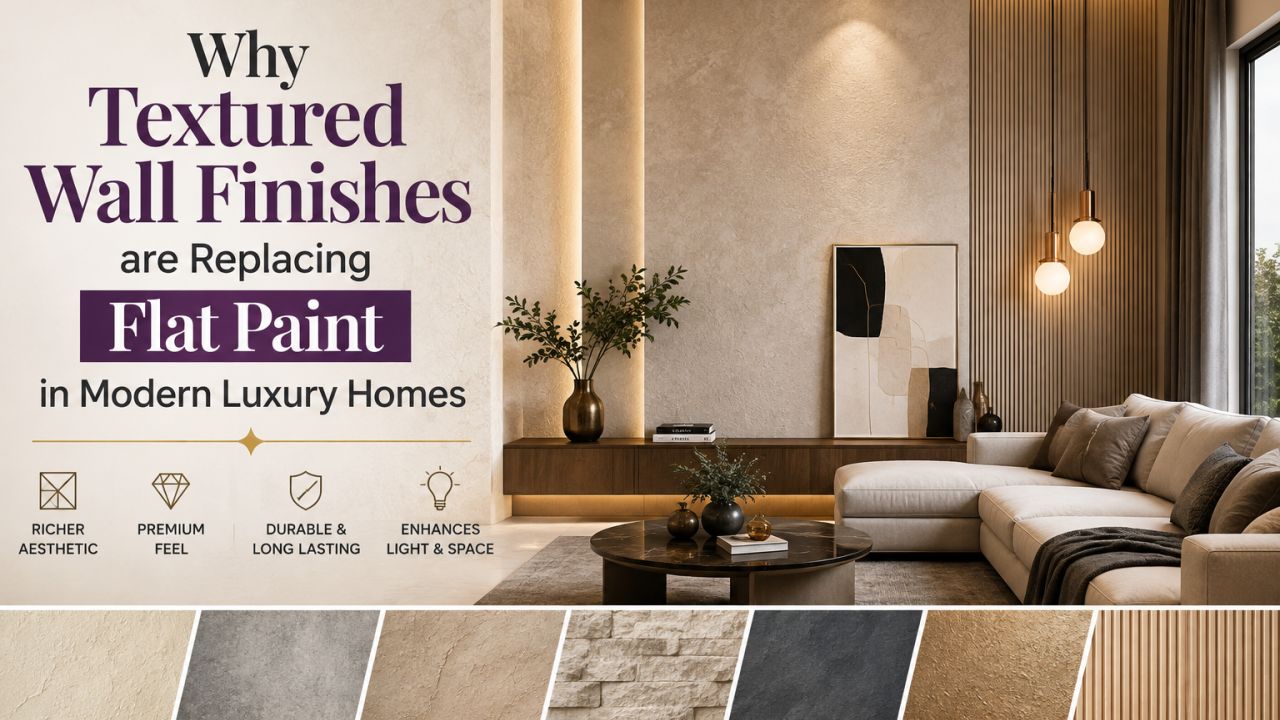
Textured Wall Finishes: The New Language of Luxury Interiors
Flat paint is still useful, but it no longer has to do all the visual work in a premium home. Across new apartments, independent houses and carefully renovated family homes in India, textured wall finishes are being used to add depth, soften light and give rooms a more considered character.
The shift is not simply about following a trend. A textured surface can conceal minor visual irregularities, create a focal wall without artwork and make a large room feel less empty. It can also create problems if the substrate, moisture conditions, lighting or maintenance plan is ignored. This guide explains where the material earns its place—and where a well-prepared painted wall is still the wiser choice.
For visual references, browse the WallsToWonder projects collection and compare finish ideas with the broader interior design posts. There is no locality-specific directory supplied for this guide, so homeowners can use these resources to study approaches before speaking with designers and companies serving their area.
From plain paint to designed surfaces
For years, most walls followed a familiar sequence: putty, primer and two coats of emulsion. It was economical, quick to touch up and easy to coordinate with modular furniture. As premium interiors became more detail-led, homeowners began looking for surfaces that contributed to the room rather than merely carrying a colour.
This has encouraged the use of limewash, plaster effects, mineral finishes, microcement, stone treatments and carefully selected panels. The change is especially noticeable in open-plan living and dining areas, foyers, bedrooms and home offices where one broad wall is visible from several angles. The finish becomes part of the architecture, much like a stone ledge, timber ceiling or statement light.
Why texture feels luxurious
Luxury is often perceived through restraint and sensory quality rather than the number of decorative objects. Texture gives the eye something to read at close range. Fine plaster catches a morning beam differently from an evening lamp; a fluted panel creates a quiet rhythm; a stone finish adds visual weight without requiring a busy pattern.
There is also a psychological benefit. Completely flat, empty walls can make a large room feel unfinished, while gentle variation makes it feel layered and settled. Subtle texture can reduce the glare associated with a large, uniform painted plane. However, pronounced texture creates stronger shadows and visual activity. Used on every wall, it can make a home feel crowded rather than calm.
Depth
Low-relief surfaces create changing highlights and shadows, giving a wall dimension that a single colour cannot provide.
Atmosphere
Mineral and plaster-like finishes often feel softer and more tactile than glossy, perfectly uniform paint.
Identity
A considered finish can express the design direction—quiet Japandi, warm contemporary or richly layered luxury—without relying on decoration alone.
Perceived scale
Vertical lines can draw the eye upward; a pale, fine texture can add depth without making a compact room feel smaller.
Types of textured wall finishes to consider
| Finish | Visual character | Good uses | Watch-outs |
|---|---|---|---|
| Limewash | Cloud-like, softly varied and matte | Bedrooms, reading corners, relaxed living rooms | Needs a suitable base and can show variation; confirm the application system and touch-up method. |
| Venetian plaster | Polished, layered and sometimes marble-like | Feature walls, foyers, formal living and dining spaces | Application quality matters greatly; repairs may be visible and the finish can be costly. |
| Microcement | Continuous cement-like surface with minimal joints | Contemporary walls, niches and selected wet-area applications | Requires skilled preparation, sealing and movement-joint planning; do not assume every product is suitable for shower zones. |
| Stucco | Raised, trowelled or softly rustic plaster effect | Feature walls, Mediterranean or earthy contemporary interiors | Heavy texture collects dust and may overwhelm small rooms. |
| Texture paint | Patterned or granular effect in many colours | Budget-conscious accent walls and quick renovations | Some patterns date quickly and are harder to patch invisibly than flat paint. |
| Concrete finish | Urban, tonal and deliberately unfinished-looking | Home offices, media rooms and industrial-contemporary schemes | Dark or cool tones can reduce warmth; test beside flooring and artificial light. |
| Stone finish | Natural variation and visual solidity | Foyers, TV walls, dining backdrops and outdoor-linked spaces | Check weight, fixing method, joints, edge details and cleaning requirements. |
| Metallic finish | Reflective shimmer or brushed sheen | Small accents, bars, powder rooms and dramatic niches | Every surface defect is more visible; excess reflection can feel harsh. |
| Fabric finish | Soft, upholstered or woven appearance | Bedrooms, headboard walls and quiet lounges | Dust, stains and humidity require careful material selection and maintenance. |
| Wood texture panels | Warm linear grain, fluting or slatted rhythm | TV units, bed backdrops, dining walls and entry zones | Confirm veneer or laminate specification, fire considerations, edge treatment and protection from moisture. |
“Textured” is not one performance category. Ask for the exact product or system, not just a sample labelled stone, plaster or concrete. The substrate, primer, topcoat, sealer and installer can affect the final result as much as the visible material.
Which rooms benefit most?
Living and dining areas usually offer the best opportunity because they have broad, visible walls and controlled furniture placement. A plaster finish behind a console or a restrained stone surface near the dining area can establish a focal point without competing with artwork.
Bedrooms suit matte limewash, fabric-effect finishes and warm wood panels. Keep the texture restful around the bed; strong metallic or highly ridged finishes can become tiring at close range.
Foyers, corridors and home offices can use texture efficiently because these spaces often lack furniture depth. A narrow fluted panel or tonal plaster can make a transition zone feel intentional.
Kitchens and bathrooms require more caution. Texture may work on a dry, well-ventilated wall away from direct splashing, but grease, steam and cleaning chemicals change the maintenance equation. Wet areas need a system specifically rated for that exposure, with proper waterproofing underneath.
Where textured walls should not be used
- Do not cover active dampness, seepage, salt deposits or cracking with decorative material.
- Avoid deep, dust-catching relief beside a hob, wash basin or high-touch passage unless cleaning access is realistic.
- Do not use a high-sheen or busy texture on every wall of a small, poorly lit room.
- Be careful on walls likely to receive frequent furniture movement, children’s activity or impact from doors.
How texture changes size and lighting
Fine, light-coloured texture generally reflects light softly and can add interest without visually closing in a room. Deep grooves, dark colours and strong contrast absorb or interrupt light, making a wall appear heavier. Vertical timber battens can make a low ceiling feel taller, while horizontal lines may visually widen a narrow wall.
Direction matters too. A wall beside a window will reveal more variation than one in a uniformly lit corridor. Grazing light from a wall washer exaggerates trowel marks and ridges; diffuse ceiling light produces a quieter effect. Always inspect a large sample at morning, afternoon and evening, with the proposed fixture switched on.
Lighting and sample checklist
- View a sample at least as large as the most visible section of the wall.
- Place it beside flooring, curtains, cabinetry and metal hardware.
- Test both daylight and the intended warm or neutral artificial lighting.
- Ask whether the sealer changes the sheen or colour.
- Check corners, window returns, skirting junctions and switch plates—not just the centre of the wall.
Choose the finish for your interior style
Modern minimalist
Choose one restrained surface: fine concrete, microcement or very subtle plaster. Keep the palette narrow and let junctions and workmanship carry the detail.
Scandinavian
Use pale limewash, light wood texture or a softly chalky finish. Avoid excessive contrast and pair texture with daylight-friendly fabrics.
Japandi
Look for tactile matte surfaces, natural wood grain and earthy neutrals. The best result is quiet variation rather than a theatrical feature wall.
Contemporary
Concrete effects, linear panels and selective metallic accents can work well, provided the room retains a clear visual hierarchy.
Luxury interiors
Venetian plaster, refined stone, warm timber and layered lighting can create depth. Use fewer finishes, specify them carefully and invest in edge details.
Cost: flat paint versus textured finishes in India
There is no dependable single rate for textured wall finishes. Pricing changes with the wall condition, area, number of coats, design complexity, material brand, sealer, access, city, labour skill and whether civil repair is included. Flat emulsion paint is normally the simpler and more economical baseline because application is faster and touch-ups are familiar. Decorative plaster, microcement, stone and panel systems usually cost more because they involve specialised labour, additional preparation or higher material quantities.
| Cost factor | Flat paint | Textured finish |
|---|---|---|
| Preparation | Putty, primer and basic surface correction | May need levelling, reinforcement, specialised primer or substrate treatment |
| Labour | Usually easier to source and schedule | Skilled applicator may be essential, especially for plaster and continuous finishes |
| Material scope | Paint system and routine consumables | Base material, pigments, binders, sealers, trims or panels where applicable |
| Repairs | Usually straightforward if the shade is still available | Matching a hand-finished patch may require an experienced applicator or a larger rework area |
| Best budgeting approach | Measure wall area and separate repair work | Request a sample, system specification, wastage allowance and room-wise application quote |
Before approving a premium finish, use the interior cost estimator as an early planning aid, then compare at least two itemised quotations. The estimate is not a substitute for a site measurement, but it can help you identify whether the proposed scope is proportionate.
Use AI to compare options before execution
Texture is difficult to judge from a tiny catalogue chip. AI visualisation can help homeowners compare a limewash wall, wood panel, concrete effect or plaster treatment in the same room before committing to samples and labour. Treat the images as design exploration, not a guarantee of exact colour, grain, sheen or installation feasibility.

Estimate the interior budget
Use WallsToWonder’s cost estimation tool to organise an early budget conversation around scope and room requirements.

Review the quotation
Run the proposal through the quotation checker to spot unclear inclusions, exclusions or line items that deserve questions.
You can also explore Design my room for early visual direction or use Find my style when the household has not yet agreed on a design language.
Maintenance, cleaning and durability
Ask for a written care method before installation. Some sealed finishes tolerate a lightly damp microfibre cloth; others should only be dusted. Avoid assuming that a decorative wall is washable simply because it has a protective topcoat. Abrasive cleaners, hard scrubbing and unapproved touch-up paint can change sheen or leave patches.
- Keep the wall dry where the system is not designed for repeated moisture.
- Use soft dusting tools on deep relief, slats and fabric-like surfaces.
- Deal with plumbing leaks and condensation quickly rather than waiting for staining.
- Keep the product name, batch information, colour formula and care instructions for future repairs.
- Ask how often the sealer may need renewal, particularly for high-contact or semi-outdoor locations.
Durability depends on impact, humidity, sunlight, cleaning and installation quality. A hard stone or sealed microcement surface may withstand more contact than an unsealed fabric-effect finish, but neither removes the need for correct substrate preparation.
Common mistakes homeowners make
- Choosing from a small sample: Scale, lighting and adjacent materials can change the impression completely.
- Ignoring the wall condition: Dampness, movement cracks and uneven plaster must be resolved first.
- Using too many feature walls: Texture works best when the eye knows where to rest.
- Leaving junctions until the end: Skirting, corners, sockets, curtain pockets and cabinetry edges need a coordinated detail.
- Accepting vague quotations: “Premium texture” is not enough. The quote should name the system, area, preparation, sealer, labour, taxes if applicable, protection, curing time and exclusions.
- Paying a large advance without a sample approval: Agree on a signed or documented sample and clarify what happens if the executed finish differs materially.
How to compare designers and companies
Look beyond rendered rooms. Ask designers and companies serving the area for relevant completed work, material samples, a room-wise scope and the person responsible for site coordination. A designer who can explain why a finish suits the wall, light and maintenance routine is more useful than one who simply presents a fashionable image.
Questions before paying an advance
- Who will inspect and prepare the wall before application?
- Which exact product or finish system is proposed, and who supplies it?
- Will a large sample be made in the actual room?
- How are dampness, cracks, corner beads, joints and electrical plates handled?
- What is included in the price, and what is excluded?
- Who protects the floor and furniture, and who removes waste?
- What is the expected completion and curing time?
- How are defects, shade variation and future repairs handled?
Red flags include pressure to approve without a sample, unexplained lump-sum pricing, no mention of moisture treatment, promises of identical hand-finished patches, and a quotation that does not separate material from labour. Use the designer directory to begin comparing available companies, and keep the discussion scope-led rather than choosing solely on the lowest figure.
A practical decision checklist
- Define the room’s use, cleaning frequency and exposure to moisture.
- Select the design direction before selecting the technique.
- Shortlist no more than two or three finishes for the same wall.
- Inspect large samples under the actual lighting plan.
- Confirm substrate repairs and application layers in writing.
- Compare room-wise quotations, timelines and exclusions.
- Photograph the approved sample and retain product documentation.
For more ideas, visit the design ideas library. If you are comparing a renovation scope, a new apartment package or a room-by-room upgrade, estimate the cost first and then ask each designer to price the same specification. That makes the comparison fairer and exposes missing work early.
Frequently Asked Questions
Are textured wall finishes better than flat paint?
Not universally. Texture adds depth and character, while flat paint is easier to clean, repair and budget. The better choice depends on room use, wall condition, lighting and maintenance expectations.
Which textured wall finish is best for a living room?
Limewash, refined plaster, Venetian plaster, concrete effects, stone or wood panels can work. Select according to the room’s style, daylight, furniture and desired maintenance level rather than choosing by name alone.
Are textured walls suitable for humid Indian homes?
They can be, but humidity does not make every finish moisture-resistant. Repair seepage first and specify a compatible primer, sealer and product system for the exposure. Wet zones need additional technical review.
How much do textured wall finishes cost in India?
Costs vary by material, preparation, area, labour, sealer, access and location. They are generally more involved than standard paint. Compare itemised room-wise quotations instead of relying on a broad per-square-foot promise.
How can I compare textured wall options before hiring a designer?
Use AI visualisation for early comparisons, inspect large physical samples in the room, check maintenance instructions and request a detailed quotation. WallsToWonder tools can support budgeting and quotation review, while site inspection remains essential.
Textured wall finishes are replacing flat paint in many luxury homes because they give surfaces a role in the overall composition. The strongest results are not the most elaborate ones: they are the finishes that suit the wall, light, climate, household routine and budget. Explore the project references again after you have shortlisted materials, then compare scope and quotations before appointing a designer.