
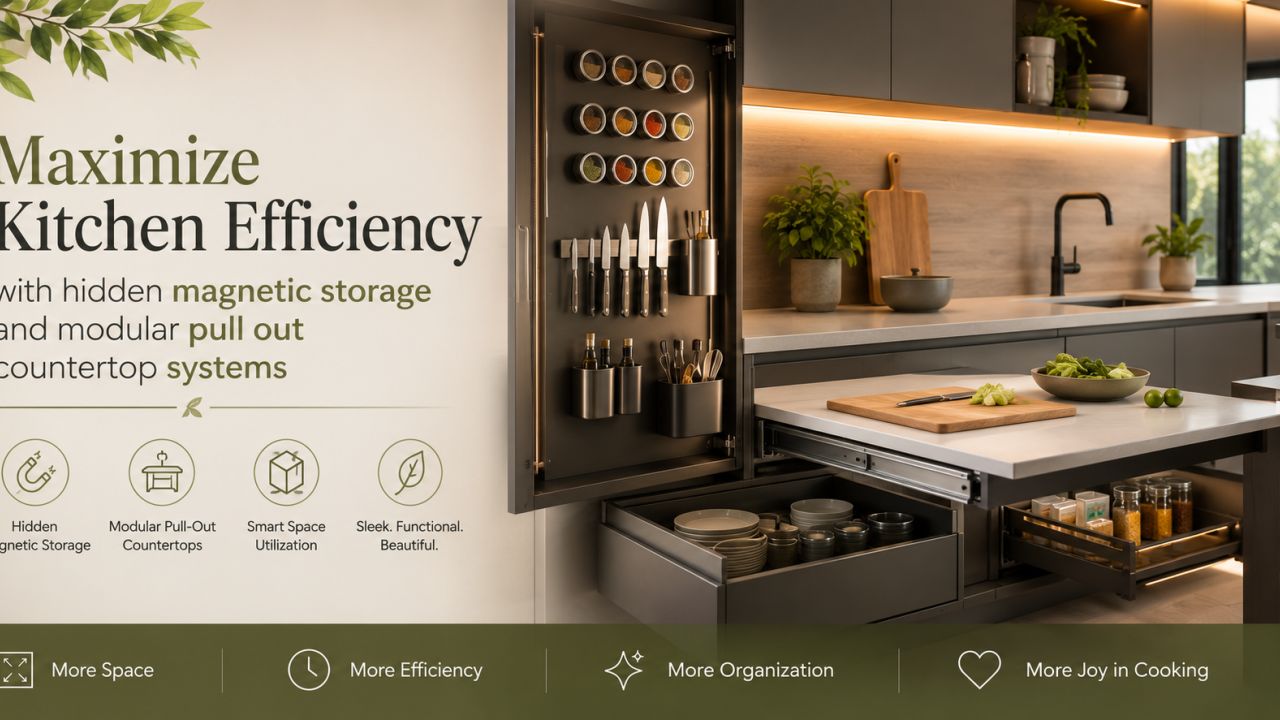
Smarter Kitchens: Hidden Magnetic Storage and Pull-Out Countertops
A kitchen can have plenty of cabinets and still feel short of storage. The problem is often not capacity but reach: a spice jar disappears behind a mixer, the counter becomes a landing strip for knives and packets, and a narrow corner is left unused. Hidden magnetic storage and modular pull-out countertop systems address those awkward moments without adding a bulky new room.
This guide is for Indian homeowners comparing kitchen designers and companies serving their area. It explains where these systems work, what to specify, how materials affect the quotation, and which questions to ask before paying an advance. For more kitchen planning references, browse the kitchen post subcategory and the wider WallsToWonder posts collection.
What these storage systems actually do
Hidden magnetic storage uses magnetic surfaces or concealed magnetic fittings to keep lightweight, frequently used items close at hand. Depending on the design, this may mean a magnetic strip under an overhead cabinet, a slim metal-backed panel inside a shutter, or a removable magnetic organiser for knives, measuring spoons and small tools. It is not a replacement for a heavy-duty drawer or a child-safe lock; it is a way to reclaim small, otherwise wasted surfaces.
Modular pull-out countertops are retractable work surfaces that slide, fold or extend from a cabinet or island. A pull-out board can provide a temporary chopping area beside the refrigerator, an extra serving surface near the dining side, or a compact breakfast ledge. The mechanism, support and clearance matter more than the novelty of the feature.
Where the idea fits Indian homes
In compact 1 BHK and 2 BHK apartments, a pull-out counter can provide occasional prep space without permanently narrowing the passage. In larger apartments, builder floors and independent homes, it can separate the main cooking zone from a utility area or serve as a second surface when several family members are preparing food together.
Indian kitchens also have a particular mix of requirements: pressure cookers, kadais, spice boxes, mixer-grinders, water purifiers and groceries bought in larger quantities. A designer should study the actual appliance list, not present a generic display-module layout. If the kitchen is being renovated, check the wall condition, plumbing points, electrical load and chimney route before finalising magnetic panels or a counter mechanism.
For a rented home or a light renovation, removable magnetic organisers and a slim freestanding pull-out unit may be more sensible than changing cabinetry. In a new modular kitchen, the same idea can be integrated into a tall unit, breakfast counter or island, provided the design leaves enough circulation space when fully extended.
Hidden magnetic storage: useful locations and limits
Good locations
- Below an overhead cabinet, where a magnetic rail can hold frequently used metal tools without taking drawer space.
- On the side of a tall unit, if the surface is protected from direct steam and splashes.
- Inside a pantry shutter for recipe cards, lightweight clips or small labelled containers.
- Along a backsplash only when the chosen finish and fixing method can tolerate heat, moisture and regular wiping.
Details that deserve attention
Ask whether the magnet is exposed or enclosed, how much weight it is rated to carry, and whether the fixing can be replaced without dismantling the cabinet. Stainless steel tools may not all respond equally to magnets, so test the actual utensils. Avoid placing sharp objects where children can reach them, and do not assume a concealed fitting is automatically safe around fingers or electrical equipment.
Magnetic systems should also be coordinated with the shutter finish. A laminate, glass, metal sheet or painted panel may each need a different adhesive or fixing. The quotation should name the backing material and installation method rather than simply saying “magnetic accessory”.
Planning a modular pull-out countertop
Begin with the task. A surface used for rolling dough needs more stability and easy cleaning than a narrow ledge used for placing a cup. A chopping board needs a hygienic removable top; a serving extension may prioritise smooth movement and a neat closed appearance.
- Measure the available cabinet width, depth and internal height, including skirting, handles and nearby appliances.
- Mark the fully open position on the floor with masking tape. Check the walkway, refrigerator door, dishwasher door and entrance to the kitchen.
- Choose the support system: heavy-duty runners, a folding leg, a hinged bracket or a combination. The support must match the expected load.
- Specify the top separately from the cabinet. Consider compact laminate, solid surface, treated wood or another surface suitable for the intended task.
- Confirm the closing action, stop mechanism, edge treatment and replacement process before production begins.
A pull-out top is not a substitute for structural counter space. If it will hold a mixer-grinder or hot vessel, ask for a written load recommendation and heat-resistance guidance. Keep it away from the sink splash zone unless the material and hardware are specifically suitable for moisture.
Compare designers by process, not just portfolio images
When comparing designers and companies serving the area, look for evidence that they can coordinate a small mechanism with the complete kitchen. A beautiful render does not show whether the drawer clears the handle, whether the electrician has left a safe socket position, or how a damaged runner will be accessed later.
| Compare | What to look for | Why it matters |
|---|---|---|
| Brief and measurements | Site measurements, appliance schedule and circulation checks | Reduces late changes and unusable extensions |
| Design service | Plan, elevations, hardware schedule and finish samples | Lets you evaluate the idea before manufacture |
| Execution | Clear responsibilities for civil, electrical, plumbing and installation work | Prevents gaps between trades |
| After-sales | Documented warranty, service contact and replacement terms | Moving hardware needs support after handover |
Ask to see a detailed drawing of the open and closed positions. Compare the same specification across proposals: cabinet board, edge band, runner brand or grade, countertop material, handle type, soft-close provision, installation and taxes if applicable. A lower total may simply exclude the hardware or site work.
Use WallsToWonder tools before you compare quotations
Estimate the budget range
Use the interior design cost estimator to organise an early budget conversation. Treat the output as a planning aid; the final amount depends on measurements, materials, hardware, site conditions and scope.

Review the line items
Run a proposal through the quotation checker to spot missing descriptions or unclear allowances. Then confirm every point with the designer in writing.
You can also test layout ideas with Design my room before a consultation. It will not replace a site survey, but it can help your family discuss whether a concealed rail, tall pantry or pull-out worktop solves a real problem.
Pricing factors and quotation checks
There is no responsible single price for this feature. The total changes with the number of cabinets, width and load of the pull-out, runner or bracket quality, countertop material, finish, edge profile, magnetic hardware, electrical or plumbing alterations, delivery and installation complexity. Existing kitchens can cost more to modify if cabinets need reinforcement or walls are uneven.
Request a quotation that separates cabinetry, internal accessories, countertop, magnetic fittings, labour, dismantling, transport, installation and taxes where applicable. Ask whether site protection, debris removal, touch-ups and final alignment are included. A “modular kitchen package” should not hide a high-cost custom mechanism in a vague accessories line.
Red flags during designer selection
- The designer promises that every wall or cabinet can take a magnetic system without checking the substrate, moisture or heat exposure.
- The pull-out is shown open in the render but no closed depth, load rating or clearance is documented.
- The quotation names only a total package amount and omits board thickness, finish, hardware, installation and exclusions.
- Payment is requested before a measured design, scope document or written cancellation and variation terms are shared.
- The designer dismisses maintenance questions, cannot explain access to runners, or offers no route for post-handover service.
These are prompts for caution, not proof of poor workmanship. Give the designer an opportunity to clarify in a revised proposal, and compare the response with other proposals on identical requirements.
Questions to ask at the site meeting
- What exact daily task will this feature improve, and what happens if the mechanism fails?
- Will the extension obstruct the refrigerator, dishwasher, passage or utility access when open?
- Which surfaces are moisture-, heat- and stain-suitable for my cooking habits?
- Who coordinates electrical, plumbing, chimney and civil changes, and what is excluded?
- Can I inspect a physical sample of the runner, magnetic fitting, edge and countertop?
- What is the maximum recommended load, and are those details recorded in the final handover documents?
Make the next comparison more useful
Prepare a short inventory of appliances, frequently used tools, grocery habits and the moments when your current kitchen feels crowded. Share the same brief with each designer and ask for the open and closed views of every pull-out feature. That makes proposals easier to compare and keeps the conversation grounded in your home rather than a showroom display.
Explore more planning articles, browse kitchen ideas, and use the designer directory to research designers and companies serving your area. If you are still shaping the brief, the design ideas collection can help you identify priorities before requesting proposals.
Frequently Asked Questions
Is hidden magnetic storage suitable for every modular kitchen?
No. It depends on the cabinet substrate, heat and moisture exposure, object weight and the magnet’s fixing method. Test the intended items and specify the fitting clearly.
What is a modular pull-out countertop used for?
It provides temporary prep, serving or breakfast space from a cabinet or island. Its usefulness depends on adequate clearance, stable support, a suitable top and an appropriate load rating.
How much does a pull-out kitchen countertop cost in India?
There is no fixed price. Width, hardware, top material, cabinet changes, finish, installation and site conditions all affect the quotation. Compare itemised proposals rather than package totals.
What should be included in a kitchen storage quotation?
Ask for measured drawings, cabinet and finish specifications, hardware details, countertop material, labour, installation, exclusions, payment milestones, warranty and service terms.
How can I compare kitchen designers for hidden storage solutions?
Compare their measurements, open-and-closed drawings, hardware specifications, coordination plan, quotation clarity, installation responsibility and after-sales process—not only their portfolio.