

Skirted Console Ideas for Concealed Everyday Storage
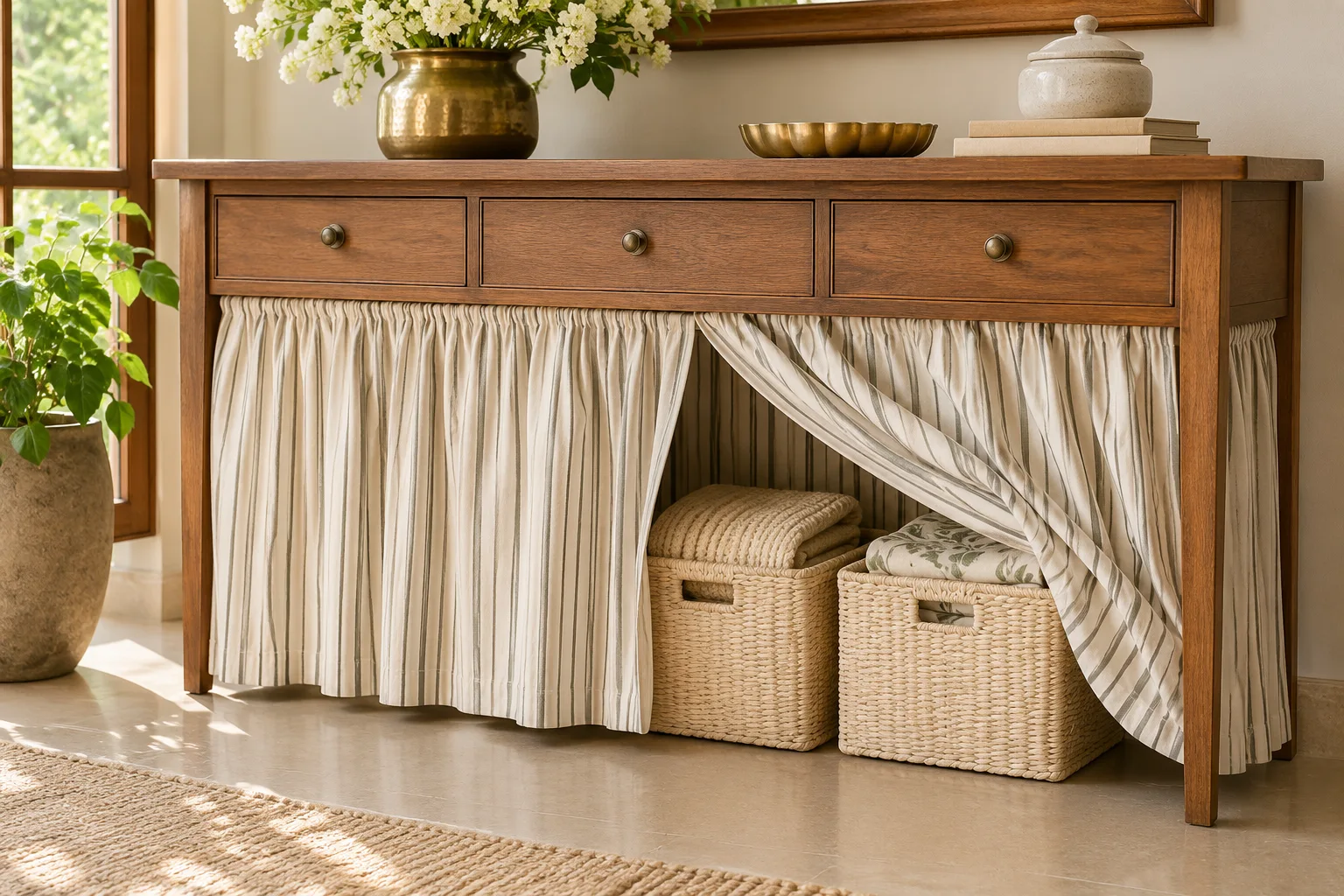
A skirted console conceals light everyday storage behind a removable fabric panel. Start with a stable console, measure its usable opening and choose a skirt that clears the floor and detaches for washing. Keep the arrangement away from heat and equipment, and test basket access before committing to fabric or tailoring.
What to prepare
Existing console dimensions, a tape measure, sample fabric, a temporary paper outline, baskets or boxes you intend to retain, care information and details of the proposed removable attachment system.
Decide what belongs behind the skirt
List the objects you want to store and how often they are used. Light baskets for reusable bags, table linen or similar items may suit the idea. Do not use a fabric panel to disguise an unresolved electrical setup, equipment requiring ventilation or a location where storage blocks a route.
Measure the actual containers and try withdrawing them from beneath the console. A concealed area can look tidy while being frustrating to use. Keep the most frequently needed items easy to retrieve without moving the whole furniture piece or lifting several other boxes.
Check the existing console first
Inspect the furniture’s condition and stability. Confirm whether it is freestanding or needs an appropriate anti-tip arrangement under its product guidance. The skirt is decorative and does not improve the support of the console. Resolve loose joints or an unsuitable location before adding fabric.
Measure the opening between legs, the underside details and any protruding elements. Check nearby door movement and the route past the console. A narrow hallway is not improved if a fabric panel hides a cabinet that was too deep to begin with.
Choose a skirt shape that supports access
A simple straight panel, a centre opening or several smaller sections provide different ways to reach storage. Mock up the opening with paper or an old cloth held temporarily during a supervised trial. Do not use that trial as the final attachment.
Sit or bend as you normally would to retrieve a basket. Check whether the chosen opening exposes enough space and whether fabric catches on handles. A generous decorative fold may look attractive but be unnecessary if it makes daily retrieval harder. Keep the simplest shape that performs the task.
Measure the finished drop carefully
Record the intended attachment position and finished lower edge. Leave appropriate clearance for the floor and cleaning routine instead of allowing the fabric to drag. Check the measurement along the full console because floor and furniture levels may vary.
Ask the maker how headings, hems and any opening affect the finished size. Do not give the overall furniture height as though it were automatically the required fabric drop. Keep a dimensioned sketch and the attachment detail with the order so both sides understand what is being made.
Select fabric for washing and handling
Compare the sample beside the console top, floor and nearby upholstery. A stripe can give the panel structure, while a plain fabric may suit a busier room. Look at the actual sample hanging vertically; a small swatch lying on a table does not show the same drape.
Read the care instructions and ask about shrinkage, lining and colour transfer where relevant. Choose a fabric you can realistically remove, wash or clean and rehang. A decorative textile that needs an inconvenient maintenance routine may not suit everyday concealed storage.
Use a suitable removable attachment
Discuss the attachment with the maker or furniture supplier. Options differ in compatibility, loading and effect on the furniture finish. Avoid improvising adhesives or fasteners on a valuable or delicate piece without checking their suitability. Obtain permission before altering rented or borrowed furniture.
The panel should remain attached during normal retrieval yet be removable for care. Keep any fastening components accessible and out of the path of moving drawers. Do not route lamp cables behind fabric in a way that prevents inspection or creates a snag when a basket is removed.
Keep the top and hidden area disciplined
Choose what the console top must hold before adding decor. A tray for keys or one useful lamp may be enough. The fabric already adds texture and pattern, so the surface does not need a second collection of small objects.
Inside, use defined containers and leave enough room to retrieve them independently. Review the contents after a week of normal use. If unrelated items accumulate because they are hidden, reduce the storage brief. Concealment works best when it supports a routine rather than postpones decisions about clutter.
Compare a skirt with closed furniture
A skirt is one option, not a substitute for every cabinet. A closed unit may suit objects needing more protection, frequent handling or a firmer boundary from the room. Compare the usable internal space, cleaning effort and complete cost before changing the console.
If you already own a sound console and light containers, a fabric trial can help you decide. If you need to buy all three, ask whether a purpose-built cabinet would solve the same need more directly. Choose based on the stored objects and household use, with appearance as one part of the decision.
Compare the practical options
| Option | What to check |
|---|---|
| One straight panel | Simple appearance; test how items are reached |
| Centre-opening skirt | Reach baskets without lifting the full panel |
| Closed cabinet instead | Compare when objects need a firmer enclosure |
Build a useful budget
List furniture repair if needed, fabric, tailoring, removable attachment and containers as separate costs. Retain useful baskets instead of purchasing a matching set purely for a concealed space. Ask the maker to quote the actual finished dimensions and care requirements. Compare the complete project with a closed cabinet if no suitable console is already available.
Planning time and supplier schedule
Allow 30–45 minutes for the storage inventory and an access trial, then review the fabric sample in place. Tailoring and installation dates need to be confirmed with the maker after the attachment and finished dimensions are agreed. Include time to test washing and rehanging if the product requires special care.
Frequently asked questions
Can a skirt hide electronic equipment?
Do not use fabric to conceal equipment without resolving ventilation, access and electrical requirements. This idea is intended for suitable light storage containers.
Should the fabric touch the floor?
Plan a finished edge that works with the floor and cleaning routine. Measure the actual piece and discuss appropriate clearance with the maker.
Is a skirt always cheaper than a cabinet?
No. Compare fabric, tailoring, attachment and any furniture repair with the complete price of the alternative.
Plan the next step with WallsToWonder
Read Decorative Storage Baskets for Living Rooms: Choose by What Goes Inside for the related planning checks. Explore the overall look with Design My Room, keeping your retained furniture and measured requirements in the brief. Use physical samples and product information for final choices.
Turn this idea into a plan for your home
Visualise your space, understand the likely budget, or find a professional who can bring the idea to life.