
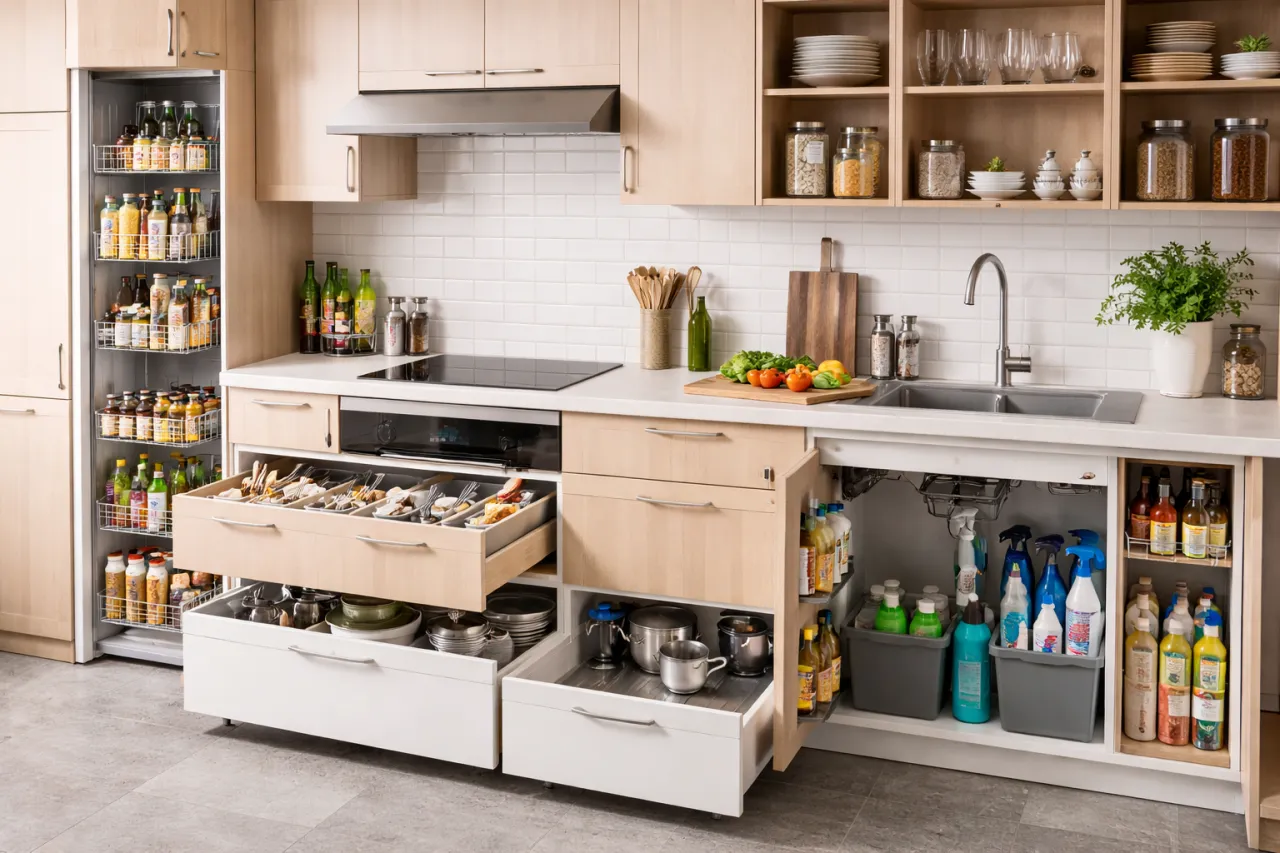
Kitchen Storage Ideas: Smart Ways to Make Your Kitchen More Organized and Functional
A kitchen works best when everything has its place. No matter how beautiful the finishes are, a kitchen can quickly start feeling stressful if the storage is not planned properly. Crowded countertops, overflowing shelves, hard-to-reach cabinets, and poorly organized drawers can make daily cooking and cleaning more tiring than they need to be.
That is why good kitchen storage is not only about fitting more things into the space. It is about making the kitchen easier to use every day. The right storage ideas can improve workflow, reduce clutter, save time, and make even a compact kitchen feel more efficient and comfortable.
Whether you have a small apartment kitchen or a larger modular setup, smart kitchen storage planning can make a major difference. This guide covers practical kitchen storage ideas that help create a kitchen that feels clean, functional, and well organized.
Why Kitchen Storage Matters So Much
The kitchen is one of the hardest-working spaces in the home. It handles cooking, preparation, washing, cleaning, storing groceries, organizing utensils, and often much more. If the storage is not thoughtfully planned, even a large kitchen can become difficult to manage.
Well-designed kitchen storage helps with daily convenience, better organization, quicker access to essentials, and cleaner-looking surfaces. It also improves how the kitchen feels. A space with smart storage usually feels calmer, more open, and easier to maintain.
The real goal of kitchen storage is not just to hide things. It is to make everyday routines smoother.
Start by Understanding What You Need to Store
Before choosing storage solutions, it helps to understand what actually needs to be stored in the kitchen. Every home uses the kitchen differently. Some households cook heavily every day, while others use the kitchen more lightly. Some need more pantry space, while others need more room for utensils, small appliances, or containers.
A practical storage plan should consider daily-use utensils, pots and pans, plates, bowls and glasses, spices and condiments, dry groceries, cleaning supplies, lunch boxes and containers, small appliances, serving items, and rarely used extras.
Once you know what needs space, it becomes easier to organize the kitchen in a more logical way.
Keep Everyday Items Easy to Reach
One of the best kitchen storage principles is simple: frequently used items should be the easiest to access. Daily-use plates, cooking utensils, spices, oils, and pans should be placed where they support the natural cooking flow.
This means the most-used items should stay close to the cooking area, at comfortable height, in easy-to-open drawers or shelves, and in places that do not require bending or stretching too often.
Rarely used serving pieces, extra containers, or occasional appliances can go in higher or less accessible storage zones. A kitchen becomes much more efficient when storage follows real usage patterns.
Use Deep Drawers Instead of Only Lower Cabinets
Deep drawers are one of the most useful kitchen storage ideas in modern homes. Compared to traditional lower cabinets with shelves, drawers are easier to access and organize.
They work especially well for pots and pans, plates and bowls, large utensils, containers, grocery storage, and kitchen linens.
Because drawers pull out fully, they make it easier to see everything inside. This reduces the need to crouch down and search in dark cabinet corners. In many modular kitchens, drawers are one of the biggest improvements in day-to-day convenience.
Add Drawer Organizers for Smaller Items
Kitchen drawers become messy quickly if smaller items are not separated properly. Cutlery, tools, openers, peelers, spatulas, measuring spoons, and other essentials need clear sections.
Drawer organizers are useful because they keep small items visible, prevent clutter, save time during cooking, make cleaning easier, and improve overall order.
Even a simple divider can make a regular kitchen drawer feel much more functional.
Make the Most of Corner Storage
Kitchen corners are often underused or difficult to access. But with the right design, corner cabinets can become highly useful.
Common corner storage solutions include carousel units, pull-out corner systems, magic corner fittings, angled shelves, and open corner display shelves in selected layouts.
These help use space that would otherwise be wasted. Corner storage is especially valuable in L-shaped and U-shaped kitchens where every inch matters.
Plan a Smart Pantry Zone
A pantry does not have to be a separate room. Even a well-planned tall cabinet or dedicated section can function as an excellent pantry.
A pantry zone is ideal for storing dry groceries, grains and pulses, snacks, breakfast items, bottles, packaged food, and backup supplies.
Good pantry storage works best when it is organized with categories and visibility. Clear containers, labeled jars, baskets, and pull-out pantry units make this much easier. A kitchen feels more manageable when grocery storage is neat and easy to understand at a glance.
Use Tall Units for Vertical Storage
Tall kitchen units are one of the best ways to increase storage without using too much floor space. They make use of vertical height, which is especially helpful in compact kitchens.
Tall units can store groceries, ovens or microwaves, cleaning supplies, serving ware, extra containers, and small appliances.
Pull-out tall units are especially effective because they allow easy access to many items at once. Vertical storage is often the difference between a crowded kitchen and a well-organized one.
Add Open Shelves Carefully
Open shelves can be useful in kitchens, but they should be used thoughtfully. They work best for items that are either used regularly or visually neat enough to stay on display.
Good uses for open shelves include everyday mugs, spice jars, cookbooks, neatly arranged bowls, small plants, and a few decorative kitchen accents.
Too many open shelves can make a kitchen look cluttered, especially if everything on them is not well arranged. A mix of closed storage and a few open shelves usually works best.
Organize Under-Sink Storage Properly
The under-sink cabinet is often one of the most overlooked parts of kitchen storage. It tends to become messy because it is used for cleaning supplies, bins, and utility items.
A better under-sink setup may include pull-out bins, cleaning bottle organizers, trays for smaller items, vertical holders for cloths and scrubbers, and moisture-resistant storage solutions.
Because this area is exposed to plumbing and possible dampness, the storage should be practical, easy to clean, and durable.
Create a Dedicated Spice Storage Area
Spices are used frequently in most kitchens, so they should be stored in a way that is visible and easy to reach. Poor spice storage often leads to cluttered counters and repeated searching while cooking.
Useful spice storage ideas include narrow pull-out spice units, drawer inserts for jars, wall-mounted spice racks, shelf organizers inside cabinets, and small trays near the cooking zone.
Spice storage works best when it is close to the hob but still neat and contained.
Use Pull-Out Storage for Narrow Gaps
Small gaps between cabinets or appliances can often be turned into useful storage spaces. Pull-out storage is especially effective in compact kitchens where every bit of space matters.
Narrow pull-out units can be used for oils and sauces, spice bottles, cleaning products, trays and chopping boards, and slim pantry items.
These units make use of areas that would otherwise go unused.
Keep the Countertop as Clear as Possible
A kitchen automatically feels more spacious and organized when the countertop is not overloaded. That is why one of the best storage strategies is to keep only the truly necessary items outside.
Countertops should ideally hold a few daily-use appliances, a tray with oils or essentials if needed, a fruit bowl or one decorative element, and items used multiple times a day.
Everything else should be stored away in cabinets, drawers, or pantry space. Clear counters improve both appearance and work efficiency.
Store Appliances Based on Frequency of Use
Not every appliance needs to stay out on the counter. Some are used daily, while others are only used once in a while.
A practical approach is that daily-use appliances stay easily accessible, weekly-use appliances go in lower cabinets or tall units, and rarely used appliances go in upper or back storage.
This keeps the kitchen from feeling crowded while still allowing convenient access to the things that matter most.
Add Storage for Containers and Lids
Containers often become one of the messiest categories in any kitchen. Different sizes, missing lids, and stacking problems can create constant disorder.
A better solution is to assign a dedicated zone for lunch boxes, food containers, matching lids, storage jars, and reusable bottles.
Drawer dividers, pull-out baskets, and vertical separators make container storage much easier to manage.
Use Wall Space Where Needed
In smaller kitchens, walls can offer extra storage without taking away floor or counter space.
Wall space can be used for hooks for mugs or utensils, hanging rails, knife strips, open shelves, paper towel holders, and magnetic organizers.
This works best when done in moderation. The goal is to add function without making the kitchen visually crowded.
Kitchen Storage Ideas for Small Homes
Small kitchens need storage that works harder and smarter. The best ideas for compact kitchens include tall cabinets, pull-out pantry units, deep drawers, wall-mounted storage, foldable or nested accessories, under-sink organization, multi-use shelves, and minimal countertop styling.
In a small kitchen, every item should earn its place. Good storage is less about abundance and more about efficiency.
Common Kitchen Storage Mistakes to Avoid
Some common mistakes can reduce how well a kitchen functions. These include storing daily items too far from the work zone, relying too much on open shelves, not using drawer organizers, wasting corner space, allowing too many appliances on the counter, ignoring vertical storage, not planning pantry organization, and keeping no dedicated place for containers and lids.
A kitchen does not stay organized by chance. It becomes organized when the storage is designed around real life.
Final Thoughts
Good kitchen storage is one of the most important parts of a functional kitchen. It affects how easily you cook, clean, organize, and move through the space every day. The best storage ideas are not always the most complex. Often, they are the ones that make daily tasks simpler and more natural.
Whether it is deep drawers, pull-out units, tall pantry storage, under-sink organization, or better use of corners and walls, the right storage decisions can make the kitchen feel bigger, cleaner, and much more enjoyable to use.
A well-designed kitchen is not only beautiful to look at. It is easy to live with.
FAQs
1. What are the best kitchen storage ideas for small kitchens?
The best kitchen storage ideas for small kitchens include tall cabinets, deep drawers, pull-out pantry units, wall-mounted shelves, under-sink organizers, and narrow pull-out storage. These solutions help use limited space more efficiently without making the kitchen feel crowded.
2. How can I make my kitchen look less cluttered?
To make your kitchen look less cluttered, keep the countertop as clear as possible, use drawer organizers, assign a fixed place for containers and lids, and store daily items in easy-to-reach but organized zones. Closed storage usually helps the kitchen look cleaner and calmer.
3. Are drawers better than lower cabinets in a kitchen?
In many modern kitchens, drawers are often more practical than lower cabinets because they pull out fully and make it easier to see and access stored items. They work especially well for pots, pans, plates, and containers.
4. What is the best way to organize kitchen drawers?
Kitchen drawers work best when they include dividers or organizers for cutlery, utensils, tools, and smaller accessories. This prevents clutter and makes everyday cooking more efficient.
5. How do I organize spices in the kitchen?
Spices can be organized in drawer inserts, narrow pull-out units, wall-mounted racks, or small shelf organizers inside cabinets. The most effective spice storage is close to the cooking zone and easy to access while preparing meals.
6. What should be stored near the cooking area?
Items used daily during cooking should be stored near the cooking area, such as oils, spices, spatulas, pans, ladles, and basic utensils. This helps improve workflow and reduces unnecessary movement while cooking.
7. How can I use kitchen corner space better?
Kitchen corners can be used more effectively with carousel units, pull-out corner systems, magic corner fittings, or angled shelves. These solutions help access space that is otherwise difficult to use.
8. What is the best storage solution for pots and pans?
Deep drawers are one of the best storage solutions for pots and pans because they make heavy cookware easier to access and organize. In some kitchens, pull-out lower units also work very well.
9. How do I organize under-sink kitchen storage?
Under-sink kitchen storage can be improved with pull-out bins, bottle holders, trays, and moisture-resistant organizers. It is best used for cleaning products, scrubbers, bins, and utility items.
10. Is open shelving a good idea in kitchens?
Open shelving can work well in kitchens when used in moderation. It is best for everyday mugs, neatly arranged bowls, jars, or decorative accents. Too many open shelves can make a kitchen look cluttered.
11. How do I store kitchen appliances without crowding the counter?
Store appliances based on how often they are used. Daily-use appliances can stay accessible, while less frequently used ones can go in tall units, lower cabinets, or pantry storage. This helps keep the countertop more open.
12. What is the best pantry storage idea for modern kitchens?
Tall pantry units, pull-out pantry cabinets, labeled jars, baskets, and clear containers are some of the best pantry storage ideas for modern kitchens. They keep groceries visible, organized, and easy to manage.
13. How do I organize kitchen containers and lids?
Kitchen containers and lids should have a dedicated storage zone. Drawer dividers, vertical separators, baskets, and pull-out organizers help keep them sorted and easy to access.
14. What makes a kitchen more functional?
A kitchen becomes more functional when storage is planned around daily use. Easy access to essentials, organized drawers, smart pantry storage, clear countertops, and proper zoning all help make the kitchen more efficient.
15. How can I increase kitchen storage without renovating the whole kitchen?
You can increase kitchen storage by adding shelf risers, drawer organizers, wall hooks, pull-out baskets, pantry containers, under-sink trays, and countertop decluttering solutions. Small changes can make a big difference without a full renovation.
Turn this idea into a plan for your home
Visualise your space, understand the likely budget, or find a professional who can bring the idea to life.