
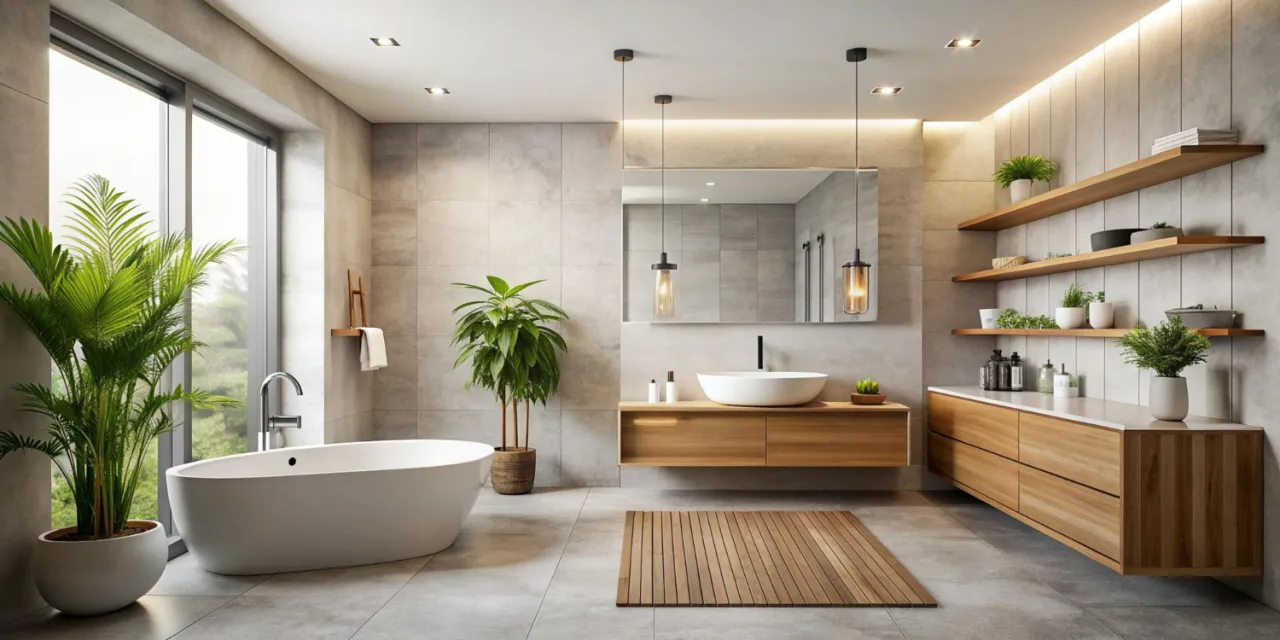
Bathroom Tile Selection: Finish, Suitability and Cleaning Checks
Choose bathroom tiles by their intended use, documented product information and suitability for the actual floor or wall. Matte appearance alone does not prove slip resistance, and tiles alone do not make a bathroom waterproof. Review samples, drainage, installation and cleaning with the relevant professionals before approving the tile schedule.
Separate floor, wall and shower requirements
Mark the bathroom plan with wall surfaces, general floor areas and the shower or other wet zones. Ask the supplier to identify which exact products are intended for each application. A wall tile should not be assumed suitable for a floor because it matches the colour scheme.
Request the product data and installation guidance. Check the intended setting, surface characteristics and maintenance requirements. Keep the product name and batch information with the order so the supplied material can be checked.
Read slip information in context
Ask about relevant test information and how it relates to the intended use. Daltile’s guidance on slip-resistance testing explains why test results need to be considered with application conditions. A finish label or one number is not a universal safety guarantee.
Actual conditions also involve water, cleaning residue, footwear or bare feet, installation and maintenance. Discuss the needs of the household, including anyone with mobility or balance difficulties. Do not rely on a small dry showroom sample to reproduce every wet bathroom condition.
Coordinate size with the layout
Large tiles can reduce the number of joints on some surfaces, but their layout still needs to suit dimensions, corners, falls and drainage. Ask the installer how cuts and changes in level will be managed. Review the proposed layout around the drain before buying.
Smaller tiles introduce more joints and a different cleaning pattern. Choose based on the product, geometry and maintenance you can manage rather than assuming either size is inherently better. Ask how the wall and floor junctions will be detailed.
Treat waterproofing and drainage as separate work
A tile finish is one part of a bathroom assembly. Ask the appropriate professional to review the substrate, waterproofing system, junctions, penetrations and drainage design. Record who supplies and installs each part and which checks are included.
Do not cover unresolved leakage or drainage problems with new tiles. If the project is a renovation, establish what investigation or repair is needed first. The scope and time depend on the actual condition; a visual makeover estimate may not include corrective work.
Test colour, texture and care practically
View a sample under the bathroom’s intended lighting and beside the sanitaryware, vanity and fittings. Ask for the maker’s cleaning instructions and compatible products. A textured surface may look different after routine use and may require a different cleaning method.
Matte finishes can still show marks, and glossy finishes can show residue. Ask about grout selection and joint care as well as the tile. Avoid using harsh chemicals or abrasive demonstrations without manufacturer guidance.
Plan the order and installation
Ask the installer to confirm quantities, cut allowances and any spare tiles to retain for future repairs. Order by the agreed product reference and check supplied batches as advised. Confirm delivery, storage and inspection before installation begins.
Budget for removal if needed, substrate work, waterproofing, tiling, grout, trims and service coordination. Obtain a programme that accounts for the chosen systems and required curing or testing steps. Do not invent a universal bathroom completion period.
Keep a usable handover record
Retain product details, care instructions, installation records and spare material information. At handover, review drainage and workmanship with the responsible professional and record defects for correction. Avoid accepting a surface appearance alone as proof that concealed work is correct.
Use WallsToWonder design ideas to compare visual arrangements and WallsToWonder interior cost estimator to organise the wider scope. Make final choices from the actual product guidance and the requirements of your bathroom.
Frequently asked questions
Are matte tiles automatically slip-resistant?
No. Check the exact product’s intended use and relevant test information in the context of the bathroom conditions.
Do tiles waterproof a bathroom?
No. Waterproofing and drainage require an appropriately designed and installed assembly beneath and around the finish.
Are large tiles suitable for every bathroom floor?
Not automatically. The layout, falls, drain position, cuts and product suitability need review.
Turn this idea into a plan for your home
Visualise your space, understand the likely budget, or find a professional who can bring the idea to life.