
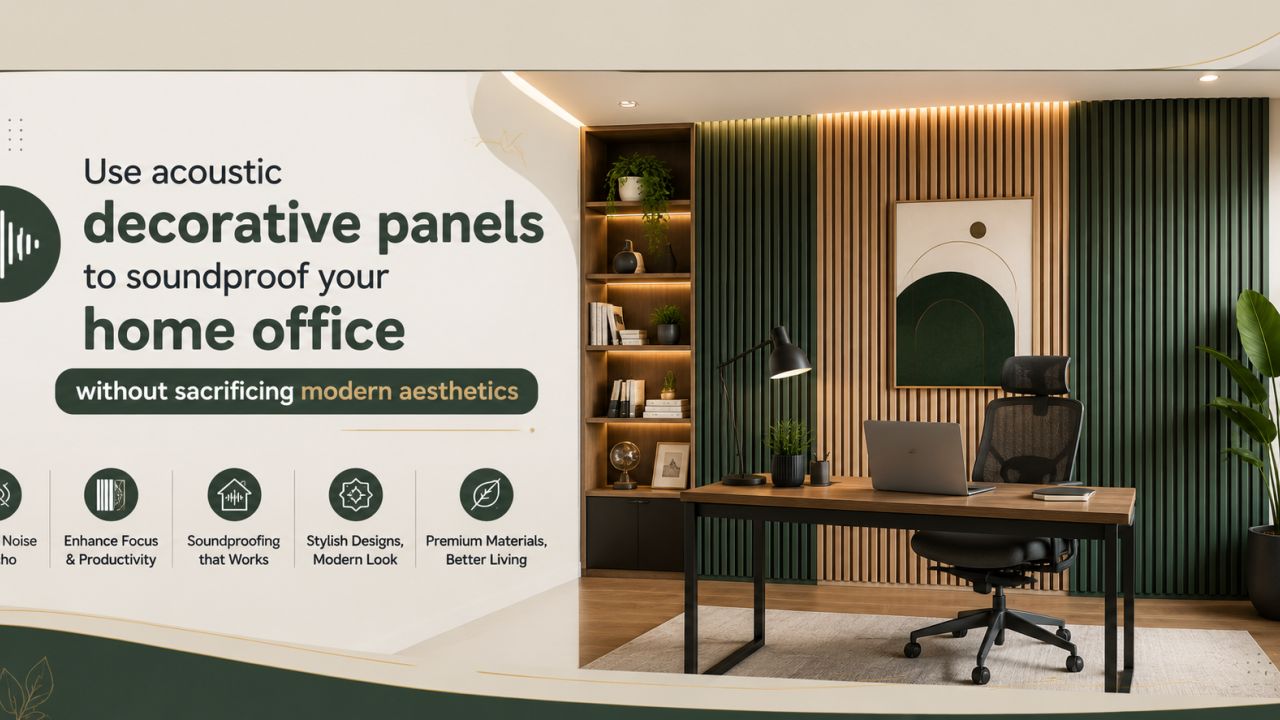
A Better-Looking Home Office: Acoustic Panels That Actually Help
A home office should support concentration, calls and long stretches at a screen. It should not look like a recording booth. Acoustic decorative panels can make the room sound calmer and more controlled, but they are not a magic substitute for construction work. The useful approach is to match the panel, placement and expected result to the actual noise problem.
If you are comparing designers and companies serving your area, browse the practical ideas in WallsToWonder Posts before you request a quote. A little preparation makes it easier to tell a well-resolved acoustic proposal from a wall covered in attractive but ineffective slats.
First, separate sound absorption from soundproofing
This distinction will save you from an expensive disappointment. Most decorative acoustic panels are designed to absorb reflected sound inside a room. They reduce echo, soften speech and make video calls clearer. They do not, by themselves, stop a pressure cooker, traffic, television or a neighbour’s drill from entering the office.
- Hard, echoing rooms with tile, glass or bare plaster.
- Speech intelligibility during online meetings.
- Reducing the harshness of a keyboard, chair movement or room reverberation.
- Mass, sealed gaps and sometimes a new wall or ceiling build-up.
- Attention to doors, windows, electrical boxes and shared walls.
- A realistic expectation about what frequency of noise is being addressed.
For many apartments and spare bedrooms, improving absorption is the sensible first step. If low-frequency music, building services or constant outside noise is the main issue, ask a designer or acoustic consultant about isolation measures before selecting a finish.
Choose panels that belong in a home office
There is no single best panel. The right option depends on the wall area available, the level of visual texture you want, cleaning needs and whether the treatment is fixed or reversible.
| Panel type | What it contributes | Good fit | Check before buying |
|---|---|---|---|
| PET felt panels | Softens reflections and offers strong colour control. | Contemporary offices, pinboards and feature walls. | Edge finish, density, fire documentation and dust-cleaning method. |
| Fabric-wrapped panels | Absorption with a more upholstered, tailored appearance. | Call-heavy rooms or a quieter study with a refined finish. | Fabric durability, stain response and the condition of the backing. |
| Timber slat panels with an acoustic backing | Adds warmth while the backing absorbs some reflected sound. | Modern Indian interiors using wood tones and vertical lines. | Do not assume the timber slats alone provide acoustic performance. |
| Perforated or grooved wood panels | Balances a hard decorative surface with absorption behind it. | Built-in walls, libraries and more formal offices. | Perforation pattern, backing depth and access for repairs. |
| Decorative foam | Can absorb sound but often reads as studio equipment. | Utility-first recording or gaming areas. | Appearance, ageing, cleaning and suitability near heat sources. |
Look for technical information rather than vague phrases such as ‘noise-proof’ or ‘100% silent’. A supplier should be able to explain the product’s absorption behaviour, thickness, backing and installation method. If those details are unavailable, treat the performance claim cautiously.
Plan the room requirement, not just the feature wall
Desk and video-call wall
Place absorption where your voice and monitor reflections are most noticeable, often on the wall behind or beside the desk. Keep enough clear space for lighting, shelving and a camera background. A full-height panel is not automatically better than a well-positioned portion of wall.
Bedroom study corner
Use a fabric or felt panel in a colour related to the headboard, curtains or rug. This keeps the work zone visually quiet and avoids making a small room feel like a commercial office. Removable mounting may matter if the bedroom has to return to its original use.
Living-room workstation
Consider slatted panels, framed fabric art or a joinery-backed acoustic insert so the work area reads as part of the living space. Check that the treatment does not obstruct a balcony door, fan airflow or television access.
Storage and renovation
Acoustic treatment can sit between storage modules, inside a shallow niche or on a movable screen. During renovation, use the opportunity to seal obvious gaps and plan electrical points before panelling. Do not cover inspection points or create a wall that is difficult to service later.
In a complete interior project, the office should be coordinated with the rest of the home: door swing, air-conditioning, lighting, data points, storage and furniture clearances all affect the result. A beautiful wall can still fail if the desk faces glare, the microphone sits beside a hard window or the door has a large undercut.
Use a designer comparison process that tests the thinking
Ask at least two designers or companies serving the area to respond to the same brief. Give them the room dimensions, wall construction if known, a short recording of the echo or noise, furniture requirements and the hours when the room is used. You are comparing diagnosis and documentation, not just render quality.
- Does the proposal distinguish absorption from sound isolation?
- Does it show panel coverage, thickness, backing and fixing details?
- Are door seals, windows, ceiling reflections and floor finishes considered?
- Can the designer coordinate carpentry, electrical work, painting and installation?
- Does the scope explain what happens if the chosen product is unavailable?
Services may range from a focused material-and-layout consultation to a full interior package covering design, procurement, site coordination and installation. Confirm which service you are actually paying for. A designer supplying drawings is not necessarily responsible for acoustic testing or the performance of a third-party product.
Estimate the budget without relying on a per-square-foot shortcut
The cost can change substantially with panel material, coverage, custom framing, wall preparation, access, hardware and the amount of joinery around it. A small premium finish may cost more than a larger standard panel treatment. Construction for genuine isolation is a separate and potentially much larger scope.
Start with a scope-based estimate
Use the interior cost estimator to organise the room size, work items and finish assumptions. Treat the result as a planning aid, not a final contractor price.

Interrogate the quotation
When proposals arrive, use the quotation checker to spot missing descriptions, unclear quantities or inconsistent line items before asking the designer to clarify them.
For a quick planning exercise, list the panel area separately from substrate preparation, frames, adhesive or cleats, electrical relocation, painting, delivery and labour. Also record whether GST, removal of existing finishes and touch-ups are included. This prevents a low headline figure from hiding the work needed to finish the wall.
Read the material and quotation details carefully
A usable specification should identify the manufacturer or approved equivalent, panel dimensions, thickness, colour, edge treatment, backing, quantity and installation method. If a natural timber finish is proposed, ask how shade variation will be handled. For fabric, request the exact collection and cleaning guidance rather than accepting a generic colour name.
The quotation should show assumptions. For example, it might state that the existing wall is sound, dry and reasonably level, or that civil repair is excluded. Those notes are not paperwork for its own sake; they define who carries the cost when the site differs from the drawing.
Before paying an advance, ask:
- What measurable outcome is expected: less echo, clearer speech or reduced transmission?
- Which parts are decorative and which parts provide acoustic absorption?
- What is the sample approval process, and can the final batch vary from the sample?
- Who handles damage, replacement and colour mismatch during installation?
- What is the payment schedule, cancellation position and completion definition?
- Will the installation affect warranties, fire-safety requirements or access to services?
Red flags worth taking seriously
Be cautious when a proposal promises complete soundproofing from thin decorative panels, gives no product specification, or covers every wall without explaining why. A design that ignores the door and window may be treating the most visible surface rather than the actual route of noise.
Other warning signs include pressure to pay before a scope is issued, a quotation that bundles materials and labour into one unexplained number, unwillingness to provide a physical sample, and drawings that do not show sockets, vents or maintenance access. A polished render is useful for appearance; it is not evidence of acoustic performance.
How WallsToWonder can support the comparison
WallsToWonder is useful when you want to move from inspiration to a more organised brief. Use the design ideas collection to compare visual directions, browse designers and companies serving your area, and prepare questions before contacting anyone. The Design my room tool can also help you test broad layout and style directions before a detailed consultation. It cannot certify acoustic performance, but it can make your preferences easier to communicate.
Keep your brief honest: ‘I need clearer calls and less echo’ is more useful than simply saying ‘soundproof the office’. Share the room’s dimensions, wall type if known, furniture, noise sources and preferred visual language. Near the end of your search, revisit the WallsToWonder Posts library to cross-check planning questions before choosing a proposal.
Frequently Asked Questions
Do acoustic decorative panels completely soundproof a home office?
No. They mainly absorb reflected sound inside the room. Blocking noise from outside usually requires mass, airtight construction, improved doors or windows, and sometimes decoupled wall or ceiling systems.
Where should acoustic panels be placed in a home office?
Start with the wall behind or beside the desk, then consider other strong reflection points such as a bare wall opposite the desk. Placement should follow the room’s echo and furniture layout, not only the most visible wall.
Are timber slat acoustic panels suitable for a modern home office?
Yes, when the slats are installed over a suitable acoustic backing. The timber surface provides the look; the spacing, backing and depth determine much of the absorption. Ask for the full system specification.
What should an acoustic panel quotation include?
It should identify the product, dimensions, thickness, finish, backing, coverage, fixing method, preparation, labour, delivery, taxes where applicable, exclusions and the expected acoustic objective.
How can I compare designers for a home office acoustic treatment?
Give each designer the same brief and compare their diagnosis, product documentation, placement plan, coordination with electrical and furniture work, exclusions, payment schedule and after-installation responsibility.