
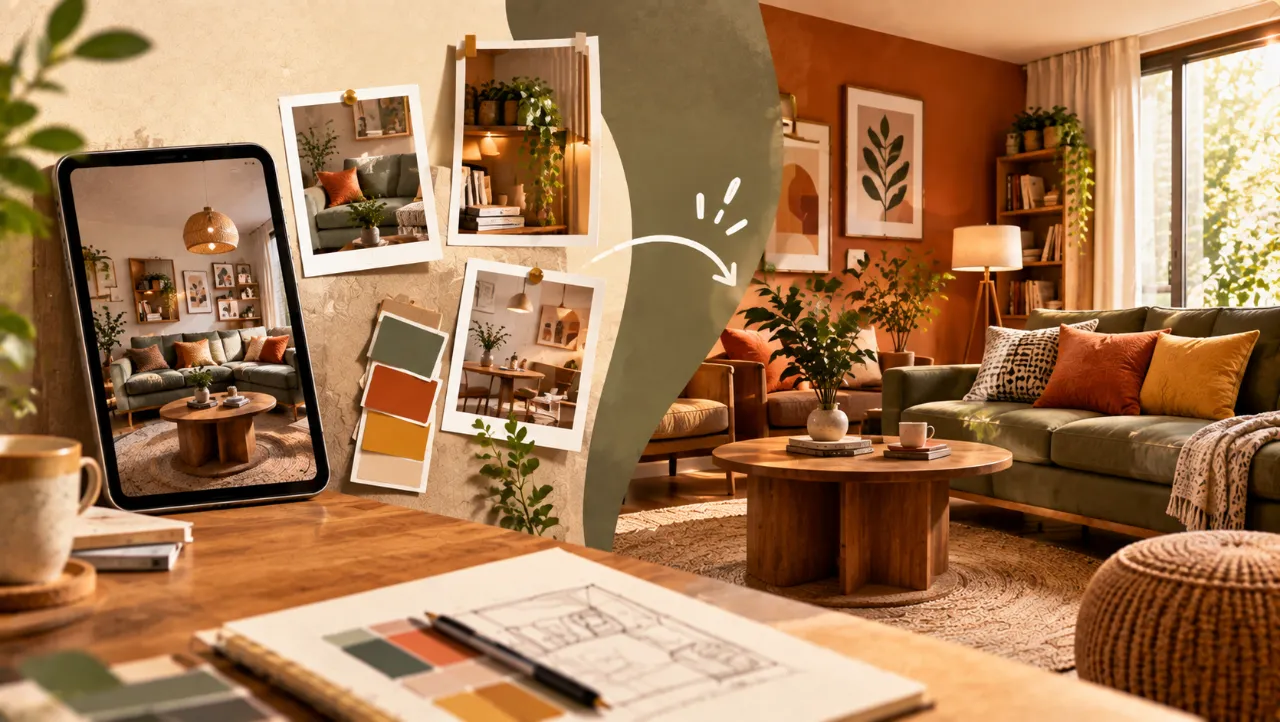
Love an Inspiration Photo? Here's How to Make It Work in Your Room
Saving an inspiration photo is easy. Making that photo work in your own home is where the real design thinking begins.
You may find a living room you love on Pinterest or Instagram, save a bedroom with the perfect colour palette, or screenshot a kitchen that looks exactly like what you imagined. But when you compare it with your own room, the differences quickly become obvious.
The room in the photo may be twice the size. It may have taller ceilings, larger windows, more natural light, fewer doors, different wall proportions, or completely different structural conditions.
That doesn't mean the idea won't work.
The goal is not to recreate the inspiration photo exactly. The goal is to understand what you actually like about it and adapt that idea to the room you have.
Use an inspiration photo as a design reference rather than a blueprint. Identify the colours, materials, furniture style, proportions, lighting and mood you like, then adapt them around your room's actual dimensions, structure, natural light, budget and lifestyle.
- Start by identifying what you actually like
- Separate the inspiration into design elements
- Measure your room before adapting anything
- Don't ignore the room's existing architecture
- Pay attention to proportions
- Adapt the layout before the aesthetics
- Work with your natural light
- Consider your existing furniture
- Adapt expensive inspiration to your actual budget
- Don't try to copy every detail
- Think about your lifestyle too
- Use the inspiration image as a design brief
- A simple inspiration-to-room checklist
Start by identifying what you actually like
Before buying furniture, choosing colours or sending the image to a designer, look at the inspiration photo carefully.
Ask yourself: What exactly attracted me to this room?
- The overall colour palette
- The furniture style
- The lighting
- The wall treatment
- The material combination
- The layout
- The amount of storage
- The artwork or accessories
- The feeling of openness
- The contrast between light and dark elements
- The use of natural materials
- The overall mood
This distinction matters.
If you simply say, "I want this room," you are trying to copy an entire space.
If you say, "I like the warm wood, cream walls and soft lighting," you have identified design elements that can be translated into your own space.
Separate the inspiration into design elements
An inspiration image usually contains several decisions working together.
Break it down into individual components before deciding what can actually be used in your room.
Colour
Look at the dominant, secondary and accent colours.
For example, an image might appear to be a simple beige living room, but the actual palette could include warm ivory walls, walnut furniture, muted brown upholstery and small brass accents.
You don't necessarily need the exact same shades. You need to understand the relationship between them.
Materials
Look for materials such as wood, stone, marble, metal, glass, fabric, wallpaper and fluted or textured surfaces.
If the inspiration uses expensive natural stone across an entire wall, you might recreate the same visual effect through a smaller application or another suitable finish.
Furniture
Look at the furniture's proportions rather than just its appearance.
A large sectional may look perfect in the inspiration image but overwhelm a compact living room.
Instead, you might recreate the same visual language with a smaller sofa, one accent chair and a compact coffee table.
Lighting
Lighting is often one of the biggest reasons an inspiration photo looks different from the real room.
Look at where the light comes from and how it is layered: natural daylight, cove lighting, pendant lighting, wall lighting, floor lamps or accent lighting.
The exact fixtures may not be practical for your room, but the lighting strategy can often be adapted.
Measure your room before adapting anything
An inspiration image can hide a lot of information.
Your room cannot.
Before trying to recreate an idea, measure:
- Room length and width
- Ceiling height
- Door positions
- Window positions
- Column locations
- Beam locations
- Electrical points
- Plumbing points where relevant
- Existing furniture
- Passageways and circulation space
These measurements establish what is actually possible.
A beautiful inspiration image with a large dining table might depend on generous circulation space around it. If your room is narrower, reproducing the same table size could make everyday movement uncomfortable.
Don't ignore the room's existing architecture
One of the easiest mistakes is treating your room as a blank box.
Most homes already have conditions that cannot simply be moved.
- Structural columns
- Beams
- Windows
- Doors
- Shafts
- Niches
- Existing flooring
- Electrical points
- Plumbing lines
- Built-in storage
Instead of fighting these elements, ask how the inspiration can work around them.
A column that interrupts a wall may become part of a storage composition. A niche can become shelving. An awkward corner may become a reading area or work zone.
The objective is not to make your room identical to the reference image.
It is to make the reference work with your room.
Pay attention to proportions
Two rooms can use the same furniture, colours and materials but still look completely different because their proportions are different.
This is particularly important with:
- Sofas
- Beds
- Dining tables
- Wardrobes
- TV units
- Coffee tables
- Pendant lights
- Wall panelling
- Curtains
For example, a floor-to-ceiling TV wall may look balanced in a large room but visually dominate a smaller one.
The solution isn't necessarily to remove the idea completely.
You may need to reduce its scale, simplify the detailing or use the treatment on a smaller portion of the wall.
Adapt the layout before the aesthetics
When people use inspiration images, they often focus on finishes first.
Layout should come first.
Before choosing the exact sofa fabric or wall colour, determine:
- Where people will walk
- Where furniture will sit
- How doors will open
- How windows will be accessed
- Where the TV will be viewed from
- Where storage is required
- How much space is needed between furniture
- Whether the room still feels comfortable when occupied
A room can look beautiful in a photograph and still be inconvenient to live in.
Your version needs to work when someone is actually using it.
Work with your natural light
The same colour can look completely different in two homes.
An inspiration room may receive strong natural daylight throughout the day. Your room may face a different direction or have smaller windows.
This can affect:
- Wall colours
- Wood tones
- Upholstery
- Flooring
- Reflective surfaces
- Lighting temperature
If the inspiration uses deep colours in a naturally bright room, reproducing those colours in a darker room may make the space feel heavier.
Instead, consider using the same colour family with lighter values or introducing the darker shade through smaller elements.
Consider your existing furniture
You don't always need to start from zero.
If you already own a sofa, dining table, bed, wardrobe or other major furniture, decide what should stay before building the new design around the inspiration image.
Ask:
- Can this piece work with the new palette?
- Can it be reupholstered?
- Can its finish be changed?
- Can it be repositioned?
- Does it create a proportion problem?
- Would replacing it solve a larger layout issue?
Sometimes one existing piece can become the starting point for the entire room.
This can also make the final design more personal rather than looking like a replica of something found online.
Adapt expensive inspiration to your actual budget
An inspiration image doesn't come with a visible price tag.
The room may include custom furniture, premium stone, imported lighting, expensive hardware or highly detailed wall treatments.
You don't necessarily need every expensive element to reproduce the same overall feeling.
Instead, identify where the visual impact comes from.
| Inspiration | Possible Adaptation |
|---|---|
| Full-height premium stone wall | A smaller feature section with a complementary finish |
| Large custom sectional | A more compact sofa with a similar silhouette |
| Designer pendant | A simpler fixture with similar proportions and lighting effect |
| Extensive custom cabinetry | Focused storage in the areas where it is actually needed |
The aim is to spend where the design creates the most visible and functional difference.
Don't try to copy every detail
A common mistake is trying to reproduce everything in the image.
The result can become visually crowded, especially when the original room was larger or more carefully staged.
Choose the elements that define the look.
A useful approach is to identify three to five key characteristics.
For example:
Inspiration style: Warm contemporary
- Warm neutral walls
- Walnut-toned furniture
- Soft layered lighting
- Curved seating
- Minimal metallic accents
Those five elements may be enough to establish the same design direction without copying every accessory, artwork or decorative object.
Think about your lifestyle too
Your room has to work for you, not for the person who created the inspiration image.
A beautiful open shelf may work in a carefully styled photograph but require constant maintenance in your home.
A low coffee table may look elegant but be inconvenient if the room is frequently used by children.
An open wardrobe may look visually light but may not suit someone who prefers concealed storage.
Ask practical questions:
- How many people use the room?
- How often do you entertain?
- Do you need more storage?
- Do you work from home?
- Do you have children or pets?
- How much maintenance are you comfortable with?
- Do you prefer open or closed storage?
- Which furniture pieces do you use every day?
These answers should influence the adaptation.
Use the inspiration image as a design brief
Instead of handing an inspiration photo to a designer and saying, "Make my room like this," explain what you want to take from it.
For example:
"I like the warm neutral palette, the wood detailing and the soft lighting. I don't need the exact furniture or wall treatment, but I want my room to have the same warm, calm feeling."
That gives the designer room to solve the actual constraints of your home.
The result can be inspired by the reference without becoming a copy.
If you are still collecting references, you can browse the WallsToWonder design ideas collection for additional interior concepts and planning references.
A simple inspiration-to-room checklist
Before finalising your design, compare the inspiration with your actual room.
| Inspiration | Your Room |
|---|---|
| What do I like about it? | What can I realistically recreate? |
| How large is the reference room? | What are my actual dimensions? |
| What is the main colour palette? | How will those colours behave in my light? |
| What furniture creates the look? | What furniture will fit comfortably? |
| What materials are being used? | Which materials suit my budget and maintenance needs? |
| How is the room lit? | What lighting can my room support? |
| What makes the room feel spacious? | What can create a similar feeling in my space? |
| What decorative elements stand out? | Which few details are actually worth keeping? |
This simple comparison can prevent a lot of unnecessary trial and error.
The goal is adaptation, not duplication
The best use of an inspiration image is not to recreate someone else's room.
It is to understand why the room works and translate those principles into your own home.
Your room may be smaller. Your ceiling may be lower. Your windows may be in a different position. Your budget may be different. Your family may use the space differently.
None of those things make the inspiration irrelevant.
They simply mean the design needs to be interpreted.
The strongest interiors often come from this process: take the feeling, understand the principles, adapt the details and let the final room belong to you.
Frequently Asked Questions
Can I recreate an inspiration room exactly?
Usually, an exact recreation isn't necessary or practical. Focus on the design elements and principles you actually like.
What should I measure first?
Start with room dimensions, ceiling height, doors, windows, columns, beams, electrical points and major existing furniture.
Should I copy the furniture from the image?
Not necessarily. Compare proportions, function and circulation first, then find pieces that suit your room.
What if my room is much smaller?
Reduce furniture scale, simplify large features and prioritise circulation and storage while retaining the main visual language.
What if my budget is lower than the inspiration room?
Identify the elements that create the biggest visual impact and allocate your budget there instead of trying to reproduce every detail.
Should I show my designer inspiration photos?
Yes. But explain what you like about each image so the designer can adapt the idea to your actual space.
Turn Your Inspiration Into a Room That Works
Once you understand what you like, the next step is translating that inspiration into your actual space, budget and requirements.
Design My Room Estimate Interior Cost Explore DesignersTurn this idea into a plan for your home
Visualise your space, understand the likely budget, or find a professional who can bring the idea to life.