
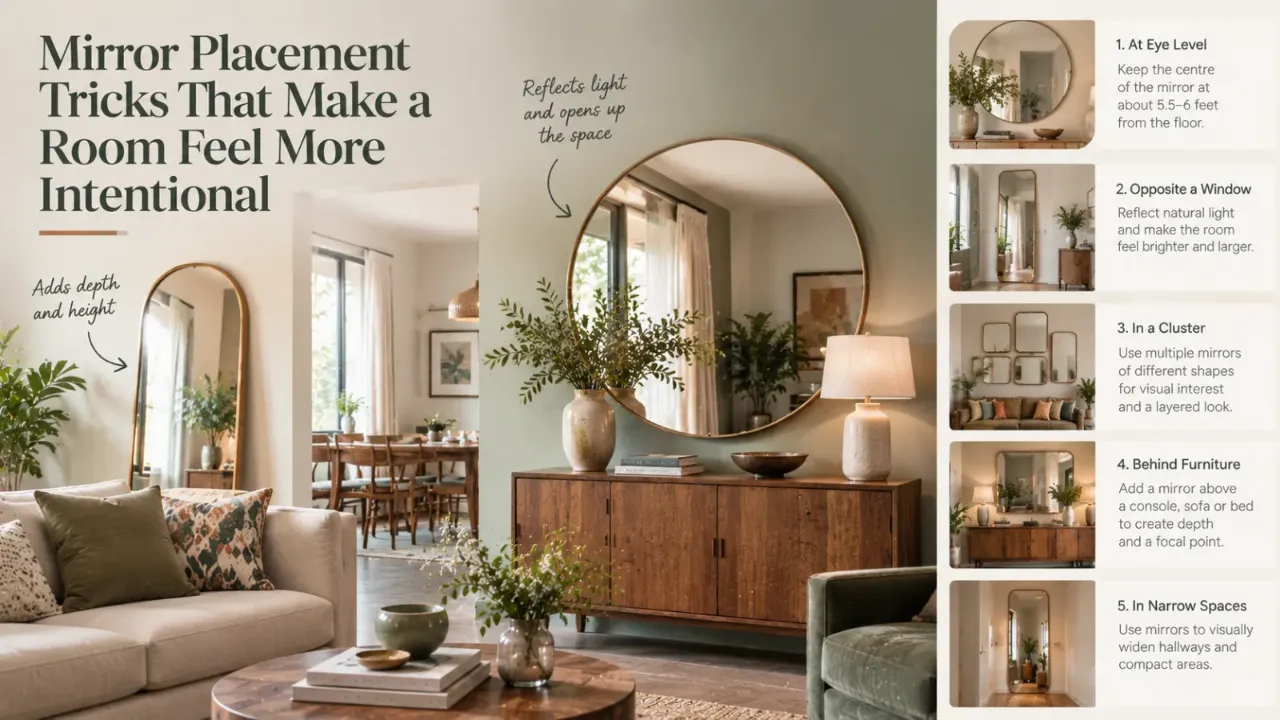
Mirror Placement Tricks That Make a Room Feel More Intentional
Mirrors have an almost automatic reputation in interior design. Put one in a small room and it will look bigger. Put one opposite a window and it will become brighter. Put one above a console and the entrance is suddenly finished. Except it does not always work that way.
A mirror can improve a room dramatically. It can also make a good room worse.
A Mirror Does Not Make Space. It Changes What You See.
A mirror does not physically add floor area. What it can do is extend a visual field by reflecting another part of the room.
That can make a space feel more open because the eye sees more depth. But the effect depends entirely on the reflection.
Reflect a bright window and you may introduce more light and visual openness. Reflect an attractive architectural feature and you reinforce it. Reflect a pile of bags, a cluttered shelf or an awkward doorway and you have simply doubled the thing you wanted to ignore.
So before asking, “Where can I put a mirror?” ask, “What will the mirror show me?”
The Best Mirror Position Often Has a Strong Reflection Behind It
One position reflects a blank wall. Another reflects the window. Another reflects a beautiful artwork. Another reflects the television. Another reflects the entryway clutter.
The mirror may be identical in every position. The room will not feel identical.
This is why designers think about reflection composition rather than just wall availability.
Use a Mirror to Borrow Light
One of the most useful applications is placing a mirror where it can reflect available daylight.
This can work especially well in rooms with limited natural light or interiors that have a dark corner.
The idea is not simply to put the mirror opposite any window. Check the angle. Does it actually catch the window? How much of the reflected view will be visible? Will the reflection be blocked by furniture? Will it create glare at certain times of day?
A Mirror Can Extend a Sightline
Suppose your living room opens toward a balcony, corridor or another bright area. A strategically placed mirror can reflect that view and make the visual connection feel longer.
If you enter a room and the sightline naturally leads toward a window, placing a mirror where it reflects part of that visual direction can reinforce the sense of depth.
Entryways Are One of the Most Natural Places for Mirrors
The entrance is where a mirror can serve a genuine everyday function: a quick appearance check before leaving, a final look at clothing and a visual focal point when you enter the house.
But an entryway mirror should not simply be hung on the first empty wall.
Look at what it reflects. If it faces a shoe rack overflowing with footwear, the mirror may make the clutter more prominent. If it reflects the living room's best wall, it can immediately make the entrance feel more connected to the rest of the home.
Above a Console Is Classic for a Reason
A mirror above a console works because the two elements naturally create a visual composition.
The console provides a horizontal base. The mirror creates vertical presence. Together, they create a defined zone.
But proportion matters. A tiny mirror floating above a wide console can look disconnected. A huge mirror can overwhelm a delicate console.
Think about whether the mirror and furniture feel like they were designed as a pair.
Dining Rooms Can Handle Larger Mirrors
Dining areas are often good places for mirrors because they can reflect light, furniture and table settings.
A large mirror can also create another visual plane behind the dining table without requiring additional furniture.
But ask: What does it reflect while you are actually using the room?
A mirror reflecting the dining table, lighting fixture or an attractive wall can feel intentional. A mirror reflecting the kitchen clutter or a constantly busy passage can make the dining area feel more chaotic.
Be Careful With Mirrors Opposite Televisions
A mirror opposite a television will reflect the screen. Even when the television is switched off, you may simply end up with two large visual elements competing across the room.
This does not mean a mirror can never be near a TV wall. It means you should check the sightline before committing to the placement.
Bedrooms Need More Thought Than “Full-Length Mirror”
A full-length mirror can be extremely useful in a bedroom. But where it goes matters.
If it sits in a narrow circulation path, it can make the room feel busier. If it reflects the bed directly and you dislike that visual, you will notice it every night.
Think about how you use the mirror. Do you need a dressing check? Do you need a standing mirror near the wardrobe? Would a wall-mounted mirror be enough?
A Wardrobe Mirror Can Save Space
In a compact bedroom, attaching a mirror to a wardrobe door can combine two functions in the same footprint.
That can be useful when there is no room for a separate full-height mirror.
Long Corridors Can Benefit From Strategic Mirrors
A long passage can sometimes feel narrow or visually repetitive. A mirror can interrupt that feeling by adding reflection and another layer of depth.
But a corridor is also a circulation space. A badly positioned mirror can reflect people walking past, cluttered side walls or multiple door frames and make the passage feel even busier.
Instead of covering an entire corridor with mirrors, think about one or two deliberate moments.
The End-of-Room Mirror Trick
Sometimes the strongest placement is at the far end of a room or sightline.
You see the mirror from the entrance. The reflected space appears to continue. The effect can be particularly useful in compact rooms or narrow passages.
Don't Automatically Put a Mirror Behind the Sofa
This is a popular living-room arrangement. Sometimes it works beautifully. Sometimes it simply creates a large reflective rectangle above a sofa without adding much to the room.
Before placing one there, ask what it will reflect: a window, artwork, plants or another attractive part of the room? Good. A ceiling fan, television or cluttered opposite wall? Maybe reconsider.
Consider the Height
A mirror that is too high can feel disconnected from the furniture below it. A mirror that is too low can feel awkward or become impractical.
Rather than relying on one universal measurement, relate the mirror to the furniture, people using it and the visual centre of the room.
For a dressing mirror, practical visibility matters most. For a decorative mirror, composition matters more. For a large wall mirror, the overall relationship to the room's height and proportions matters.
Large Mirrors Need Strong Anchoring
The larger the mirror, the more important its relationship to surrounding elements becomes.
A large mirror can work almost like architecture. It can define a wall, create symmetry, frame a dining area, anchor a console or visually connect two spaces.
But a very large mirror on a completely unrelated wall can feel overpowering.
Multiple Small Mirrors Are Not Always Better
A collection of mirrors can look interesting, particularly in decorative or eclectic interiors. But several reflective surfaces can create visual noise quickly.
If you want a mirror arrangement, give the group a clear composition through similar frames, a common shape, a deliberate grid or controlled spacing.
Frameless Does Not Mean Invisible
Frameless mirrors can be useful when you want a lighter visual effect. They can blend into walls, make cabinetry feel less bulky and work well in contemporary spaces.
But the reflection itself is still large. So think about what it reveals.
Mirrors Can Highlight Architecture
A mirror does not always need to be the star. Sometimes it is more interesting when it reinforces something that already exists.
Arches
A curved mirror can echo an arched doorway or architectural opening.
Clean Grids
A rectangular mirror can reinforce a room with strong architectural lines.
Soft Shapes
A circular or rounded mirror can soften an interior dominated by straight lines.
Defined Zones
A mirror can strengthen a console, niche, dining zone or dressing area.
Use Mirrors to Balance Heavy Furniture
A room with a large wooden cabinet, tall storage wall or substantial console can feel visually heavy.
A mirror can introduce a lighter reflective surface into that composition.
Think of reflection as another material.
Watch What Happens at Night
A mirror that looks beautiful during the day may behave very differently in the evening.
It can reflect pendant lights, ceiling fixtures, lamps, television screens, bright windows from neighbouring buildings or harsh spotlights.
This can create sparkle — or glare.
So mirror placement should be tested under the lighting conditions you actually live with.
Be Careful With Mirrors in Busy Homes
Mirrors magnify activity visually because they repeat it.
In a family home, that can mean reflecting children moving around, laundry, open doors, shoes, bags, kitchen activity and guests.
If the home is naturally busy, consider using mirrors to reflect quieter architectural surfaces rather than the most active parts of the house.
What to Reflect, Room by Room
Living Room
Window, artwork, greenery or an attractive architectural view.
Dining Room
Lighting, table setting or a composed wall.
Bedroom
Wardrobe area, dressing zone or a calm part of the room.
Entryway
A useful final-check area or an attractive view into the home.
The exact location will change from home to home. The principle remains the same: place the mirror where the reflection adds value.
The “Reflection Test”
Before drilling into the wall, stand where the mirror will go. Hold up a smaller temporary mirror if necessary. Then look at the reflection from the main positions in the room.
What do I see?
Do I like seeing it twice?
Does it add light or depth?
Does it make the room feel more connected?
Does it reflect something distracting?
Will that reflection still work at night?
If the answer is mostly positive, you probably have a good placement. If not, move it.
The Biggest Mirror Mistake
It is not choosing the wrong frame.
It is choosing the right mirror for the wrong wall.
A beautiful mirror cannot rescue a bad reflection. A simple mirror in the right location can transform a room.
That is why mirror placement should happen after you understand the room's sightlines, furniture arrangement and lighting — not before.
The Bottom Line
Mirrors are often described as space-enhancing accessories. That is only part of the story.
Their real power comes from controlling what the eye sees.
They can borrow light, extend a sightline, frame a focal point, balance heavy furniture, create a useful entry zone or make a corridor feel less repetitive.
But they can also reflect everything you wish you had hidden.
Final Thought
A mirror is not just something you hang on an empty wall. It is a design tool that creates a second view of the room.
Use that view deliberately. Reflect the light you want. Repeat the architecture you like. Highlight the corners worth seeing. And keep clutter out of the frame.
Because the best mirror is not necessarily the biggest one. It is the one that gives the room a better second view.
Ready to Visualise Your Mirror Placement?
Walls to Wonder's Design My Room tool lets you upload a room photo and explore different interior directions before committing to furniture, colours or styling details.
When you want professional help refining the layout, you can also explore designers through the Walls to Wonder Gallery .
Frequently Asked Questions
1. Where is the best place to put a mirror in a small room?
There is no single universal position. A good starting point is a wall where the mirror can reflect light, extend a useful sightline or highlight an attractive part of the room without reflecting clutter.
2. Should a mirror face a window?
It can work well when the mirror actually captures the window and its light. Check the angle and make sure the reflected view is useful rather than simply creating glare.
3. Is it good to put a mirror opposite the bed?
It depends on personal preference and the reflected view. If you do not want the bed to become a prominent repeated image, consider placing the mirror where it reflects the wardrobe, dressing area or another calmer part of the room.
4. Can mirrors make a room look bigger?
A well-placed mirror can create the visual impression of greater depth by reflecting another part of the room. The effect depends heavily on what the mirror reflects and where it is placed.
5. Should the mirror be centred above a console?
Often, yes, because the two can form a clear composition. But the mirror should still be proportionate to the console and the wall rather than being centred simply because there is empty space above it.
6. Are multiple mirrors a good idea?
They can work in the right interior, but multiple reflective surfaces can quickly create visual noise. A deliberate composition is more important than the number of mirrors.
7. Can I use a mirror in a narrow corridor?
Yes. A strategically placed mirror can interrupt a long visual plane and create a sense of depth. Avoid positions that reflect clutter or create a confusing series of repeated doorways and movement.
8. What should I check before installing a large mirror?
Check its scale, the surrounding furniture, the reflected view from key positions in the room, daylight and nighttime lighting, and whether the wall and installation method are appropriate for the mirror's size and weight.
Turn this idea into a plan for your home
Visualise your space, understand the likely budget, or find a professional who can bring the idea to life.