
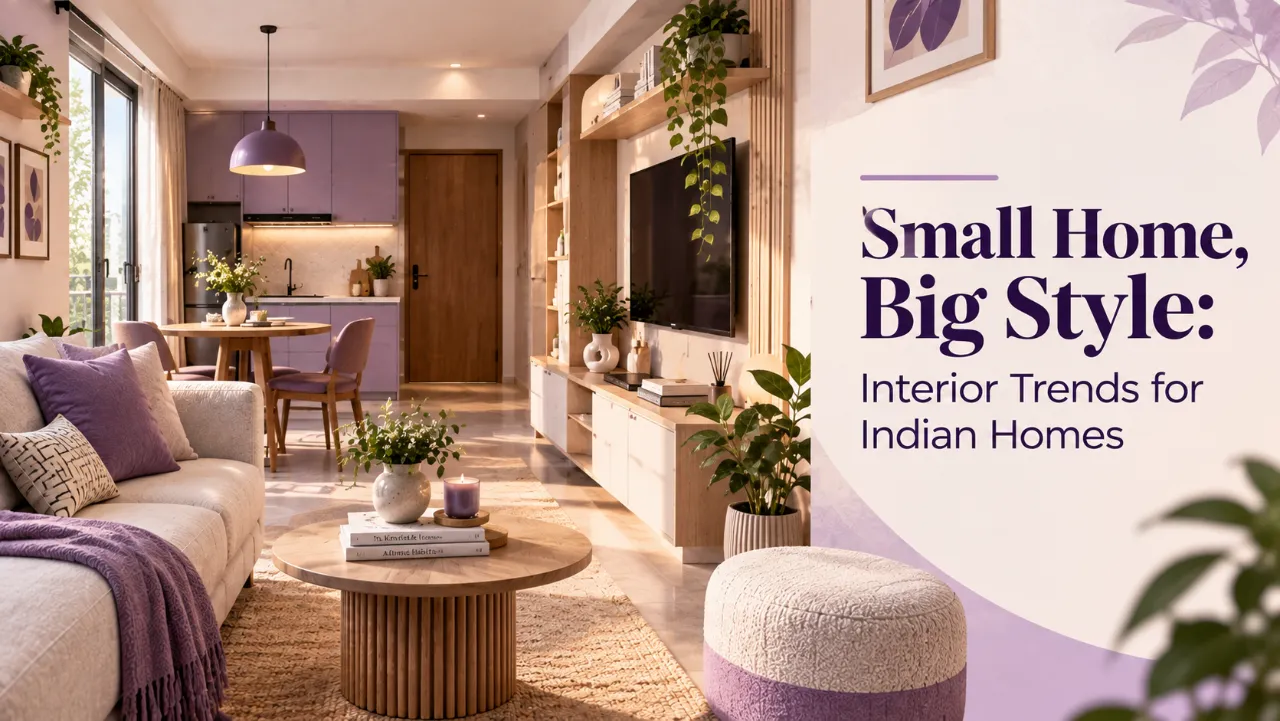
Small Home, Big Style: 2026 Interior Trends for Indian Homes
Every year brings a new wave of interior design trends. Some look beautiful in large homes, luxury apartments, hotel-style spaces, or perfectly staged photographs—but that does not automatically mean they will work in a compact Indian home.
For a smaller apartment, especially a 1 BHK, 2 BHK, or compact 3 BHK, good design has to do more than look current. It needs to make the most of limited floor area, provide enough storage, support everyday routines, and still leave the home feeling comfortable rather than crowded.
That is why the most useful 2026 design trends for small Indian homes are not necessarily the most dramatic ones.
The trends worth considering are the ones that combine style, functionality and space efficiency.
From multifunctional furniture and warm minimalism to smarter storage, layered lighting and carefully chosen textures, 2026 is moving toward interiors that are designed around how people actually live.
- Multifunctional spaces
- Warm minimalism instead of stark minimalism
- Smart, built-in storage
- Layered lighting
- Curves—used selectively
- Natural materials and tactile finishes
- Layered textures instead of too many decorative objects
- A more personal, less “showroom” interior
- Indian craft and contemporary details
- Flexible dividers instead of permanent walls
- Colours that work with Indian light
- Statement pieces—but only one at a time
- Trends that need more caution in small homes
- The “trend test” for a small Indian home
- What a good 2026 small-home interior looks like
- A simple room-by-room approach
- The biggest 2026 design lesson for small Indian homes
- Frequently asked questions
1. Multifunctional Spaces
One of the strongest trends for 2026 is designing rooms to perform more than one function.
A dining area may also become a work-from-home station. A guest room may double as a study. A living room may need to accommodate entertaining, relaxing, working and storage—all within the same footprint.
This is particularly relevant for Indian apartments, where a separate room for every activity is not always practical.
How to use it in a small home
Instead of adding more furniture, look for furniture and layouts that can perform multiple jobs.
- A dining table that doubles as a work desk
- A window seat with hidden storage
- A sofa bed for occasional guests
- A foldable or wall-mounted study desk
- A storage unit that also functions as a TV console
- A kitchen counter that can work as a breakfast or work zone
- Sliding partitions that can separate spaces when required
The goal is not to make every piece of furniture multifunctional. It is to identify the areas where one element can realistically serve two purposes.
2. Warm Minimalism Instead of Stark Minimalism
Minimalism is not disappearing, but its colder version is being softened.
In 2026, interiors are increasingly moving toward warmer, more tactile and more personal spaces rather than rooms dominated by stark white surfaces and an almost empty appearance.
For a small home, this can be especially useful.
A visually calm room generally feels less crowded, but that does not mean it needs to look bare.
Try:
- Warm whites
- Beige and sand tones
- Soft taupe
- Muted terracotta
- Warm wood finishes
- Soft olive or sage accents
- Natural fabrics
- Subtle wall textures
- A few carefully selected decorative pieces
Instead of filling a small room with accessories, create interest through materials, colour variation and texture.
A warm neutral wall paired with wood, fabric and soft lighting can feel richer than an all-white room without making the space visually busy.
3. Smart, Built-In Storage
Storage is not simply a practical requirement in a small home—it can determine how spacious the entire home feels.
In Indian homes, where storage often needs to accommodate everything from clothing and kitchenware to appliances, documents, luggage and household supplies, this trend makes particular sense.
Use the vertical space
- Full-height wardrobes
- Loft storage where appropriate
- Tall kitchen cabinets
- Built-in display and storage units
- Storage beneath seating
- Bed storage
- Wall-mounted cabinets
- Concealed utility storage
The advantage of built-in storage is that it can be planned around the room rather than added afterward.
But avoid one common mistake
More storage does not automatically mean better storage.
A wall covered entirely in cabinets can make a small room feel heavy.
Balance closed storage with a few open or visually lighter areas so the room still has breathing space.
4. Layered Lighting
A single ceiling light can illuminate a room, but it does not necessarily make a small home feel comfortable or sophisticated.
Layered lighting is becoming an important part of contemporary interiors, with ambient, task and accent lighting being used together rather than relying on one overhead source.
For a compact home, this can also help create different moods without changing the furniture layout.
Think in three layers
Ambient Lighting
Provides general illumination throughout the room.
Task Lighting
Supports specific activities such as reading, cooking, studying or working.
Accent Lighting
Highlights artwork, shelving, architectural details or decorative elements.
For example, a living room could combine ceiling lighting with a floor or table lamp and a subtle LED detail within a display unit.
The result is more depth without requiring additional floor space.
5. Curves—Used Selectively
Curved furniture and softer forms continue to appear in 2026 interiors.
Curves can work beautifully in small homes because they can soften the visual effect of a room dominated by straight walls, cabinets and rectangular furniture.
But there is an important distinction between using curves as an accent and making everything curved.
Good ways to introduce curves
- A rounded coffee table
- A curved accent chair
- A softly rounded mirror
- An arched niche
- A curved headboard
- Rounded edges on a console or side table
You do not need a curved sofa, curved wall, arched doorway and rounded furniture all in the same room.
One or two softer forms can be enough to make a compact interior feel more considered.
6. Natural Materials and Tactile Finishes
Another important direction in 2026 interiors is the move toward materials that add warmth and sensory depth.
Natural wood, stone, woven fabrics, handcrafted elements and textured surfaces are being used to make homes feel more personal and less showroom-like.
For a small Indian home, however, the key is controlled application.
You do not need five different materials in one room.
Instead, choose a simple combination such as:
- Warm wood + neutral wall + textured fabric
- Stone-look surface + muted paint + natural woven accents
- Wood + soft upholstery + brushed metal
The smaller the room, the more important material coordination becomes.
7. Layered Textures Instead of Too Many Decorative Objects
A small home can quickly look cluttered when visual interest comes from too many objects.
Instead, 2026's emphasis on texture offers another approach.
You can create depth through:
- Textured upholstery
- Curtains
- Rugs
- Wood grain
- Fluted or ribbed details used selectively
- Matte finishes
- Natural fabrics
- Subtle wall treatments
- Handcrafted décor
The idea is simple: make the room interesting without filling every surface.
This can be especially useful for living rooms and bedrooms where floor space is already limited.
8. A More Personal, Less “Showroom” Interior
One of the broader shifts in 2026 design is toward homes that feel personal rather than perfectly matched.
This is good news for small homes.
You do not need a large room to make an interior feel distinctive.
Instead of filling a wall with multiple decorative pieces, consider:
- One meaningful artwork
- A family photograph
- A handcrafted Indian object
- A small collection of books
- A statement mirror
- A carefully chosen textile
- A plant or natural element
A small space benefits from editing.
Choose fewer things, but give the things you choose a reason to be there.
9. Indian Craft and Contemporary Details
A modern Indian home does not have to choose between contemporary design and traditional character.
Indian materials, crafts, colours and decorative details can be incorporated into modern interiors without turning the room into a themed space.
For example:
- Brass accents with contemporary furniture
- Handcrafted pottery on minimalist shelving
- Indian textiles in neutral interiors
- Traditional artwork in a modern living room
- Cane or woven details
- Locally inspired patterns used as accents
- Natural wood paired with contemporary forms
The key is proportion.
A small home usually benefits from one strong cultural or handcrafted element rather than many competing elements.
10. Flexible Dividers Instead of Permanent Walls
Open layouts can make a compact home feel larger, but completely open spaces are not always practical.
In a small Indian apartment, you may need separation between the living room and dining area, kitchen and living space, or work and relaxation zones.
Instead of immediately creating a permanent wall, consider lighter forms of zoning.
Options include:
- Sliding partitions
- Fluted glass
- Open shelving
- Half-height partitions
- Curtains
- Screens
- Furniture placement
- Changes in lighting
- Different flooring or ceiling treatments
This creates visual separation without necessarily making the home feel divided into small boxes.
11. Colours That Work With Indian Light
Colour trends can look very different in real homes than they do in photographs.
Indian homes can receive strong natural light, and the direction and intensity of that light can significantly affect how colours appear.
“Is this colour trending in 2026?”
Ask:
“How does this colour behave in my room throughout the day?”
A soft beige may feel warm and bright in one room but yellow in another.
A deep green may create a sophisticated accent wall but make a poorly lit room feel heavier.
A muted terracotta may add warmth without overwhelming the room when used on one wall or through accessories.
The trend should serve the room—not the other way around.
12. Statement Pieces—But Only One at a Time
Small homes do not have to avoid statement design.
They simply need to use it more strategically.
A large artwork, distinctive light fixture, sculptural mirror or unusual accent chair can give a compact room personality without requiring additional furniture.
The trick is to let the statement element have enough visual space around it.
If everything is trying to be the focal point, nothing becomes the focal point.
One statement piece + simple supporting elements.
This creates impact without visual overload.
13. Trends That Need More Caution in Small Homes
Not every popular 2026 trend should automatically make its way into a compact apartment.
Some ideas can work, but require careful adaptation.
Heavy Material Layering
Using multiple bold stones, woods, metals and textures can create depth in a large room, but in a small space it can quickly become visually overwhelming.
Oversized Furniture
A large sectional may look luxurious, but if it leaves almost no circulation space, it is not necessarily a practical choice.
Excessive Decorative Walls
Multiple feature walls, elaborate panelling and strong patterns can fragment a small home visually.
Too Many Open Shelves
Open shelving looks light, but every shelf eventually needs to be organised and maintained.
Excessive Dark Colours
Dark colours are not automatically unsuitable for small rooms, but they need to be considered alongside natural light, ceiling height, lighting and the rest of the palette.
Trend-Heavy Interiors
If every surface follows a different trend, the home can quickly feel dated.
A better approach is to use trends as accents within a timeless base.
14. The “Trend Test” for a Small Indian Home
Before adopting any 2026 trend, ask five questions:
1. Does it save space?
If yes, it has a practical advantage.
2. Does it improve storage?
If yes, it can solve a real everyday problem.
3. Does it support more than one activity?
Multifunctionality is particularly valuable in compact homes.
4. Will it still work if my lifestyle changes?
A flexible design generally has a longer useful life.
5. Can I maintain it easily?
A beautiful idea that requires constant maintenance may not be practical for everyday living.
If a trend looks good but fails most of these questions, consider using it only as a small decorative element.
15. What a Good 2026 Small-Home Interior Looks Like
The best small-home interiors are not necessarily the ones with the fewest things.
They are the ones where every major design decision has a purpose.
A well-planned compact Indian home might combine:
- Warm neutral colours
- Multifunctional furniture
- Full-height storage
- Layered lighting
- Natural materials
- Selective curves
- Flexible zoning
- Personal décor
- Carefully chosen statement pieces
- Clear circulation paths
The result does not need to look minimal in the traditional sense.
It simply needs to feel intentional rather than crowded.
16. A Simple Room-by-Room Approach
Living Room
Focus on:
- Compact but comfortable seating
- A multifunctional coffee table
- Vertical storage
- Layered lighting
- One strong focal point
- Clear circulation
Bedroom
Focus on:
- Bedside storage
- Full-height wardrobe planning
- Under-bed storage where practical
- Soft lighting
- Calm colours
- Minimal floor clutter
Kitchen
Focus on:
- Vertical storage
- Organised cabinets
- Efficient work zones
- Easy-to-maintain materials
- Good task lighting
- Smart use of corners
Dining Area
Focus on:
- Compact dining furniture
- Round or space-efficient tables where suitable
- Built-in seating where practical
- Wall-mounted storage
- Flexible work/dining use
Balcony
Focus on:
- Vertical greenery
- Compact seating
- Foldable furniture
- Weather-appropriate materials
- Minimal floor obstruction
17. The Biggest 2026 Design Lesson for Small Indian Homes
The biggest lesson is not to follow every trend.
It is to adapt the right trends to the way you actually live.
A multifunctional dining table is useful if you work from home.
Built-in storage is useful if your household needs more storage.
Warm minimalism can work if you want a calm interior without making the home feel empty.
Layered lighting can improve both atmosphere and functionality.
A curved chair can add character without taking over the room.
But a trend should never be adopted simply because it is popular online.
Your home's size, natural light, family requirements, storage needs, lifestyle and maintenance preferences matter more than what is currently trending.
Final Takeaway
For small Indian homes, the most useful 2026 design trends are the ones that make limited space work harder without making it feel busier.
Think multifunctional rather than excessive.
Think warm rather than sterile.
Think integrated storage rather than added clutter.
Think layered lighting rather than one bright ceiling light.
Think personal details rather than a showroom-perfect interior.
The goal is not to make a small home look like a large home.
It is to make the small home work beautifully on its own terms.
Before choosing your next interior trend, start with the space you have, the way you live, and what your home needs every day. Then use the trend to support that design—not dictate it.
Planning a Small-Home Interior?
Explore interior design ideas, discover designers, and plan your next home project with Walls to Wonder.
Explore Design Ideas Explore Designers Design My RoomFrequently Asked Questions About 2026 Design Trends for Small Indian Homes
What are the best 2026 design trends for small Indian homes?
The most practical trends include multifunctional furniture, warm minimalism, smart built-in storage, layered lighting, natural materials, flexible zoning and selective use of curves and statement pieces.
Is minimalism suitable for a small Indian home?
Yes, but a warm and functional version of minimalism can be more practical than an extremely sparse interior. Warm colours, wood, textiles and subtle textures can keep the home visually calm without making it feel empty.
Are dark colours suitable for small rooms?
They can be, but the result depends on natural light, ceiling height, artificial lighting and how extensively the colour is used. Dark colours can work particularly well as controlled accents.
How can I use 2026 trends without making my small home look cluttered?
Use trends selectively. Focus on multifunctional furniture, integrated storage, layered textures and one or two statement elements instead of adding several trend-heavy features to the same room.
What is the biggest mistake when following interior design trends in a small home?
The biggest mistake is copying a trend without considering the actual room. A design that works in a large, well-lit space may not work the same way in a compact Indian apartment.
How can I make a small Indian home feel more spacious?
Prioritise clear circulation, vertical storage, appropriately scaled furniture, a controlled colour palette, layered lighting and flexible zoning. The objective is to reduce visual and physical clutter while keeping the home functional.
Turn this idea into a plan for your home
Visualise your space, understand the likely budget, or find a professional who can bring the idea to life.