
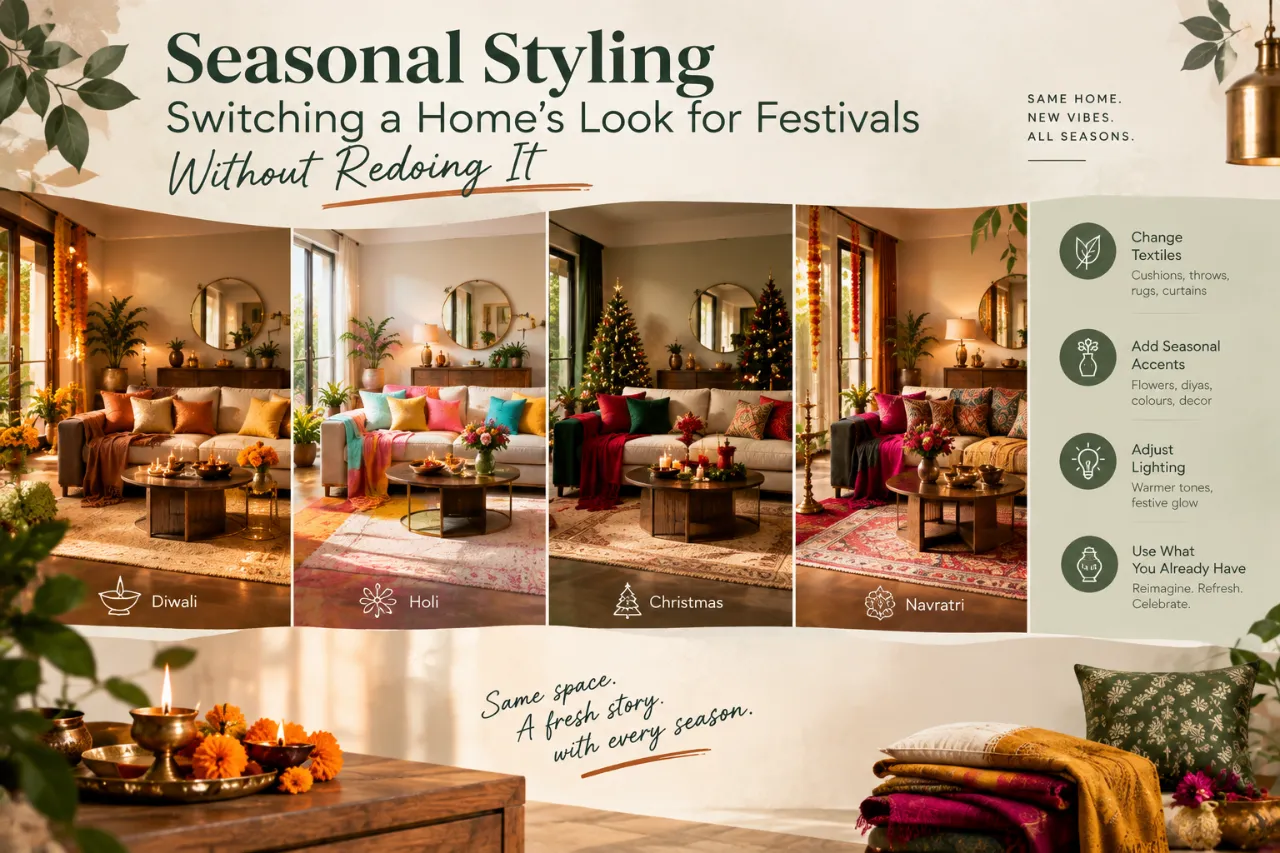
Seasonal Styling: Switching a Home's Look for Festivals Without Redoing It
Festivals are one of the best reasons to make a home feel different for a while. The challenge is doing it without changing the home itself.
Your permanent interiors may have a specific colour palette, furniture layout, lighting plan and architectural identity. Replacing those elements every few months is expensive, inconvenient and often unnecessary.
A better approach is seasonal home styling: keep the permanent foundation intact and change the atmosphere through reversible details such as textiles, lighting, artwork, flowers, table settings, accessories and selected festive accents.
This allows the same home to feel different for Diwali, Navratri, Eid, Christmas, Onam, Pongal or other celebrations without making every festival feel like a complete redesign.
Quick answer: The easiest way to switch your home's look for festivals is to divide the interior into permanent and seasonal layers. Keep flooring, major furniture, cabinetry and wall finishes consistent, then change softer and reversible elements such as cushions, throws, rugs, lighting, flowers, tableware, artwork and decorative objects. A consistent base makes each festive update feel intentional rather than temporary or cluttered.
- Why festive styling does not require renovation
- Separate permanent design from seasonal design
- Create one flexible festive base
- Use lighting to transform the mood
- Let textiles do most of the visual work
- Introduce festival-specific colours carefully
- Style the entryway
- Refresh the living room without moving everything
- Use flowers and natural elements
- Change the dining experience
- Create a festive corner
- Use artwork and accessories as seasonal layers
- Store seasonal décor intelligently
- How to adapt the same home for different festivals
- Common festive styling mistakes
- A practical seasonal styling formula
- Frequently asked questions
Festive Styling Does Not Mean Redecorating
A festival is a change in mood, not necessarily a change in architecture. You do not need a new sofa, fresh wall paint or a completely different furniture arrangement every time you want the home to feel celebratory.
In most rooms, a relatively small number of visible elements create a large part of the atmosphere. Lighting, fabrics, colour accents, artwork, flowers and decorative objects can therefore change the character of a room without disturbing the permanent layout.
Think in layers: Your permanent interior is the base. Seasonal styling is the layer that can be added, removed and changed throughout the year.
1. Separate Permanent Design From Seasonal Design
Before buying festival décor, divide your home into two categories.
| Permanent Layer | Seasonal Layer |
|---|---|
| Flooring | Rugs and runners |
| Large furniture | Cushions, throws and slipcovers |
| Kitchen cabinetry | Tableware and serving accessories |
| Wall finishes | Artwork, temporary décor and festive elements |
| Built-in lighting | Lamps, candles and decorative lights |
| Fixed storage | Display objects and seasonal accessories |
Once you understand this distinction, seasonal styling becomes much easier. You are no longer trying to transform the entire room. You are simply changing the layer that communicates the occasion.
2. Create a Flexible Festive Base
If you celebrate several festivals throughout the year, a flexible base can save both money and storage space.
Warm neutrals, natural materials, simple furniture and restrained decorative elements can work as a foundation for many different seasonal palettes.
For example, a living room with cream upholstery, warm wood, neutral curtains and simple lighting can move toward a rich gold-and-burgundy look for one festival and a softer green-and-ivory look for another without changing the sofa or walls.
Keep the Base Calm
Neutral walls, flooring and larger furniture give seasonal colour more freedom.
Repeat a Few Materials
Wood, brass, stone, cotton or linen can connect different festive looks across the year.
Leave Visual Breathing Room
A less crowded base makes it easier to add festive details without creating visual overload.
Invest in Reusable Pieces
Choose décor that can work across more than one festival rather than buying single-use accessories whenever possible.
3. Let Lighting Do Most of the Transformation
Lighting can change the atmosphere of the same room dramatically without requiring any permanent alteration.
Instead of adding lights randomly, build several layers: ambient lighting for general illumination, accent lighting for architectural or decorative features, and small decorative sources for warmth.
Festival styling can then focus on selected lamps, lanterns, candles, string lights or decorative fixtures placed where they contribute to the overall composition.
Use Warm Pools of Light
Smaller light sources can make seating areas, entryways, side tables and display corners feel more intimate during evening celebrations.
Highlight Existing Architecture
Rather than filling every surface with decoration, use lighting to bring attention to niches, artwork, shelves, plants or textured walls that already exist in the home.
Do Not Light Everything Equally
A festive evening usually feels more sophisticated when some areas remain quieter while selected areas receive stronger visual emphasis.
4. Use Textiles as Your Fastest Seasonal Change
Textiles are among the easiest things to change because they do not require construction and can dramatically alter colour and texture.
Cushions, throws, table runners, rugs, curtains and accent fabrics can introduce a new palette while leaving the basic furniture untouched.
Cushions
Change only a few cushion covers to introduce richer festive colours, embroidery or texture.
Throws
A textured throw can add warmth and visual depth to a neutral sofa or lounge chair.
Runners
A dining or console runner can provide a clear seasonal colour cue without changing the furniture.
Rugs
A smaller accent rug can define a festive seating or entryway zone while remaining easy to replace later.
5. Introduce Festival Colours Without Changing the Whole Palette
You do not need to repaint the home to make it feel festive.
Instead, choose one or two temporary accent colours that complement the permanent interior.
For a warm neutral room, this could mean introducing deep red, burgundy, saffron, emerald, royal blue, plum or rich gold through smaller objects.
The important part is repetition. If one accent colour appears in the cushions, flowers, table setting and a small decorative piece, the room will feel coordinated without needing more decoration.
Avoid the “everything festive” trap: Choose one dominant accent, one supporting tone and a restrained metallic or neutral element. A smaller palette usually looks more intentional.
6. Style the Entryway First
The entryway creates the first visual impression, so it is one of the most efficient places to concentrate seasonal styling.
You can create a strong festive moment with a combination of lighting, flowers, a small arrangement, an artwork swap, a runner or a carefully styled console.
The key is proportion. A small entryway may need only one focal arrangement, while a larger entrance can support a more layered composition.
7. Refresh the Living Room Without Moving Everything
The living room is usually where the most visible seasonal transformation takes place. But changing the entire furniture arrangement is rarely necessary.
Start by identifying the natural focal points that already exist: the coffee table, TV wall, console, centre table, shelves, artwork wall or seating area.
Then style only a few of these zones instead of decorating every available surface.
Coffee Table
Use a tray, flowers, candles, books or a small decorative arrangement.
Console
A console can become a seasonal display point through one larger artwork, lamp, arrangement or decorative grouping.
Seating
Change cushions and throws before considering new furniture.
Shelves
Remove a few everyday objects and replace them with selected festive pieces rather than adding décor on top of existing clutter.
8. Use Flowers and Natural Elements
Flowers and foliage can make a room feel seasonal without requiring permanent changes.
Fresh flowers, branches, leaves and natural arrangements introduce colour, texture and movement. They can also be changed more frequently than furniture or permanent décor.
The arrangement should respond to the scale of the space. One large statement arrangement may be more effective than several tiny displays scattered throughout the home.
9. Make the Dining Table a Seasonal Canvas
The dining table is another place where seasonal styling can feel significant without affecting the permanent interior.
Table runners, placemats, napkins, serving bowls, glassware, flowers and centrepieces can create a completely different mood.
| Layer | Everyday Version | Festive Version |
|---|---|---|
| Table Base | Simple wood or neutral surface | Add a runner or textile layer |
| Tableware | Everyday plates and glasses | Introduce a coordinated festive set |
| Centre | Minimal arrangement | Flowers, candles or a seasonal centrepiece |
| Napkins | Neutral | Add one accent colour or texture |
| Lighting | General dining illumination | Add softer decorative or accent lighting |
10. Create One Festive Corner Instead of Decorating Every Room
Whole-home decoration can quickly become expensive and visually overwhelming. A more controlled approach is to create one or two clear seasonal focal points.
A console, reading corner, balcony, dining area, prayer space or living-room niche can become the main festive moment while the rest of the home stays relatively calm.
This is especially useful in compact homes where too many decorative objects can interfere with circulation and everyday use.
11. Use Artwork and Accessories as Temporary Layers
Artwork, mirrors, trays, vases and decorative objects can change the mood without touching the permanent architecture.
Keep a small collection of interchangeable pieces that can be rotated throughout the year.
For example, a neutral artwork can be replaced temporarily with a more colourful piece during a celebration, then returned to storage once the festival is over.
This approach makes seasonal decorating feel more like styling and less like constantly buying new things.
12. Treat Festival Décor as a Capsule Collection
Instead of storing dozens of unrelated decorations, think of each festival's décor as a small capsule collection.
A capsule can contain a few reusable elements that work together:
Lighting
A selected set of lamps, lanterns, string lights or candles.
Textiles
A few cushion covers, runners, throws or accent fabrics.
Table Styling
Coordinated napkins, tableware or a centrepiece.
Decorative Objects
A small number of vases, trays, artwork pieces or festive accents.
A limited collection makes storage easier and encourages you to style with intention rather than quantity.
13. Design Storage for Seasonal Décor
Seasonal styling only works efficiently when taking the décor out and putting it away is manageable.
Use labelled boxes, protective wrapping and dedicated storage areas for fragile items, lighting, textiles and small accessories.
Grouping items by festival or by category can make the annual changeover much faster.
Storage rule: If seasonal décor takes hours to find and sort, it is more likely to become unused. Make your festive collection easy to access, easy to identify and easy to pack away.
14. Let the Same Home Support Different Festival Moods
One of the advantages of a restrained permanent interior is flexibility. The same room can support different visual identities throughout the year.
| Festival Mood | Possible Styling Direction | Best Places to Introduce It |
|---|---|---|
| Diwali | Warm metallics, deep colours, layered lights | Entry, living room, console, dining |
| Navratri / Dussehra | Stronger colour accents, textiles, flowers | Living room, entryway, dining |
| Eid | Elegant greens, creams, metallic details and soft lighting | Dining, living room, entryway |
| Christmas | Greens, reds, warm lights and natural textures | Living room, windows, dining |
| Onam / Harvest Celebrations | Natural materials, floral elements and lighter festive tones | Entry, dining, balcony |
| Pongal / Makar Sankranti | Sunlit colours, natural textures and seasonal floral accents | Entry, dining, kitchen-adjacent areas |
These are styling directions rather than fixed rules. A festive home can reflect personal taste, regional traditions and the colours that already exist in the interior.
15. Keep Existing Furniture and Change the Mood Around It
One of the easiest ways to overspend on seasonal styling is to assume that festive means new furniture.
In most cases, your existing sofa, dining chairs, side tables, console, bed and storage can remain exactly where they are.
Change what surrounds them instead: textiles, décor, lighting, artwork, plants and table settings.
This also creates greater consistency because the permanent furniture continues to anchor every seasonal version of the room.
16. Do Not Decorate Every Surface
Festive styling becomes more sophisticated when there is contrast between decorated and quiet areas.
A console with one strong arrangement can have more impact than ten small decorative objects scattered across every surface.
Keep some negative space around the focal elements. This allows the décor to be noticed instead of turning the whole room into one continuous display.
17. Layer Tradition Into a Modern Interior
A contemporary home does not need to become completely traditional during festivals.
Traditional elements can be introduced as accents while the existing architecture and furniture remain modern.
Handcrafted objects, brass details, woven textiles, pottery, flowers, traditional artwork and regional decorative elements can sit comfortably alongside modern furniture when their colours and proportions are considered.
This creates a home that feels festive without feeling as though its entire design language has changed overnight.
18. A Modern Formula for Seasonal Home Styling
1. Keep the Permanent Base
Leave major furniture, flooring, walls and built-in elements unchanged.
2. Pick One Mood
Decide whether the season should feel elegant, colourful, warm, traditional, natural or contemporary.
3. Choose Two Accent Colours
Use a controlled palette instead of adding every festive colour at once.
4. Change the Lighting
Add selected decorative sources that create warmth and focus.
5. Add Textiles
Refresh cushions, throws, runners, rugs or other soft elements.
6. Create One Focal Point
Concentrate decoration around an entry, console, dining area or living room rather than filling every surface.
19. Common Seasonal Styling Mistakes
Buying New Décor Every Year
A growing collection can become expensive and difficult to store. Reusable pieces usually offer more flexibility.
Trying to Transform Every Room
A few well-styled spaces can create a stronger festive impression than decorating the entire home equally.
Using Too Many Colours
Festive does not automatically mean multicoloured. A restrained palette can look richer and more sophisticated.
Blocking Circulation
Floor décor, large arrangements and temporary furniture should never make everyday movement difficult.
Ignoring Safety and Maintenance
Candles, decorative lights, fabrics and temporary installations need to be placed responsibly and kept away from hazards.
Leaving Old Décor Underneath New Décor
Adding new pieces without removing everyday accessories often creates clutter. Seasonal styling works better when some ordinary elements are temporarily put away.
20. How to Make Festival Styling Feel Expensive Without Overspending
A sophisticated festive interior does not depend on the number of objects in the room.
Focus your effort where it will be noticed most: lighting, textiles, colour coordination, table styling, flowers and one or two strong decorative moments.
Repeating the same colour or material in several places can create a feeling of cohesion without requiring a large quantity of décor.
For example, a single brass tone repeated through a lamp, tray, vase and candle holder may feel more coordinated than using several unrelated metallic finishes.
21. Seasonal Styling Can Be Planned Like a Wardrobe
A useful way to think about festival décor is to treat it like a capsule wardrobe.
Keep a reliable permanent base and rotate a smaller collection of seasonal pieces depending on the occasion.
Some pieces can work for several festivals, while a few distinctive items can create the identity of a particular celebration.
This keeps the home flexible without creating a storage problem every time the calendar changes.
22. A Room-by-Room Seasonal Styling Guide
| Room | Keep Permanent | Change Seasonally |
|---|---|---|
| Living Room | Sofa, tables, flooring | Cushions, throws, lighting, flowers, artwork |
| Dining Room | Dining table and chairs | Tableware, runner, centrepiece, lighting |
| Entryway | Console and mirror | Flowers, lamps, seasonal arrangement, artwork |
| Bedroom | Bed, wardrobe, major finishes | Bedding accents, cushions, lamps, small décor |
| Balcony | Permanent seating and flooring | Plants, cushions, lanterns and temporary lighting |
| Kitchen | Cabinetry and appliances | Tableware, flowers, small display elements |
23. A Practical Seasonal Styling Checklist
Before each festival, ask:
What mood do I want the home to have? Which two or three colours will define the styling? Which everyday objects can temporarily be put away? Where is the main focal point? Can lighting create most of the transformation? Which textiles can be changed? Do I need flowers or natural elements? Can existing furniture stay exactly where it is? Are pathways and entrances still clear? Can the décor be reused for another festival? Where will everything be stored afterward?
24. The Best Festive Interior Still Looks Like Your Home
Seasonal styling works best when the festival feels added to the home rather than when the home appears to have been replaced for the festival.
Your permanent interior should still be visible beneath the celebration. The furniture, architecture, proportions and overall design language provide the continuity.
The seasonal layer simply changes the emotional tone.
That might mean more glow, richer colour, softer textiles, traditional materials, flowers or a stronger dining experience. The exact combination can change from one festival to another.
Style Your Home Around the Way You Live
Explore design ideas, visualise different styles for your space and find professional guidance for creating an interior that can evolve with you.
Design My Room with AI Explore Interior Designers Estimate Interior CostFrequently Asked Questions
How can I decorate my home for festivals without renovating?
Use reversible changes such as cushions, throws, rugs, flowers, decorative lighting, artwork, table settings and small accessories. These can change the atmosphere without affecting permanent interiors.
What should stay permanent in a home?
Major elements such as flooring, built-in storage, cabinetry, large furniture and permanent wall finishes can usually remain consistent while seasonal styling changes the softer decorative layers.
What is the easiest way to make a home look festive?
Lighting is one of the quickest ways to change the mood. Adding a few coordinated textiles, flowers and decorative accents can strengthen the effect without creating a major amount of work.
How many colours should I use for festive home styling?
There is no fixed number, but a controlled palette is usually easier to coordinate. One dominant accent, one supporting colour and a neutral or metallic element can create a clear visual direction.
How do I make festive décor look modern?
Keep the permanent furniture and architecture simple, then introduce festive details through clean arrangements, restrained colour palettes, modern lighting and a limited number of traditional or decorative accents.
How can I decorate a small home for festivals?
Concentrate the styling around one or two focal zones, keep circulation clear and use vertical or tabletop decoration rather than filling the floor with temporary objects.
How should I store festive decorations?
Use labelled containers and group pieces by festival or category. Keep fragile lighting, textiles and decorative objects protected so the collection remains easy to access and reuse.
Can the same decorations be used for different festivals?
Yes. Neutral lanterns, flowers, brass accents, trays, textiles and decorative lighting can often work across multiple occasions when the surrounding colour palette and styling are changed.
Final Takeaway
Your home does not need a new interior every time there is something to celebrate.
A well-planned permanent interior can act as a flexible canvas for seasonal styling. Change the lighting, textiles, colour accents, flowers, table settings and decorative details, while leaving the expensive and permanent parts of the home untouched.
The result is more practical, easier to store and often more visually sophisticated than constantly redesigning the space.
The goal is not to make your home different every festival. It is to make your existing home feel ready for the moment.
Turn this idea into a plan for your home
Visualise your space, understand the likely budget, or find a professional who can bring the idea to life.