
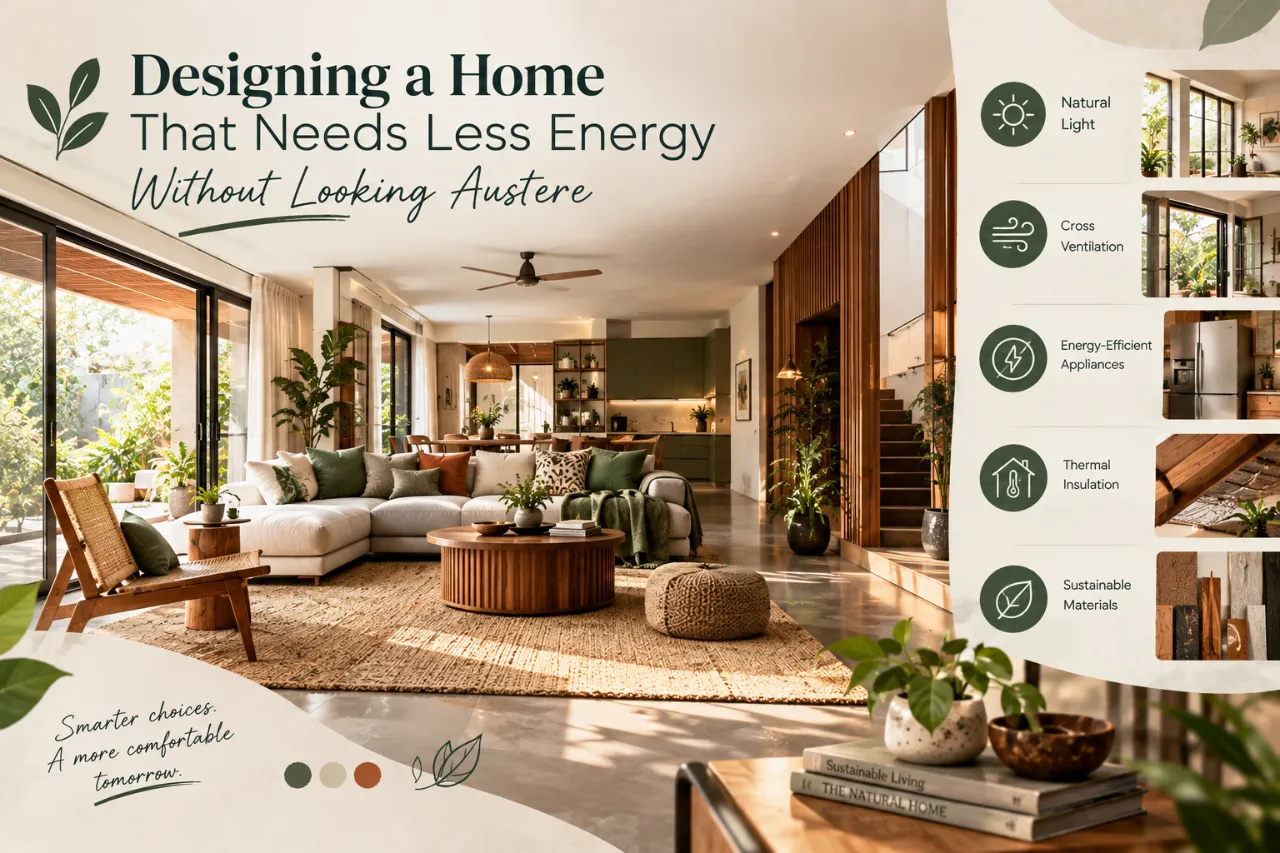
Designing a Home That Needs Less Energy Without Looking Austere
When people hear energy-efficient home design, they may imagine solar panels, plain façades, limited lighting and an interior where everything has been reduced to the bare minimum.
But using less energy does not require a home to look austere. In fact, some of the most effective strategies begin with the way a home is planned: where it receives sunlight, how it is shaded, how air moves through it, how much natural light reaches the interiors and which materials are used.
The goal is not to make the home feel less comfortable. It is to reduce unnecessary energy demand while preserving the things that make a home enjoyable: daylight, fresh air, visual warmth, comfortable temperatures, good lighting and a sense of personality.
Quick answer: An energy-efficient home does not need to look minimal or industrial. Start with passive strategies such as orientation, external shading, natural ventilation, useful daylight and appropriate materials. Then use efficient lighting, appliances and mechanical systems as supporting layers. The best result is a home that feels naturally comfortable rather than visibly “eco.”
- Why energy efficiency starts with design
- Use orientation before technology
- Control sunlight instead of blocking daylight
- Design for useful natural ventilation
- Make daylight part of the interior design
- Choose materials for performance and appearance
- Use thermal mass and insulation intelligently
- Make lighting efficient without making it flat
- Choose appliances around real usage
- Bring greenery and outdoor spaces into the strategy
- Do not confuse energy efficiency with austerity
- Design smaller spaces to work harder
- Common mistakes to avoid
- A practical energy-efficient home checklist
- Frequently asked questions
Energy Efficiency Starts With the Building, Not the Appliance
It is easy to think about energy efficiency as a shopping list: energy-saving lights, efficient air conditioners, smart appliances and solar equipment.
Those technologies can be important, but the building itself can influence how much energy is needed in the first place.
A home that receives intense afternoon sun through large unshaded windows may require more cooling. A poorly ventilated room may depend more heavily on mechanical cooling. A badly planned lighting layout may require artificial light even when useful daylight is available.
Good design addresses these conditions before the systems are switched on.
Think in this order: reduce unnecessary heat gain and energy demand first, then use efficient systems to meet the remaining requirement.
1. Use Orientation Before Technology
The orientation of a home affects its relationship with sunlight, heat and prevailing breezes. This makes orientation one of the earliest decisions in an energy-conscious design.
The right response depends on the location and climate. A home in a hot-dry region will have different priorities from one in a warm-humid coastal environment. A colder climate may require more attention to retaining heat rather than preventing it.
Instead of beginning with a fixed façade style, study the actual site: where does the strongest sunlight arrive, which sides need protection, and where can openings benefit from useful breezes?
These answers can influence window placement, room arrangement, balconies, shading devices and even which spaces sit along the hotter edges of the home.
2. Control Sunlight Instead of Simply Blocking It
Daylight is valuable, but direct solar radiation can add unwanted heat. Energy-efficient homes therefore need a balance between admitting useful daylight and controlling excessive heat gain.
This is where external shading can become more useful than simply covering every window with heavy curtains.
Overhangs
Can protect windows and walls from direct sun while keeping daylight available underneath the shaded area.
Fins and Screens
Can provide additional solar control where the orientation requires more targeted protection.
Balconies
Can act as a useful buffer between the interior and strong outdoor exposure while also creating usable outdoor space.
Landscape Shade
Appropriately placed trees and planting can contribute to shading around the building and improve the visual quality of outdoor areas.
The result does not have to look technical. Shading can become part of the architecture through proportion, material, colour and detailing.
3. Natural Ventilation Should Be Designed, Not Assumed
Opening a window does not automatically create good ventilation. Air needs a meaningful pathway through the home.
Cross-ventilation can become possible when openings are positioned to allow air to enter and leave rather than placing every opening on the same side. Internal doors and connected rooms can also influence how air moves through a plan.
In suitable climates, this can help reduce reliance on mechanical cooling during periods when outdoor air is comfortable enough to use.
Ask a simple question during planning: “Where does the air enter, and where does it leave?” If the answer is unclear, the ventilation strategy probably needs more thought.
4. Make Daylight Part of the Interior Design
Energy-efficient design does not mean making interiors darker. The objective is to use available daylight intelligently.
Window placement, room depth, reflective surfaces, lighter finishes and internal openings can all influence how daylight is distributed.
A well-lit room also does not require every surface to be bright white. Warm off-whites, cream, pale beige, soft stone tones and other light-reflective finishes can create a comfortable visual atmosphere without making the interior feel clinical.
Interior planning matters too. Avoid placing tall storage or bulky furniture directly where it blocks useful daylight from reaching the deeper part of a room.
5. Let the Interior Feel Warm Through Materials
One reason people associate energy-efficient design with austerity is that sustainability is sometimes presented entirely through technical materials and exposed systems.
A comfortable home can use natural-looking textures and warm finishes while still being energy-conscious.
Wood
Adds visual warmth through furniture, cabinetry, flooring and wall details.
Textiles
Curtains, rugs and upholstery can soften the interior and introduce depth through texture.
Stone and Natural Finishes
Can add material variation and visual character without requiring a heavily decorated room.
Earthy Colours
Warm neutrals, muted greens, clay tones and natural browns can give a sustainable home a more inviting visual identity.
6. Use Thermal Mass and Insulation Intelligently
The building envelope plays a major role in controlling heat flow. Walls, roofs, floors, windows and insulation work together rather than functioning as isolated decisions.
Thermal mass can help moderate temperature changes in suitable climates, while insulation reduces unwanted heat transfer between the interior and exterior.
The correct combination depends on climate, construction type, building orientation and how the home is occupied. A material should therefore not be labelled “energy efficient” in isolation.
Design principle: Think about the whole building envelope rather than choosing one supposedly sustainable material and expecting it to solve the home's energy needs.
7. Windows Need More Than a Good View
Windows perform several jobs at once: they bring in daylight, provide views, support ventilation and connect interiors with outdoor spaces. They can also be a significant route for unwanted heat transfer or solar heat gain.
That means window size, placement, glazing, orientation and shading all need to work together.
A large window can look beautiful but may not be the most appropriate choice for every orientation. Conversely, reducing every opening simply to control energy can make interiors dark and disconnected from the outside.
The better solution is to design the window around the climate and the experience you want inside the room.
8. Efficient Lighting Does Not Have to Feel Clinical
Energy-conscious lighting does not mean using one bright ceiling fixture for the entire house.
A layered lighting strategy can provide the right light only where it is needed while also creating atmosphere.
| Lighting Layer | Purpose | Design Opportunity |
|---|---|---|
| Ambient | General room illumination | Create a comfortable overall light level |
| Task | Focused activities | Light work surfaces without illuminating everything |
| Accent | Highlight features | Draw attention to artwork, textures or architecture |
| Decorative | Visual character | Use selected fixtures to add warmth and personality |
This approach can make an energy-conscious interior feel more sophisticated, because the lighting becomes part of the atmosphere rather than simply a utility.
9. Choose Appliances Around Real Use
Efficient appliances matter, but efficiency should be considered alongside actual household behaviour.
A rarely used appliance that is highly efficient may have less practical significance than an appliance used several hours every day. Focus first on the equipment that contributes meaningfully to the home's ongoing energy use.
Placement matters as well. Refrigeration, cooking, laundry and other equipment should be planned so that heat, ventilation and servicing requirements are properly considered.
10. Ceiling Fans Still Have a Design Role
Energy-conscious homes do not need to rely exclusively on air conditioning for comfort.
In climates and seasons where air movement improves comfort, ceiling fans can become an important part of the everyday environmental strategy.
They can also be integrated visually into the interior rather than treated as an afterthought. Simple forms, appropriate scale and thoughtful placement can help them sit naturally alongside modern lighting and furniture.
11. Make Outdoor Spaces Work Harder
Balconies, verandahs, shaded terraces and courtyards can provide more than visual connection with the outdoors.
They can create intermediate zones between the external climate and interior rooms. In suitable conditions, this can make parts of the home usable without immediately relying on full mechanical conditioning.
These spaces also make a home feel richer rather than more austere. Plants, comfortable seating, textured flooring and outdoor lighting can turn an energy-conscious strategy into a lifestyle feature.
12. Bring Nature Into the Experience of the Home
An energy-efficient home does not need to communicate sustainability through technical aesthetics alone.
Natural materials, indoor plants, filtered daylight, views toward greenery, shaded balconies and connections to outdoor spaces can create a more comfortable sensory experience.
The important distinction is that greenery should support the design rather than become a decorative substitute for actual energy planning.
13. Design Compact Homes to Work Harder
Smaller homes can have an advantage because there is less conditioned space to maintain, but only when the layout is efficient.
A compact home can still feel spacious through good circulation, multifunctional furniture, integrated storage, visual continuity and useful daylight.
Instead of adding more rooms, consider whether a single well-designed space can support several activities at different times.
This approach can reduce unnecessary construction while also making the home feel more intentional.
14. Energy Efficiency Does Not Mean Removing Comfort
One of the biggest mistakes in sustainable home design is assuming that comfort has to be sacrificed in the name of efficiency.
A comfortable home can still have:
Soft Furnishings
Rugs, curtains, cushions and upholstery can create warmth and acoustic softness.
Beautiful Lighting
Efficient lighting systems can still support a layered and atmospheric interior.
Statement Pieces
One strong furniture piece, artwork or material feature can provide character without filling the room.
Personal Details
Books, photographs, objects and collected pieces help the home feel lived in rather than engineered.
15. Passive Strategies Can Become Design Features
Some of the most useful energy-saving features can also become architectural highlights.
A deep window reveal can create shadow and visual depth. A screened balcony can become a privacy feature. A shaded courtyard can become the centre of the home. A carefully positioned skylight can become a dramatic source of daylight.
This is the key to avoiding an austere result: do not hide sustainability away from the design. Let performance and aesthetics support one another.
Energy-Efficient Design vs. Austere Design
| Concern | Energy-Efficient Approach | How to Keep It Warm |
|---|---|---|
| Sunlight | Control excessive heat gain | Keep useful daylight and views |
| Ventilation | Create purposeful airflow paths | Use openings as part of the architectural design |
| Materials | Consider thermal and environmental performance | Use natural textures and warm finishes |
| Lighting | Use efficient, targeted illumination | Layer ambient, task and accent lighting |
| Appliances | Prioritise efficient equipment | Integrate appliances into a visually cohesive interior |
| Outdoor spaces | Use shade and environmental buffering | Make balconies, courtyards and verandahs inviting |
16. Common Mistakes That Make Energy-Efficient Homes Feel Austere
Using Sustainability as an Aesthetic
A home does not need to look unfinished, industrial or extremely plain to be energy-conscious.
Blocking Too Much Daylight
Trying to prevent solar heat by making every opening small or heavily covered can create darker interiors and increase dependence on artificial lighting.
Ignoring the Local Climate
A strategy that works in a dry, hot climate may not produce the same benefits in a humid or cooler environment.
Adding Technology Too Late
Solar systems, efficient appliances and smart controls can be useful, but they work best when their space, wiring and integration are considered early.
Making the Interior Too Bare
Removing furniture, textiles and accessories simply to signal minimalism does not make the home more energy efficient.
Forgetting Everyday Behaviour
The performance of a home also depends on how occupants open windows, use shading, operate appliances and manage cooling and lighting.
17. A Better Way to Think About Home Energy
Instead of asking, “What sustainable products should I buy?”, ask a broader set of questions:
Can I Reduce Heat Gain?
Look first at orientation, windows, roof exposure, shading and the building envelope.
Can I Use More Useful Daylight?
Review room depth, window placement, interior finishes and furniture positioning.
Can Air Move Naturally?
Identify possible ventilation pathways instead of simply increasing the number of windows.
Can the Home Stay Comfortable Longer?
Consider insulation, thermal mass, shading and passive strategies before increasing mechanical cooling.
18. A Practical Energy-Efficient Home Formula
A simple way to approach the design is to build the home in layers:
| Layer | What to Consider |
|---|---|
| 1. Site | Orientation, sunlight, wind, surrounding buildings and landscape |
| 2. Building Form | Room arrangement, compactness, roof and outdoor buffers |
| 3. Envelope | Walls, roof, windows, glazing, insulation and shading |
| 4. Ventilation | Cross-ventilation, openings and airflow pathways |
| 5. Daylight | Useful natural light without excessive glare or heat |
| 6. Interiors | Materials, furniture, layout and finishes |
| 7. Systems | Efficient lighting, appliances, cooling and renewable systems |
19. Sustainable Does Not Have to Mean Visually Minimal
There is no requirement for an energy-efficient home to follow one particular interior style.
It can be contemporary, traditional, warm modern, luxury, eclectic or minimalist. The energy strategy sits underneath the aesthetic rather than dictating it.
A warm modern home, for example, can combine natural wood, textured fabrics, soft colours and comfortable furniture with external shading, efficient lighting and passive ventilation.
This is an important distinction: energy efficiency is a performance goal, not a decorating style.
20. A Practical Checklist Before You Finalise the Design
Ask these questions during planning:
Where does the strongest sunlight hit the home? Which windows need external shading? Can useful daylight reach the main living spaces? Does each major room have a realistic ventilation strategy? Where can warm air escape? Are the walls and roof appropriate for the local climate? Have insulation and thermal performance been considered? Are outdoor spaces providing useful shade or buffering? Are lighting layers planned rather than relying on a single fixture? Are frequently used appliances efficient and appropriately positioned? Can the home remain comfortable without constantly relying on mechanical cooling or artificial lighting? Does the interior still feel warm, personal and inviting?
The Best Energy-Efficient Home May Not Look Energy-Efficient
That can actually be a sign of good design.
When shading is integrated into the architecture, ventilation is built into the plan, daylight is carefully distributed, materials are chosen thoughtfully and efficient systems are discreetly integrated, the result does not need to announce itself as a sustainable home.
It simply feels comfortable.
The home may have warm wood, beautiful furniture, soft textiles, artwork, plants, layered lighting and inviting outdoor spaces. None of those qualities conflict with energy efficiency when the underlying planning is sound.
Design a Home Around Your Real Needs
Explore different design directions, visualise your spaces and connect with professionals who can help translate your ideas into a practical home design.
Design My Room with AI Explore Interior Designers Estimate Interior CostFrequently Asked Questions
What makes a home energy efficient?
Energy efficiency can come from a combination of building orientation, shading, ventilation, daylighting, insulation, suitable materials, efficient lighting, appliances and mechanical systems.
Does an energy-efficient home have to be minimalist?
No. Energy efficiency is about reducing unnecessary energy demand and improving building performance. The interior can follow almost any aesthetic style.
How can I make my home energy efficient without making it look plain?
Integrate performance features into the architecture and use warm materials, layered lighting, textiles, artwork, plants and comfortable furniture to maintain visual character.
Can natural ventilation reduce energy use?
In suitable weather conditions, purposeful natural ventilation can improve comfort and reduce the need for mechanical cooling. Its effectiveness depends on climate, building layout and outdoor conditions.
Are large windows energy efficient?
Not necessarily. Large windows can provide daylight and views, but their energy performance depends on orientation, glazing, shading and the building's climate.
What is passive cooling?
Passive cooling refers to design strategies that help limit heat gain or improve thermal comfort without relying entirely on mechanical cooling. Shading, ventilation and climate-responsive planning are common examples.
Is sustainable home design expensive?
Costs vary depending on the strategy, building type, materials and project scope. Some measures involve construction investment, while others are primarily planning decisions. It is useful to evaluate the whole project rather than one feature in isolation.
Can energy-efficient design work in Indian homes?
Yes. The exact strategy should respond to the home's local climate, orientation, construction, occupancy and site conditions rather than applying one universal solution across India.
Final Takeaway
Designing a home that needs less energy does not mean designing a home that feels like less of a home.
The strongest approach begins with the building itself: orientation, shading, ventilation, daylight, materials and the envelope. Efficient lighting, appliances and mechanical systems can then support those choices.
The result can still be warm, layered, comfortable and deeply personal.
The goal is not to make the home look sustainable. The goal is to make comfort require less energy.
Turn this idea into a plan for your home
Visualise your space, understand the likely budget, or find a professional who can bring the idea to life.