
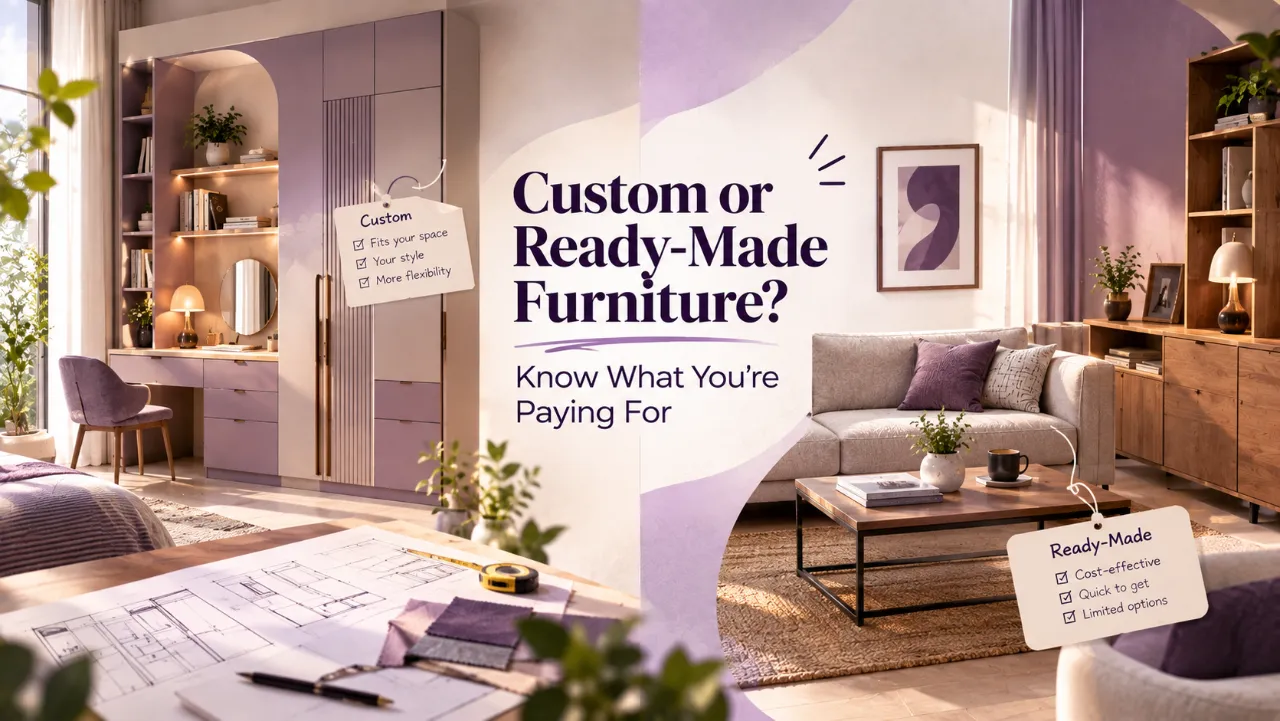
Custom or Ready-Made Furniture? Know What You're Paying For
When you compare custom furniture with ready-made furniture, the price tag can make the decision look simple. One piece costs ₹X, another costs ₹Y, so it is tempting to assume you are simply choosing between an expensive option and a cheaper one.
But that is rarely the whole story. Custom and ready-made furniture are often priced around different scopes of work. The real question is not just “Which one costs less?” but “What exactly am I getting for the price I am being quoted?”
- What ready-made furniture includes
- What custom furniture includes
- Why measurement matters
- The cost of design and planning
- Materials and hardware
- Finishing and installation
- Custom vs. ready-made comparison
- The hidden costs to consider
- What to check in a furniture quote
- When each option makes sense
- Why a combination can work
- Frequently asked questions
1. What are you paying for with ready-made furniture?
Ready-made furniture is typically designed around standard sizes and common room requirements. The product already exists as a defined design, so you are usually choosing from available dimensions, materials, colours, finishes and configurations.
Standard dimensions
The furniture is manufactured around predetermined sizes. This makes it easier to compare products and can reduce the amount of design work required before purchase.
Existing design
You are generally selecting from an established product rather than paying for a completely new design developed specifically for your room.
Manufacturing
The manufacturing process is often standardised, allowing the same product design to be produced repeatedly.
Delivery and assembly
Depending on the seller, transport, delivery and assembly may be included separately or bundled into the purchase price.
This standardisation is one reason ready-made furniture can often be purchased and installed more quickly. You are not starting the process from a blank sheet.
2. What are you paying for with custom furniture?
Custom furniture starts with the space rather than a fixed product. The design can be developed around your room dimensions, walls, columns, beams, niches, windows, doors, electrical points, plumbing, ceiling conditions and storage requirements.
That additional adaptation is a major part of what you are paying for.
A custom piece may therefore involve several stages that do not appear in the price of a standard retail product: measurement, design development, material selection, production, finishing, quality checks, transportation, installation and on-site adjustments.
3. Measurement is part of the value
One of the biggest differences between custom and ready-made furniture is how the furniture relates to the actual dimensions of your home.
Ready-made furniture works with the dimensions available in the product range. If a wardrobe is 1800 mm wide but the available wall is 1920 mm, you may have a gap or need to rethink the arrangement.
Custom furniture can be designed to use that 1920 mm wall more precisely.
This matters particularly in apartments where rooms may include irregular walls, structural columns, narrow passages, beams, window projections or awkward corners.
4. Design and planning have a cost too
Custom furniture is not only about cutting boards to a particular size. The process may include decisions about proportions, storage capacity, door styles, drawer layouts, internal organisation, finishes, handles, lighting integration and hardware.
For example, a custom wardrobe might be designed around:
- the exact available wall width and height,
- the location of windows and doors,
- your preferred hanging and storage requirements,
- drawer and shelf proportions,
- electrical points or integrated lighting,
- ceiling height and skirting conditions, and
- the overall interior design of the room.
With ready-made furniture, many of these decisions have already been made by the manufacturer.
5. Materials and hardware affect the price
Two pieces of furniture can look similar from the outside and still have significantly different costs because of what is used inside them.
When comparing furniture, look beyond the visible finish and ask about the board or core material, edge treatment, laminate or veneer, paint system, hardware and internal fittings.
Board and core materials
The underlying material can affect durability, weight, moisture resistance and overall cost.
Hardware
Hinges, drawer runners, lift-up mechanisms, channels and other hardware can vary considerably in specification and price.
Surface finish
Laminate, veneer, acrylic, PU paint and other finishes can have different material, labour and maintenance requirements.
Internal fittings
Pull-out baskets, organisers, drawer systems, shelves and specialised storage accessories can add to the final cost.
6. Finishing and installation matter
A furniture quote may include manufacturing but exclude other stages. Another quote may include transportation and installation. Unless the scope is clearly stated, comparing the two totals can be misleading.
Check whether the quoted price includes:
- manufacturing,
- surface finishing,
- hardware,
- transportation,
- installation,
- on-site adjustments,
- electrical or lighting integration where applicable, and
- removal or disposal of existing furniture, if required.
For custom furniture, installation can also require adjustments once the piece reaches the site. Walls are not always perfectly straight, floors may not be perfectly level and actual site conditions can differ from drawings.
7. Custom vs. ready-made furniture: what are you actually paying for?
| Factor | Ready-Made Furniture | Custom Furniture |
|---|---|---|
| Design | Pre-designed product | Designed or adapted for the specific space |
| Dimensions | Standard product sizes | Space-specific dimensions |
| Measurement | Usually limited to checking whether the product fits | Detailed site measurement is generally part of the process |
| Materials | Selected from the manufacturer's available specifications | Can often be selected or specified according to the project |
| Hardware | Usually predetermined | Can be selected according to design and requirements |
| Lead time | Often shorter for available products | Usually requires design, manufacturing and installation time |
| Space utilisation | Depends on how well standard dimensions fit | Can be designed to maximise available space |
| Personalisation | Limited to available options | Greater flexibility in dimensions, layout and detailing |
| Installation | Depends on the seller and product | Usually coordinated as part of the custom furniture process |
8. The hidden cost of ready-made furniture
Ready-made furniture can have a lower upfront price, but the cheapest product is not automatically the lowest-cost solution for your room.
A standard unit may leave unused space above it, beside it or behind it. In some situations, you may need additional furniture to solve storage requirements that one custom unit could have handled more efficiently.
For example, a standard wardrobe might fit into a bedroom but leave a 100 mm gap on one side and unused space above it. A custom wardrobe could potentially use more of that available area.
That does not mean custom furniture is always the better financial decision. It means the total cost should include how effectively the furniture solves the actual requirement.
9. The hidden cost of custom furniture
Custom furniture has its own trade-offs. A more personalised product usually requires more decisions, coordination and time.
- Higher upfront cost in many cases
- Longer design and manufacturing timeline
- More decisions about materials and finishes
- Greater dependence on measurement accuracy
- More coordination between designer, manufacturer and installer
- Potential delays if materials or hardware are unavailable
- More complicated changes once production has started
The quality of execution also matters. Custom furniture is only as good as the design, materials, manufacturing and installation behind it.
10. Why custom furniture can look more expensive
A custom quote can appear expensive because it may combine several services that are invisible in the final piece of furniture.
You may be paying for measurement, design, drawings, material procurement, manufacturing, finishing, transportation, installation and site coordination in addition to the physical materials.
A ready-made product may have already absorbed much of its design and development cost into a standardised manufacturing process that is repeated across many units.
11. What should you compare in a furniture quote?
Before choosing between custom and ready-made furniture, create a simple comparison based on the complete scope.
| Check | Question to Ask |
|---|---|
| Dimensions | Are the quoted dimensions exactly what my space requires? |
| Material | What board or core material is being used? |
| Finish | What surface finish is included? |
| Hardware | Which hinges, runners, channels or mechanisms are included? |
| Internal layout | How many shelves, drawers, compartments or organisers are included? |
| Installation | Is installation included in the quoted amount? |
| Transport | Are delivery and transportation charges included? |
| Adjustments | Who handles site-specific modifications if the actual conditions differ? |
| Timeline | What is the expected manufacturing and installation timeline? |
12. When does ready-made furniture make more sense?
Ready-made furniture can be practical when you need a faster solution, the available dimensions work well for your room, and the product already provides the features you need.
It can be particularly useful for:
- temporary or rental homes,
- rooms with straightforward dimensions,
- frequently changing furniture arrangements,
- quick furnishing requirements,
- small individual furniture purchases, and
- spaces where standard products fit without significant gaps.
13. When does custom furniture make more sense?
Custom furniture becomes more relevant when the room has unusual dimensions, when storage needs are highly specific, or when you want furniture to integrate closely with the overall interior design.
It can be useful for:
- full-height wardrobes,
- built-in storage,
- TV units designed around specific walls,
- home offices,
- awkward corners and niches,
- spaces with columns or structural constraints,
- specific storage requirements, and
- interiors where furniture needs to follow a particular design language.
14. Small homes can benefit from the right combination
A home does not have to be entirely custom or entirely ready-made.
A combination can sometimes provide a practical balance. For example, a homeowner may choose custom wardrobes and kitchen storage where every centimetre matters, while using ready-made sofas, dining chairs, side tables or occasional furniture.
This approach can allow you to spend more of the budget on areas where space efficiency and integration matter most.
Custom where space matters
Use custom solutions for built-in storage, awkward walls, specialised layouts and areas where standard furniture would leave significant unused space.
Ready-made where flexibility matters
Use ready-made pieces where standard dimensions work and you may want to move, replace or update the furniture more easily.
15. What are you really paying for?
The real value of custom furniture is not simply that it is “made specially for you.” Its value comes from solving a specific problem that a standard product may not solve efficiently.
That could mean using an awkward wall more effectively, increasing storage capacity, integrating lighting, matching a particular finish or creating a piece that works with the rest of the interior.
Ready-made furniture, meanwhile, can offer value through standardisation, faster availability, established designs and simpler purchasing.
Neither model needs to be treated as automatically superior. The right comparison depends on what your room needs and what each quote actually includes.
Planning your home interior?
Explore interior design ideas, connect with professional designers, or use Walls to Wonder tools to understand your space and plan your next interior project.
Explore Design Ideas Find Designers Design My Room Estimate Interior Cost16. A simple way to make the decision
Before choosing furniture, ask yourself these questions:
- Does a standard size fit my space properly?
- How important is maximum storage?
- Are there awkward walls, corners, beams or columns?
- Do I need a specific internal storage arrangement?
- How quickly do I need the furniture?
- What materials and hardware are included?
- Does the price include delivery and installation?
- Can I compare both options on the same scope?
- Will I still be happy with the solution several years from now?
These questions make the decision less about the label and more about the actual requirements of your home.
Frequently asked questions
Is custom furniture always more expensive than ready-made furniture?
Not necessarily in every situation. Custom furniture often has a higher upfront cost because it can include measurement, design, custom manufacturing, material selection and installation. Ready-made furniture may have a lower purchase price because it is standardised, but the total cost should still be compared based on what each option includes.
Why does custom furniture cost more?
Custom furniture can involve additional design, measurement, manufacturing, finishing, material procurement and installation work. It is also produced for a specific space rather than manufactured as a standard product.
Is custom furniture better for small homes?
Custom furniture can be useful in small homes when storage and space utilisation are important. It can be designed around specific dimensions and awkward areas. However, ready-made furniture can also work well when standard sizes fit the room.
What should I check before buying ready-made furniture?
Check the exact dimensions, material specifications, finish, hardware, storage capacity, delivery terms, assembly requirements and warranty or service terms. Also measure the room, access route, doors and lift or staircase before ordering a large piece.
What should I check before ordering custom furniture?
Confirm the site measurements, design, materials, hardware, finish, internal layout, price inclusions, manufacturing timeline, installation scope and payment schedule. Make sure the final specification is documented before production begins.
Can I combine custom and ready-made furniture?
Yes. Many interiors use custom furniture for built-in storage and space-specific requirements while using ready-made furniture for sofas, chairs, tables and other movable pieces.
What is the biggest mistake when comparing furniture prices?
Comparing only the final price without comparing the scope. A proper comparison should consider dimensions, materials, hardware, finish, storage features, delivery, installation, timeline and any additional work included in the quote.
Final takeaway: The real question is not whether custom or ready-made furniture is universally better. It is whether the furniture you are buying solves the right problem at the right total cost. Compare the scope, understand the materials and installation, and spend more where customisation genuinely improves how your home works.
Get a personalised estimate for your home
Choose your rooms, materials and preferences to understand a practical interior budget before you commit.