
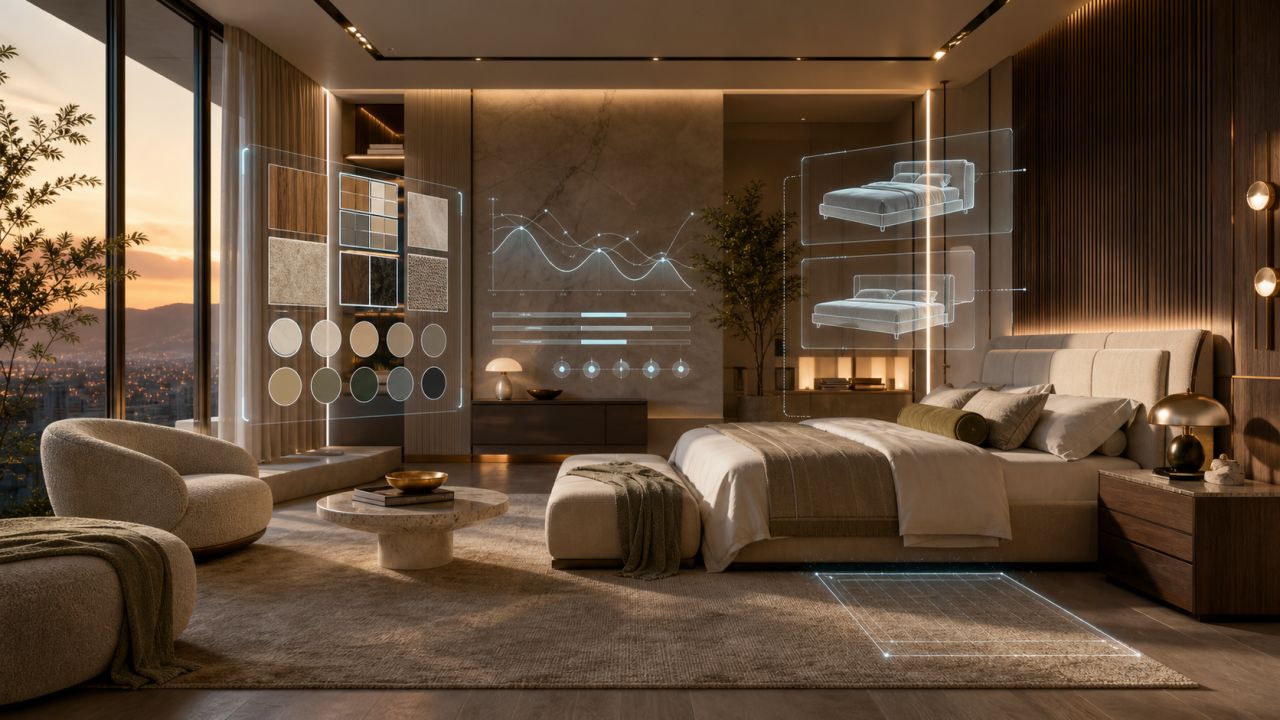
How AI Predicts the Next Luxury Bedroom Trends for Indian Homes
A luxury bedroom is no longer planned only around a large bed, a padded wall and concealed wardrobes. Homeowners are asking for calmer lighting, healthier materials, flexible storage and technology that does not make the room feel like a showroom. Artificial intelligence can help identify these shifts, but its real value is in connecting broad design signals to your room, budget and daily habits.
This guide explains how AI predicts future interior design trends for a new luxury bedroom and how to use those predictions while comparing designers and companies serving your area. You can also browse the latest WallsToWonder posts and explore the designer directory before requesting proposals.
What does AI actually predict?
AI does not know with certainty which colour or finish will become fashionable next year. It analyses patterns in large sets of design images, product descriptions, search behaviour, project briefs and material combinations. A system may notice, for example, that warm neutrals, fluted timber, integrated lighting and hotel-style bedside storage are appearing together more often.
The useful output is not a prediction to follow blindly. It is a shortlist of likely directions that can be checked against Indian conditions: dust, humidity, strong daylight, power points, cleaning habits, apartment rules and the size of a typical master bedroom. A trend becomes worth considering only when it remains practical after those checks.
How the prediction process works for a luxury bedroom
- Pattern collection: AI reviews recurring visual and written signals, such as curved furniture, layered lighting, natural textures or a preference for uncluttered rooms.
- Combination mapping: It groups features that repeatedly appear together. This can reveal a wider direction, such as “quiet luxury” expressed through restrained colours, tactile surfaces and fewer visible handles.
- Room and lifestyle matching: Better tools ask about room dimensions, sunlight, storage needs, preferred style and the people using the room. The result is more useful than a generic mood board.
- Scenario testing: A homeowner can compare a veneer wardrobe with laminate, a full-height headboard with a smaller feature wall, or open shelves with closed storage before discussing execution.
- Human review: An architect or interior designer still needs to resolve structure, electrical planning, hardware quality, site measurements, procurement and installation.
Trend signals worth examining room by room
AI can be most helpful when a bedroom is assessed as part of the whole home. The following scenarios show where a predicted trend may help—and where it should be questioned.
Master bedroom
AI may suggest soft, layered palettes, upholstered panels, integrated reading lights and concealed charging points. Ask whether the headboard is easy to clean and whether the lighting can be operated from both sides of the bed.
Guest or children’s bedroom
Future-facing design often means adaptability rather than expensive decoration. A movable study surface, replaceable handles and closed storage can outlast a highly specific theme.
Living space
Open-plan homes influence bedroom choices. If the living room uses warm wood and stone textures, the bedroom can repeat one or two materials without copying the entire palette.
Modular kitchen
Kitchen finishes affect the visual language of the home. AI may identify a preference for muted laminates, handleless shutters or tall utility storage, but ventilation, heat and cleaning should decide the final specification.
Storage and dressing area
Trend forecasts frequently favour hidden storage. In practice, divide wardrobes by actual use: hanging lengths, folded clothing, luggage, accessories and a serviceable place for laundry.
Renovation or complete interiors
For a renovation, AI can help compare a targeted refresh with a full rebuild. Existing flooring, plumbing, false-ceiling condition and electrical capacity may make reuse more sensible than replacing everything.
Materials: separate a visual trend from a sound specification
A digital image cannot tell you whether a finish will chip at the edge, swell near a damp wall or be easy to repair. Ask every designer to identify the substrate, surface finish, thickness where relevant, edge treatment, hardware brand or grade, warranty terms and cleaning guidance.
| Design decision | Questions to take to a designer |
|---|---|
| Wardrobe shutters | Is the proposal using laminate, veneer, acrylic, glass or paint? How will edges and hinges perform with daily use? |
| Headboard feature | Can the fabric, panel or wall finish be dusted and repaired? Are switches and sockets accessible? |
| Lighting | Which fittings, colour temperature, drivers and control points are included? Is task lighting separate from decorative lighting? |
| Floor and ceiling | What remains from the existing home, and what site condition could change the installation scope? |
Use AI tools before you compare quotations
Commercial investigation becomes easier when each designer receives a clearer brief. Start with your room measurements, photographs, possession or renovation stage, preferred look, storage list and a realistic spending boundary. WallsToWonder’s planning tools can help structure that preparation.
Estimate the scope first
Use the interior design cost estimator to think through how room count, finishes, storage and renovation work may affect the brief. Treat the result as an early planning aid, not a final quotation.
Read the quotation carefully
Once proposals arrive, the quotation checker can help you spot unclear inclusions, missing quantities or items that need a direct question.
How to compare interior designers fairly
Do not compare only the total figure or the prettiest bedroom render. Designers and companies serving the area may offer very different levels of service: concept development, measured drawings, 3D views, material selection, vendor coordination, project management, installation supervision and post-handover support.
| Compare | What a useful comparison looks like |
|---|---|
| Design response | Does the proposal respond to your room size, storage list, daylight and routine, or does it look interchangeable? |
| Scope | Are civil work, electrical changes, painting, loose furniture, appliances, curtains and soft furnishings clearly marked as included or excluded? |
| Execution | Who measures, coordinates trades, checks installation and communicates delays? |
| Materials | Can you see samples and written specifications before approving the final selection? |
| Commercial terms | Are taxes, payment stages, revision limits, delivery assumptions and cancellation terms stated? |
For additional perspective, use Design my room to clarify a starting concept and Find my style to describe your preferences in language a designer can work with. If you are uncertain about a design decision, the AI interior assistant can help you form better questions.
Pricing factors behind a luxury bedroom
There is no responsible single price for a luxury bedroom without knowing its dimensions, existing condition and scope. Costs can change substantially with the amount of custom carpentry, internal wardrobe fittings, veneer or specialty finishes, bed and mattress requirements, lighting controls, false ceiling work, electrical relocation, wall preparation, curtains, loose furniture and installation complexity.
For a complete interior project, kitchen, living room, bathrooms, utility areas and renovation work may carry separate assumptions. Ask for room-wise costs rather than accepting one attractive package number. If a designer gives a provisional amount, request the conditions that could revise it.
- What exact deliverables does this payment unlock?
- Is the advance adjusted against design, materials, execution or a combination?
- When will measured drawings and a room-wise scope be shared?
- What happens if the design is revised or the project does not proceed?
- Who owns the drawings, samples and procurement responsibility?
Quotation red flags that deserve attention
- A very low total with no quantities, material names or exclusions.
- “Luxury” used as a finish label without explaining the actual board, surface, hardware or workmanship.
- Large advances requested before site measurement, scope confirmation or a written payment schedule.
- Renders that show decorative lights, appliances or furniture missing from the estimate.
- Verbal promises about timelines, replacements or warranty that do not appear in the proposal.
- Pressure to approve a trend immediately, even though samples, dimensions or maintenance requirements are unclear.
These points do not automatically prove poor work. They do signal that you need clarification before committing. Keep changes in writing and retain the approved drawings, quotation versions and payment records.
A practical decision path for homeowners
- Write a room-by-room brief, including what must stay, what must change and how much storage is required.
- Use AI tools to explore styles and identify questions, not to select materials without physical samples.
- Shortlist designers based on relevant service scope and comparable project requirements.
- Request itemised proposals with inclusions, exclusions, assumptions, taxes and payment stages.
- Compare the people, process and documentation behind each proposal—not only the design image.
- Approve an advance only after the scope, revision process, timeline assumptions and responsibilities are understandable.
Make your next designer conversation more informed
A future-ready bedroom should feel personal, maintainable and appropriate to the rest of your home. Explore interior design ideas, review designers serving your area through the WallsToWonder designer directory, and use the planning tools before you compare proposals. The better your questions, the less likely a fashionable image will hide an unsuitable specification.
Frequently Asked Questions
How accurate are AI predictions for bedroom interior design trends?
AI can identify recurring design patterns, but it cannot guarantee what will become popular or suit your home. Validate every suggestion against climate, maintenance, room size, availability and budget.
Can AI design a luxury bedroom without an interior designer?
AI can help with style exploration, layouts and questions. A designer is still valuable for site measurements, technical drawings, material coordination, execution and resolving on-site issues.
What should I ask an interior designer before paying an advance?
Ask for the written scope, deliverables, room-wise inclusions, material specifications, payment stages, revision limits, timeline assumptions, warranty terms and cancellation conditions.
Which materials should I compare for a luxury bedroom?
Compare the substrate and surface finish for wardrobes and panels, along with hardware, edge treatment, lighting components, fabric maintenance and repair options—not just colour or appearance.
How can I compare luxury bedroom quotations?
Place proposals side by side by scope, quantities, materials, labour, civil and electrical work, exclusions, taxes, delivery assumptions and project management. Clarify every provisional item before comparing totals.