
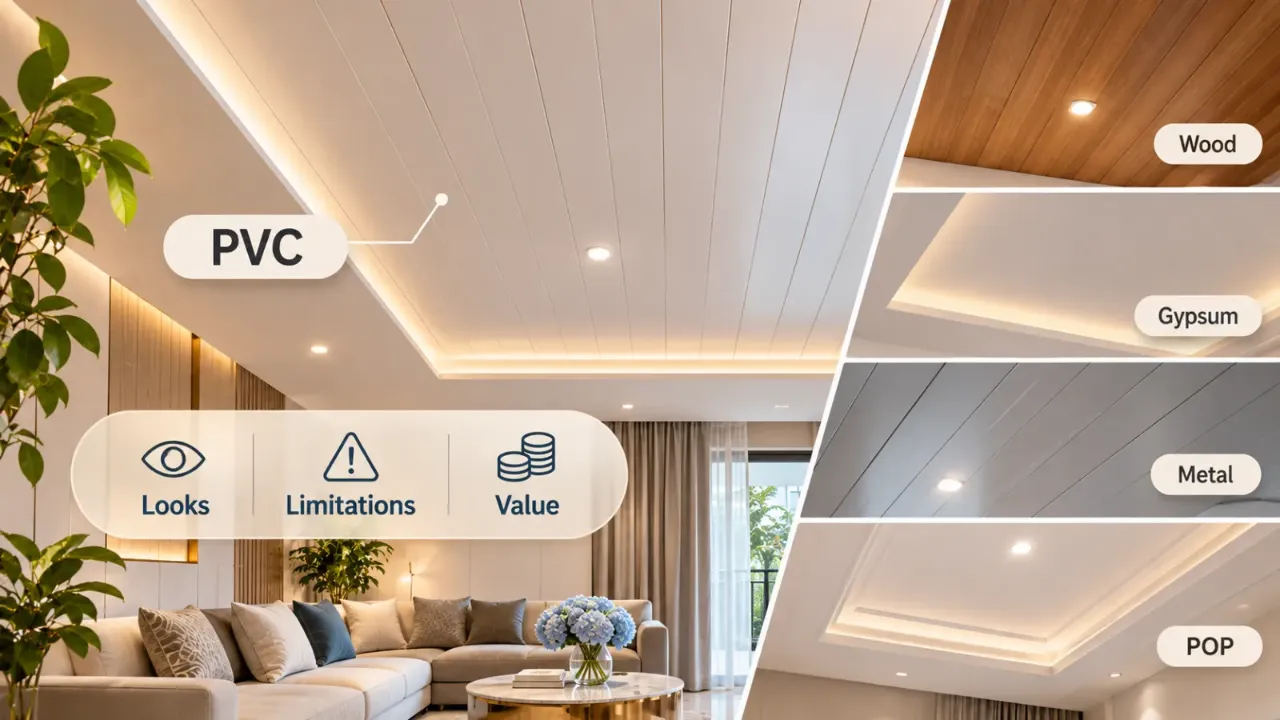
PVC vs Other Ceiling Materials: Looks, Limitations and Value
PVC ceiling panels are often considered when homeowners want a false ceiling without spending too much on elaborate designs or lengthy installation work. They are lightweight, available in several colours and patterns, and particularly useful in spaces where moisture is a concern.
But there is one question that often comes up before making the purchase: do PVC ceiling panels actually look cheap?
The honest answer is that they can. Some panels have a noticeably artificial finish, visible joints or a glossy surface that does not suit every interior. However, not every PVC ceiling looks unattractive. A carefully selected product, a neat installation and the right room can make a significant difference.
The important thing is to understand what PVC does well, where it falls short and whether its appearance matches the kind of home you want to create.
1. What Exactly Are PVC Ceiling Panels?
PVC stands for polyvinyl chloride, a type of plastic used in various building and interior products. PVC ceiling panels are generally lightweight boards or strips fitted onto a supporting framework. Many designs use an interlocking system, with one panel joining the next.
They are available in different finishes, including:
- Plain white and off-white panels.
- Glossy and matte finishes.
- Printed wood-grain patterns.
- Marble-inspired patterns.
- Decorative and textured designs.
- Coloured panels for contemporary interiors.
Unlike a conventional painted gypsum ceiling, PVC panels arrive with their surface finish already applied. They do not normally require painting after installation.
This makes them convenient, but the factory-applied finish is also a major part of how the ceiling will look. A poor-quality print or overly glossy surface is difficult to disguise once installed.
2. Why Do Some PVC Ceilings Look Cheap?
The material itself is not the only reason. Several design and installation decisions can make a PVC ceiling look less refined.
An Artificial Wood or Marble Finish
Printed finishes are intended to imitate natural materials. However, low-quality patterns can look repetitive, overly shiny or noticeably artificial.
A printed wood finish, for example, may not have the depth and variation of real wood veneer. Similarly, a marble pattern can look like a printed plastic surface rather than a natural stone-inspired finish.
Visible Panel Joints
PVC panels are commonly installed in strips or sections. The joints between them may remain visible, particularly when the installation is not precise.
On a large living room ceiling, repeated lines can become a prominent design feature, whether intended or not.
Excessive Gloss
Highly reflective panels can make the ceiling look more like a plastic surface. This effect becomes more noticeable under bright ceiling lights.
A subtle matte or low-sheen finish is often easier to integrate into a contemporary interior.
Repetitive Patterns
Some printed panels repeat the same grain, marble vein or decorative motif. When several identical sections are placed next to one another, the repetition can make the ceiling look manufactured rather than thoughtfully designed.
Poor Edge and Corner Finishing
Unfinished edges, uneven trims, visible gaps and poorly cut sections can make even a reasonably good panel look untidy.
The supporting framework and installation quality matter just as much as the panel's appearance.
3. Where PVC Ceiling Panels Work Best
PVC is not necessarily the right material for every room. It tends to make the most sense when practicality is more important than creating a seamless decorative ceiling.
Bathrooms
Bathrooms are exposed to moisture and humidity. PVC panels are moisture-resistant and can be a practical option when a suitable product and installation system are selected.
Plan access to plumbing and ventilation equipment rather than permanently concealing everything above the ceiling.
Utility Areas
Laundry areas, storage spaces and utility rooms often benefit from an easy-to-clean ceiling finish. PVC can be useful here without needing an elaborate decorative design.
Covered Balconies
PVC may be considered for covered balconies where moisture resistance is useful. However, check whether the product is suitable for the actual outdoor exposure, including sunlight, heat and wind-driven rain.
Kitchens
PVC may be used in some kitchen ceiling applications, but it needs careful consideration around cooking equipment, heat sources and fire safety. Do not assume that every PVC panel is suitable for every kitchen.
A product's fire-performance documentation and the applicable building requirements should be checked before installation.
4. Where PVC May Not Be the Best Choice
A ceiling in a living room or master bedroom often plays a bigger visual role than one in a utility area. It may need to coordinate with lighting, furniture, wall finishes and the overall design language.
In these spaces, PVC panels may feel limiting.
Main Living Rooms
If the goal is a seamless, elegant ceiling with recessed lighting, layered details or custom shapes, gypsum board or POP may offer more design flexibility.
PVC can still be used in a simple living room, but panel joints and printed finishes should be considered carefully.
Bedrooms
Bedrooms usually benefit from softer, more understated finishes. A glossy or heavily patterned PVC ceiling can compete with the bed, wardrobe and lighting.
If the room is intended to feel calm and minimal, a smooth painted ceiling may be a better fit.
Formal Dining Areas
A formal dining space may benefit from a more integrated ceiling design, especially when decorative lighting or a feature chandelier is part of the plan. PVC's visible panel structure may not deliver the desired look.
5. PVC vs Gypsum vs POP: What Looks Better?
These materials serve different purposes. The right choice depends on the finish, room conditions, budget and installation requirements.
| Factor | PVC panels | Gypsum board | POP |
|---|---|---|---|
| Appearance | Depends heavily on printed or surface finish; joints may show | Smooth, continuous painted finish | Can create smooth and decorative shapes |
| Design flexibility | More limited | Good for layered and recessed designs | Good for custom mouldings and curves |
| Moisture considerations | Generally moisture-resistant | Standard boards need suitable specifications and protection in damp areas | Can be affected by persistent moisture |
| Installation | Panel-based installation | Requires framing, jointing and finishing | Applied and shaped on site |
| Painting | Usually not required | Usually painted after finishing | Usually painted after finishing |
| Maintenance | Often simple surface cleaning | May need repainting or repair | May need crack repairs or repainting |
| Main consideration | Plastic appearance and fire performance | Quality of framing, jointing and finishing | Workmanship, drying and cracking |
There is no universal winner. A smooth gypsum ceiling may look more refined in a formal living room, while PVC may be more practical in a moisture-prone utility area.
6. How to Make a PVC Ceiling Look Better
If PVC is the practical choice for your project, the design can still be approached thoughtfully.
Choose a Subtle Finish
Plain white, warm white and understated matte finishes are generally easier to coordinate with furniture and wall colours than highly reflective or heavily patterned panels.
Be Careful With Wood-Grain Prints
Wood-look panels can work as an accent, but the print should look convincing. Examine a full-size sample rather than judging the design from a small catalogue image.
Keep the Design Simple
A straightforward panel arrangement often looks more intentional than a ceiling filled with multiple colours, patterns and decorative borders.
Plan the Lighting Before Installation
Lighting can emphasise panel joints, uneven surfaces and gloss. Decide where recessed fittings, surface lights or other fixtures will go before the framework and panels are installed.
Use compatible fittings and follow the manufacturer's requirements for heat clearance and electrical installation.
Pay Attention to Trims
Corners, wall junctions and exposed edges should be finished neatly. Ask the installer how the edges will be treated and inspect a completed sample section before approving the full installation.
Inspect the Actual Product
Do not select a ceiling based only on a photograph. Ask for a sample or visit a completed installation using the same product. Check the surface under both daylight and artificial lighting.
7. Important Limitations Beyond Appearance
The appearance of PVC is only one part of the decision. There are practical limitations worth understanding.
Fire performance: Ordinary PVC should not be treated as non-combustible. PVC products vary, and a fire-retardant claim does not automatically mean a panel is fireproof. Ask for relevant test documentation and check applicable building requirements. The National Building Code of India discusses the fire-safety implications of combustible interior ceiling finishes.
Heat sensitivity: Some panels can deform, discolour or deteriorate when exposed to excessive heat. Follow product instructions and keep them away from unsuitable heat sources.
Impact damage: Lightweight panels can be vulnerable to dents or cracks if struck. Their performance depends on thickness, construction and supporting framework.
Installation quality: An inadequate framework or incorrect support spacing can lead to sagging, uneven surfaces or opening joints.
Concealed services: A false ceiling can hide wiring, plumbing and other services. Plan suitable access points so maintenance does not require unnecessary dismantling.
Product variation: Two panels labelled PVC may differ considerably in thickness, construction, surface quality and performance. Compare specifications rather than relying only on appearance or price.
8. Questions to Ask Before Buying PVC Ceiling Panels
Before approving the material, ask the supplier or installer:
- What is the panel's thickness and construction?
- Is the finish matte, glossy, laminated or printed?
- Is there documented fire-performance information for this exact product?
- Is it suitable for the room's moisture, heat and sunlight conditions?
- What supporting framework will be used?
- How will panel joints, corners and edges be finished?
- Can individual panels be removed for maintenance?
- What warranty covers the panels and installation?
- Are there completed installations you can inspect?
- Does the quotation include the framework, trims, fittings and installation?
These questions help you compare products on more than just their initial price.
9. So, Should You Choose PVC Ceiling Panels?
PVC ceiling panels are worth considering when moisture resistance, quick installation and easy maintenance are important. They can be a sensible choice for selected bathrooms, utility spaces and covered areas.
However, if your priority is a seamless, premium-looking ceiling in a formal living room or bedroom, gypsum or POP may offer greater design freedom and a more integrated finish.
The mistake is not choosing PVC itself. It is choosing a finish that does not suit the room, overlooking installation details or expecting a budget panel to create the same effect as a carefully designed custom ceiling.
Closing Thoughts
Do PVC ceiling panels look cheap? Sometimes, yes. Low-quality prints, excessive gloss, visible joints and poor installation can make them look less refined. But the material can still serve a useful purpose when selected for the right space and installed properly.
Think about the room first, then the finish, product specifications and installation quality. A ceiling should not be judged only by how it looks in a catalogue. It should also perform well in the conditions of your home.
Explore More with Walls to Wonder
Planning a home renovation or exploring ceiling and interior design ideas? Explore Walls to Wonder's AI-powered tools to visualise spaces, compare design directions and plan your interiors with greater clarity.
- Whole Home Visualizer
- Design My Room
- Interior Design Cost Estimate
- Interior Quotation Checker
- Rate My Room Design
- Interior Style Finder
Discover more at Walls to Wonder.
Turn this idea into a plan for your home
Visualise your space, understand the likely budget, or find a professional who can bring the idea to life.