
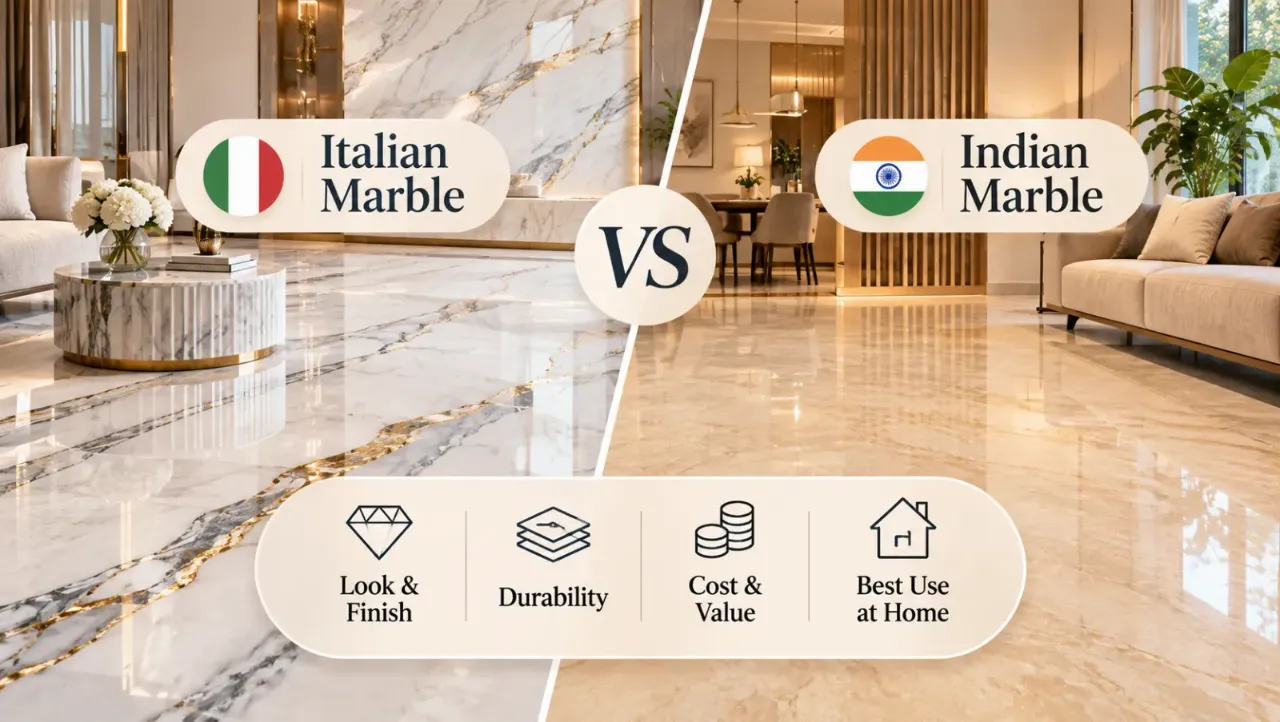
Italian Marble vs Indian Marble: What You Really Pay For
Italian marble is often associated with luxury interiors, premium finishes and elegant veining. Indian marble, on the other hand, is frequently considered a more budget-conscious option. But the actual difference is not simply about where the stone comes from or how expensive it looks.
When you choose between the two, you are paying for several things: the stone's origin, appearance, rarity, consistency, processing, transportation, installation and maintenance. A more expensive slab does not automatically mean a better choice for every home.
This article looks beyond the showroom price to understand what you really pay for when selecting Italian or Indian marble for an Indian home.
1. What Is the Difference Between Italian and Indian Marble?
The first difference is geographical origin, but the more noticeable difference for homeowners is often the appearance and selection available.
Italian marble
Italian marble is quarried in Italy and is popular for its refined appearance, distinctive veining and premium white and beige varieties.
- Carrara: Usually white or grey-white with softer grey veining.
- Statuario: Known for a bright white background and more pronounced grey veining.
- Calacatta: Often features a white background with bold, dramatic veins.
- Botticino: A warm beige or cream-coloured marble.
These varieties are not interchangeable. Their appearance, availability and prices can differ considerably.
Indian marble
India has several marble-producing regions, each offering different colours, patterns and finishes.
- Makrana: Known for its white appearance and association with traditional Indian architecture.
- Ambaji: Available in white and off-white shades with varying patterns.
- Banswara: Offers light-coloured options used for flooring and wall applications.
- Morwad: A popular choice for white and grey-white flooring.
- Udaipur Green: Recognised for its green tones and contrasting natural patterns.
The Indian market is not limited to inexpensive marble. Premium Indian varieties can also be used in sophisticated residential interiors.
2. Italian Marble vs Indian Marble: What Does Each Cost?
The price difference is often the first thing homeowners notice. However, there is no single price for either category. The rate depends on the exact variety, grade, thickness, finish, slab size, availability and supplier.
For preliminary budgeting, the following are broad indicative material-price ranges seen in the Indian market in 2026:
| Marble category | Indicative material price per sq ft |
|---|---|
| Indian marble | ₹150–₹600+ |
| Italian marble | ₹500–₹3,000+ |
These are broad planning ranges, not fixed market quotations. Some entry-level Indian varieties may cost less, while exceptional Makrana selections can exceed the usual range. Similarly, premium Italian varieties and selected slabs can cost considerably more than the indicative range.
Why does Italian marble usually cost more?
The higher price can reflect several factors:
- Importing and international transportation.
- Customs and other supply-chain costs.
- Premium quarry selections and limited availability.
- Larger slab formats and distinctive vein patterns.
- Processing, resin treatment and reinforcement where required.
- Dealer selection, storage and handling.
You are not simply paying for the word "Italian". You are paying for a particular stone, its grade, its appearance and the cost of bringing it to the Indian market.
3. Appearance: What Does the Extra Money Buy?
One of the strongest reasons homeowners select Italian marble is its visual character.
Italian varieties such as Statuario and Calacatta can have striking veins that become a major design feature. Large slabs can create a more continuous visual effect, particularly when carefully selected and installed.
Indian marble offers a different kind of appeal. Depending on the variety, it can create a subtle, traditional, uniform or naturally patterned finish.
The right choice depends on the look you want.
Choose Italian marble when:
- You want prominent natural veining.
- You prefer a bright white or premium-looking surface.
- You want large slabs for a visually continuous floor or feature wall.
- You are planning a statement foyer, living room or feature installation.
Choose Indian marble when:
- You prefer a more understated natural-stone finish.
- You want more variety across different price points.
- You are covering a larger floor area within a controlled budget.
- You want to explore regional stones and locally available options.
Remember that marble is a natural material. Even slabs sold under the same variety name can differ in colour, veins and markings. Always inspect the actual slabs rather than approving a small showroom sample alone.
4. Is Italian Marble More Durable Than Indian Marble?
A higher price does not automatically make a stone more durable.
Durability depends on the specific variety, its mineral composition, density, fissures, porosity, thickness, finish and installation quality.
Both Italian and Indian marble varieties can scratch, stain or develop dull marks. Many commonly used white marbles are calcium-carbonate-based stones, which makes them vulnerable to etching from acidic substances.
For example:
- Lemon juice can leave a dull mark.
- Vinegar-based cleaners can damage the polished surface.
- Harsh bathroom cleaners may affect the finish.
- Dragging heavy furniture can scratch the floor.
Some Indian varieties may be denser or more suitable for demanding applications than particular imported varieties. But it would be inaccurate to say that all Indian marble is stronger or all Italian marble is weaker.
Ask the supplier for the stone's technical details and inspect the actual lot. The name and country of origin alone are not enough to judge performance.
5. The Hidden Costs: What the Showroom Price Doesn't Include
This is where many homeowners underestimate their marble budget.
A dealer may quote a price per square foot for the stone, but that is not necessarily the final cost of having a finished floor.
A. Material quantity and wastage
The area of the room is not always equal to the quantity of marble you need to purchase.
Cuts around columns, corners, doorways and borders create wastage. Book-matched patterns and directional vein arrangements can require additional material.
As an initial planning allowance, you may consider approximately 5–10% extra for straightforward layouts and a higher allowance for complex patterns. The final requirement should be calculated from the actual slab dimensions and cutting layout.
B. Transportation and handling
Italian marble may travel through international and domestic supply chains before reaching your home. Even after it reaches the dealer, delivery to the site, unloading and carrying heavy slabs can add to the cost.
The distance from the supplier, building access, floor level and availability of lifting equipment can all affect the quotation.
C. Laying and installation
Marble installation requires careful handling, levelling, alignment and joint finishing.
Large slabs may require more careful transportation and installation than smaller pieces. The installer also needs to account for the stone's thickness, backing and the selected laying system.
D. Grinding and polishing
Many marble floors are ground and polished after installation to achieve a smooth, continuous finish.
The number of polishing stages, the desired finish and the condition of the slabs influence the cost.
E. Skirting, borders and edge work
Skirting, staircase edges, decorative borders, thresholds and special cuts are often quoted separately.
These details may look minor in a design drawing but can add to the final bill.
F. Sealing and future maintenance
Depending on the stone, finish and application, a suitable sealer may be recommended. Sealing does not make marble stain-proof or acid-proof. It is also important to use cleaning products suitable for natural stone.
Ask the installer or stone supplier what maintenance is appropriate for the particular material you are buying.
6. A Simple Cost Comparison: Why Material Price Changes the Budget
Consider a hypothetical flooring project covering 1,000 sq ft.
To understand the difference, assume the following material prices:
- Indian marble: ₹250 per sq ft.
- Italian marble: ₹800 per sq ft.
For this illustration, assume 10% extra material for Indian marble and 15% for Italian marble. These are budgeting assumptions, not fixed wastage rules.
| Cost component | Indian marble | Italian marble |
|---|---|---|
| Floor area | 1,000 sq ft | 1,000 sq ft |
| Material quantity including assumed wastage | 1,100 sq ft | 1,150 sq ft |
| Assumed material rate | ₹250/sq ft | ₹800/sq ft |
| Material cost | ₹2,75,000 | ₹9,20,000 |
| Difference in material cost | — | ₹6,45,000 |
This comparison covers only the assumed stone purchase. It does not include laying, transportation, polishing, skirting, taxes or other project costs.
The example demonstrates why the headline rate matters, but also why the final comparison must be based on a complete quotation.
A homeowner may find that the extra cost of imported marble is manageable in one room but difficult to justify across the entire house.
7. Maintenance: What Will It Cost You Over Time?
Marble is not a completely maintenance-free flooring material.
Both Indian and Italian marble need sensible cleaning and care. The actual maintenance requirement depends on the stone, finish, usage and quality of installation.
Daily cleaning
- Use a soft mop and a pH-neutral cleaner suitable for natural stone.
- Avoid acidic products such as vinegar and lemon-based cleaning solutions.
- Wipe spills promptly, particularly tea, coffee, fruit juice and other staining substances.
- Avoid abrasive scrubbers and harsh cleaning chemicals.
Periodic maintenance
Depending on usage, the surface may need professional polishing or restoration when it becomes dull or scratched.
Sealing may also be recommended for certain stones and applications. Ask the supplier or installer about the appropriate product and maintenance interval.
The important point is that a higher initial purchase price does not eliminate maintenance costs. Equally, choosing Indian marble does not mean you can ignore maintenance.
8. Where Should You Use Italian Marble and Where Does Indian Marble Make Sense?
The best stone depends on the location, usage and design objective.
| Area of the home | Option worth considering | Why |
|---|---|---|
| Living room | Italian or premium Indian marble | Depends on the desired visual effect and budget |
| Foyer | Italian or selected Indian marble | Both can create an attractive entrance |
| Bedrooms | Indian marble or suitable alternatives | Can offer a more budget-conscious natural-stone finish |
| Staircase | Suitable Indian or imported variety | Requires attention to thickness, edges and slip resistance |
| Feature wall | Italian marble | Distinctive veining can become a design highlight |
| Pooja room | Makrana or another suitable Indian variety | Popular for traditional white-stone aesthetics |
| High-use areas | A suitable tested stone or alternative | Performance and maintenance should take priority over origin |
For wet areas, stairs and homes with elderly family members, the surface finish and slip resistance deserve particular attention. A highly polished surface is not automatically the safest choice.
Also, marble is not usually the first choice for a kitchen worktop because acidic foods and household substances can etch its surface. Consider the intended application before buying.
9. Can You Combine Italian and Indian Marble in One Home?
Absolutely. In fact, this can be a practical way to control the overall interior budget without giving up the appearance you want.
For example:
- Use Italian marble in the living room or foyer as a statement finish.
- Use a suitable Indian marble in bedrooms and less prominent areas.
- Introduce a contrasting Indian stone for borders or selected details.
- Use a complementary material in utility spaces where easy maintenance matters more.
The key is to coordinate the colours, undertones, patterns and transitions between materials.
A combination should look intentional rather than like two unrelated flooring decisions. Ask your designer to show the materials together under the lighting conditions of your home.
10. What to Check Before Buying Marble
Before paying an advance or approving a particular lot, use this checklist:
- Confirm the exact marble variety and its country or region of origin.
- Ask for the grade, thickness and finish.
- Inspect the actual slabs in natural light.
- Check for cracks, fissures, filled areas and visible repairs.
- Look at the consistency of colour and veining across the entire lot.
- Confirm whether resin treatment or mesh backing is present.
- Ask how much extra material is required for your cutting layout.
- Get transportation, unloading and installation costs in writing.
- Confirm whether laying, grinding, polishing and skirting are included.
- Ask about the recommended cleaning and sealing process.
- Keep a few matching spare pieces if the budget and slab availability allow.
Do not make the final decision using only a photograph or a small sample. Marble is a natural stone, and the actual slab is what will eventually appear in your home.
Closing Thoughts
Italian marble can be worth the extra investment when its distinctive appearance, large slab format and natural veining are central to your design. Indian marble can offer excellent value across a wider range of budgets, colours and applications.
Neither is automatically superior. The real decision comes down to the exact variety, its quality, where you plan to use it and how much you are willing to spend on the complete installation.
Instead of asking whether Italian marble is better than Indian marble, ask a more useful question: Does this particular stone justify its total cost for the way I plan to use it?
That is the comparison that helps you spend wisely.
Explore More with Walls to Wonder
Planning your flooring or renovating your home? Explore Walls to Wonder's AI-powered tools to visualise spaces, understand design costs and make more informed interior decisions.
- Whole Home Visualizer
- Design My Room
- Interior Design Cost Estimate
- Interior Quotation Checker
- Rate My Room Design
- Interior Style Finder
Visit Walls to Wonder to explore more ideas and make your dream home a reality.
Get a personalised estimate for your home
Choose your rooms, materials and preferences to understand a practical interior budget before you commit.