
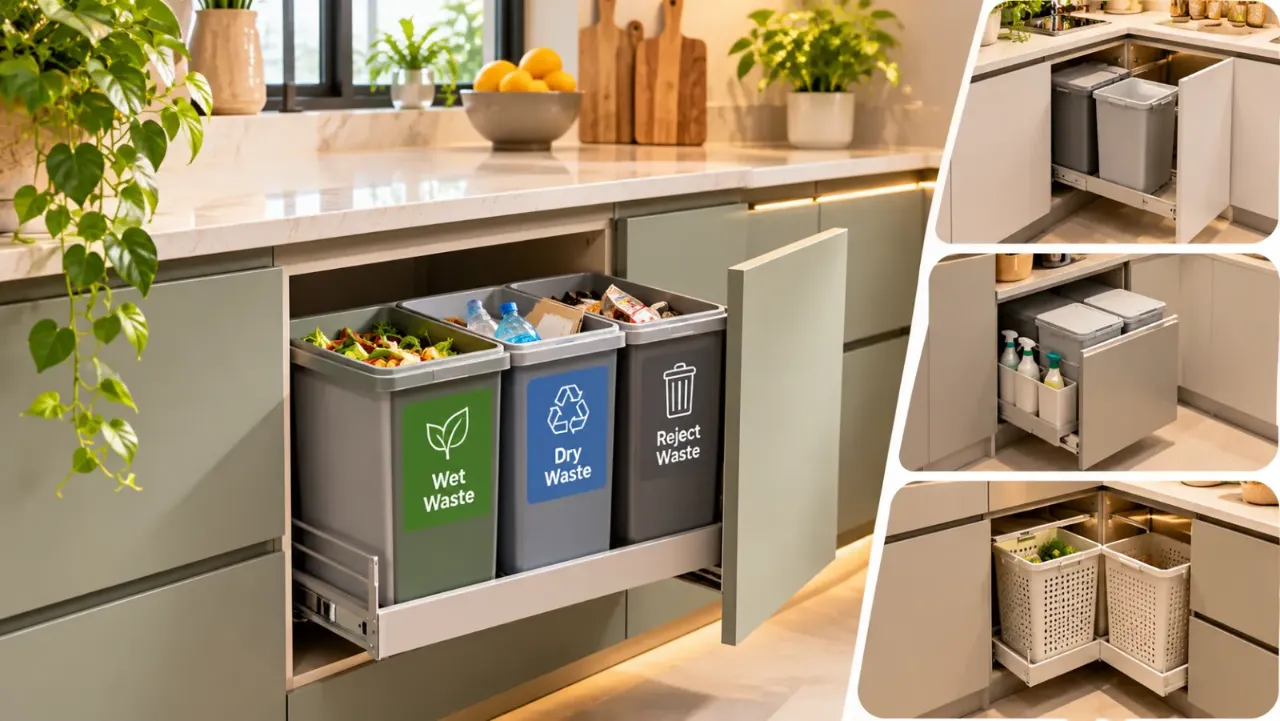
Built-In Waste Bins and Segregation Corners in Cabinets
A well-planned kitchen is not just about attractive cabinets, spacious countertops and organised storage. It should also make everyday waste disposal simple. Yet, the waste bin is often treated as an afterthought and placed wherever a little space is left over.
Built-in waste bins and dedicated segregation corners can make a kitchen cleaner, more organised and easier to maintain. Instead of keeping multiple bins visible on the floor, you can integrate them into a base cabinet, plan separate compartments for different waste categories and create a convenient routine for disposing of everyday kitchen waste.
The key is to plan the system around how your household actually cooks, cleans and separates waste.
1. Why Should You Plan a Built-In Waste Bin?
A standalone dustbin can take up valuable floor space, interrupt movement and make a compact kitchen feel cluttered. A built-in system offers a more organised alternative.
- A cleaner appearance: Bins remain concealed behind cabinet shutters when not in use.
- Better space utilisation: The cabinet can accommodate multiple containers within one planned unit.
- Convenient disposal: A pull-out mechanism brings the bins towards you instead of making you reach into a corner.
- Easier segregation: Separate containers make it simpler to keep different waste categories apart.
- A more organised routine: Every household member knows where different types of waste belong.
However, a built-in bin is only useful when it is easy to access, remove and clean. A concealed bin that is difficult to empty can become less convenient than a simple standalone one.
2. Understand the Waste Categories Before Designing the Cabinet
Before choosing the number of bins, understand what your household needs to separate.
India's Solid Waste Management Rules, 2026, which came into effect on 1 April 2026, provide for four-stream segregation at source:
Wet waste
This includes biodegradable kitchen waste such as:
- Vegetable and fruit peels.
- Leftover food.
- Food scraps and other organic kitchen waste.
- Flowers and similar biodegradable material.
Use a covered, removable container that can be emptied frequently. A smaller wet-waste bin is often more practical because kitchen waste can become heavy, produce odours and attract insects if left for too long.
Dry waste
This includes materials such as:
- Paper and cardboard.
- Plastic packaging.
- Glass.
- Metal containers and cans.
- Other recyclable or non-biodegradable materials.
Keep these materials as clean and dry as practical. A larger container may be useful because dry packaging can occupy considerable volume even when it weighs very little.
Sanitary waste
This includes used sanitary products such as diapers and sanitary towels. The rules require such waste to be securely wrapped and stored separately from wet and dry waste.
Plan a separate, covered container or suitable designated storage arrangement. It should be easy to access without mixing it with food waste or recyclable materials.
Special care waste
This includes items such as:
- Expired medicines.
- Used batteries.
- CFL bulbs and tube lights.
- Paint containers and pesticide cans.
- Broken mercury thermometers.
- Used needles and syringes.
These items should not be casually thrown into the regular kitchen bins. Keep them in a separate, clearly identified and secure storage arrangement until they can be handed over to an authorised collector or designated collection point.
For a household kitchen, the practical approach is to use the main cabinet system for everyday wet and dry waste, while planning separate, secure storage for sanitary and special care waste.
Always follow the collection and handover instructions issued by your local authority.
3. Different Built-In Waste Bin Designs for Modular Kitchens
The best system depends on the cabinet dimensions, available floor space and number of waste categories you need to accommodate.
A. Single pull-out bin
A single pull-out bin is suitable for kitchens where space is limited or where the household uses a separate segregation arrangement elsewhere.
It is simple to install, easy to access and generally requires less cabinet space. However, it does not provide separate compartments for multiple waste streams.
B. Double pull-out bin
A double-bin system is one of the most practical options for everyday kitchen use.
One container can be assigned to wet waste and the other to dry waste. The compartments should be clearly labelled so that everyone in the household uses them correctly.
Choose removable containers rather than fixed compartments. This makes emptying and cleaning easier.
C. Triple-bin arrangement
A triple-bin arrangement offers additional flexibility. It may be used for wet waste, dry waste and a separately managed household waste category, depending on local collection arrangements.
If you plan to include sanitary waste in this arrangement, it must remain securely wrapped and separated from wet and dry waste. Do not assume that three compartments automatically cover all four waste streams.
D. Deep pull-out segregation drawer
A deep drawer can accommodate multiple removable containers and useful accessories.
It works well when the cabinet has enough width and depth, and when the drawer runners can support the combined weight of the bins and their contents.
E. Under-sink waste bin
The space below the sink is often considered a convenient place for waste bins because it is close to the washing and preparation areas.
However, the cabinet must account for the sink bowl, plumbing, water filter connections and cleaning supplies. Check for leaks and moisture before selecting this location.
If the available space is cramped or damp, a separate base cabinet may be a better choice.
4. Where Should the Waste Segregation Corner Be Located?
The location matters as much as the bin design. A system that is too far from the preparation counter may not be used consistently.
Near the sink
This is convenient for disposing of food scraps and cleaning up after meal preparation. However, the bins should not obstruct the plumbing or interfere with access to cleaning products.
Next to the preparation counter
This is often a practical location because vegetable peels and food scraps can be discarded while chopping. A pull-out bin positioned close to the preparation area reduces unnecessary movement.
At the end of the kitchen counter
If the kitchen has a longer counter run, a dedicated base cabinet at one end can work as a waste segregation station.
In a separate utility area
For larger households, a utility area may provide more room for additional waste containers, temporary storage and cleaning. This can be especially useful for dry recyclables that do not need to be emptied every day.
The best position is one that is convenient during cooking but does not interfere with the main kitchen workflow.
5. How Much Cabinet Space Should You Reserve?
There is no single cabinet size that works for every kitchen. The required dimensions depend on the number and capacity of the bins, their shape, the pull-out hardware and the internal cabinet construction.
Before finalising the cabinet, check:
- Internal width: The containers must fit side by side without rubbing against the cabinet walls.
- Internal depth: Allow enough room for the bin body, handles and pull-out mechanism.
- Internal height: Check that the containers can be lifted out without hitting the countertop or sink fittings.
- Door opening: The shutter should open far enough for the bins to slide out completely.
- Runner capacity: The hardware must support the weight of the filled containers.
- Removal clearance: You should be able to lift each bin out easily for emptying and washing.
Do not select the bin first and expect the carpenter to adjust the cabinet around it later. Choose the actual bin model and hardware before the final cabinet drawing is approved.
6. Choosing the Right Bin Capacity
A large bin is not always better. Capacity should be based on how much waste your household generates and how frequently it is collected.
- Small households: May need compact containers, especially for wet waste.
- Medium households: May benefit from a double-bin pull-out with separate wet and dry compartments.
- Large households: May need larger dry-waste storage or an additional segregation station in the utility area.
- Homes with frequent cooking: Should prioritise easy access and frequent emptying of wet waste.
For wet waste, avoid selecting a container that is so large that it encourages waste to remain inside for several days. For dry waste, a larger container can be useful because packaging is often bulky.
The collection schedule in your locality should also influence your choice.
7. Materials and Features to Look for in Built-In Bins
The container and the pull-out hardware both matter.
Removable plastic containers
These are lightweight and easy to wash. Look for sturdy containers with smooth internal surfaces and handles that allow easy removal.
Stainless steel containers
Stainless steel can offer a durable, easy-to-clean option. Check the quality of the finish, edges and removable inner bucket.
Soft-close runners
Soft-close hardware helps the drawer return smoothly and reduces sudden impact. It is particularly useful when the bins are frequently accessed.
Full-extension slides
These allow the bin drawer to come further out, making it easier to reach the rear containers.
Lids and covers
A removable lid can help contain odours and prevent accidental contact with waste. Make sure the lid does not make daily disposal inconvenient.
Washable base trays
A removable protective tray beneath the containers can help catch small spills and make cleaning easier.
8. Hygiene and Maintenance: What Makes the System Work?
A concealed waste bin does not automatically make a kitchen hygienic. The cabinet needs regular cleaning and proper handling.
- Empty wet waste frequently, preferably daily.
- Use suitable liners where appropriate and compatible with local waste collection practices.
- Wash and dry removable containers regularly.
- Wipe the cabinet base and pull-out mechanism when spills occur.
- Keep dry waste reasonably clean and dry.
- Avoid storing wet and dry waste together.
- Check the cabinet periodically for moisture, leakage or insect activity.
- Keep cleaning chemicals away from food storage and waste containers.
- Ensure that the cabinet can be opened and ventilated enough for it to dry after cleaning.
Avoid placing unprotected food scraps directly inside the cabinet. The removable container should be the surface that comes into contact with waste.
9. Common Mistakes to Avoid While Planning a Segregation Corner
Choosing bins before measuring the cabinet: The container may look compact in a product photograph but fail to fit once the cabinet sides, runners and plumbing are considered.
Ignoring the sink trap and plumbing: An under-sink unit may have less usable space than expected. Always measure the actual internal clearance.
Using one large bin for everything: Mixing different waste categories defeats the purpose of segregation. Provide separate, clearly identified containers.
Making the bins difficult to remove: Fixed or tightly fitted containers can make cleaning and emptying frustrating. Each bin should be easy to lift out independently.
Forgetting wet-waste odour control: A large, poorly maintained wet-waste container can create unpleasant smells and attract pests. Choose a suitable covered bin and empty it regularly.
Keeping special care waste with ordinary kitchen waste: Batteries, bulbs, medicines and similar items require separate handling. Do not place them in the regular wet- or dry-waste containers.
Ignoring the collection system: The household segregation arrangement should match the separate waste streams accepted by the local authority or authorised collector.
10. A Practical Checklist Before Finalising Your Kitchen Cabinet
Before approving the modular kitchen design, confirm the following:
- Decide which waste categories need separate storage.
- Select the actual bin model and capacity.
- Check the cabinet's internal width, depth and height.
- Confirm clearance for plumbing if the bin is under the sink.
- Check the shutter opening and pull-out mechanism.
- Verify the runner's load capacity.
- Make sure each container can be removed independently.
- Include lids, handles and labels where useful.
- Plan a washable protective base.
- Keep special care waste in a separate secure arrangement.
- Confirm that the system matches your local waste collection requirements.
A well-planned waste corner should be easy to use, easy to clean and simple enough for every household member to follow.
Closing Thoughts
Built-in waste bins may seem like a small modular kitchen accessory, but they can make a meaningful difference to how organised your kitchen feels every day.
The best design is not necessarily the one with the most compartments or the most expensive pull-out hardware. It is the one that gives each waste category a suitable place, makes disposal convenient and allows containers to be removed and cleaned without difficulty.
Plan the segregation system before the cabinets are manufactured. A little attention to cabinet dimensions, bin capacity, hygiene and local collection requirements can turn an overlooked corner into a genuinely useful part of your kitchen.
Explore More with Walls to Wonder
Planning your kitchen or renovating your home? Explore Walls to Wonder's AI-powered tools to visualise spaces, understand design costs and make more informed interior decisions.
- Whole Home Visualizer
- Design My Room
- Interior Design Cost Estimate
- Interior Quotation Checker
- Rate My Room Design
- Interior Style Finder
Visit Walls to Wonder to explore more ideas and make your dream home a reality.
Turn this idea into a plan for your home
Visualise your space, understand the likely budget, or find a professional who can bring the idea to life.