
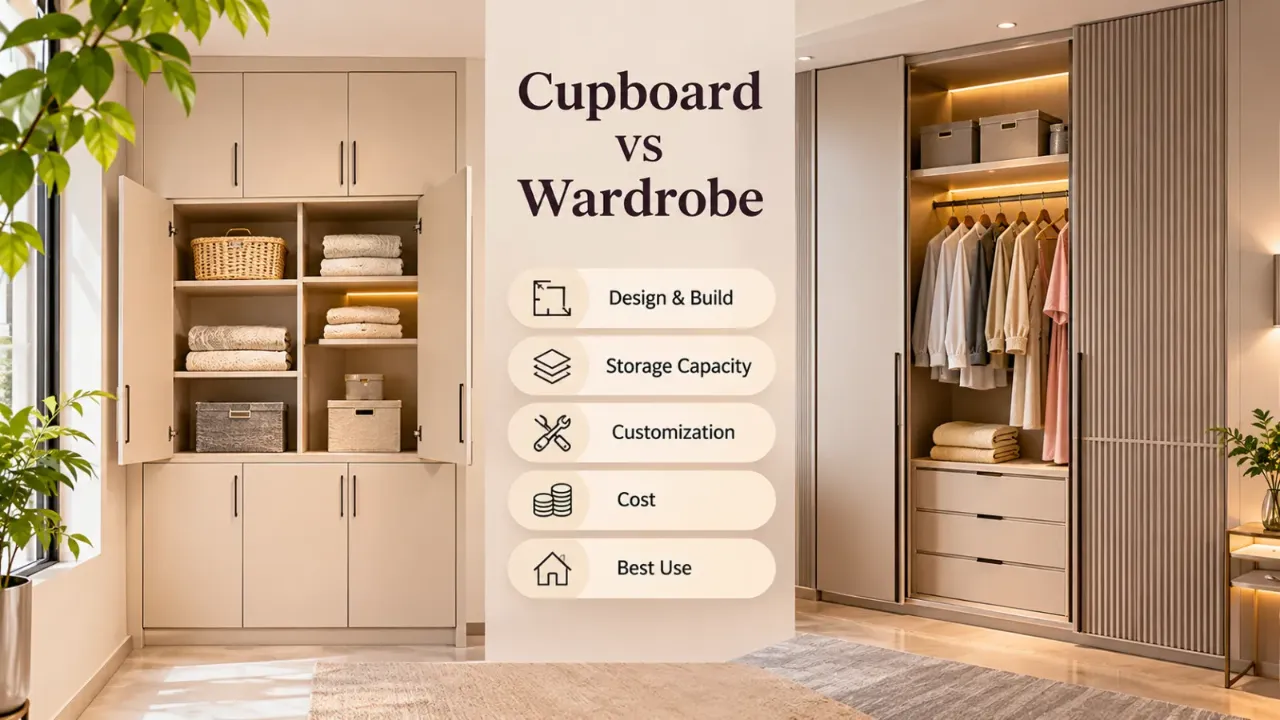
Cupboard vs Wardrobe: What's the Difference in Design and Cost
When planning bedroom storage, two words often come up: cupboard and wardrobe. In everyday Indian conversations, they are frequently used interchangeably. A furniture store may call a unit a cupboard, while an interior designer may describe a similar piece as a wardrobe.
However, there are useful differences in how these terms are commonly understood. A cupboard is a broad category of enclosed storage furniture, while a wardrobe is generally designed specifically for clothing, footwear and accessories. The distinction becomes more important when you compare freestanding furniture, built-in storage and customised bedroom units.
So, which one should you choose? And does one cost more than the other? The answer depends less on the name and more on the size, construction, materials, finish and storage features.
1. What Is a Cupboard?
A cupboard is an enclosed storage unit with doors, shelves, drawers or a combination of these. It can be used in almost any room and is not limited to clothing.
Common examples include:
- Kitchen cupboards for utensils, groceries and appliances.
- Living room cupboards for books, crockery and household items.
- Bedroom cupboards for folded clothes, accessories and personal belongings.
- Utility cupboards for cleaning supplies and everyday essentials.
- Bathroom cupboards for toiletries and storage products.
Cupboards are available in different sizes and materials. They may be freestanding, wall-mounted or built into a larger storage arrangement.
The main characteristic of a cupboard is its versatility. Its internal layout is designed around whatever needs to be stored.
2. What Is a Wardrobe?
A wardrobe is a storage unit primarily designed for clothes and personal accessories. Its internal arrangement usually includes hanging sections, shelves, drawers and compartments.
Typical wardrobe features include:
- Hanging rods for shirts, dresses, jackets and trousers.
- Shelves for folded clothes and linen.
- Drawers for smaller garments and accessories.
- Shoe storage or pull-out organisers.
- Mirrors, jewellery trays and other optional fittings.
- Loft compartments for seasonal or less frequently used belongings.
Wardrobes can be freestanding furniture pieces or customised installations fitted along a bedroom wall. Some are designed as compact two-door units, while others extend from floor to ceiling.
The defining feature is not necessarily the size or appearance. It is the clothing-focused storage arrangement.
3. Cupboard vs Wardrobe: Key Differences
The terms can overlap, particularly in Indian homes. A bedroom cupboard with hanging space and drawers may function exactly like a wardrobe. The following comparison explains the common distinction.
| Feature | Cupboard | Wardrobe |
|---|---|---|
| Main purpose | General-purpose storage | Primarily clothing and accessory storage |
| Internal layout | Shelves, drawers and compartments | Hanging space, shelves, drawers and organisers |
| Typical locations | Kitchen, bedroom, living room, utility | Mainly bedrooms and dressing areas |
| Design | Can be compact or large, simple or decorative | Usually planned around clothing storage |
| Installation | Freestanding, wall-mounted or built-in | Freestanding, modular or built-in |
| Customisation | Depends on storage requirements | Often customised to clothing and user needs |
In practice, the words are not strict construction categories. When comparing quotations, focus on the actual specifications rather than whether a vendor uses the word cupboard or wardrobe.
4. Different Design Options Available
Both cupboards and wardrobes can be designed in several ways. The right choice depends on the available space, the items being stored and the overall room layout.
Freestanding Cupboards
These are independent storage units that can be placed against a wall. They are useful when you need additional storage without undertaking a full interior installation.
They work well in rented homes, guest rooms and utility spaces because they can usually be moved when required.
Freestanding Wardrobes
These are ready-made or assembled clothing-storage units. They generally include hanging space and shelves, with drawers or mirrors depending on the model.
They are useful when you need a dedicated clothes-storage unit without committing to wall-to-wall carpentry.
Built-In Wardrobes
Built-in wardrobes are designed to fit a specific wall or recess. They can use the available height and width efficiently and create a more integrated bedroom appearance.
They are suitable for homeowners planning long-term storage, particularly when the room has an awkward wall dimension or limited floor space.
Modular Wardrobes
Modular wardrobes are manufactured in sections and assembled at the site. They offer a more standardised production process and can be planned with different internal configurations.
Depending on the design and product system, some modular units can be dismantled and reinstalled more easily than site-built carpentry.
Sliding-Door and Hinged-Door Designs
A wardrobe can also be classified by how its doors open.
- Hinged doors: Open outward and provide access to the full compartment, but need clear floor space in front.
- Sliding doors: Move along tracks and are useful where door-swing clearance is limited. However, only part of the wardrobe is accessible at a time.
The door mechanism affects both usability and cost, so it should be considered during planning.
5. Cupboard vs Wardrobe: What Does Each Cost in India?
There is no fixed price difference between a cupboard and a wardrobe simply because of their names. A basic cupboard can cost less than a customised wardrobe, but a large, premium cupboard can also cost more than a simple bedroom wardrobe.
For a fair comparison, consider the construction method, dimensions, board material, shutter finish, hardware and internal fittings.
For customised wardrobes, broad indicative Indian planning bands are:
| Wardrobe specification | Indicative cost per sq ft |
|---|---|
| Budget | ₹800–₹1,200 |
| Standard / mid-range | ₹1,200–₹2,200 |
| Premium | ₹2,200–₹3,500 |
| Luxury / specialised | ₹3,500+ |
These are broad planning figures, not fixed market rates. The measurement basis and inclusions differ between vendors. Some quote on the front-facing shutter area, while others may calculate or itemise components differently.
For ready-made cupboards and wardrobes, prices depend on the product's dimensions, material, brand, finish and delivery or assembly charges. A smaller basic unit may be considerably less expensive than a large customised installation.
6. Example: Estimating the Cost of a Bedroom Wardrobe
Suppose you are planning a wardrobe that is 6 feet wide and 7 feet high.
- Width: 6 ft
- Height: 7 ft
- Front-facing area: 6 × 7 = 42 sq ft
Using the indicative planning bands above:
| Category | Rate used | Illustrative base cost |
|---|---|---|
| Budget | ₹800–₹1,200/sq ft | ₹33,600–₹50,400 |
| Standard / mid-range | ₹1,200–₹2,200/sq ft | ₹50,400–₹92,400 |
| Premium | ₹2,200–₹3,500/sq ft | ₹92,400–₹1,47,000 |
These calculations are examples, not complete quotations. They assume that the quoted rate applies to the 42 sq ft front-facing area. Confirm whether the price includes the carcass, shutters, hardware, internal shelves, loft, accessories, installation, delivery and applicable taxes.
A cupboard of the same dimensions may cost differently if it has fewer internal fittings, a different construction method or a different finish. That is why comparing only the total price can be misleading.
7. What Factors Influence the Final Cost?
The following details can change the price significantly, whether you are buying a cupboard or commissioning a wardrobe.
Material Used
Common options include particle board, MDF, plywood and solid wood. Their cost, performance and suitability vary.
The choice should reflect the intended use, expected exposure to moisture, construction quality and maintenance requirements.
Shutter Finish
Laminate, membrane, acrylic, veneer, glass and painted finishes can have different price points.
A simple laminate finish is often a practical choice for everyday storage, while premium finishes may increase the overall budget.
Internal Accessories
Drawers, pull-out shoe racks, trouser organisers, jewellery trays, mirrors and lighting add convenience but also increase the cost.
Plan these around your actual storage habits rather than adding every available accessory.
Door Mechanism
Sliding systems require tracks and rollers, while hinged doors use hinges and need swing clearance. The mechanism, hardware quality and shutter size affect the final price.
Size and Loft Storage
A taller or wider unit requires more material and may need additional structural support. Loft compartments, corner sections and unusual dimensions can also increase complexity.
Installation and Hardware
Ask whether the quotation includes installation, handles, hinges, drawer channels, soft-close mechanisms, delivery and finishing work. These items can be included in one vendor's package and charged separately by another.
8. Which Option Is Better for Your Home?
The right choice depends on what you need to store and how permanent the installation should be.
Choose a freestanding cupboard if:
- You need general-purpose storage.
- You are furnishing a rented home.
- You want a unit that can be moved.
- You need storage for books, linen, household supplies or miscellaneous items.
Choose a freestanding wardrobe if:
- You need clothing storage without major carpentry.
- You want a ready-made unit.
- You may relocate in the future.
- Your storage requirements fit standard dimensions.
Choose a built-in or modular wardrobe if:
- You want to use a bedroom wall efficiently.
- You need a customised hanging and drawer arrangement.
- You want storage to align with the room's design.
- You are planning a longer-term bedroom interior.
For a small bedroom, sliding doors may help preserve floor clearance. For a larger room, hinged doors can offer full access to the wardrobe interior. Neither option is automatically better; the room layout should decide.
9. Questions to Ask Before Buying or Ordering
Before finalising a cupboard or wardrobe, clarify the following:
- What is the exact width, height and depth?
- Is the unit freestanding, modular or built on site?
- Which material is used for the carcass and shutters?
- What is the finish, and how should it be maintained?
- How many shelves, drawers and hanging sections are included?
- Which hinges, tracks and drawer channels will be supplied?
- Is the loft included in the quoted dimensions and price?
- Does the price include delivery, installation and taxes?
- What warranty applies to the materials and hardware?
- Can the unit be dismantled or relocated if required?
Request an itemised quotation so that you can compare products and vendors on the same specifications.
Closing Thoughts
A cupboard and a wardrobe may look similar, but their intended storage functions are not always the same. Cupboards are versatile units for general household storage, while wardrobes are usually planned around clothing, hanging space and personal accessories.
In Indian homes, the terms are often used interchangeably, so the name alone should not decide your purchase. Compare the dimensions, internal layout, materials, finish, hardware and total installed cost.
The best option is the one that fits your room, storage habits and budget without paying for features you do not need.
Explore More with Walls to Wonder
Planning a bedroom storage upgrade or a complete home interior? Explore Walls to Wonder's AI-powered tools to visualise room designs, estimate interior costs, check quotations and discover styles that suit your home.
- Whole Home Visualizer
- Design My Room
- Interior Design Cost Estimate
- Interior Quotation Checker
- Rate My Room Design
- Interior Style Finder
Discover more at Walls to Wonder.
Get a personalised estimate for your home
Choose your rooms, materials and preferences to understand a practical interior budget before you commit.