
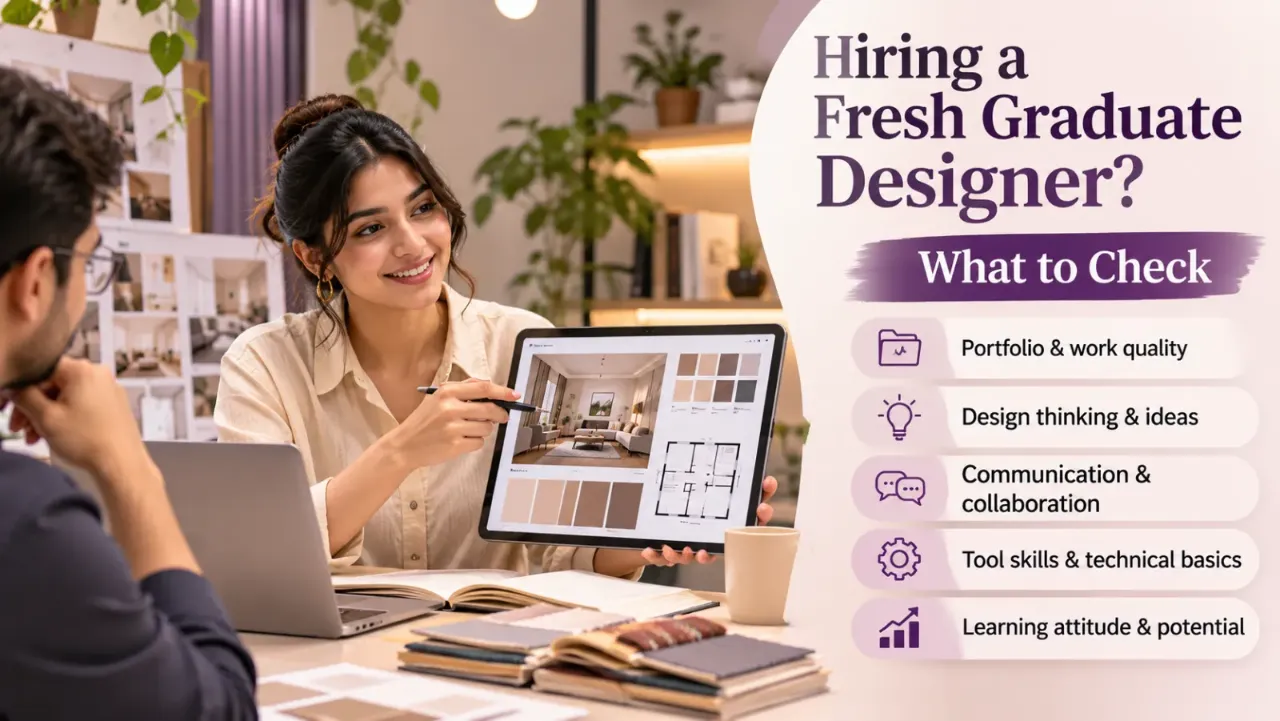
Hiring a Fresh Graduate Designer: What to Check
Hiring a fresh graduate interior designer can be an opportunity to bring new ideas, creativity and energy into your design team. However, a degree alone does not tell you whether a candidate can understand client requirements, prepare practical layouts, work with materials or coordinate with vendors.
For an interior design firm, the challenge is slightly different when hiring someone at the beginning of their career. You may not expect a long list of completed projects, but you do need to understand their design fundamentals, working approach and willingness to learn.
So, what should you check before hiring a fresh graduate designer? Here are the areas worth evaluating.
1. Review the Portfolio, Not Just the Degree
A portfolio is often the first place to understand how a graduate approaches design. It does not need to contain completed client projects. Academic assignments, studio projects, internships and personal design exercises can all provide useful evidence.
Look for:
- Space planning: Can the candidate arrange furniture and circulation logically?
- Concept development: Can they explain the idea behind a design?
- Design consistency: Do colours, materials, furniture and lighting work together?
- Visual presentation: Are drawings, layouts and renders organised and understandable?
- Attention to detail: Have they considered dimensions, storage, finishes and practical requirements?
Do not judge a portfolio only by how attractive the final renders look. Ask the candidate to explain the decisions behind two or three projects.
A strong presentation should communicate not just what the candidate designed, but why they designed it that way.
2. Check Their Understanding of Design Fundamentals
Software can help someone produce drawings and renders, but it cannot replace an understanding of basic design principles.
During the interview, assess whether the candidate understands:
- Space planning and furniture placement
- Scale and proportion
- Colour combinations
- Lighting principles
- Material selection
- Ergonomics and circulation
- Storage planning
- Balance between aesthetics and functionality
For example, show the candidate a small bedroom layout and ask them how they would improve it. Their explanation can reveal whether they consider movement, furniture clearances, storage and everyday use rather than focusing only on appearance.
3. Evaluate Their Software Knowledge
A fresh graduate does not need to know every design application. However, they should be comfortable with the software commonly used by your studio.
Depending on the firm's workflow, relevant tools may include:
- AutoCAD: For drafting floor plans, elevations and technical drawings.
- SketchUp: For developing three-dimensional models.
- 3ds Max: For detailed modelling and visualisation.
- V-Ray or Enscape: For rendering and visual presentations.
- Revit: For BIM-based modelling and documentation.
- Photoshop: For editing renders and preparing presentations.
Ask which applications they have used, what tasks they can complete independently and where they still need guidance.
Instead of accepting a software name on a résumé as proof of proficiency, ask the candidate to demonstrate a small task or explain their actual workflow.
4. Test Their Ability to Read Drawings
An interior designer needs to understand drawings, not simply create attractive visuals.
Check whether the candidate can interpret:
- Floor plans
- Furniture layouts
- Elevations
- Sections
- Basic electrical layouts
- Reflected ceiling plans
- Dimensions and annotations
You can give them a simple floor plan and ask them to identify the room dimensions, doors, windows and possible furniture positions.
This is particularly useful for a junior designer who may eventually assist with working drawings, site coordination and execution.
5. Understand Their Knowledge of Materials and Finishes
A design may look excellent on screen but become impractical when the materials are selected.
A graduate should have at least a basic understanding of commonly used interior materials and finishes, such as:
- Plywood, MDF and particle board
- Laminates and veneers
- Natural stone and engineered surfaces
- Ceramic and vitrified tiles
- Glass and aluminium
- Paint and wall finishes
- Fabrics and upholstery
- Hardware and fittings
Ask simple, practical questions. For example:
- Where might you use laminate instead of veneer?
- What factors would you consider before selecting flooring for a kitchen?
- What would you check before finalising wardrobe hardware?
- How would you select a finish for a high-use surface?
You are not necessarily looking for an expert. You are checking whether the candidate understands that material selection involves durability, maintenance, budget and application.
6. Assess Communication and Client Understanding
Interior design involves continuous communication with clients, contractors, vendors and other members of the design team.
A fresh graduate may not have handled clients independently, but they should be able to listen carefully, ask relevant questions and explain their ideas clearly.
Check whether they can:
- Understand and summarise a design brief
- Ask questions when requirements are unclear
- Explain design decisions without relying only on technical terms
- Accept feedback professionally
- Present ideas in an organised manner
- Communicate changes accurately to team members
You can use a short role-play exercise. Describe a client who wants a modern living room but has a limited budget. Ask the candidate what questions they would ask before preparing a design proposal.
Their response will show how they approach requirements rather than immediately jumping to a visual concept.
7. Check Their Practical Understanding of Site Work
Not every fresh graduate has extensive site experience. That is perfectly reasonable. However, they should be interested in understanding how designs are implemented.
Check their awareness of:
- Site measurements
- Existing site conditions
- Furniture dimensions
- Electrical and plumbing points
- Material samples
- Installation sequences
- Coordination with contractors
- Differences between drawings and actual site conditions
Ask whether they are comfortable visiting sites and learning from execution teams.
A useful interview question is: "What would you do if the actual site measurement does not match the approved drawing?"
A thoughtful answer should involve rechecking measurements, documenting the discrepancy, informing the responsible senior designer and obtaining approval before making changes.
8. Give a Small Practical Design Assignment
A short, relevant assignment can reveal more than a lengthy interview. It should test the candidate's thinking without expecting the output of an experienced professional.
For example, provide a simple bedroom or living-room floor plan and ask the candidate to prepare:
- A basic furniture layout
- A simple colour and material concept
- A mood board
- A short explanation of the design decisions
Keep the assignment limited and communicate the expected time and deliverables in advance. Avoid using unpaid recruitment assignments as a substitute for actual client work.
Evaluate the submission on clarity, functionality, creativity, attention to detail and the ability to explain decisions.
9. Look at Their Attitude Towards Feedback and Learning
A fresh graduate is still developing professionally. Their ability to learn can be just as important as the skills they already possess.
Look for candidates who:
- Are open to constructive feedback
- Show curiosity about materials and design techniques
- Take responsibility for mistakes
- Are willing to revise their work
- Ask questions when they are unsure
- Can manage tasks with guidance
- Show interest in understanding the complete design process
During the interview, ask them to describe a project where they received criticism. Find out what they changed and what they learned from the experience.
The aim is not to find someone who already knows everything. It is to find someone who can grow into the responsibilities of the role.
10. Understand Their Work Expectations
Before making an offer, discuss the practical expectations of the position.
Clarify:
- Working hours and office location
- Site visits and travel requirements
- Software and equipment provided
- Reporting structure and supervisor
- Nature of projects they will assist with
- Training and development opportunities
- Salary, leave and other employment terms
- Expected responsibilities during the initial months
Be transparent about whether the role is primarily drafting, visualisation, client coordination, site assistance or a combination of responsibilities.
This helps avoid a mismatch between what the graduate expects and what the studio needs.
11. A Simple Fresh Graduate Designer Evaluation Checklist
Use the following checklist to structure the selection process.
| Evaluation area | What to check |
|---|---|
| Portfolio | Design thinking, presentation and project explanation |
| Design fundamentals | Space planning, colour, proportion and functionality |
| Software | Actual proficiency in relevant applications |
| Drawings | Ability to read plans, elevations and dimensions |
| Materials | Basic knowledge of finishes, applications and maintenance |
| Communication | Listening, clarity and presentation |
| Site awareness | Measurements, coordination and execution interest |
| Practical assignment | Problem-solving and design approach |
| Attitude | Learning ability, feedback and responsibility |
| Work expectations | Role clarity, availability and employment terms |
You can also use a simple rating system, such as 1 to 5, for each area. Give more weight to the skills that matter most for the specific role. For example, a drafting-focused position may require stronger drawing skills, while a concept-design role may place more emphasis on visualisation and creative thinking.
Closing Thoughts
Hiring a fresh graduate interior designer should not be about finding a candidate who already has the experience of a senior professional. It should be about identifying someone with sound design fundamentals, a genuine interest in the field, practical thinking and the ability to learn.
Review the portfolio carefully, test relevant skills through a short assignment and understand how the candidate responds to feedback. Most importantly, make the job responsibilities clear before hiring.
A well-selected junior designer can gradually become a valuable part of the studio, contributing to projects while developing the skills needed for greater responsibility.
Explore More with Walls to Wonder
Looking to build your interior design knowledge or plan your next project? Walls to Wonder offers AI-powered tools to help you visualise spaces, explore design styles and understand interior costs.
- Whole Home Visualizer – Explore design possibilities for your space.
- Design My Room – Experiment with different layouts and interior ideas.
- Interior Design Cost Estimate – Get an initial understanding of interior costs.
- Interior Quotation Checker – Review and understand an interior quotation.
- Rate My Room Design – Evaluate your room design.
- Interior Style Finder – Explore styles that suit your preferences.
Visit Walls to Wonder to explore more.
Turn this idea into a plan for your home
Visualise your space, understand the likely budget, or find a professional who can bring the idea to life.