
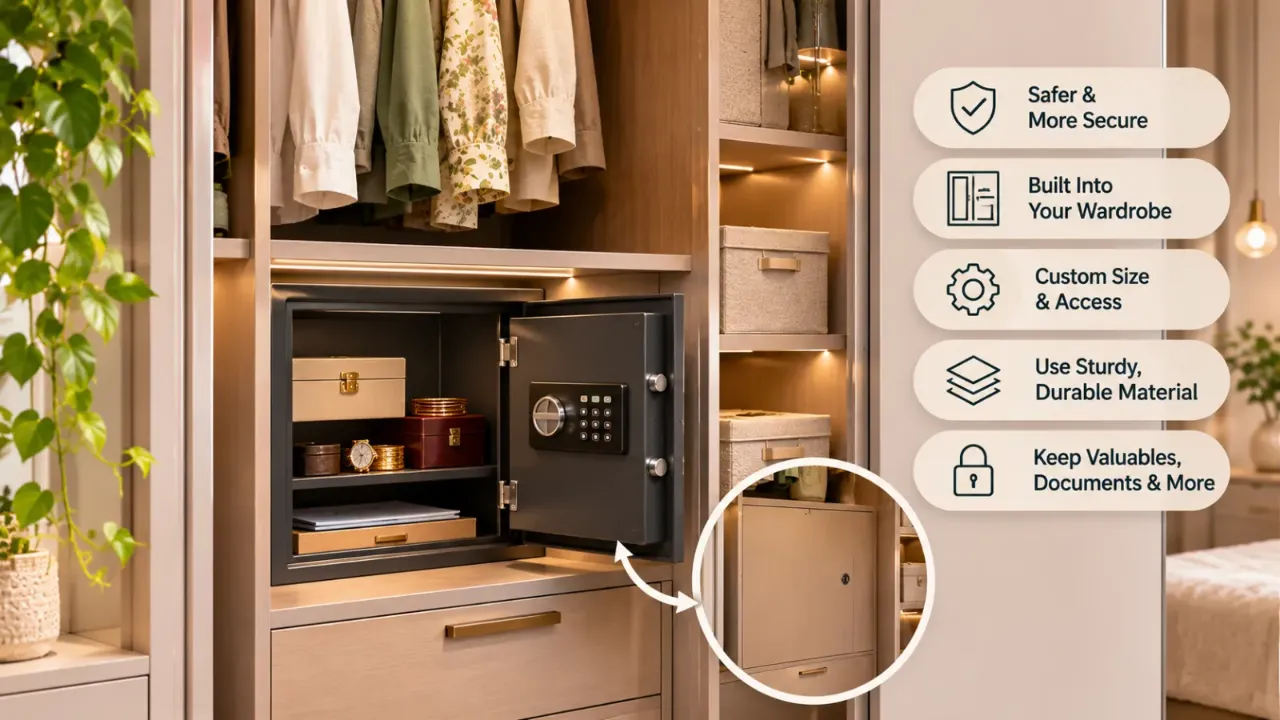
Building a Locker or Safe Inside a Wardrobe
A wardrobe is usually planned around clothes, footwear and everyday accessories. But with a little additional planning, it can also accommodate a dedicated locker or safe for jewellery, important documents, personal valuables and small belongings that need controlled access.
Integrating a safe into a wardrobe can keep the bedroom looking organised while making valuables accessible when required. However, it is not simply a matter of placing a metal box behind a wardrobe shutter. The safe needs the right dimensions, a suitable location, proper structural support, secure installation and enough clearance for everyday use.
Here is how to plan a locker or safe inside a wardrobe without compromising the storage design or creating a false sense of security.
1. Decide What You Actually Need to Store
Start by identifying the items that will go inside the locker. This determines the safe's size, internal arrangement and protection requirements.
- Jewellery, watches and small valuables.
- Passports, property papers and important certificates.
- Cash and personal documents.
- Small electronic devices and backup drives.
- Personal items that need restricted access.
Make a rough inventory before selecting the safe. Consider the size of document folders, jewellery boxes and other containers, rather than estimating capacity based only on the number of items.
Also distinguish between a basic lockable compartment and a tested security safe. A small metal locker inside a wardrobe may offer privacy and convenient storage, but it should not automatically be treated as equivalent to a certified burglary-resistant safe.
2. Choose the Right Type of Locker or Safe
The product you select should match the level of protection you need.
Basic Lockable Locker
A basic locker is a compact metal compartment with a key or electronic lock. It can be suitable for everyday personal belongings and items that need to be kept separate from general wardrobe storage.
It is generally more affordable and easier to integrate into a customised wardrobe, but its level of resistance to forced entry may be limited.
Electronic Safe
An electronic safe uses a keypad or another electronic access system. Depending on the model, it may offer user codes, multiple access options and other convenience features.
Check the manufacturer's instructions for battery replacement, emergency access and what happens if the keypad or power supply fails.
Biometric Safe
A biometric safe uses fingerprint recognition for access. It can be convenient when quick personal access is important.
Before buying one, check how it handles failed fingerprint recognition, battery failure and emergency opening. Do not rely on biometric access as the only recovery method.
Certified Security Safe
If you intend to store high-value jewellery, cash or important documents, consider a safe with clearly documented security performance and applicable certification.
In India, BIS publishes standards for safes, including IS 550 (Part 1), and for safe deposit locker cabinets, including IS 5244. These are different product categories. Check the applicable standard, certification and product documentation for the exact model you are purchasing.
3. Decide Where the Safe Should Be Placed
The location should balance convenient access, privacy, structural suitability and the wardrobe's internal layout.
Common design possibilities include:
- Inside a dedicated compartment: A separate section can be planned within the wardrobe, with its own door and adequate operating clearance.
- Within a drawer-style arrangement: A compact safe may fit into a specially designed lower or middle section, provided its weight and installation requirements are properly supported.
- Inside a full-height storage section: A larger safe can be accommodated in a dedicated section where its dimensions and door movement have been considered.
- As part of a dressing or accessory zone: A smaller locker may be integrated into a section used for personal accessories, provided access remains practical.
The safe should be easy for the authorised user to operate without requiring clothes, drawers or other furniture to be moved every time.
Avoid choosing a position purely because it is visually hidden. A discreet location does not replace proper security or structural installation.
4. Plan the Wardrobe Dimensions Around the Safe
The safe should be selected before the wardrobe's internal partitions are finalised. This avoids having to alter shelves or cut panels after installation.
Measure the following:
- External width, height and depth of the safe.
- Door projection and opening clearance.
- Space needed for the keypad, handle or locking mechanism.
- Location of manufacturer-provided fixing points.
- Space needed for installation and future maintenance.
- Additional clearance for ventilation or access, where specified by the manufacturer.
Remember that the safe's external dimensions are not the same as its usable internal storage capacity.
For a customised wardrobe, share the safe's product drawing or installation manual with the designer or carpenter. The compartment should be designed around the actual model rather than a guessed standard size.
5. Give Structural Support and Secure Installation Priority
This is one of the most important parts of the project.
A wardrobe's shelves, thin back panels and ordinary partitions are generally designed for storage loads, not as structural anchoring points for a security safe. The safe should not simply be screwed into a decorative MDF or particle-board panel and assumed to be secure.
Before installation:
- Check the safe's weight and manufacturer-approved mounting options.
- Confirm whether it is designed for floor anchoring, wall anchoring or another specified method.
- Identify the actual supporting surface behind or beneath the wardrobe.
- Check for concealed electrical wiring, plumbing and other services before any drilling.
- Use the correct fixing hardware for the safe and the building substrate.
- Arrange a qualified installer if the safe is heavy or the supporting structure is uncertain.
Some safes have pre-drilled fixing points and specific installation instructions. Follow the manual for the exact model. Do not drill new holes into the safe or modify its body unless the manufacturer expressly permits it, as this may affect its protective performance or warranty.
The wardrobe can be designed around the safe, but the wardrobe carcass itself should not be assumed to provide burglary-resistant anchoring.
6. Choose a Locking System That Suits Your Use
The locking mechanism affects convenience, maintenance and access.
| Lock type | Main advantage | What to consider |
|---|---|---|
| Key lock | Simple operation | Keep keys secure and plan for key loss |
| Electronic keypad | Convenient code-based access | Check battery and emergency access instructions |
| Biometric lock | Quick access for registered users | Check backup access and recognition reliability |
| Combination lock | Does not rely on a battery | Operation and combination management may take practice |
Whichever option you choose, understand the manufacturer's procedure for forgotten codes, lost keys, battery failure and emergency access.
Avoid sharing access codes casually. If the safe supports multiple user codes, use the facility according to the manufacturer's security guidance.
7. Consider Fire and Moisture Protection Separately
A safe designed to resist burglary is not necessarily fire-resistant. Similarly, a fire-resistant safe is not automatically designed to provide a high level of burglary protection.
If you need protection against both risks, look for product documentation that clearly identifies the relevant performance claims and test standards.
For document storage, check the safe's stated protection for paper or digital media. These contents may require different temperature and humidity protection.
Moisture also deserves attention, especially in Indian homes during the monsoon. A safe placed inside a wardrobe can still be affected by damp walls, condensation or a humid bedroom.
Useful precautions include:
- Avoid installing the safe against a wall with seepage or recurring dampness.
- Keep the surrounding wardrobe compartment dry.
- Use suitable desiccants if permitted by the safe manufacturer.
- Inspect the safe interior periodically.
- Avoid storing damp documents, jewellery pouches or fabric bags inside.
Do not assume that a sealed-looking safe is completely airtight or moisture-proof.
8. Integrate the Safe Without Disturbing the Wardrobe Design
A well-planned locker should look like a considered part of the wardrobe rather than an afterthought.
Design details to consider include:
- Separate internal compartment: Give the safe its own space so that clothing and accessories do not interfere with access.
- Matching exterior finish: The surrounding shutter or panel can match the wardrobe's laminate, veneer or other finish.
- Adequate door clearance: Ensure that the safe door can open fully and the lock can be operated comfortably.
- Independent access: Avoid placing frequently used clothes or storage boxes directly in front of the safe.
- Practical lighting: If the compartment is deep or poorly lit, a suitable internal light can make it easier to use.
- Maintenance access: Plan for battery replacement, lock servicing and future inspection without dismantling the entire wardrobe.
A clean design does not need complicated mechanisms. A simple, well-supported compartment is often more practical than an elaborate concealed arrangement.
9. Common Mistakes to Avoid
A few planning mistakes can reduce convenience or undermine the safe's intended protection.
- Choosing the safe after the wardrobe is built: This can lead to poor fit, unnecessary alterations and compromised storage.
- Fixing it only to a thin wardrobe panel: Decorative board is not automatically a suitable anchoring surface.
- Ignoring the safe's weight: The supporting structure and installation method must suit the actual load.
- Blocking the safe door: Nearby drawers, shelves or shutters should not obstruct operation.
- Assuming every safe is fireproof: Verify the exact model's tested protection claims.
- Ignoring humidity: A damp bedroom or wardrobe can affect both the safe and its contents.
- Forgetting emergency access: Understand the backup procedure before relying on the lock.
- Treating concealment as security: A hidden compartment is not a substitute for a suitable, properly installed safe.
10. Checklist Before Finalising the Design
Use this checklist with your interior designer, carpenter or safe supplier before approving the wardrobe drawings.
- The intended contents and required storage capacity have been identified.
- The safe model has been selected.
- External dimensions and door clearance have been checked.
- The safe's weight and supporting structure have been assessed.
- The manufacturer's anchoring instructions have been reviewed.
- Concealed wiring and plumbing have been considered before drilling.
- The locking system and emergency access procedure are understood.
- Fire and burglary protection claims have been checked separately.
- The wardrobe compartment allows easy operation and maintenance.
- The quotation clearly lists the safe, hardware, installation and related carpentry work.
Closing Thoughts
Building a locker or safe inside a wardrobe is a useful way to combine personal storage with bedroom design. But the success of the arrangement depends on more than fitting a metal box into a cabinet.
Choose the safe according to what you need to protect, plan the compartment around its actual dimensions, and give proper attention to anchoring, structural support, moisture and access. Most importantly, remember that a wardrobe can provide a neat enclosure, but it does not automatically make an ordinary locker secure.
When the safe and wardrobe are planned together from the beginning, the result can be practical, organised and visually integrated with the rest of the bedroom.
Explore More with Walls to Wonder
Planning a new wardrobe or redesigning your bedroom storage? Explore Walls to Wonder's AI-powered tools to visualise room designs, estimate interior costs, check quotations and discover styles that suit your home.
- Whole Home Visualizer
- Design My Room
- Interior Design Cost Estimate
- Interior Quotation Checker
- Rate My Room Design
- Interior Style Finder
Discover more at Walls to Wonder.
Turn this idea into a plan for your home
Visualise your space, understand the likely budget, or find a professional who can bring the idea to life.