
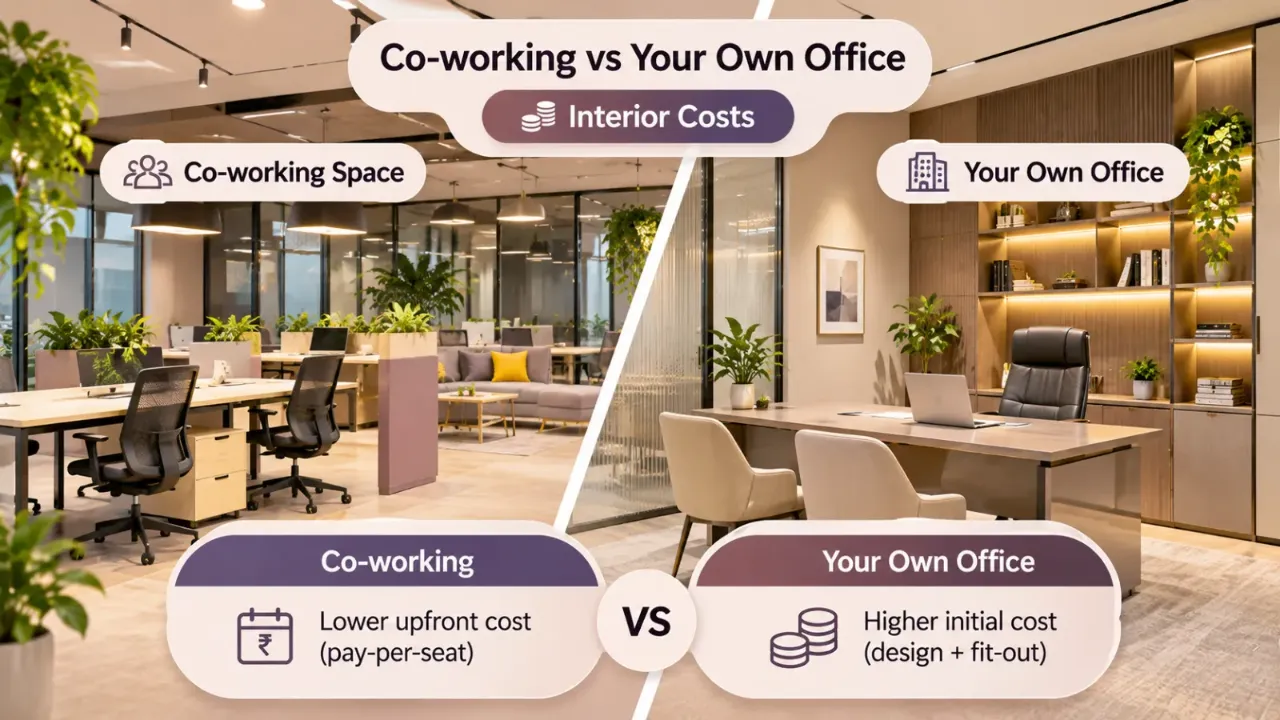
Co-working vs Your Own Office: Interior Costs
Choosing between a co-working space and a private office is not just a question of where your team will work. It is also a financial decision about how much you want to invest in the workspace, how much control you need over its design and how long you expect to use it.
A co-working space usually comes ready with workstations, chairs, internet, meeting rooms and shared amenities. You pay for access rather than building the entire office yourself. A private office, on the other hand, gives you the freedom to design the space around your team, work culture and brand identity, but the initial setup can involve a substantial interior investment.
So, which option makes more financial sense? Let's compare the costs from an interior-design perspective.
1. Understanding What You Are Paying For
The biggest difference is the way the initial investment is structured.
In a co-working space, much of the interior infrastructure is already in place. Workstations, common areas, meeting rooms, lighting, reception facilities and sometimes pantry services are included in the membership or rental fee.
In your own office, these elements must be planned and paid for separately unless the premises already include some of them.
Co-working spaces generally include:
- Ready-to-use desks and ergonomic chairs
- Shared meeting and conference rooms
- Common reception and waiting areas
- Internet and basic utility services
- Shared pantry and breakout areas
- Cleaning and routine facility management
A private office may require:
- Workstations, desks and office chairs
- Reception and waiting-area furniture
- Meeting-room tables and seating
- Partitions, cabins and storage
- Lighting, electrical and data points
- Pantry and breakout-area interiors
- Branding, signage and decorative finishes
The important distinction is that co-working shifts much of the initial fit-out investment to the operator. It does not mean those facilities are free; their cost is reflected in the membership fee.
2. Co-working Space: The Interior Cost Advantage
A co-working space is attractive to businesses that want to start operating without waiting for a complete office fit-out.
The operator has already invested in the furniture, flooring, lighting, partitions, meeting rooms and shared facilities. Your business pays for access to the finished environment.
This can be particularly useful for freelancers, consultants, small teams, startups and businesses testing a new location.
- Lower initial investment: You do not need to purchase a full set of workstations or build meeting rooms.
- Ready-made infrastructure: Lighting, electrical points, internet and shared facilities are usually already arranged.
- Flexible capacity: Depending on the agreement, you may be able to add or reduce seats without redesigning an entire office.
- Shared amenities: Meeting rooms, reception areas and breakout spaces can be accessed without building them yourself.
- Less maintenance responsibility: Routine upkeep is generally handled by the facility operator.
However, check what is actually included. Printing, dedicated meeting-room hours, additional storage, parking, premium cabins and after-hours access may cost extra.
3. Your Own Office: Where the Interior Budget Goes
A private office gives you greater control, but the interior budget has several components.
Workstations and furniture
Desks, chairs, storage units and collaborative tables are among the first purchases. The number of employees, desk configuration, furniture quality and ergonomic requirements influence the total.
Partitions and cabins
If you need private cabins, manager rooms, phone booths or enclosed meeting spaces, you must account for partition materials, doors, hardware and acoustic considerations.
Glass partitions can create an open appearance, while solid partitions may provide more privacy. The right choice depends on the work environment and the level of sound separation required.
Electrical and lighting
A well-planned office needs sufficient power points, data connections, task lighting and general illumination. Meeting rooms may also require display connections, video-conferencing equipment and additional electrical provisions.
Reception and branding
A reception desk, waiting seats, logo wall and signage help establish the identity of the business. These are optional in a co-working setup but can be important in a private office.
Pantry and breakout areas
A pantry, informal seating zone or staff breakout area adds convenience. However, it also increases the requirement for cabinetry, plumbing where applicable, appliances, furniture and electrical work.
Flooring, ceiling and finishes
The condition of the rented premises matters. A warm-shell office may already have some basic services and finishes, while a bare-shell space can require considerably more work. Before preparing an estimate, establish exactly what the landlord is providing.
4. Comparing the Costs: Co-working vs Private Office
The following table highlights how the two options differ.
| Cost component | Co-working space | Your own office |
|---|---|---|
| Workstations | Usually included | Purchased separately |
| Office chairs | Usually included | Purchased separately |
| Meeting rooms | Shared or paid access | Designed and furnished by you |
| Reception | Shared facility | Separate setup if required |
| Partitions and cabins | Already available | Additional fit-out cost |
| Lighting and electrical | Existing infrastructure | Existing services may need modification |
| Pantry | Shared or common facility | Separate setup if required |
| Branding | Limited customisation | Full design control |
| Maintenance | Usually handled by operator | Managed by your business or landlord |
| Expansion | Depends on available seats | May require more space and fit-out |
The co-working model generally reduces the amount of capital tied up in interiors. A private office gives you more control over how that capital is spent.
5. What Do Office Fit-outs Cost in India?
Office interior costs vary according to the city, carpet area, condition of the premises, design specifications, furniture quality and services included in the project.
For a broad market reference, Cushman & Wakefield's 2026 India Office Fit Out Cost Guide reports collaborative-hybrid fit-out benchmarks of approximately ₹5,847 per sq. ft. in cities such as Pune, Hyderabad, Chennai, Kolkata and Ahmedabad, around ₹6,027 in Bengaluru, ₹6,207 in Delhi and ₹6,567 in Mumbai.
These are corporate workplace fit-out benchmarks. They should not be treated as a fixed quotation for a small startup office or a basic interior package. The scope, specification and project size can make a significant difference.
When requesting an office interior estimate, ask whether the quotation includes:
- Civil and partition work
- Flooring and ceiling
- Electrical and lighting
- HVAC modifications
- Workstations and loose furniture
- Meeting-room furniture
- Data and networking provisions
- Branding and signage
- Project management and applicable taxes
A quotation that only mentions a per-square-foot rate is not enough to compare two contractors.
6. An Illustrative Cost Comparison for a 10-Person Team
Consider a business that needs workspace for ten employees. It could choose a ten-seat private cabin in a co-working facility or lease a separate office and create its own layout.
For illustration, Qdesq's published 2026 city-wise co-working guide lists private cabins for ten seats in Pune at approximately ₹90,000–₹1,80,000 per month. Actual prices depend on the centre, location, cabin type, amenities, contract duration and taxes.
A private office requires a different calculation. You need to consider the rent, deposit, fit-out, furniture, technology, utilities and maintenance. The fit-out is generally an upfront investment, while rent and operating expenses recur.
| Expense | Co-working | Private office |
|---|---|---|
| Initial interior investment | Usually limited | Can be substantial |
| Monthly workspace payment | Membership or cabin fee | Rent and operating expenses |
| Furniture | Generally included | Separate purchase |
| Meeting-room provision | Shared or included within limits | Separate fit-out |
| Branding | Limited | Customisable |
| Maintenance | Usually bundled or managed | Separate responsibility |
The two options should be compared over the same period. Comparing only a co-working monthly fee with a private-office interior quotation would produce a misleading result.
7. The Hidden Costs Businesses Often Miss
The visible interior budget is only one part of the decision.
In a co-working space
Check for additional charges for:
- Meeting-room bookings beyond the included allowance
- Dedicated parking
- Printing and other office services
- Additional storage
- Extra access cards or employees
- Premium cabins or upgraded seating
- GST and other applicable charges
Also check the deposit, minimum commitment, notice period, annual price increases and exit conditions.
In a private office
Remember to budget for:
- Security deposit and brokerage, where applicable
- Electricity, internet and other utilities
- Cleaning and housekeeping
- Repairs and maintenance
- Furniture replacement
- Access control and security
- Insurance and compliance requirements
- Restoration or reinstatement at the end of the lease
The lease agreement should clearly explain which alterations are permitted and who is responsible for restoring the premises.
8. How Interior Design Changes the Decision
The right workspace is not always the one with the lowest initial price. It should support the way your team works.
A co-working space may be sufficient if employees mainly need desks, internet and occasional meeting rooms. A private office may be more suitable if the business regularly handles confidential conversations, client presentations, specialised equipment or team-specific workflows.
For a co-working space, look for:
- Comfortable chairs and adequate desk space
- Good natural and artificial lighting
- Suitable meeting-room availability
- Acoustic privacy for calls
- Convenient access to shared facilities
For a private office, prioritise:
- Efficient workstation layouts
- Proper circulation and storage
- Meeting rooms with suitable acoustics
- Lighting planned for screen-based work
- Brand identity without unnecessary decorative spending
- Flexible furniture that can support future growth
A well-planned, modest office can be more functional than an expensive space with poor circulation and too many decorative features.
9. When Does Having Your Own Office Make Financial Sense?
A private office may become attractive when the business has a stable team, predictable space requirements and a clear reason to invest in a customised workplace.
It can also make sense when the business needs dedicated facilities that are difficult to access consistently in a shared environment.
However, do not make the decision based only on the number of employees. Consider how often the team works from the office, how much meeting space it needs and whether the business is likely to expand or reduce its headcount.
Calculate the total cost over a realistic period, such as 24 or 36 months. Include the initial fit-out, recurring expenses and the cost of leaving the premises.
If you are taking a short lease, a large customised fit-out may be difficult to justify. If you have a longer lease and a stable team, the investment may be easier to spread across the period of use.
10. A Practical Checklist Before You Decide
Before signing a co-working agreement or leasing a private office, ask yourself:
- How many people will use the workspace regularly?
- Does the team need dedicated desks or flexible seating?
- How frequently will meeting rooms be required?
- Do you need private cabins or confidential work areas?
- Is a reception area important for clients?
- What furniture and services are already included?
- What is the complete monthly cost after additional charges and taxes?
- What is the upfront investment for a private fit-out?
- How long do you expect to occupy the premises?
- Can the layout accommodate future growth?
- What are the lease, exit and reinstatement conditions?
Compare the complete cost of both options over the same time period before making a decision.
Closing Thoughts
Co-working and private offices serve different business needs. Co-working can help businesses avoid a large upfront interior investment and access ready-made facilities. A private office requires more planning and capital, but offers greater control over layout, branding, privacy and the overall work environment.
The better choice depends on your team size, working style, lease duration and growth plans. Instead of looking only at the initial cost, compare the complete cost of occupying and maintaining the workspace over time.
Explore More with Walls to Wonder
Planning a workspace or evaluating an office interior budget? Walls to Wonder offers AI-powered tools to help you visualise spaces, explore design styles and understand interior costs.
- Whole Home Visualizer – Explore design possibilities for your space.
- Design My Room – Experiment with different layouts and interior ideas.
- Interior Design Cost Estimate – Get an initial understanding of interior costs.
- Interior Quotation Checker – Review and understand an interior quotation.
- Rate My Room Design – Evaluate your room design.
- Interior Style Finder – Explore styles that suit your preferences.
Visit Walls to Wonder to explore more.
Get a personalised estimate for your home
Choose your rooms, materials and preferences to understand a practical interior budget before you commit.