
How to Compare Interior Design Quotes Before You Decide
Receiving three interior design quotations for the same home can feel like having three different answers to one question. One designer may quote ₹8 lakh, another ₹10 lakh and a third ₹12 lakh. At first glance, choosing the lowest amount might seem like the easiest way to save money.
But what if the first quotation uses a different plywood grade, excludes certain hardware, or does not include electrical modifications? What if the most expensive quotation includes services and materials that the other two have left out?
The final amount alone does not tell you which quotation offers better value. You need to compare what each designer is actually promising to deliver.
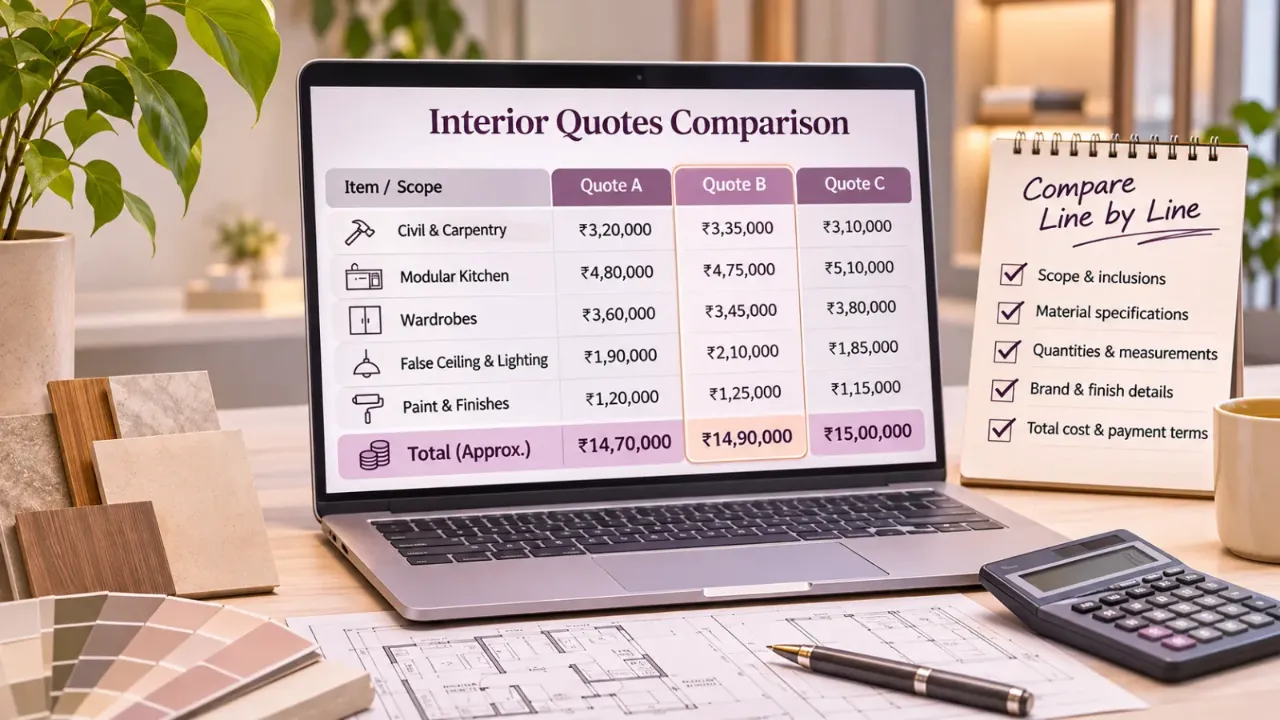
A line-by-line comparison helps you identify differences in specifications, quantities, workmanship, services and payment conditions before committing to a project.
1. Start by Making All Three Quotes Comparable
Before comparing individual prices, check whether all three designers have quoted for the same scope of work.
For example, if your home requires a modular kitchen, wardrobes in three bedrooms, a TV unit, a shoe cabinet and false ceiling work, all three quotations should ideally cover these same items.
Create a common list of spaces and requirements:
- Living room and TV unit
- Dining area
- Modular kitchen
- Master bedroom wardrobe
- Other bedroom wardrobes
- Beds and storage
- Bathroom vanities
- False ceiling
- Electrical and lighting work
- Painting and finishing
- Installation and site work
If one designer has included a dining table while another has not, their totals cannot be compared directly.
The first rule: Compare identical work wherever possible. Record additional or missing items separately instead of treating them as equivalent.
2. Compare Materials, Not Just Furniture Names
A quotation might simply say "wardrobe – ₹1,20,000." That description tells you very little about what you are buying.
Ask each designer to specify the material used for the carcass, shutters, back panels and internal components.
For example, check:
- Plywood, MDF, HDHMR or particle board
- Grade and thickness of the board
- Laminate, acrylic, veneer or membrane finish
- Back-panel material and thickness
- Edge-banding specifications
- Moisture-resistant treatment, where applicable
Two wardrobes may have similar dimensions but very different material specifications. Their prices may therefore differ for a valid reason.
Do not assume that a higher price automatically means better material. Ask for written specifications and compare equivalent products.
3. Check Hardware and Accessories Separately
Hardware is one of the easiest areas to overlook when comparing interior quotations.
A kitchen quotation may include cabinets but provide limited information about hinges, drawer channels, tandem boxes, lift-up systems and corner accessories.
Create a separate hardware checklist:
- Hinges and their brand or specification
- Drawer channels and load capacity
- Soft-close mechanisms
- Handles and profiles
- Pull-out baskets
- Tandem drawers
- Lift-up fittings
- Wardrobe accessories
- Sliding-door tracks
For instance, one quotation may include standard drawer channels while another includes soft-close channels. The second may cost more, but the difference should be visible in the specification.
Ask for the brand, model or equivalent technical details wherever possible. A generic description such as "premium hardware" is not enough to establish what is included.
4. Compare Quantities and Measurements
Even when two quotations mention the same furniture, the quantities may differ.
A wardrobe quoted at ₹1,20,000 might be 8 feet wide, while another quoted at ₹1,35,000 might be 10 feet wide. Comparing only the total price would be misleading.
Check:
- Width, height and depth
- Square feet or running feet
- Number of shutters
- Number of drawers and shelves
- Internal divisions
- Countertop area
- Number of electrical points
- Ceiling coverage
- Quantity of lights and fixtures
Where possible, request dimensioned drawings or measurement sheets to support the quotation.
If one designer has quoted a lump sum without quantities, ask for a more detailed breakdown before making a decision.
5. Examine Finishes and Surface Treatments
The finish affects both the appearance and cost of an interior project.
For kitchens, wardrobes and other furniture, compare the exact finish specified rather than relying on broad descriptions.
For example:
- Matte laminate versus high-gloss laminate
- Acrylic versus laminate shutters
- Natural veneer versus decorative laminate
- Painted finish versus factory-finished panels
- Standard laminate versus textured or premium finishes
Also check whether the quotation includes edge finishing, polishing, touch-ups and final adjustments.
A quotation that includes a more expensive surface finish may justify a higher amount, but only if the product and coverage are clearly specified.
6. Compare Labour, Installation and Transportation
Some quotations combine labour and installation with the furniture price. Others list them separately.
This difference can make one estimate appear cheaper than another.
Check whether each quotation includes:
- Factory fabrication
- On-site carpentry
- Installation and fitting
- Transportation
- Loading and unloading
- Debris removal
- Final adjustments
- Site supervision
Ask whether labour charges are fixed or subject to changes if the project scope increases.
Also clarify who is responsible for coordinating electricians, plumbers, painters and other contractors.
7. Look Carefully at Electrical, Plumbing and Civil Work
Interior quotations sometimes include furniture and decorative work but exclude essential modifications.
For a kitchen, this may include plumbing changes, additional electrical points, appliance connections or countertop modifications.
For a full home, it may include:
- Electrical rewiring or point shifting
- Plumbing changes
- Civil modifications
- Wall preparation and painting
- Waterproofing
- Ceiling framework and installation
- AC provisions
- Exhaust and ventilation provisions
If these items are excluded, obtain separate estimates so that you can calculate the actual project budget.
Never assume that an item is included simply because it is necessary for completing the room.
8. Identify Exclusions and Hidden Costs
The exclusions section deserves as much attention as the inclusions.
A quotation may exclude appliances, lights, loose furniture, curtains, decorative accessories, taxes or additional site work.
Prepare a separate list of excluded items and check whether you will need to purchase them independently.
Ask each designer to clarify:
- Are GST and other applicable taxes included?
- Are appliances included?
- Are decorative lights included?
- Are curtains and blinds included?
- Are loose furniture items included?
- Are design revisions chargeable?
- What happens if measurements change?
- How are additional works priced?
A low quotation with several exclusions may eventually cost more than a higher quotation with a more complete scope.
9. Compare Design Fees and Project Services
Not every interior quotation covers the same professional services.
One designer may include concept development, 3D visualisations, working drawings, material selection and site supervision. Another may charge separately for some of these services.
Check whether the quotation includes:
- Space planning and layouts
- 2D drawings
- 3D renders
- Electrical and plumbing drawings
- Material and finish selection
- Vendor coordination
- Site visits
- Project management
- Handover and snag-list support
Ask how many revisions are included and whether site visits are limited.
A higher design fee may be reasonable if it includes substantial planning and project coordination. However, these deliverables should be clearly documented.
10. Review Payment Terms and Timelines
The payment schedule can affect your cash flow and the risk involved in the project.
Compare the following across all three quotations:
- Booking or advance amount
- Payment after design approval
- Payment before material procurement
- Payments linked to manufacturing or installation
- Final payment after completion
- Retention amount, if agreed
- Cancellation and refund conditions
Also check the estimated project duration and the milestones attached to it.
Avoid relying only on verbal promises. Ask for the payment schedule, project milestones, delay conditions and handover expectations in writing.
11. Build a Three-Quote Comparison Sheet
The easiest way to evaluate all three quotations is to place them in one comparison table.
Use the following format:
| Comparison item | Quote A | Quote B | Quote C |
|---|---|---|---|
| Total quoted amount | ₹8,00,000 | ₹9,50,000 | ₹10,20,000 |
| Kitchen materials | Verify | Verify | Verify |
| Wardrobe materials | Verify | Verify | Verify |
| Hardware specification | Verify | Verify | Verify |
| Finish specifications | Verify | Verify | Verify |
| Furniture quantities | Verify | Verify | Verify |
| Electrical work | Verify | Verify | Verify |
| Civil work | Verify | Verify | Verify |
| Transportation | Verify | Verify | Verify |
| Design and drawings | Verify | Verify | Verify |
| Site supervision | Verify | Verify | Verify |
| Taxes | Verify | Verify | Verify |
| Exclusions | Verify | Verify | Verify |
| Payment schedule | Verify | Verify | Verify |
| Estimated timeline | Verify | Verify | Verify |
The amounts above are illustrative. The table is a comparison template, not a real market quotation.
Do not fill unclear entries with assumptions. Mark them as "not specified" and request clarification.
12. Calculate the Actual Comparable Cost
Once you have checked the specifications, calculate the cost of each quotation on the same basis.
Comparable project cost = Quoted amount + Excluded essential work + Applicable additional charges
For example, imagine:
- Quote A: ₹8,00,000, with ₹1,00,000 of essential work excluded.
- Quote B: ₹9,00,000, with ₹30,000 of essential work excluded.
- Quote C: ₹9,50,000, with the listed essential work already included.
The comparable amounts would be:
| Quotation | Quoted amount | Additional essential work | Comparable cost |
|---|---|---|---|
| A | ₹8,00,000 | ₹1,00,000 | ₹9,00,000 |
| B | ₹9,00,000 | ₹30,000 | ₹9,30,000 |
| C | ₹9,50,000 | ₹0 | ₹9,50,000 |
These figures are hypothetical and assume the work is otherwise equivalent. Taxes, specification differences and other adjustments must still be checked.
The exercise shows why the lowest initial quotation is not necessarily the lowest final cost.
13. Watch Out for These Common Red Flags
Before selecting a designer, pay attention to warning signs such as:
- A single lump-sum price without a detailed breakdown
- No material brands, grades or thicknesses mentioned
- Missing measurements and quantities
- Vague descriptions such as "premium quality"
- Unclear exclusions
- No written payment schedule
- No defined completion timeline
- Verbal promises that are missing from the contract
- Large unexplained price differences
- Unclear responsibility for third-party contractors
A quotation does not have to list every screw, but it should provide enough information to understand the scope, quality and cost of the work.
14. Make Your Final Decision Beyond the Price
After completing the comparison, evaluate each designer on four broad factors:
- Specification: Are the materials, hardware and finishes clearly defined?
- Completeness: Does the quotation cover the work you actually need?
- Transparency: Are costs, exclusions and payment conditions explained?
- Execution: Does the designer have a credible plan for drawings, coordination, installation and handover?
You can also request a revised quotation from each designer based on the same scope and specifications. This makes the final comparison much more meaningful.
Closing Thoughts
Comparing three interior design quotations is not about finding the smallest number. It is about understanding what each designer is offering for the amount being charged.
Look at materials, hardware, dimensions, labour, services, exclusions and payment conditions before making your decision. A detailed comparison today can help prevent budget surprises, misunderstandings and avoidable disputes during execution.
Take the time to clarify every unclear line before signing. The right quotation is the one that gives you a clear understanding of the work, its cost and the responsibilities involved.
Explore More with Walls to Wonder
Planning your home interiors becomes easier when you have the right tools to evaluate ideas, materials and costs.
- Whole Home Visualizer
- Design My Room
- Interior Design Cost Estimate
- Interior Quotation Checker
- Rate My Room Design
- Interior Style Finder
Discover more at Walls to Wonder.
Get a personalised estimate for your home
Choose your rooms, materials and preferences to understand a practical interior budget before you commit.