
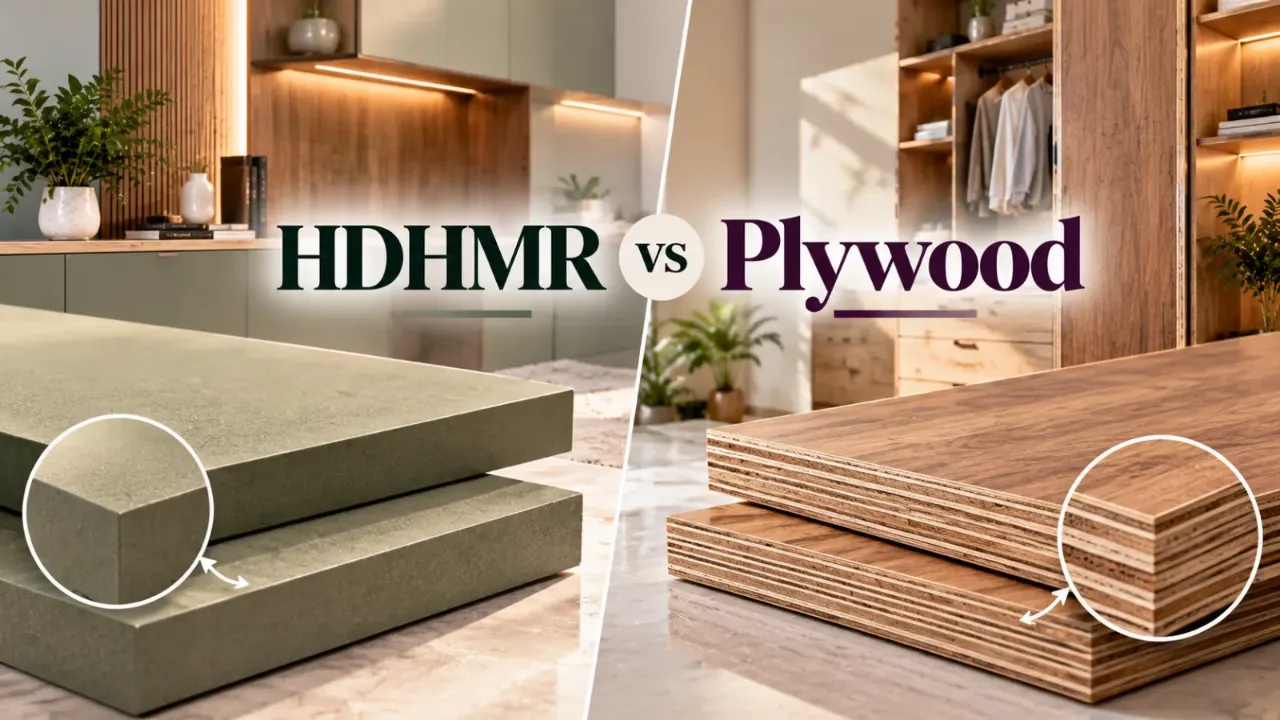
HDHMR vs Plywood
Choosing boards for a modular kitchen, wardrobe or TV unit is not simply a matter of picking the material with the better-sounding name. HDHMR and plywood can both work well, but they behave differently when exposed to moisture, fasteners, weight, edge treatment and repeated use.
This guide answers the practical questions Indian homeowners usually face while comparing an interior quotation. It also explains what to check when designers and companies serving your area specify one material for the whole home without explaining the reason.
Planning your shortlist? Browse designers and companies serving your area, then compare their projects rather than relying only on a material brand or a low headline quote.
What is the difference between HDHMR and plywood?
Plywood is made by bonding layers of wood veneer, usually with the grain direction alternated between layers. Its performance depends on the veneer quality, adhesive, construction, thickness and grade. The layered structure often gives it good screw-holding ability and useful strength across a range of applications.
HDHMR stands for high-density high-moisture-resistant board. It is an engineered wood panel made from refined wood fibres compressed with resin under heat and pressure. It has a relatively uniform core and a smooth face, which can be convenient for painted shutters and routed designs.
Neither name alone tells you everything. A plywood quotation should identify its grade and thickness. An HDHMR quotation should identify the product specification, thickness and intended use. “Waterproof” is especially worth questioning: no wood-based board should be treated as immune to an active leak, standing water or poorly sealed sink plumbing.
Which is stronger: HDHMR or plywood?
The honest answer is application-dependent. Good plywood is commonly preferred for carcasses, long shelves and components that must hold screws through repeated installation and use. HDHMR has a dense, consistent surface and can be strong for many furniture parts, but its edge and fastener performance depend on the board, fixing method and design.
Strength also comes from construction. A well-supported shelf made from an appropriate board may outlast a thicker board used with a long unsupported span. Hinges, confirmat screws, dowels, edge bands, back panels and wall fixing all influence the finished result.
- Ask what load each shelf is designed to carry and how often it will be used.
- Check whether tall shutters need additional hinges, stiffeners or a different substrate.
- Look at the back panel and internal partitions; a strong front shutter cannot compensate for a weak carcass.
- Confirm how cut edges will be sealed, particularly near floors, sinks and wet utility areas.
Which material is better for moisture-prone rooms?
HDHMR is often considered for areas where occasional humidity or splashes are expected because its dense fibre structure and moisture-resistant formulation can offer useful protection. Plywood, particularly a suitable moisture-resistant or exterior-grade specification, is also widely used in kitchens and utility areas.
The important distinction is between moisture resistance and waterproof construction. Water can enter through an unsealed sink cut-out, a leaking trap, an exposed edge, a poorly protected plinth or a gap behind a backsplash. Once that happens, the board specification is only one part of the problem.
Kitchen and utility
Compare the specified board with edge sealing, shutters, plinth construction and proximity to water. The right choice may differ between an upper cabinet, sink unit and tall pantry.
Bedroom wardrobe
Moisture exposure is usually lower, so finish, screw holding, shutter stability and budget may carry more weight than maximum moisture resistance.
Is HDHMR better for painted shutters?
It can be a practical option for a painted or membrane-style design because its smooth, consistent face may reduce visible variation after preparation. That does not remove the need for proper sanding, primer, edge treatment and a suitable paint system.
Plywood can also receive paint, laminate, veneer or acrylic finishes. Its layered edge may be a design feature in some interiors, or it may need careful filling and preparation for a very smooth painted look. The finish specification should state the surface preparation, number and type of coats, edge treatment and how repairs will be handled.
For a laminate finish, the board face is only part of the result. The adhesive, pressing quality, alignment, edge banding and treatment around cut-outs affect appearance and durability.
Which one costs more?
There is no responsible single answer without a defined scope. Board grade, thickness, brand or manufacturer, finish, hardware, internal accessories, installation conditions and wastage can all change the quotation. A cheaper board can be paired with a costly finish, while a higher board rate may be offset by a simpler design.
Compare like with like. If one proposal includes a complete kitchen with hardware and another gives a running-foot rate for shutters only, their totals cannot be judged fairly.
| Pricing factor | What to ask | Why it changes the total |
|---|---|---|
| Board specification | What material, grade and thickness are included? | Different grades and thicknesses have different material and performance characteristics. |
| Surface finish | Is the rate for laminate, veneer, paint, acrylic or another finish? | Finishing labour, surface preparation and edge work vary considerably. |
| Hardware | Which hinges, channels, lifts and handles are included? | Hardware quantity and specification can materially affect usability and cost. |
| Internal layout | Are drawers, baskets, pull-outs and lofts included? | Accessories add both product and installation work. |
| Site conditions | Are demolition, wall corrections, electrical changes or plumbing work included? | Renovation work often involves tasks outside cabinet fabrication. |
| Taxes and exclusions | Are taxes, transport, installation and civil work clearly stated? | Unlisted items can create a large difference between the quoted and payable amount. |
How should I compare two interior designers quoting different boards?
Start with the room and usage, not with the board label. Ask each designer to explain why the selected material suits that component. A thoughtful proposal may use more than one substrate: for example, a moisture-conscious choice near a sink, a different specification for wardrobe shutters and another for a decorative panel.
- Compare the scope: verify measurements, carcasses, shutters, backs, fillers, skirting, lofts and installation.
- Compare the material line: record board type, thickness, grade, finish and edge band specification.
- Compare the hardware: note brand or equivalent wording, load rating where relevant, soft-close provisions and warranty terms.
- Compare drawings: check elevations, internal storage, service access and appliance clearances.
- Compare responsibility: identify who handles site measurement, electrical or plumbing coordination, delivery damage and snag correction.
Review the designer’s relevant projects and completed-room references for evidence of the kind of cabinetry and finish you want. A portfolio cannot prove the exact board used, so request a material sample or written specification before approval.
Can I use both HDHMR and plywood in one home?
Yes. A material schedule based on location and use is often more sensible than insisting on one board everywhere. The decision can account for humidity, expected load, visible edges, paint requirements, access for repairs and the budget assigned to each room.
For a modular kitchen
Pay close attention to the sink unit, plinth, shutters, tall units and appliance cut-outs. Request a sealing and service-access detail rather than accepting a generic “waterproof kitchen” description.
For wardrobes and storage
Look at shutter height, hinge count, shelf spans and the way the unit is anchored. A consistent finish and accurate installation may matter more than choosing the same substrate as the kitchen.
For a study or home office
Check desktop span, cable openings, drawer use and wall support. Moisture may be a minor factor, while screw holding and resistance to daily movement are more relevant.
For a TV unit or decorative panel
Focus on the fixing system, concealed wiring, ventilation for equipment and finish quality. Do not let a decorative front hide an inaccessible electrical or service arrangement.
Which quotation details should I check before paying an advance?
The advance should follow a defined scope, not replace one. Before signing, ask for a drawing set or measurable description and a material schedule that can be attached to the quotation. If the company uses “or equivalent”, ask who approves the substitute and what minimum specification applies.
- Board material, grade, thickness and intended location.
- Finish name or description, including inside surfaces and visible edges.
- Hardware quantities, model or specification, and replacement terms.
- Measurement method, site conditions, delivery, installation and debris removal.
- Payment stages linked to measurable milestones.
- Change-order process if you alter colour, dimensions or accessories.
- Warranty wording, exclusions and the process for reporting defects.
Use WallsToWonder’s quotation checker as a second review of missing line items and unclear inclusions. It should support your questions, not replace reading the final agreement.
Can AI help me estimate and compare the decision?
It can help organise early thinking, especially when you have room dimensions, storage needs and more than one quotation. Treat any estimate as a planning aid. Final pricing depends on site measurement, selected materials, finish, hardware and the designer’s scope.
Start with a budget range

Use the AI interior cost estimator to structure a preliminary budget by room and scope. Add your expected finish and storage requirements before comparing proposals.
Interrogate the quotation

Try the AI quotation checker to flag unclear descriptions and omissions that deserve a direct answer from the designer.
You can also collect visual references through design ideas, use Find my style to clarify finish preferences, or ask the AI interior assistant to turn your room needs into a question list.
What are the red flags in an HDHMR or plywood quotation?
Be cautious when the material is described only as “premium”, “waterproof” or “commercial quality”. These words do not provide a measurable basis for comparison. Another warning sign is a very low package price with no board thickness, finish, hardware or internal layout.
- The quotation names a board but not its grade, thickness or application.
- One rate covers every room despite visibly different designs and usage.
- There is no drawing, measurement record or material sample.
- Exclusions are vague, especially for plumbing, electrical work, civil changes and delivery.
- The designer requests a large advance before confirming scope and payment milestones.
- Substitution is allowed without your written approval.
- Warranty language exists, but no contact or defect-reporting process is stated.
A substitution is not automatically bad; availability can change. The problem is an unrecorded substitution that changes performance or finish after you have paid.
What questions should I ask before choosing a designer?
Take these questions to the consultation. The quality of the explanation is useful evidence: a designer should be able to discuss trade-offs without presenting one material as universally superior.
- Why is this board suitable for this particular cabinet or room?
- What happens at the sink cut-out, floor edge and plumbing access point?
- Which parts use a different material, and why?
- How will long shelves and tall shutters be supported?
- What is included inside the cabinet and at the back?
- Can I approve a physical sample showing the core and edge?
- When are measurements frozen, and how are changes priced?
- Who coordinates the designer, installer, electrician and plumber?
- What is the process if a board or finish is substituted?
Use Design my room to explore a brief before meeting a professional, then use the designer directory to build a comparison set. The aim is not to choose a tool or company blindly; it is to arrive with clearer priorities.
Which material should I finally choose?
Choose plywood when the project needs dependable layered construction, practical screw holding or a proven solution for a particular structural component, and when the quoted grade is clearly stated. Choose HDHMR when its dense, smooth surface and moisture-resistant specification suit the component, especially where a consistent painted finish is important.
In many homes, the best answer is a carefully documented combination. Give more attention to water management, edge sealing, hardware, support and installation quality than to a board-versus-board argument in isolation.
Before approving the final order, compare the material schedule against the drawings, inspect samples and keep the agreed specification with the contract. That small paper trail is valuable if a substitution or finish dispute appears later.
Frequently asked questions
1. Is HDHMR completely waterproof?
No. It is designed to offer moisture resistance, but leaks, standing water and unsealed cut edges can still damage wood-based boards. Sealing and installation remain essential.
2. Is plywood always better than HDHMR?
No. Suitability depends on the component, grade, thickness, finish, fixing method and exposure. A clearly specified board used correctly is more useful than a vague claim of superiority.
3. Can HDHMR be used for kitchen cabinets?
It can be considered for suitable kitchen components, provided the specification, edge protection, sink-area detailing and installation method are clearly documented.
4. How can I compare two quotes fairly?
Match the scope, board grade and thickness, finish, hardware, internal accessories, installation, taxes, exclusions and warranty terms. Do not compare a package total with a partial running-foot rate.
5. What should I do before paying an interior design advance?
Confirm drawings, measurements, material schedule, finish, hardware, milestones, exclusions, substitution rules and warranty or defect procedures in writing.
For more planning references, visit WallsToWonder’s designer and company listings and keep your final quotation review focused on the actual room, materials and workmanship promised.
Turn this idea into a plan for your home
Visualise your space, understand the likely budget, or find a professional who can bring the idea to life.